Yes, display response time matters for immersion, but it is not the only monitor spec that matters. For cinematic third-person games, the best experience usually comes from balanced motion clarity, low input lag, stable refresh rate, strong contrast, and well-tuned display settings.
Ever swung the camera around a character in a dark forest and noticed trees, fences, or character outlines leaving faint trails behind them? On a 144Hz monitor, each refresh lasts about 6.94 ms, so sluggish pixel transitions can still show remnants of the previous frame during fast camera movement. This guide explains when response time is worth prioritizing, when it is overhyped, and how to choose a gaming monitor that keeps story-driven games feeling smooth and cinematic.
Why Response Time Affects Cinematic Immersion
Response Time Is About Pixel Transitions
Display response time measures how quickly a monitor’s pixels change from one shade or brightness level to another. In gaming monitor language, this is often listed as gray-to-gray, or GtG, response time. A fast transition helps the new frame look clean; a slow transition can leave a faded duplicate of the previous image behind moving objects.
That matters in cinematic third-person games because immersion depends on readable motion. When the camera pans behind a character, the game is constantly moving scenery, hair, armor edges, shadows, foliage, and UI elements across the screen. Slow pixel transitions can create faint trails, especially around dark textures, tree lines, road edges, walls, and character silhouettes.
Ghosting Is More Distracting Than a Spec Sheet Suggests
Response time problems usually appear as ghosting, smearing, or inverse ghosting. Ghosting looks like a soft trail following an object. Dark smearing can make shadow-heavy scenes look muddy when the camera moves. Inverse ghosting happens when overdrive is pushed too hard and creates bright or colored halos around moving objects.

This is why a simple “1 ms” marketing claim is not enough. A monitor may hit that number in one best-case transition while performing worse across darker shades or mixed tones. Motion clarity depends on response time, backlight behavior, and panel type, not just the fastest advertised transition.
Cinematic Games Expose Slow Transitions Differently
Competitive shooters expose response time through fast flicks and target tracking. Cinematic third-person games expose it through camera composition. A slow panel may look acceptable while the character walks forward, then fall apart during a horseback sprint, a dodge-heavy boss fight, a vehicle chase, or a slow panoramic sweep across a night scene.
The issue is not only “speed.” It is whether the game’s visual language remains intact. If a carefully lit cave, rainy street, or forest trail turns into a smeared wash whenever you rotate the camera, the display is reducing the game’s cinematic effect even if the frame rate counter looks healthy.
Response Time vs. Refresh Rate vs. Input Lag
These Specs Measure Different Problems
Response time, refresh rate, and input lag are often discussed together, but they are not interchangeable. Response time describes how long pixels take to change. Refresh rate describes how often the monitor can present a new image. Input lag describes how long it takes for an action to become visible after the display receives and processes the signal.

For gaming, input lag differs from response time: input lag measures when the image starts appearing, while response time measures how long the pixel transition takes. A display can have fast response time but still feel sluggish if it adds heavy processing. A display can also feel responsive but look blurry if pixel transitions are slow.
Refresh Rate Sets the Time Window
Higher refresh rates reduce the amount of time each frame stays on screen. At 60Hz, a new frame arrives every 16.67 ms. At 120Hz, it arrives every 8.33 ms. At 144Hz, the window is about 6.94 ms. At 240Hz, it is about 4.17 ms. At 360Hz, it is about 2.78 ms.
That timing matters because a pixel transition has to fit inside the refresh window to preserve clean motion. If a 240Hz monitor has transitions that take longer than 4.17 ms in real scenes, the next frame may arrive before the previous transition fully settles. This is why a low GtG number does not automatically guarantee clear motion across every game, panel type, or refresh rate.
Input Lag Is About Control Feel
For cinematic third-person games, input lag affects immersion through control feel. Dodges, parries, camera turns, platforming jumps, aiming, and lock-on adjustments all feel worse when the display adds delay. A display-testing site notes that roughly 30 ms of input lag is a common point where delay becomes noticeable, while about 20 ms can affect reaction-heavy games.
Response time affects what motion looks like; input lag affects how the game responds. Story-driven players should not ignore either, but if a display’s processing delay is high, fixing response time alone will not make the game feel connected to the controller or mouse.
When Response Time Really Matters in Third-Person Games
Fast Camera Movement Is the First Test
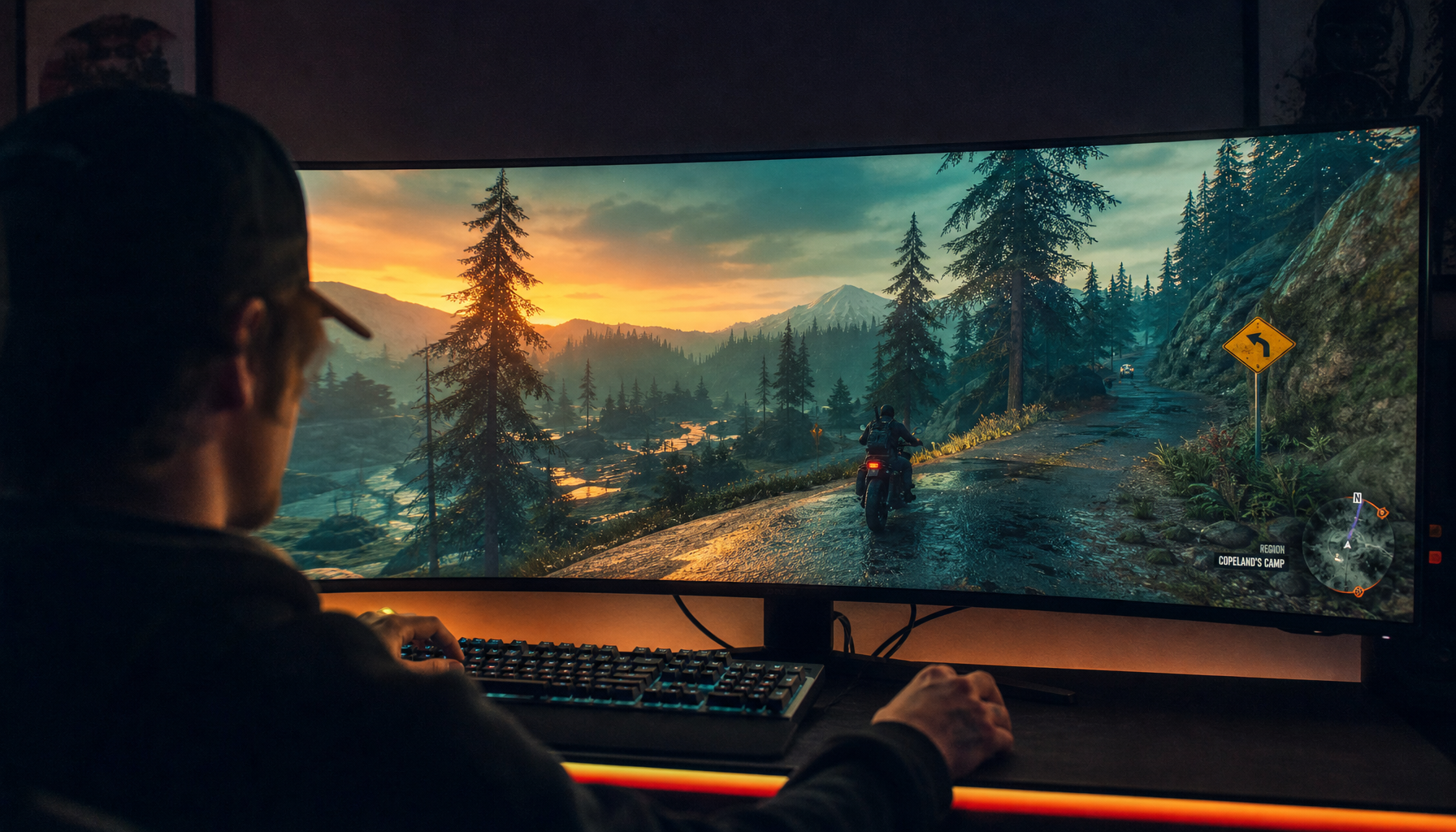
Cinematic third-person games often use close cameras, shoulder views, wide environmental shots, and dramatic camera pans. These camera moves can stress motion clarity more than ordinary forward movement. If the monitor’s response time is slow, you may see trailing on character outlines, weapon edges, stair rails, foliage, fence posts, and high-contrast scenery.
A practical test is simple: load a dark area, stand near a wall or row of trees, and slowly rotate the camera. Then repeat with a faster pan. If you see trails following edges or a dark smear across textured surfaces, the monitor’s pixel transitions are affecting the image. Ghosting is especially visible in shadows and night scenes, where some gray-to-gray transitions are slower.
Combat and Traversal Raise the Stakes
Slow response time is easier to tolerate in dialogue scenes, cutscenes, photo mode, and slow exploration. It becomes more noticeable during dodge timing, parries, fast horseback or vehicle traversal, climbing, aiming, sprinting through dense scenery, or rapidly turning the camera while enemies move around the player.
This is where cinematic games overlap with action games. A third-person title can be visually story-driven and still demand sharp display behavior during boss fights or performance-mode gameplay. Lower response delay matters in camera-heavy traversal, quick turns, aiming, and timing-based defensive moves.
Performance Mode Makes Weak Panels Easier to Notice
Many console and PC games offer quality and performance modes. A 30 FPS quality mode may emphasize resolution, ray tracing, and visual effects. A 60 FPS or 120 FPS performance mode improves motion and control response. Once frame rate rises, the display becomes more important because more motion information is being presented.
If you play mostly at 30 FPS, response time still matters, but the game’s own frame persistence is already high. At 60 FPS and above, a slow display can become the bottleneck. At 120Hz or 144Hz, a monitor with inconsistent transitions can make movement look less clean than the refresh rate suggests.
What Response Time Is Good Enough?
Practical Ranges for Cinematic Players
For cinematic third-person games, you usually do not need the absolute fastest monitor on the market. A well-tuned 1 ms to 4 ms Fast IPS or OLED gaming monitor is typically strong for balanced story gaming, provided it also has low input lag, good contrast, stable refresh support, and sensible overdrive behavior. A 3 ms to 5 ms display can still work for slower single-player games if ghosting is controlled.
The better buying question is not “Is it 1 ms?” but “Does it maintain clean motion across dark and bright transitions at the refresh rate I will actually use?” Suggested response-time ranges place 1 ms to 4 ms in the balanced gaming and content work range, while 3 ms to 5 ms can be acceptable for slower single-player titles.
Do Not Overpay for a Number Alone
A “1 ms” LCD monitor can still show visible artifacts if it uses aggressive overdrive or performs poorly in darker shades. Conversely, a monitor with a slightly slower advertised spec can feel better if its tuning is consistent, its input lag is low, and its refresh rate matches your gaming hardware.
For cinematic immersion, prioritize the total package: panel quality, contrast, HDR behavior, refresh stability, variable refresh rate support, input lag, and usable overdrive settings. Response time should be part of the decision, but not the only reason to buy.
A Useful Comparison Table
Display option |
Typical response behavior |
Strength for cinematic third-person games |
Watch out for |
|
60Hz standard monitor |
Often adequate for slow scenes, weaker for motion clarity |
Fine for casual play and cutscene-heavy games |
Higher frame persistence and less responsive camera feel |
Acceptable only if budget is tight or the game is locked to 30 FPS or 60 FPS |
120Hz to 144Hz gaming monitor |
Good balance when response time is well tuned |
Strong choice for performance modes, camera pans, and action scenes |
Poor overdrive can still create ghosting or inverse ghosting |
Best mainstream target for cinematic players |
165Hz to 200Hz gaming monitor |
Smoother than 144Hz if the panel keeps up |
Useful for PC players who can sustain higher FPS |
Spec-sheet gains shrink if GPU frame rate is unstable |
Worth considering for high-end PC setups |
240Hz to 360Hz monitor |
Demands very fast pixel transitions |
Excellent for fast action and competitive crossover play |
More expensive; weak transitions become easier to expose |
Buy if you also play fast multiplayer or high-FPS action games |
OLED gaming monitor |
Near-instant pixel transitions |
Excellent motion clarity, contrast, and dark-scene readability |
Price, burn-in management, brightness behavior by model |
Premium pick for cinematic immersion if budget allows |
VA ultrawide monitor |
Can have strong contrast but slower dark transitions |
Great field of view and cinematic framing |
Dark smearing can be visible in shadow-heavy games |
Choose carefully; check real motion tests, not just specs |
Varies widely by panel and refresh rate |
Useful for travel, dorms, or compact setups |
Some models have weaker overdrive or limited brightness |
Look for 120Hz or higher, low input lag, and tested response behavior |
Panel Type, Ultrawide Screens, and Portable Monitors
Fast IPS Is the Safe Mainstream Choice
Fast IPS gaming monitors are often the most practical choice for cinematic third-person players. They usually offer good color, wide viewing angles, high refresh rates, and response times in the 1 ms to 4 ms range. For players who want a monitor that works well for games, streaming, browsing, and creative work, Fast IPS is usually easier to recommend than older TN or slower VA options.
TN panels can be very fast, but their weaker viewing angles and image quality make them less appealing for cinematic games. OLED panels deliver the cleanest pixel transitions and excellent contrast, but they cost more and require more care around static UI elements. VA panels can offer strong contrast, which helps dark cinematic scenes, but some VA monitors show slower dark transitions and visible smearing.
Ultrawide Monitors Can Make Artifacts Easier to See
Ultrawide monitors are attractive for cinematic third-person games because they fill more of your peripheral view. A 21:9 screen can make open-world exploration, horseback travel, driving, and environmental storytelling feel broader and more theatrical. That larger field of view can also make motion artifacts easier to notice because more scenery moves across the screen during every camera pan.
This does not mean ultrawide monitors are a bad choice. It means response behavior matters more, especially on large VA ultrawides where dark smearing can stand out in caves, forests, night cities, and interior scenes. If you are buying ultrawide for immersion, check whether the monitor’s real-world motion clarity matches its refresh rate rather than trusting refresh rate alone.
Portable Monitors Need Extra Scrutiny
Portable gaming monitors can be excellent for travel, apartments with limited desk space, dorm setups, or console play away from the main display. But they vary widely. Some offer 120Hz, 144Hz, or higher refresh rates with decent response behavior; others advertise gaming features while delivering weaker brightness, limited overdrive control, or noticeable latency.
For cinematic third-person games, a portable monitor should still meet the basics: native resolution support, low input lag, stable refresh rate, usable color presets, and response time that does not smear camera movement. If you play with a controller, also keep the whole chain in mind: wireless devices can add delay, while wired inputs usually keep response more consistent.
Settings That Improve Immersion Before You Buy Again
Use Game Mode as the Default
Cinema Mode sounds ideal for cinematic games, but it often increases processing. It may adjust warmth, contrast, brightness, dynamic contrast, sharpening, motion smoothing, or color remapping. Those changes can look pleasing in a paused scene yet make controls feel heavier during gameplay.
Game Mode is usually the better default because it reduces processing and lowers latency. Switching from a heavily processed Standard or Cinema Mode to Game Mode can reduce lag dramatically on some displays; one example cites a drop from about 80 ms to about 15 ms when heavy processing is bypassed. For gaming monitors, Game Mode should be tested first, then adjusted for color and brightness.

Set Overdrive Conservatively
Overdrive can make pixels transition faster, but aggressive overdrive can create inverse ghosting. For cinematic games, the best setting is often Normal, Medium, or whatever the monitor maker labels as the balanced mode. The fastest overdrive setting may look impressive in one test but produce halos during real gameplay.
Test overdrive in three situations: a dark scene, a bright outdoor area, and a fast camera pan across detailed scenery. If Normal leaves too much trailing, try the next level. If the next level creates bright edges or colored halos, go back. The goal is not the fastest menu setting; it is the cleanest motion with the fewest artifacts.
Match Refresh Rate, VRR, and Frame Rate
Set the monitor to its maximum stable refresh rate in your operating system or console menu. Enable variable refresh rate if your monitor and platform support it. VRR helps smooth frame pacing when FPS fluctuates, which is common in open-world cinematic games with dense environments, weather effects, and large combat encounters.
Also disable in-game motion blur if you are trying to diagnose display ghosting. Game motion blur is an artistic effect; monitor ghosting is a hardware motion clarity issue. Turning off the in-game effect makes it easier to identify whether trails are coming from the game engine or the display.
FAQ
Q: Can slow response time make cinematic third-person games feel less immersive?
A: Yes. Slow response time can create ghosting, dark smearing, or trailing during camera movement, especially around character outlines, foliage, walls, fences, and shadow detail. It is most noticeable during fast pans, traversal, combat, and dark scenes.
Q: Is response time more important than refresh rate for story-driven games?
A: Usually no. Refresh rate, frame rate stability, input lag, panel quality, contrast, and HDR performance all matter. Response time becomes critical when the panel cannot keep up with the refresh rate or when slow transitions create visible trails. A balanced 120Hz to 144Hz monitor with good tuning is often better than a higher-refresh display with poor pixel behavior.
Q: Should casual cinematic gamers pay extra for 240Hz or 360Hz?
A: Not unless they also play competitive games or high-FPS action titles. For most cinematic third-person players, 120Hz to 144Hz with low input lag, good contrast, VRR, and clean response tuning is the better value. OLED or a high-quality Fast IPS panel may improve immersion more than chasing the highest refresh rate.
Practical Next Steps
Start by tuning the monitor you already own. Set native resolution, enable the highest stable refresh rate, turn on Game Mode, use VRR if available, and choose a moderate overdrive setting. Then test a real game scene with fast camera movement, dark backgrounds, and fine details like trees, fences, stairs, or character hair.
If you are buying a new display for cinematic third-person games, aim for balance rather than a single headline number. A strong 120Hz to 144Hz gaming monitor with low input lag and clean motion is a better immersion upgrade than a poorly tuned display that advertises extreme speed. For premium setups, OLED is especially compelling because its pixel transitions are extremely fast and its contrast helps dark scenes stay readable.
For players who prioritize cinematic clarity over maximum refresh rate, a 27” 4K 160Hz HDR1400 Mini LED gaming monitor is a relevant example of that balance: 4K resolution, 160Hz refresh, 1ms response time, Mini LED, and HDR1400.

Action checklist:
- Set the monitor to native resolution and its highest stable refresh rate.
- Enable Game Mode before testing Cinema, Standard, or Movie presets.
- Use Normal or Medium overdrive first, then adjust only if trails remain visible.
- Enable VRR when supported by the monitor, GPU, and game platform.
- Turn off in-game motion blur while checking for display ghosting.
- Test dark scenes, bright scenes, and fast camera pans before judging the monitor.
- When buying, compare real motion clarity, input lag, panel type, and contrast instead of relying only on a “1 ms” claim.
References
- KTC, Gaming Monitor Ghosting: Simple Solutions That Work
- KTC, Motion Clarity vs. GtG: What Matters for Gaming Monitors
- KTC, Display Latency vs Input Lag vs Response Time Explained
- KTC, Game Mode vs. Cinema Mode: Best for Single-Player Games?
- XDA Developers, 3 Monitor Specs That Affect Motion Clarity More Than Refresh Rate
- RTINGS, Our Monitor Input Tests: Input Lag