









Dirty Screen Effect, or DSE, is usually caused by uneven panel and backlight uniformity, not actual dirt. In new Mini-LED monitors, it often appears as faint blotches, vertical bands, or cloudy patches when panning across gray skies, spreadsheets, ice rinks, or other flat-color scenes.

Why Mini-LED Can Still Look Uneven
Mini-LED improves contrast by using many tiny backlight zones, but it is still an LCD system with layers: LEDs, diffuser films, optical sheets, liquid crystal, polarizers, and coatings. If any layer varies slightly, the screen can look smudged during motion.
The key issue is uniformity. Dense Mini-LED arrays need precise LED placement, reflective materials, and heat control, and even small variations in the backlight board can affect brightness consistency. Mini-LED PCB production depends on tight tolerances for pad alignment, solder mask consistency, board flatness, and thermal handling, all of which can influence brightness consistency.
 That is why two units of the same premium monitor can look different. Enthusiasts often call this the panel lottery, where unit-to-unit variation affects contrast, backlight bleed, scanlines, flicker, and screen uniformity.
The Main Causes in New Panels
A new Mini-LED panel can show DSE for several reasons, even if it is not defective in the obvious dead-pixel sense. Backlight variation can make some zones or LED clusters output slightly different brightness. Diffuser inconsistency can spread light unevenly, while panel pressure from assembly stress can create faint bands or cloudy areas. Coating variation may make flat colors look grainy or patchy, and calibration mismatches can exaggerate unevenness through brightness settings or local dimming behavior.
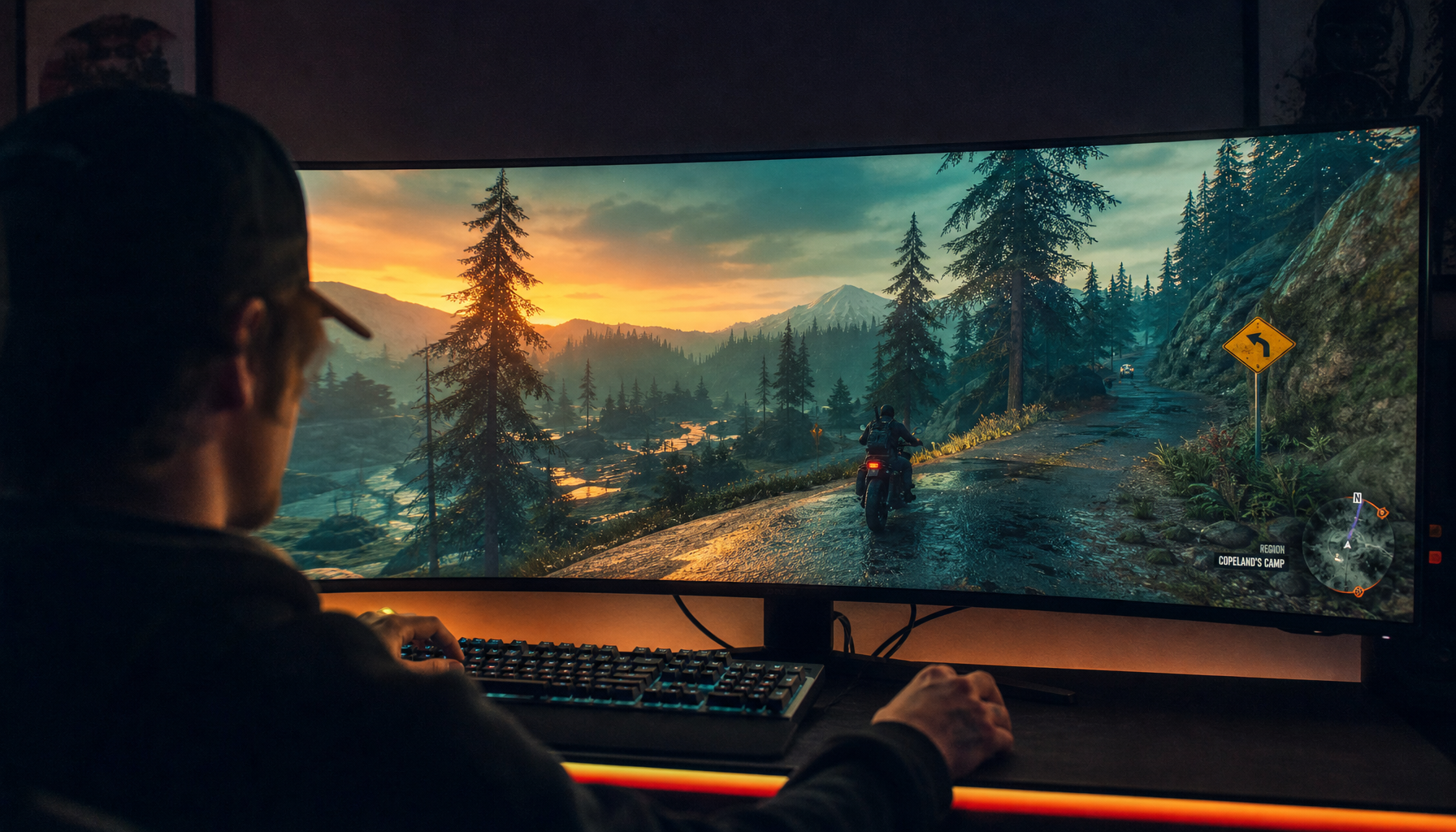
Local dimming can hide some clouding in dark scenes, but it does not always fix gray-screen blotchiness. DSE is most visible in mid-gray and bright uniform areas because your eyes can track subtle changes across the screen as the image moves.
Mini-LED may reduce blooming and improve HDR impact, but more dimming zones do not automatically guarantee perfect uniformity.
How to Tell DSE From GPU or Cable Artifacts
DSE stays in the same physical area of the screen. GPU or cable artifacts usually flicker, move, sparkle, tear, black out, or change based on software load.
If you see colored dots, checkerboard blocks, random black chunks, or flickering, look beyond the panel. Visual artifacts can come from corrupted image data, overheating, bad cables, unstable overclocks, drivers, or power problems. Portable screens can also flicker when USB-C power is insufficient.
A quick test helps:
- Open a 5%, 10%, and 50% gray image full screen.
- Turn off dynamic contrast and aggressive local dimming.
- Move the image or pan a camera or game view slowly.
- Test another input cable and another device.
- Photograph the same scene at normal brightness.

If the same blotch follows the panel area across inputs, it is likely DSE. If the pattern changes or disappears, investigate the GPU, cable, driver, or power path.
Can You Fix It?
You can reduce how noticeable DSE is, but true panel uniformity problems usually cannot be fully repaired at home.
Start with conservative settings. Lower peak brightness for office work, use standard or medium local dimming, disable black-enhancement modes, and avoid over-sharpened picture presets. For gaming, keep HDR for content that benefits from it, but use SDR for desktop-heavy productivity if uniform gray backgrounds make the issue stand out.
Do not press hard on a Mini-LED monitor. Some users have reported partial improvement from gentle microfiber pressure on older LED TVs, but that approach is anecdotal and risky on modern thin panels.
If DSE is visible during normal use, document it immediately. For a new high-end gaming monitor or productivity display, exchange the unit while the return window is open. Mini-LED should deliver immersion, contrast, and speed, but a premium screen should not make every camera pan or spreadsheet background look stained.


%20in%20Mini-LED%20panels%20creates%20blotchy%20areas%20due%20to%20uniformity%20issues.%20This%20guide%20covers%20the%20main%20causes%20and%20how%20to%20tell%20if%20it's%20the%20panel%20or%20your%20GPU.
)