Dense MMORPG interfaces are easiest to read on displays with high pixel density, clean full-color signal output, sensible UI scaling, and enough screen width to separate raid frames, chat, meters, and combat information without crowding the center of the screen.
Ever lose a boss mechanic because your raid frames, proc alerts, chat, and damage meters all competed for the same few inches of screen space? Dense MMORPGs can ask you to track 20-40 players, timers, cooldowns, party status, and ground effects at once, so the monitor is not just a picture surface; it is part of the interface. This guide explains which display characteristics actually improve readability, which specs are often misunderstood, and how to choose a monitor setup that makes long MMO sessions easier on your eyes.
Why MMORPG Interfaces Are Harder to Read Than Regular Game HUDs
MMORPGs compress a large amount of decision-critical information into a small visual field. A raider may need to watch health bars, debuffs, boss cast bars, personal resources, cooldown timers, chat warnings, and environmental mechanics while still keeping the character and boss visible. That is a different challenge from a shooter crosshair or a racing game speedometer because much of the UI is text-heavy, color-coded, and constantly updating.
Dense UI Creates Competing Priorities

A readable MMORPG display must solve three problems at the same time: small text clarity, spatial organization, and motion clarity. If the text is sharp but the screen is too small, raid frames and addons crowd the center. If the display is large but low-density, small fonts and icons can look coarse. If refresh rate is high but the signal falls back to lower chroma quality, chat, item names, and colored HUD labels may soften.
The most practical way to evaluate a monitor for MMORPGs is to ask whether it helps you keep the center of the screen clear while preserving legible detail around it. Effective MMO layouts often keep the inner character area free of persistent UI, place raid frames and target data in a nearby action zone, and move chat or logs farther out toward the edges; this “Golden Donut” approach keeps roughly the inner 15% radius around the character clear, puts key frames in the 15-35% offset area, and pushes lower-priority panels beyond about 40% offset dense MMO raid UIs.
Readability Is Not Just Resolution
Resolution matters, but it is not enough by itself. A 4K monitor can look worse than expected if the game is not running at native resolution, if the operating system or the game uses awkward scaling, or if the cable and graphics card negotiate a compressed color format. Likewise, an ultrawide monitor can improve layout space, but only if the game supports the aspect ratio well and the UI can be repositioned.
For MMORPG buying guidance, the strongest display characteristics are pixel density, native-resolution operation, full RGB or 4:4:4 chroma, comfortable scaling, adequate brightness and contrast, stable motion handling, and a screen shape that matches your UI habits. The best monitor is not always the biggest one; it is the one that makes the information you actually use readable at your desk distance.
Pixel Density and Scaling Matter More Than Raw Resolution

Pixel density is one of the most important readability specs for dense MMORPG UIs because it controls how finely the monitor can draw small text, cooldown numbers, item labels, and debuff icons. A 27-inch 1440p monitor sits around 109-111 PPI, while higher-density 4K and 5K displays can make small interface details look cleaner from normal desk distances. Higher density also reduces the visibility of jagged edges and subpixel artifacts that can make long reading sessions tiring.
Useful Resolution and Size Pairings
For many MMORPG players, 27-inch 1440p is the practical baseline: it offers enough room for addons and a high refresh rate without demanding extreme GPU power. A 32-inch 4K monitor gives more working room and sharper text, but many players will use UI scaling so chat, action bars, and nameplates do not become too small. A 27-inch 5K display reaches about 218 PPI, and that level of density can make 8-10 point UI text appear close to print-like at a normal 20-24 inch viewing distance 27-inch 5K display.
The trap is buying more pixels without planning for scaling. If you run a 4K or 5K monitor at 100% UI scale, small MMORPG text may become technically sharp but physically too small. If you run a lower resolution signal into a higher-resolution panel, such as feeding 1920 x 1080 into a 2560 x 1440 display, the monitor has to scale the image and text can become soft. Native resolution should be the starting point before any tuning.
Scaling Should Make Text Larger Without Making It Blurry
Scaling changes the visual size of UI elements without changing the panel’s physical pixel grid. On an operating system, 125% or 150% desktop scaling can make text occupy more pixels, which can reduce visible subpixel edges and improve comfort on dense monitors. Inside MMORPGs, the same idea applies through UI scale sliders, addon font sizes, chat font size, nameplate size, and action bar scale.
For a dense MMO setup, start at native resolution, then tune scaling from the game outward. Set chat fonts and raid frame text large enough to read during movement, not just while standing still in a city hub. A 4K monitor may support high information density because sharp pixels let players keep text legible at about 75-90% UI scaling 4K monitors support, but that should be tested in a dungeon, raid, battleground, or training scenario where combat effects and alerts are active.
Text Clarity Depends on Subpixels, Chroma, and Signal Quality
Two monitors with the same resolution can render text differently because of panel subpixel layout and signal format. This matters in MMORPGs because dense UI often uses tiny, high-contrast text: chat messages, raid names, debuff timers, tooltip stats, item names, auction listings, and addon labels. If the display path is wrong, red text, colored outlines, and thin fonts can look smeared even when the game itself looks sharp.
Subpixel Layout Can Create Color Fringing
Subpixel layout is the physical arrangement of red, green, and blue elements inside each pixel. Many font smoothing systems assume a standard RGB pattern. If the panel uses a different arrangement, such as BGR, WRGB, triangular emissive-panel layouts, or another nonstandard layout, high-contrast text can show thin green, purple, red, or yellow fringes. The effect is often most visible on black text against a light background, but it can also appear in inventory windows, chat panels, and addon configuration menus.
Higher pixel density does not change the subpixel layout, but it can make the artifacts smaller and less noticeable. That is why a 27-inch 1440p emissive display around 109-111 PPI may show more desktop text fringing than a higher-density 32-inch 4K panel, even if both look excellent in motion. Dense interface readability depends on more than the panel technology; typography, contrast, spacing, type size, viewing distance, and real workload testing all affect text comfort subpixel layout.
Chroma Subsampling Can Make MMO Text Softer at High Refresh Rates

For PC monitor use, full RGB or 4:4:4 chroma is the target because it preserves complete color information for every pixel. That matters for MMORPG UI because colored text and thin outlines are part of the interface language: red warnings, green healing numbers, blue mana bars, purple debuffs, orange cast bars, and class-colored names. Chroma subsampling reduces color resolution, and while it can be fine for video playback, it can make small text fuzzier in a desktop-like game UI.
The most common surprise is that text can look sharp at 60 Hz but softer at 120 Hz, 144 Hz, or higher if the graphics card, cable, port, HDR mode, or monitor bandwidth silently switches to 4:2:2 or 4:2:0. One bandwidth example shows 4K 120 Hz 10-bit needing 32.27 Gbit/s uncompressed while only 25.92 Gbit/s is available, which can force a lower-bandwidth signal path; 4:2:0 reduces the load to 21.52 Gbit/s but sacrifices text clarity chroma fallback.
A simple practical test is to check red and magenta text at 100% zoom while the monitor is set to the exact resolution, refresh rate, HDR setting, cable, and port you plan to use. Red text often reveals chroma loss first; white and blue text may still appear fairly sharp while red labels become blockier at 4:2:2 and blurrier at 4:2:0. For dense MMORPGs, do not judge clarity only from a cinematic scene; open chat, bags, maps, combat meters, and raid frames.
Ultrawide Screens Can Improve Layout, But Only With Good UI Placement

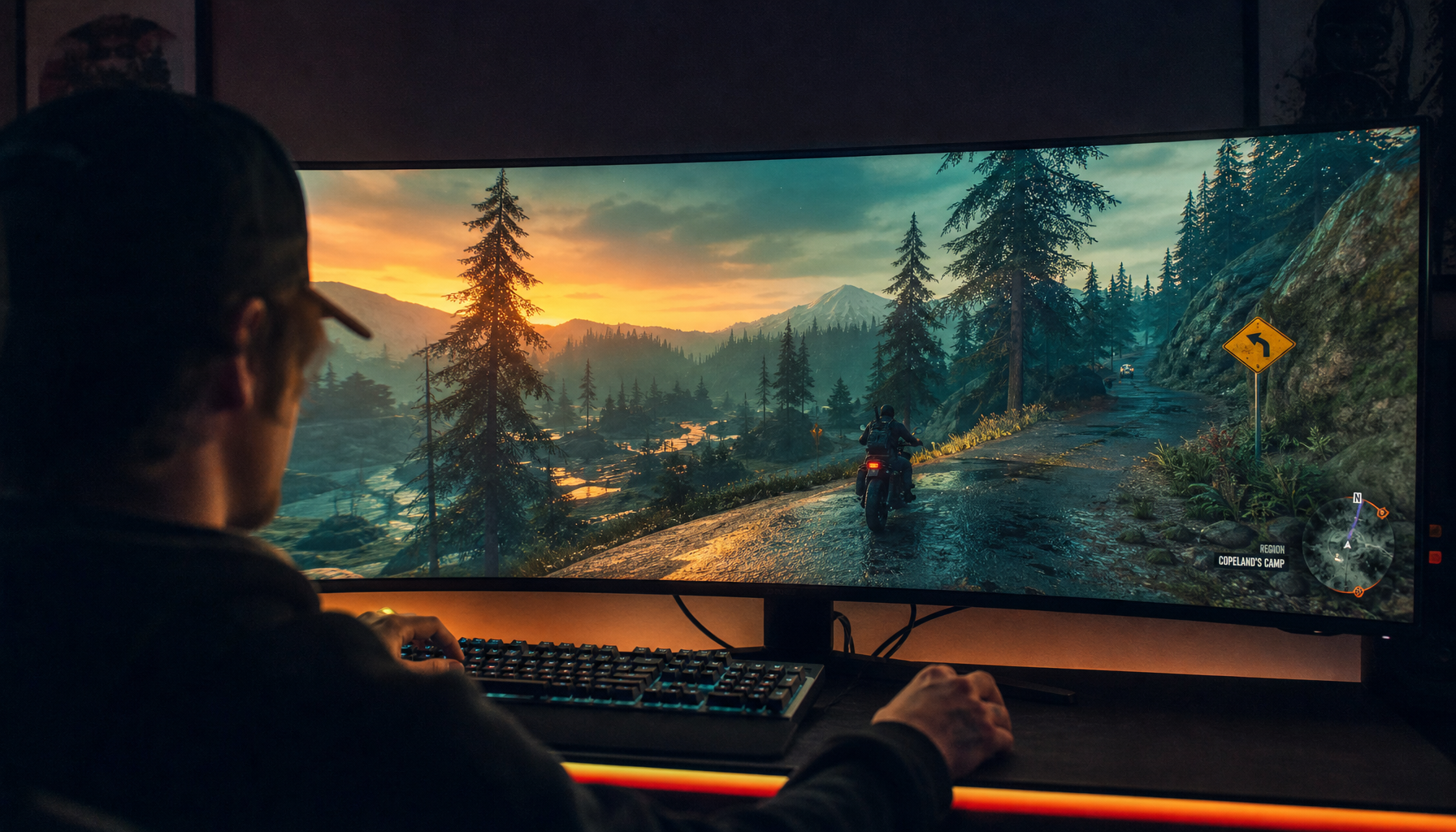
Ultrawide monitors are useful for MMORPGs because they create horizontal room for peripheral information. A 21:9 display can move chat, party tools, meters, quest trackers, and inventory windows farther from the character without pushing them off-screen. A 32:9 super ultrawide can go further, giving the player a wider peripheral workspace that is useful for gathering routes, crafting windows, auction browsing, and multi-panel addon setups.
Width Helps Separate Critical and Noncritical Information
The main readability benefit of ultrawide is not that text itself becomes sharper. It is that the UI can breathe. Raid frames and target frames can sit in the action gutter near the center, while chat, logs, damage meters, and nonessential panels move farther outward. This reduces overlap and lowers the chance that a critical mechanic is hidden behind a meter or addon window.
For example, a 49-inch DQHD monitor such as a brand’s 49” DQHD 180Hz 1000R Curved Gaming monitor can give MMO players more horizontal room for chat, meters, and raid frames outside the central play area.
That said, ultrawide is only as good as the game’s UI flexibility. Some MMORPGs handle 21:9 cleanly, while others stretch menus, lock certain frames, or place cutscenes and overlays awkwardly. Before buying a 32:9 monitor mainly for one MMO, check whether the game supports the aspect ratio, whether the HUD can be repositioned, and whether your GPU can maintain the desired frame rate at the wider resolution.
Avoid the “Too Wide to Scan” Problem
A wider screen can also increase eye travel if everything is spread too far apart. For competitive raiding or PvP, the most important elements should remain close enough to read without turning your head. Place boss timers, player health, target cast bars, and personal cooldowns near the central action zone. Move long-form or low-priority information, such as chat history or combat logs, toward the edges.
A good ultrawide setup keeps the center clean rather than empty. The character area should stay visible, but the key information should form a readable ring around it. If you find yourself constantly looking to the far left for party health or to the far right for a critical timer, the monitor is not the problem; the layout needs to be tightened.
Refresh Rate Improves Combat Tracking, Not Small-Text Sharpness
High refresh rate displays can make crowded combat easier to follow because motion is updated more often. In raids, battlegrounds, and world events, that can help with camera movement, enemy telegraphs, target switching, and fast repositioning. A 144 Hz, 165 Hz, or 240 Hz gaming monitor can feel smoother than 60 Hz when panning across a busy arena or dodging layered ground effects.
Motion Clarity and Readability Are Related but Different
Refresh rate does not directly make a tooltip, chat line, or item stat sharper. Pixel density, scaling, chroma, subpixel rendering, contrast, and font size handle that job. Refresh rate helps when the camera and effects are moving, which is why it matters more in action-heavy combat than in crafting, auction house browsing, quest reading, or turn-based map management.
A 60 Hz high-density display can still be a strong choice for reading-heavy games or slower MMO activities because static UI clarity may matter more than motion smoothness. The tradeoff is visible panning judder during manual camera movement, especially across large maps 60Hz refresh rate. For MMORPG players who raid, PvP, or play action-combat MMOs, high refresh is more valuable; for players focused on crafting, market play, questing, and social hubs, density and text clarity may deserve priority.
Do Not Let High Refresh Break Text Quality
When shopping for a high-refresh gaming monitor, confirm that it can run your intended resolution and refresh rate with full RGB or 4:4:4 chroma. For example, 4K at high refresh with HDR and 10-bit color can stress older video-connection paths. The result may be a display that feels smooth but makes small colored UI text look worse.
Use the cable included with the monitor only if it supports the monitor’s advertised mode. Check the graphics control panel for RGB or 4:4:4 output, native resolution, and the correct refresh rate. Then verify inside the MMO with the same settings you will actually use during play, including HDR if you leave it on.
Best Monitor Characteristics by MMORPG Setup
The right display depends on your desk size, eyesight, GPU, MMO genre, addon load, and whether you value motion, text density, or layout space most. A player healing mythic-style raids with 20-40 visible frames has different needs than a casual quester using chat and inventory windows on a portable monitor.
Comparison Table
Setup Type |
Best-Fit Display Characteristics |
Why It Helps Dense MMORPG UI |
Watchouts |
Compact desk raiding |
27-inch 1440p, 144 Hz or higher, good contrast, full RGB/4:4:4 |
Balanced size, readable UI, manageable GPU load, smooth combat |
Text is less crisp than 4K or 5K; avoid overly small UI scale |
Sharp text priority |
32-inch 4K or 27-inch 5K, native resolution, 125%-150% OS scaling as needed |
Higher pixel density improves chat, tooltips, bags, maps, and addon labels |
GPU demand rises; 60 Hz models may feel less smooth in fast combat |
Ultrawide layout |
34-inch 21:9 or larger, customizable HUD, high refresh if raiding |
Moves chat, meters, and logs outward while keeping the central area clearer |
Game support varies; far-edge UI can increase eye travel |
High-refresh PvP or action MMO |
144 Hz, 165 Hz, or higher with fast response and low input lag |
Improves camera motion, target tracking, and visual stability in crowded fights |
Does not fix small text; verify chroma at target refresh |
Portable MMO use |
15-18 inch portable monitor, native resolution, readable scaling, decent brightness |
Useful for travel, apartments with limited desk space, or a second-screen MMO setup |
Small panels need larger UI scale; speakers and brightness may be limited |
Buying Priorities That Actually Affect Readability
If dense UI readability is the goal, prioritize native-resolution sharpness first. A monitor should be run at its native resolution, with scaling handled by the OS and game rather than by sending a lower-resolution signal. Next, verify full RGB or 4:4:4 color at your preferred refresh rate. After that, choose a screen size and aspect ratio that gives your layout enough room without pushing critical information too far from your focus area.
Contrast and brightness also matter, especially during long evening sessions. A dim monitor with weak contrast can make gray tooltip text, cooldown overlays, and debuff borders harder to distinguish. Avoid image enhancement modes that add oversharpening, artificial contrast, or edge processing; these can make fantasy environments look punchy while making text halos and UI borders more fatiguing.
Practical Next Steps
A good MMORPG monitor setup is built through both buying decisions and calibration. The best specs on paper still need to be tested with the actual game, addons, cable, GPU output, desk distance, and UI scale you use. Do the final check in a real dungeon, raid, battleground, or crowded city hub, not just on a blank desktop.
Action Checklist
- Set the monitor to its native resolution before judging text clarity.
- Confirm full RGB or 4:4:4 output at your target refresh rate and HDR setting.
- Increase UI scale, chat font size, and addon font sizes until text is readable during movement.
- Keep the central character area clear and place critical frames in a nearby action zone.
- Move chat, combat logs, and nonessential meters toward the outer screen area.
- Test red or magenta text at 100% zoom to catch chroma subsampling problems.
- Run a real combat scenario for at least 15-20 minutes before finalizing layout or return-window decisions.
For most MMORPG players, a strong default choice is a 27-inch 1440p high-refresh monitor if smooth raiding and GPU efficiency matter, or a 32-inch 4K monitor if small text, maps, bags, and dense addon panels are the priority. Ultrawide is the better choice when interface spacing is the pain point, especially if the game lets you freely move HUD elements.
FAQ
Q: Is 4K always better than 1440p for MMORPG readability?
A: Not always. 4K can make text and UI elements sharper, especially on a 32-inch monitor, but only if the game runs at native resolution and scaling is comfortable. A 27-inch 1440p high-refresh monitor may be easier to drive and smoother in raids, while a 32-inch 4K display can be better for chat, tooltips, inventories, maps, and addon-heavy layouts.
Q: Does an ultrawide monitor make MMORPG UI easier to read?
A: It can, but mainly by improving spacing rather than text sharpness. Ultrawide monitors let you move chat, meters, quest trackers, and logs away from the center, which can reduce clutter around your character. The benefit depends on game support, HUD customization, and whether you keep critical information close enough to scan quickly.
Q: Should I choose high refresh rate or higher pixel density for MMORPGs?
A: Choose high refresh rate if you mostly raid, PvP, or play action-heavy MMOs where camera motion and reaction timing matter. Choose higher pixel density if your pain point is reading chat, tooltips, item stats, map labels, raid names, and addon text. If budget allows, a 4K high-refresh display with verified RGB or 4:4:4 output gives the best mix, but it also demands more from your graphics card.