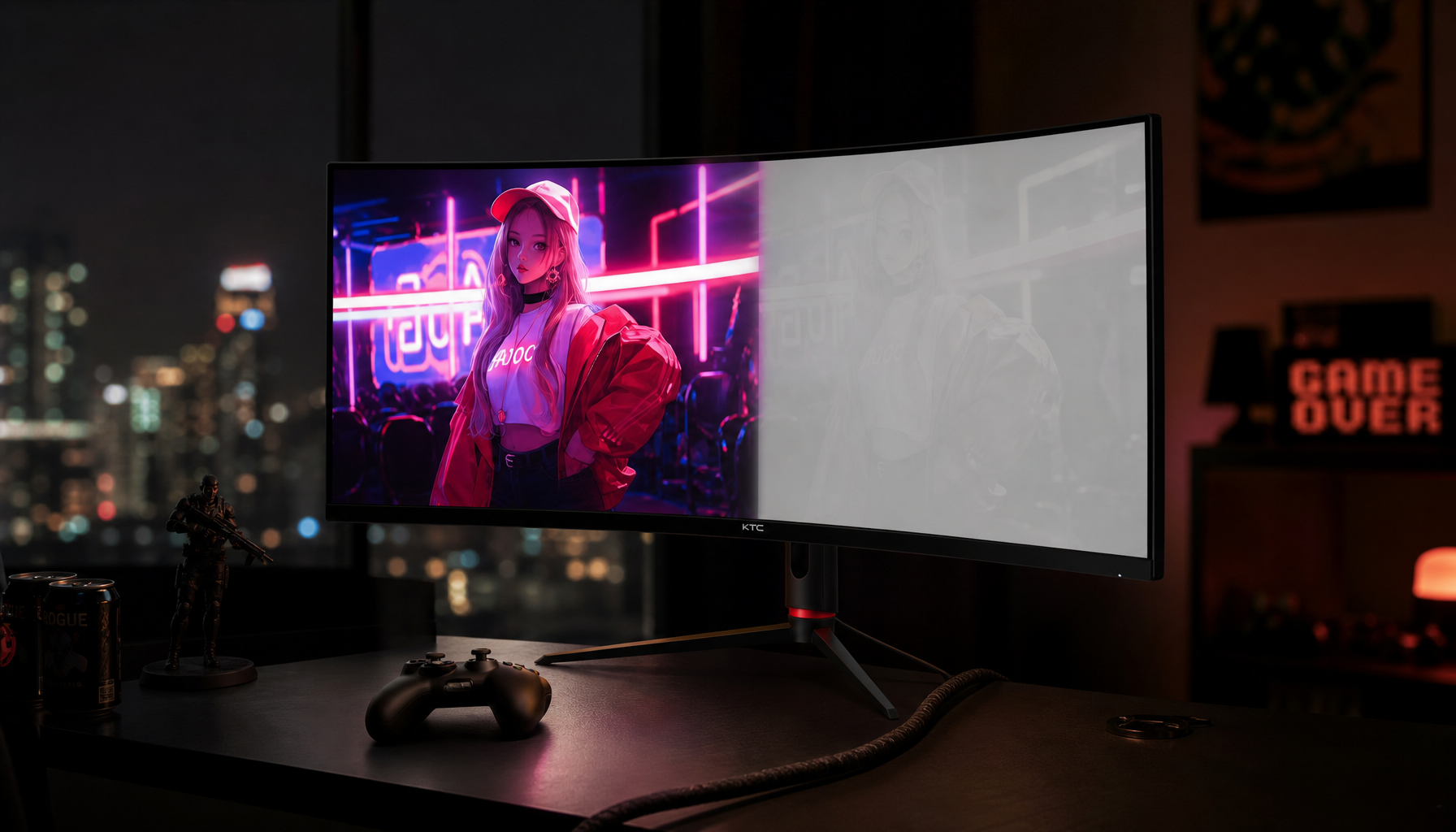
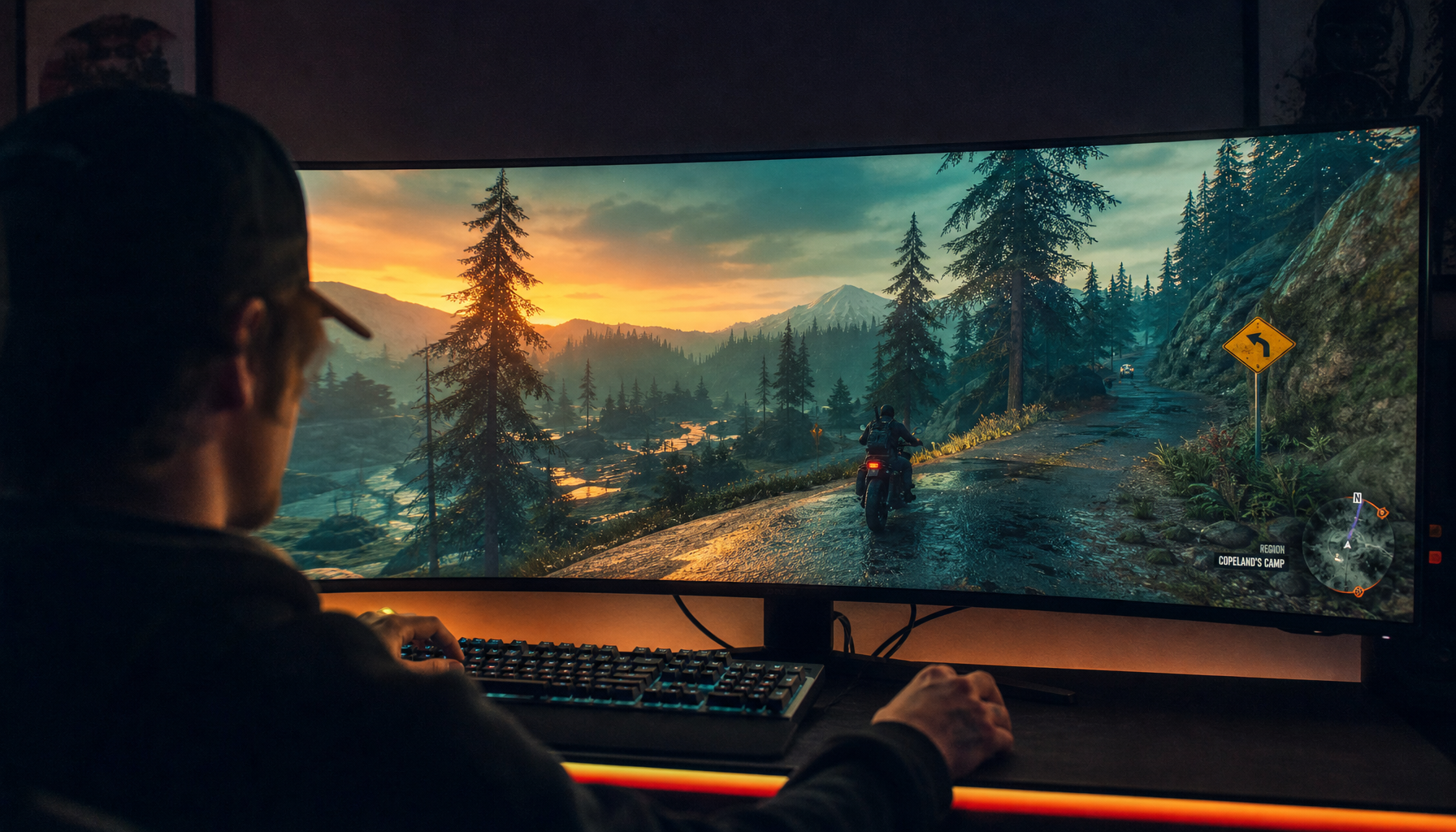
Flat displays usually create cleaner geometric symmetry, while curved displays create a more immersive, wraparound look that can feel more intentional for gaming and ultrawide setups.
Does your desk look balanced from the front but slightly awkward once you sit down and start using it? Small differences in bezel thickness, screen angle, curve radius, and viewing distance can make a dual- or triple-monitor setup feel either polished or visually unsettled. With a few practical alignment rules, you can decide whether flat panels, curved gaming monitors, or a curved ultrawide will give your desk the look and feel you actually want.
The Core Aesthetic Difference: Grid Symmetry vs Wraparound Continuity
Flat monitors are easier to make visually “square.” Their panels sit on the same plane, their bezels meet in predictable straight lines, and their edges form a clean rectangle across the desk. That makes flat displays the safer choice for minimalist workstations, dual 27-inch productivity setups, trading-style layouts, and desks where the monitors are part of the room’s visual design even when they are turned off.
Curved monitors change the aesthetic language. Instead of looking like a wall of rectangles, they create a cockpit-like arc around the user. That can look more immersive and premium, especially with high-refresh-rate gaming monitors or a 21:9 ultrawide, but it also makes strict left-right symmetry harder because the screen surface is no longer a flat visual plane.
Flat Displays Look More Architecturally Ordered
For symmetrical desk arrangements, flat monitors naturally support straight horizontal and vertical lines. A pair of matching 24- to 27-inch flat displays can look especially clean when the top edges, bottom edges, and lit pixel areas line up. This is why flat panels often look better in photos, shared offices, and setups where the monitors are meant to disappear into a tidy desk layout. In that kind of dual-monitor layout, a matching 27-inch flat QHD panel such as a brand 27-inch 2K 100Hz/120Hz home office monitor can fit the visual goal because its size, flat shape, and QHD resolution are easy to pair with a similar second display.

The trade-off is that flat dual monitors create a visible break between screens. The center bezel can interrupt a game, editing timeline, spreadsheet, or code layout. In a productivity setup, that break may be useful because it separates a primary task from chat, email, monitoring tools, or reference material.
Curved Displays Look More Intentional When They Form an Arc
Curved monitors look best when the whole arrangement follows the curve instead of fighting it. A single curved ultrawide centered with the keyboard and chair often looks more intentional than two mismatched curved monitors placed side by side. In triple-monitor gaming setups, curved displays can create a strong simulator-style effect, but only when the side monitors are angled consistently and the user sits at the right distance.

Curvature ratings matter visually as much as ergonomically. Lower “R” values mean a tighter curve, so 1000R is more aggressive than 1500R or 1800R, and curvature ratings become more noticeable on wide 21:9 and 32:9 displays than on smaller screens.
Alignment: Where Flat Monitors Have the Advantage
A symmetrical monitor setup is not just about buying two or three screens of the same size. The setup has to align physically on the desk and digitally in the operating system. A practical alignment process uses two passes: place the panels correctly first, then adjust the virtual layout in your desktop operating system, GPU surround mode, or the apps you use most.
Flat displays are generally more forgiving in this process. Because they share a straight viewing plane, you can align top edges, bottom edges, centerlines, or lit pixel areas with less trial and error. Curved displays require the same alignment work, but the curve adds another variable: the front edge, screen center, and outer corners may not sit visually where your eye expects them to.
Align the Lit Pixels, Not the Plastic Frame
The most common aesthetic mistake in mixed-monitor setups is aligning the outer plastic frames instead of the active image areas. Different monitor models often have different bottom bezels, chin thicknesses, or hidden inactive borders. For a visually clean setup, multi-monitor alignment should prioritize the lit pixel area, bezel gaps, screen height, tilt, and the way windows move across screens.

This matters more when mixing display types. For example, a 27-inch 1440p gaming monitor at roughly 109 PPI will look sharper and denser than a 27-inch 1080p monitor at roughly 81 PPI. Even if the panels are the same physical size, text, icons, and window edges may not feel visually consistent across the desk.
Choose the Right Alignment Target
Different setups should align to different visual references. Office and writing setups often look best with the top edges aligned because document windows, browser tabs, and app menus stay level. Mixed-size setups often look better when screen centers align because the eye tracks content across the middle of each display. Racing and flight simulator layouts may benefit from aligning horizon lines instead of monitor edges.
Curved displays complicate those choices because the side panels may tilt inward more dramatically. A perfectly symmetrical arc can look excellent from the chair but uneven from across the room. If the desk is in a bedroom, apartment living area, or open office, think about both viewing positions: how it looks while seated and how it looks when the workstation is idle.
Viewing Distance and Desk Depth Shape the Final Look
Curved monitors only look polished when the viewing distance matches the curve. If you sit too far away from a tight curve, the display can look like it is bending for no reason. If you sit too close to a wide flat array, the outer edges can feel distant and visually disconnected. In both cases, the desk may be technically symmetrical but aesthetically uncomfortable.

For large curved ultrawides, practical viewing distance often falls around 24 to 31 inches. For many 24- to 27-inch flat displays, 24 to 36 inches is a workable range. A dual flat setup used equally should keep both screens at the same distance and angle them slightly inward; a primary-secondary setup should keep the main screen centered and angle the secondary display toward the user.
Curve Radius Changes the Desk Presence
A 1000R monitor has a stronger wraparound effect and is typically best for a close, single-user gaming setup. A 1500R monitor is a more flexible middle ground for mixed gaming and productivity. A 1800R monitor creates a gentler curve that can look calmer on a shared desk or in a more restrained workspace.
Approximate sweet spots help explain the visual difference: 1000R works around 3.3 ft, 1500R around 4.9 ft, and 1800R around 5.9 ft. Those numbers do not mean every user must sit exactly there, but they show why a tight curve on a shallow desk can look intense while a gentle curve on a deeper desk can look more natural.
Wider Screens Increase the Stakes
The wider the display, the more visible the aesthetic choice becomes. A 34-inch curved ultrawide often feels like a balanced middle ground because it provides a continuous workspace without taking over the entire desk. A 40-inch or 49-inch super-ultrawide can look dramatic and premium, but it needs enough desk depth, arm adjustability, and room width to avoid dominating the setup.
A curved ultrawide does not automatically require more head movement than dual flat monitors; head movement depends on screen width, viewing distance, window placement, and how often you use the outer edges. Still, curved ultrawide vs dual flat comparisons show why many users treat 34-inch ultrawides as a safer ergonomic and visual middle ground than larger super-ultrawide displays.
Setup Options Compared
The best-looking setup depends on whether your priority is symmetry, immersion, desk minimalism, or task separation. A pair of flat monitors may look cleaner, while one curved ultrawide may look more cohesive because it removes the center bezel. A triple-monitor curved arrangement can look impressive, but it also requires the most careful positioning.
For most buyers, the decision is less about whether curved or flat is universally better and more about whether the display arrangement matches the room, desk depth, and main use case. Gaming, video editing, spreadsheet work, coding, streaming, and office multitasking all reward different compromises.
Setup Type |
Best Aesthetic Strength |
Main Trade-Off |
Practical Fit |
Setup Guidance |
Dual flat 24- to 27-inch monitors |
Clean symmetry and straight edges |
Center bezel breaks continuous content |
Office work, coding, dashboards, school work |
Match size, resolution, PPI, bezel thickness, and height |
Single 34-inch curved ultrawide |
Seamless desktop with no center bezel |
Less physical task separation |
Gaming, timelines, spreadsheets, side-by-side windows |
Center it with the chair and keyboard; keep top edge at or slightly below eye level |
Triple flat monitors |
Strong command-center symmetry |
Wide footprint and more bezels |
Sim racing, flight sims, finance, monitoring |
Align horizon or top edges depending on use |
Triple curved monitors |
Immersive wraparound look |
Harder to align perfectly from all viewing angles |
Dedicated gaming or simulator desks |
Use matching models and identical side angles |
Curved ultrawide plus flat side monitor |
Premium main display with utility space |
Asymmetry is visible |
Mixed productivity and gaming |
Keep the ultrawide centered; treat the side display as secondary |
Mixed flat monitors |
Budget-friendly and flexible |
Size, PPI, and bezel differences stand out |
Incremental upgrades |
Align lit pixels and use OS scaling carefully |
When Flat Looks Better
Choose flat monitors if you want a restrained, balanced, architectural desk. They work especially well with monitor arms, wall-adjacent desks, neutral cable management, and productivity layouts where the setup should look orderly from multiple angles. They are also the practical choice when you need portrait orientation, frequent repositioning, or mixed input devices across several screens.
Flat panels are also easier to buy consistently. Matching two 27-inch 1440p high-refresh-rate displays gives you similar sharpness, size, refresh behavior, and bezel geometry. For people who notice small visual mismatches, that consistency often matters more than the immersive effect of a curve.
When Curved Looks Better
Choose curved monitors when the visual goal is immersion. A curved gaming monitor or ultrawide can make the desk feel more focused around the user, especially with a centered chair, low-profile monitor arm, and speakers or lighting arranged symmetrically around the screen. The look is strongest when the display is the main object on the desk rather than one rectangle among many.
A curved ultrawide can also look cleaner than dual flat monitors because it removes the center bezel. For video timelines, large spreadsheets, racing games, RPGs, and side-by-side browser windows, the continuous canvas can feel more polished than two separate panels. The trade-off is that app management and window snapping become more important because the screen no longer gives you a physical division.
Buying Guidance for a Symmetrical Desk
Start with the desk, not the monitor. Measure usable width, depth, and the distance from your seated eye position to the back edge of the desk. A shallow desk can make a tight 1000R curve feel visually aggressive, while a deeper desk can make a flat multi-monitor row feel more balanced.
Then decide whether your setup should be visually centered on one primary screen or evenly split across multiple displays. If one display handles gaming, writing, editing, or main work, center that screen with your chair and keyboard. If two monitors are used equally, place them at equal distance and angle both slightly inward, often around 10 to 30 degrees for side positioning.
Match Specs That Affect the Look
For a polished arrangement, match more than screen size. Resolution, pixel density, refresh rate, panel type, brightness, coating, stand height, and bezel thickness all affect the final appearance. Two monitors can both be “27-inch gaming monitors” and still look mismatched if one is 1440p at about 109 PPI and the other is 1080p at about 81 PPI.
Refresh rate is less visible when the monitors are idle, but it matters during use. A 165 Hz main gaming monitor beside a 60 Hz secondary screen can feel uneven when moving windows, scrolling, or dragging content across the desktop. For symmetrical gaming or content creation setups, matching refresh rate and resolution helps the desk feel unified, not just look unified.
Use Monitor Arms Carefully
Monitor arms are often the difference between a setup that looks close enough and one that looks deliberate. They let you correct height, tilt, depth, and inward angle without stacking books or relying on fixed stands. For curved displays, arms also help position the screen so the curve wraps around the user rather than floating too far back or bending awkwardly at the edges.

Check arm capacity before buying, especially for ultrawide and super-ultrawide monitors. Larger curved displays can be heavier and deeper than flat panels of similar diagonal size. A weak arm may sag over time, which ruins both ergonomics and the clean symmetry you were trying to create.
Action Checklist for a Cleaner Multi-Monitor Layout
- Measure your seated eye distance to the screen area; aim for roughly 24 to 36 inches for many 24- to 27-inch displays and about 24 to 31 inches for many large curved ultrawides.
- Decide whether the setup is primary-centered or equal-use; center the main screen for primary use, or balance both displays equally for dual-primary work.
- Align the lit pixel areas first, then adjust the operating-system display layout so the cursor and windows cross naturally.
- Match resolution and pixel density where possible; avoid pairing a sharp 27-inch 1440p main display with a visibly softer 27-inch 1080p side display unless budget requires it.
- Keep the top edge of the main display at or slightly below eye level for long sessions.
- Angle side monitors inward by about 10 to 30 degrees, then fine-tune until the bezels look balanced from the seated position.
- For curved monitors, choose the curve based on desk depth: 1000R for close gaming, 1500R for mixed use, and 1800R for a gentler shared-desk look.
Common Misconceptions About Curved and Flat Symmetry
Curved does not automatically mean more premium. A curved monitor with the wrong desk depth, mismatched side displays, or an off-center chair can look less refined than two well-aligned flat panels. The curve has to serve the viewing position, not just the spec sheet.
Flat does not automatically mean boring. A pair of matching flat high-refresh-rate monitors on a clean dual arm can look more professional than a curved array with uneven heights and gaps. For many desk setups, visual discipline is the aesthetic advantage.
Curvature Does Not Improve Sharpness
A curved screen can make a wide display feel more visually connected, but it does not increase panel area, pixel density, sharpness, or text clarity. Resolution, subpixel rendering, scaling, panel coating, and brightness uniformity still determine how crisp the screen looks. If text clarity is your main concern, prioritize resolution and PPI before curvature.
For example, a 27-inch 1440p monitor usually looks much sharper than a 27-inch 1080p monitor at the same viewing distance. That difference will be visible whether the panel is curved or flat. Curvature changes geometry; it does not replace display quality.
Symmetry Is Mostly About Consistency
The most polished setups usually repeat the same decisions: same size, same height, same brightness, same color temperature, same bezel thickness, same monitor arm style, and same cable path. Curved and flat displays can both look excellent when the setup is internally consistent.

The riskiest look is a mixed arrangement with no hierarchy. A curved main display, a flat side monitor, a different-sized portable monitor, and unmatched stands can work, but only if the layout clearly communicates which screen is primary and which screens are supporting tools.
FAQ
Q: Do curved monitors look good in a symmetrical dual-monitor setup?
A: They can, but matching matters more than with flat panels. Two identical curved monitors placed at equal height, equal distance, and equal inward angle can look balanced from the seated position. From across the room, however, the arc may look less geometrically clean than two flat monitors because the screens do not share one straight plane.
Q: Are flat monitors better for minimalist desk aesthetics?
A: Usually, yes. Flat monitors are easier to align into clean horizontal and vertical lines, and they tend to look more neutral when the desk is viewed from different angles. They are also better when you want portrait orientation, compact monitor arms, or a setup that blends into a home office rather than feeling like a gaming cockpit.
Q: Is a curved ultrawide better-looking than two flat monitors?
A: A curved ultrawide often looks cleaner if you want one continuous screen with no center bezel. It works especially well for gaming, editing timelines, large spreadsheets, and side-by-side windows. Two flat monitors look better when you want clear task separation, easier alignment, or a more traditional symmetrical desk layout.
Final Takeaway
Choose flat displays if your priority is crisp geometric symmetry, easy alignment, and a calm desk presence. Choose curved displays if your priority is immersion, continuous screen space, and a setup that visually wraps around the user. For most mixed gaming and productivity desks, the strongest middle-ground choice is either two matching 27-inch flat monitors or one centered 34-inch curved ultrawide, depending on whether you value task separation or screen continuity more.