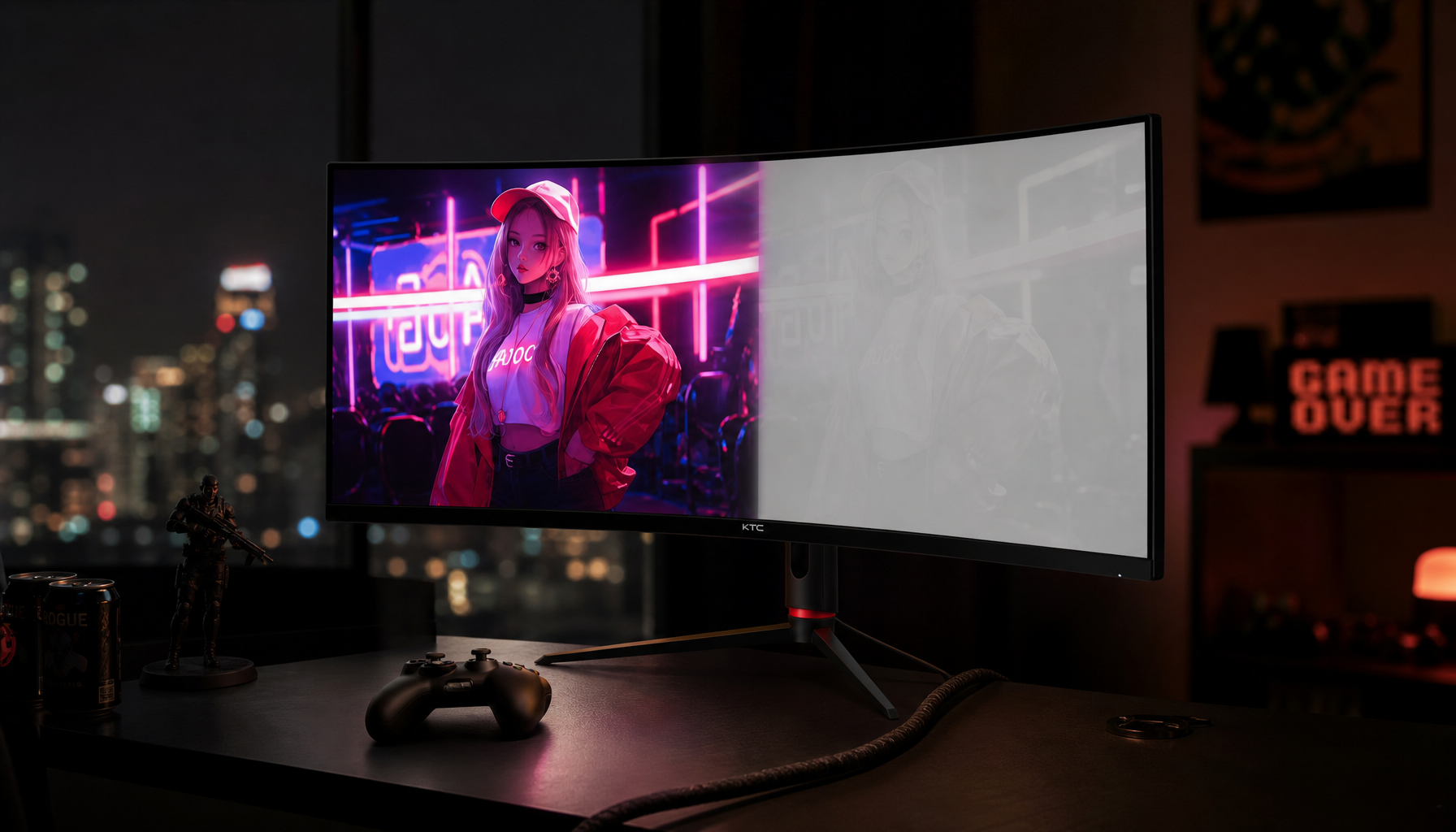
Monitor-based blue light filters can increase input lag when they switch the display into a slower picture-processing path, while software filters usually change color output before the frame reaches the monitor.
Does your mouse feel slightly “rubbery” after enabling the monitor’s Low Blue Light or Reader mode, even though the same game felt crisp minutes earlier? A practical A/B test can reveal the difference quickly: keep refresh rate, resolution, and FPS cap unchanged, then compare the monitor filter mode with a software color-temperature filter using the same aim trainer, desktop drag test, or high-speed phone recording. You’ll learn why the lag happens, when it matters, and how to protect your eyes without sacrificing control.
The Short Version: It Is Usually the Display Pipeline, Not the Color Shift
Input lag is the delay between a user action and the corresponding image appearing on screen, and one display-testing source defines input lag as the time from a monitor receiving a signal to displaying the matching image. A blue light filter does not automatically create lag because “warmer color” itself is not slow. The problem starts when the monitor’s built-in filter is bundled with extra processing, a different preset, changed brightness behavior, non-native scaling, dynamic contrast, sharpening, local dimming behavior, or another internal image path.
Software filters, such as OS night-light features or GPU color adjustments, usually work before the completed image is sent to the display. They shift the color balance in the graphics pipeline, then the monitor receives a normal video signal at the same resolution and refresh rate. That is why a software filter often feels invisible in mouse movement while a monitor-based Low Blue Light, Reader, eye-comfort, or similar mode may feel different on some displays.
What Blue Light Filters Actually Do
Blue light filtering reduces part of the short-wavelength blue light emitted by the screen. Some low-blue-light modes target a broader blue-light range, while narrower implementations preserve more picture quality while reducing selected blue-light output through blue-light filtering technology. In practice, you see this as a warmer, more amber image with less cool-white intensity.
For office work, that can be valuable. Long spreadsheet sessions, late-night writing, and multi-hour video calls are not esports conditions. Office monitor guidance often includes low blue light and flicker-free features because eye-care features can help reduce fatigue during extended screen use. The performance question is not whether blue light reduction is useful; it is where the filtering happens and whether it triggers extra display processing.
Why Monitor-Based Filters Can Add Lag
A monitor-based blue light filter runs inside the display’s own electronics. On a simple implementation, it may only change the color temperature or backlight behavior. On a slower implementation, it may activate a full picture preset with additional tonal adjustment, brightness control, contrast manipulation, sharpening, dynamic color, or panel compensation. KTC’s lag troubleshooting notes point out that different presets, HDR modes, HDMI inputs, non-native resolutions, and image-enhancement modes can send the signal through higher-latency processing paths.
Here is the real-world version. You are playing a 144 Hz shooter, where each refresh is about 6.9 ms. If the monitor’s Low Blue Light preset disables Game Mode and adds even one extra frame of processing, the display can feel meaningfully softer in aim response. If the mode also changes overdrive, strobing, HDR handling, or scaling behavior, the subjective change may feel larger than the color shift suggests.
Filter location |
What changes first |
Input-lag risk |
Best use case |
Display preset or internal image processing |
Low to moderate, depending on model and mode |
Office reading, static work, casual use |
|
Software filter |
GPU or OS color output before the signal reaches the monitor |
Usually low if refresh and frame pacing stay unchanged |
Gaming, mixed work, quick switching |
Hardware low-blue-light panel design |
Backlight or panel-level spectral tuning |
Usually low if it does not change processing mode |
Long-term productivity setups |

The key word is “depending.” Some gaming monitors keep low-lag behavior across several presets, while others only deliver their best response in Game, FPS, Instant, or Low Input Lag modes. That is why a monitor can advertise a fast response time yet still feel delayed: response time measures pixel color transitions, while input lag measures the delay before the screen begins showing the updated frame.
Why Software Filters Usually Feel Faster
A software filter generally does not ask the monitor to reinterpret the image. It changes the color values before the frame is transmitted over HDMI, DisplayPort, or USB-C DisplayPort Alt Mode. The monitor still runs at the same refresh rate, native resolution, and low-lag preset.
That distinction matters because display-lag guidance commonly recommends reducing lag by using Game or Instant Mode, disabling picture enhancement features, and relying on GPU-side upscaling when possible through lower-lag settings. A software filter fits that approach: let the PC handle the color shift, and keep the display in its fastest known mode.
For example, if your monitor’s Game Mode at 240 Hz feels immediate but its Reader Mode feels delayed, the performance-first setup is simple. Leave the monitor in Game Mode, set brightness manually, disable dynamic enhancement, then use the operating system’s night mode or GPU color controls to warm the image. You keep the monitor’s low-latency processing path while still reducing cool-blue intensity during evening work.

Refresh Rate Makes the Difference Easier to Feel

At 60 Hz, each refresh takes about 16.7 ms. At 144 Hz, it takes about 6.9 ms. At 240 Hz, it takes about 4.17 ms. KTC notes that refresh rate has a direct latency impact and that 30 FPS frames last about 33.3 ms, while 144 Hz frames arrive much more often.
This is why competitive players notice changes that office users may never detect. If you are editing documents, a 10 ms difference may not affect your output. If you are counter-strafing, tracking a target, or landing a parry window, a small processing delay can disturb timing. A public display database also emphasizes choosing displays with low input lag in Game Mode for the best gaming experience, which reinforces the practical rule: latency-sensitive use should start from the fastest preset.
Pros and Cons of Monitor-Based Blue Light Filters
Monitor-based filtering is convenient because it works with every connected device. A console, work laptop, desktop PC, streaming stick, and portable screen can all benefit without installing software. It can also be useful in locked-down office environments where users cannot change OS-level display settings.
The drawback is control. If the filter is tied to a picture preset, you may not know what else changed. Brightness, contrast, gamma, color saturation, sharpness, local dimming, overdrive, refresh handling, and power-saving behavior may move together. Business monitor guidance treats low-blue-light modes as useful workplace features, but it also frames monitor choice around practical features such as ergonomic stands, ports, resolution, panel type, and warranty. In other words, eye comfort is one part of the display equation, not a reason to ignore responsiveness.
Monitor filters are strongest for office documents, late-night browsing, and shared workstations. They are weakest when the preset cannot be separated from image processing or when the display hides latency-heavy features behind friendly names like Cinema, Eco, Comfort, or Reading.
Pros and Cons of Software Blue Light Filters
Software filtering is flexible and fast to toggle. It lets you keep the monitor in a low-lag mode while changing color temperature from the OS or GPU. It is also easier to schedule, which helps if you use one display for daytime productivity, evening browsing, and late-night gaming.
The main limitation is device dependence. A software filter on your desktop PC will not help a console plugged into the same monitor. It may also interact with color-managed creative workflows, screenshots, streaming capture, or calibration targets. If you edit product photos, grade video, or compare brand colors, disable the software filter during color-critical work and return the display to a known calibrated state.
For productivity displays, the better solution is often layered. Use good ergonomics first, then moderate brightness, then a software filter when latency matters. Home-office monitor guidance highlights larger external monitors, matte surfaces, automatic brightness control, flicker-free backlighting, and blue-light or circadian dimming as part of an ergonomic monitor setup, which is a stronger comfort strategy than relying on one aggressive yellow preset.
How to Test Your Own Monitor Without Lab Gear
The simplest test is a controlled comparison. Set the display to native resolution, confirm the active refresh rate in your operating system or GPU control panel, and keep the same game, FPS cap, and sync settings. Then switch only one variable: monitor Low Blue Light mode versus Game Mode with a software filter.
Use a fast, repeatable task. Drag a window in circles on the desktop, move a cursor across a high-contrast target, or run the same aim-training scenario for a few minutes. For a rough visual check, one display-testing method describes using two screens that show a millisecond timer and capturing the difference in a photo, though this is approximate because output timing and camera shutter timing can distort home measurements.
If the monitor filter feels slower, do not assume blue light reduction is the enemy. The likely issue is the preset. Return to Game Mode, lower brightness manually, warm the color temperature if the monitor allows it without leaving Game Mode, and use software filtering for the remaining comfort adjustment.
Best Settings for Gaming, Office Work, and Portable Screens

For competitive gaming, keep the monitor in Game, FPS, Instant, or Low Input Lag mode. Use native resolution, the highest stable refresh rate, VRR if it behaves well on your setup, and a software blue light filter when you need warmer color. Avoid heavy sharpening, dynamic contrast, aggressive noise reduction, non-native scaling, and display-side processing during ranked play.
For office productivity, comfort can take priority. A monitor-based low-blue-light mode is reasonable for writing, spreadsheets, email, and admin work, especially on a 24- to 27-inch productivity display. Office monitor advice supports choosing based on task, workspace, ergonomics, eye care, and connectivity rather than one headline spec. If you scroll large spreadsheets all day, a higher refresh productivity display may still feel better, even outside gaming.
For portable smart screens, software filtering is often the cleaner path when connected to a laptop because portable displays may have limited onboard controls and simpler processors. If the screen is used with a console, handheld PC, or phone-like device, test the built-in eye-care mode once and save two presets if available: one comfort preset for reading and one low-lag preset for play.
FAQ
Can a blue light filter itself slow pixel response time?
Usually, no. The warmer color shift is separate from pixel response time. However, if the monitor preset also changes overdrive or motion processing, motion clarity can change alongside input feel.
Is HDR the same problem as blue light filtering?
No. HDR is a different display path, and modern monitors often show little input-lag penalty with HDR, but the result is model-specific. Test HDR separately from blue light filtering instead of treating all picture modes as equal.
Should I turn off all eye-care features for gaming?
Turn off the ones that add processing, not every comfort feature blindly. Manual brightness reduction, a stable refresh rate, and software color warmth can protect comfort while keeping control sharp.
The performance-first answer is simple: keep the monitor in its fastest low-lag mode, then apply blue light reduction as close to the source as possible. For work, use the comfort tools that help you stay focused; for competition, do not let an eye-care preset quietly reroute the display pipeline.