Black level retention is usually temporary image persistence: a faint shadow from static content that remains visible in dark gray or black areas because pixels, liquid crystals, or panel-driving circuits have not fully reset. It is different from permanent burn-in, and the right fix depends on whether you use LCD, IPS, VA, mini-LED, or OLED.
Ever leave a dark game menu, trading dashboard, editing timeline, or spreadsheet open for hours, then notice a ghostly toolbar floating in the shadows? A simple gray-screen check plus a few minutes of varied full-screen motion can often tell you whether you are dealing with temporary retention or a deeper panel issue. Here is how to identify the cause, reduce the risk, and choose the right recovery steps without overreacting.
Why Dark Areas Reveal Image Persistence First
Dark scenes are unforgiving because the eye notices small brightness differences more easily when the screen is supposed to be uniform. A faint retained taskbar, browser tab row, HUD, minimap, or spreadsheet grid may be invisible on bright content, then appear clearly on a dark gray loading screen or a night scene in a game.
On LCD monitors, including IPS panels, this is often not true burn-in. Most apparent IPS “burn-in” cases are temporary image retention caused when static content keeps liquid crystals in similar states for long periods, and those faint afterimages can fade after minutes, hours, or days of varied content. The key mechanism is not the same as OLED aging because IPS LCDs use a shared LED backlight and liquid crystal shutters rather than self-emissive pixels.
OLED behaves differently. Each pixel produces its own light, so static bright UI elements can age specific pixels faster than surrounding pixels. That is why OLED delivers superb black levels, but it also carries more risk from static taskbars, fixed HUDs, channel logos, and productivity layouts. The practical rule is simple: if the content never moves, the risk goes up.
Temporary Image Persistence vs. Permanent Burn-In
Temporary image persistence is a short-term retained image that improves after rest, moving content, color cycling, or a built-in refresh routine. Permanent burn-in is uneven panel wear that does not meaningfully improve.
The distinction matters because the response is different. If a ghost outline disappears after playing changing full-screen video, it was probably temporary persistence. If the mark remains unchanged after repeated rest periods, varied content, and manufacturer-approved panel maintenance, permanent damage becomes more plausible.
Symptom |
More Likely Cause |
Practical Meaning |
Ghosting fades after minutes or hours |
Temporary image persistence |
Usually recoverable with rest and varied content |
Mark appears mainly on gray or dark scenes |
LCD retention, OLED near-black issue, or uniformity artifact |
Test with multiple solid colors before judging |
Fixed bright logo remains visible for days |
Possible burn-in |
Warranty or panel service may be needed |
Bright corners on black screen |
Backlight bleed or IPS glow |
Not image retention; it is a uniformity issue |
True LCD burn-in is uncommon in normal office and gaming use, but static-heavy deployments can still create problems. Long-running dashboards, point-of-sale screens, control rooms, and signage loops create the worst conditions because the same pixels show the same shapes for many hours every day.
What Actually Causes Retention in Dark Areas?
Static UI Elements Hold Pixels in Repeated States
The most common trigger is static content. Taskbars, menu ribbons, browser bars, code editors, stock charts, security camera grids, and game HUDs all keep the same shapes locked in place. Over time, the affected areas can respond differently from the rest of the panel, especially on mid-gray and dark-gray screens.
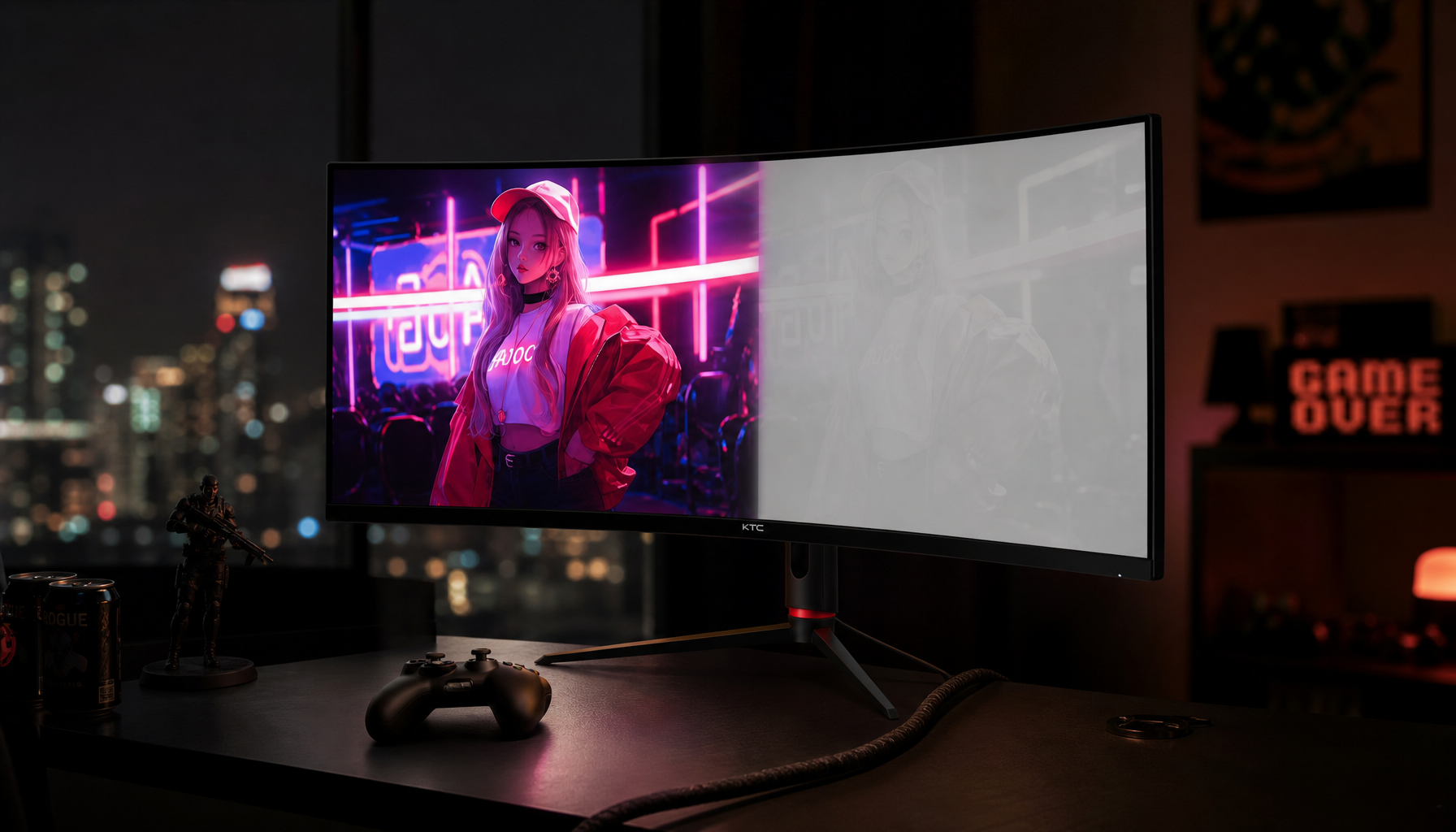
For LCD users, the issue is often liquid crystal relaxation or charge behavior rather than permanent pixel wear. Apparent LCD burn-in is commonly described as temporary image persistence from charge buildup, while true burn-in is usually permanent discoloration or ghosting from uneven cumulative use. A practical test is to show a solid gray background, then play varied full-screen motion; if the shadow fades, temporary image persistence is the better diagnosis.
High Brightness Accelerates the Problem
Brightness is performance fuel, but it is also stress. A monitor running at maximum brightness with a fixed white spreadsheet header or bright game HUD is working much harder than one set to a comfortable level in a controlled room.
For office work, many users run monitors far brighter than needed. Display-comfort recommendations commonly advise matching brightness to the room and give a practical office target around 100 to 150 cd/m² for spaces around 300 to 500 lux, which roughly aligns with a comfortable indoor productivity setup. Lowering brightness reduces eye strain and also reduces static-image stress; display brightness should be adjusted instead of left at factory defaults.
A real-world example is a 27-inch productivity monitor left at 100% brightness for an 8-hour spreadsheet day. If the room is moderately lit, dropping to a calibrated or visually matched comfort level can reduce unnecessary panel load while making text easier to read for long sessions.
Heat and Long Operating Hours Make Retention More Likely
Retention risk rises when static content, high brightness, heat, and long daily runtime stack together. A monitor used for two hours of varied gaming is a low-risk scenario. A wall-mounted dashboard showing the same layout for 12 hours a day is a very different workload.
Industrial, signage, kiosk, and control-room use cases need more active prevention. Content rotation, scheduled dimming, ventilation, and UI designs that avoid fixed high-contrast elements are not cosmetic choices; they protect the panel and maintain readable black levels over time.
OLED Has Perfect Blacks, But Static Pixels Still Age
OLED’s strength is also its exposure point. Because each pixel can turn off completely, OLED avoids traditional LCD backlight bleed and produces excellent dark-scene contrast. That is why OLED feels so immersive in cinematic games, HDR video, and dark-room editing.

But “no backlight bleed” does not mean “no dark-area artifact.” OLED panels can still show near-black banding, uniformity variation, image retention, or permanent burn-in. The important distinction is structural: OLED eliminates traditional backlight leakage because each pixel emits its own light, while LCD panels depend on a backlight shining through layers.
That tradeoff explains the buying decision. OLED is compelling for deep blacks, fast motion, and immersion. IPS or VA LCD is often the more reliable pick for static dashboards, spreadsheets, coding layouts, trading platforms, and unattended office displays.
How to Diagnose the Problem at Home
Start with normal viewing conditions, not a torture test. Set brightness to the level you actually use, sit at your normal distance, and open a full-screen mid-gray image. Gray reveals retained outlines better than pure black or pure white because it exposes small response differences across the panel.

Next, test black, white, red, green, and blue full-screen backgrounds. If the shape is visible only on gray and changes with brightness or viewing angle, temporary retention or panel uniformity is more likely than permanent burn-in. If it appears across multiple colors in the same location and never changes, the concern increases.
Then play varied full-screen video, a color-cycling pattern, or a screen-wash tool for 30 to 60 minutes. If the ghost image fades, keep using varied content and reduce static exposure for the next few days. If the retained image remains unchanged after an overnight power-off and repeated recovery attempts, treat it as a possible warranty issue.
How to Fix Temporary Black Level Retention
The first recovery step is the least dramatic: turn the monitor off for several hours or overnight. For LCDs, this allows liquid crystals and panel-driving behavior to settle. For OLEDs, standby may also allow manufacturer maintenance cycles to run, depending on the model.
After rest, use varied full-screen content rather than leaving another static image up. A fast-changing video, full-screen game footage, or color-cycling pattern can help even out temporary persistence. Manufacturer tools such as pixel refresh, panel refresh, panel protect, or screen cleaning should be used exactly as directed because overusing some maintenance routines may add unnecessary wear.
Modern OLED productivity recommendations often include reducing brightness, hiding the taskbar when practical, enabling pixel shift, and using panel protection routines. Built-in OLED care varies by model, but the principle is consistent: static UI should be dimmed, shifted, hidden, or periodically interrupted. For productivity workflows, OLED burn-in risk is tied to temperature, brightness, and static images.
Prevention for Gaming, Office, and Portable Displays
For gaming monitors, the main risk is not normal play; it is paused menus, static maps, health bars, and bright HUD elements left on-screen for long periods. Use auto-dimming, HUD opacity options, dynamic UI settings, and display sleep. If you step away, let the screen turn off rather than leaving a paused match or inventory menu overnight.
For office displays, the highest-risk shapes are taskbars, browser tabs, spreadsheet headers, app ribbons, chat sidebars, and dashboard panels. Auto-hide the taskbar, rotate window layouts, use dark mode thoughtfully, and set sleep timers. If a monitor is used for static financial charts or operations dashboards, schedule layout changes during the day instead of treating the screen like printed paper.

For portable smart screens, heat and power settings matter more because compact panels have less thermal headroom. Avoid running maximum brightness on a static second-screen layout all day, especially in direct sun or against warm surfaces. A portable display used for email, chat, and reference windows should still sleep when idle.
Pros and Cons by Panel Type
Panel Type |
Strength in Dark Areas |
Retention or Burn-In Tradeoff |
IPS LCD |
Stable color, strong productivity value |
Low permanent burn-in risk, but temporary retention and IPS glow can appear |
VA LCD |
Better native contrast than IPS |
Possible dark smearing, still backlit |
Mini-LED LCD |
Higher HDR brightness, improved local dimming |
Blooming can appear around bright objects |
OLED |
True blacks, excellent contrast, very fast response |
Higher static-image burn-in risk than LCD |
Portable LCD |
Efficient and affordable |
Heat, brightness, and static second-screen use need management |
OLED’s core performance appeal is clear: OLED can switch pixels off for true black and per-pixel contrast, while LCD local dimming depends on larger backlight zones. That is why OLED’s per-pixel dimming is so powerful for HDR and dark-room immersion, even though static desktop use still requires discipline.
When to Stop Troubleshooting and Use Warranty Support
If the retained image does not improve after an overnight power-off, varied full-screen content, and manufacturer-approved refresh routines, document it. Photograph the mark on neutral gray, white, and dark gray backgrounds using normal exposure, not a long-exposure phone shot in a pitch-black room. Record brightness settings, usage pattern, and how long the image has persisted.
Warranty outcomes vary by manufacturer and model, especially for OLED burn-in coverage. For LCDs, the support conversation may focus on uniformity, backlight bleed, or panel defect rather than burn-in. For OLEDs, the question is often whether the mark is temporary retention or permanent pixel wear.
FAQ
Is black level retention the same as backlight bleed?
No. Backlight bleed is unwanted light leakage from an LCD backlight, often near corners or edges. Black level retention is a ghosted remnant of previous content. If the bright patch stays in a corner regardless of what was displayed earlier, it is probably bleed or glow, not image persistence.
Can a screensaver still help?
Yes, if it moves. A static screensaver is just another static image. A moving screensaver, sleep timer, or screen-off setting is much better for monitors that sit unattended.
Is OLED bad for productivity?
No, but it needs better habits. OLED can be excellent for mixed work, gaming, and media, but long static layouts should use lower brightness, hidden taskbars, pixel shift, panel care features, and regular content variation.
Black level retention is usually a warning sign, not a disaster. Treat static brightness like workload, use the panel’s protection features, and test with gray screens plus varied motion before assuming permanent damage. A display should serve the session, whether that means a clean dark battlefield, a sharp editing timeline, or a reliable all-day office layout.