Anti-aliasing can smooth jagged edges, but it does not fully replace running a game at your monitor’s native resolution. For the cleanest image, start at native resolution, then tune anti-aliasing, render scale, and upscaling based on your monitor size, pixel density, refresh rate, and GPU headroom.
Ever turn on anti-aliasing and wonder why the stairs look smoother but the whole game suddenly feels a little soft? The tradeoff is real: dropping a 1440p monitor to 1080p cuts rendered pixels by about 44%, but it also forces the image to stretch across a panel that was built for a sharper 2,560 x 1,440 signal. Here is how to decide which setting matters most for your gaming monitor instead of guessing through blurry menus.
Why Native Resolution Is the Sharpness Baseline
A modern LCD or OLED gaming monitor has a fixed physical pixel grid. A 1080p panel has 1,920 columns and 1,080 rows, while a 4K UHD panel has 3,840 x 2,160 pixels, or about 8.3 million total pixels. When the game output matches that grid, one rendered image pixel maps directly to one panel pixel, which is why native resolution is the cleanest baseline for HUD text, fine lines, scope reticles, and distant geometry.

The problem starts when the monitor receives a lower-resolution image than its panel was designed to show. If a 2,560 x 1,440 gaming monitor is set to 1,920 x 1,080, the GPU or monitor has to stretch the smaller frame over the larger grid. That scaling process estimates missing pixel data, so edges can look smeared, small text can lose definition, and thin UI elements may look uneven.
Why 1080p on a 1440p Monitor Often Looks Worse Than Expected
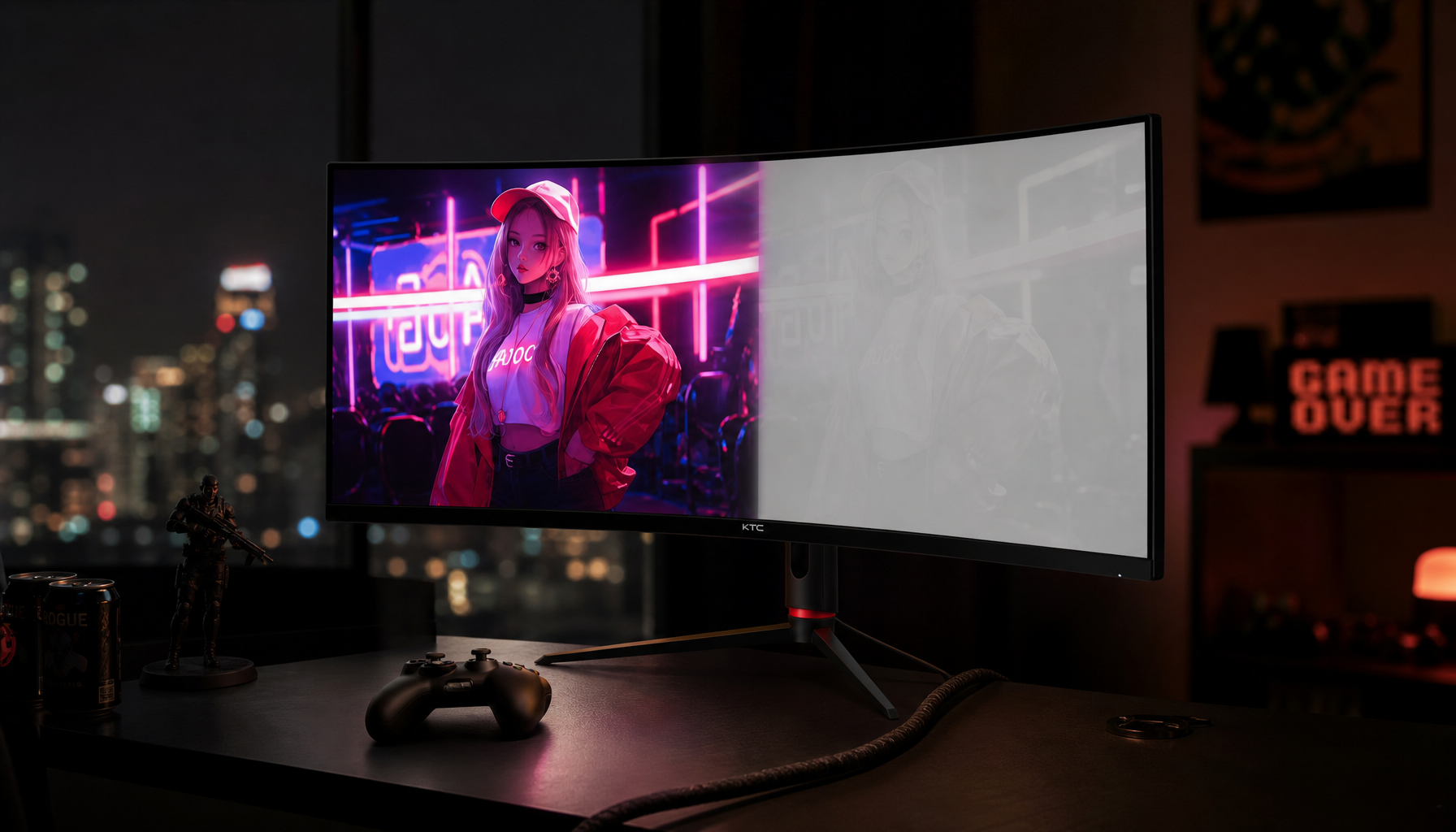
1080p does not divide cleanly into 1440p. That means many screen pixels are blended estimates rather than exact repeats. On a 27-inch 1440p high-refresh-rate monitor, the result is often obvious in game launchers, inventory text, map labels, and thin outlines around weapons or character models. For example, on a a brand 27” 2K 180Hz/1ms 1500R curved gaming monitor, the native 2K panel resolution should be the sharpness baseline before reducing render scale or anti-aliasing.

This is why lowering desktop resolution should usually be a last resort. A better first move is to keep the monitor at native resolution, reduce in-game render scale, use a game’s built-in upscaler, or lower expensive graphics settings such as shadows, ray tracing, reflections, and volumetric effects. The monitor stays sharp where it matters most, while the GPU workload still drops.
What Anti-Aliasing Fixes, and What It Cannot Fix
Anti-aliasing is designed to reduce visible jagged edges, shimmering, and crawling lines. It helps diagonal edges, fences, cables, foliage, railings, and high-contrast geometry look less harsh, especially on lower-resolution displays. But anti-aliasing is not the same thing as adding real panel pixels.
A softer 1080p image scaled to a 1440p monitor can still have anti-aliased edges, but the underlying frame contains less detail. The monitor is still inventing information to fill its physical grid. That is why anti-aliasing can make outlines smoother while textures, UI, hair, grass, and distant targets remain less defined than they would be at true native 1440p.
Why Games Can Look Blurry With Anti-Aliasing Enabled
Some anti-aliasing methods smooth edges by blending nearby pixels. That can reduce stair-stepping, but it can also soften fine details. This is most noticeable on gaming monitors with strong clarity, such as 27-inch 1440p panels, 32-inch 4K panels, OLED monitors, and high-refresh-rate displays where motion clarity makes softness easier to spot.
Temporal anti-aliasing, often called TAA, uses information from previous frames to reduce shimmer and stabilize fine detail. It is common in modern games, but it can introduce blur, ghosting, or a slightly smeared look in motion. That is why a game can look cleaner in still screenshots but less crisp while panning the camera.

Comparing Common Anti-Aliasing Options
Different anti-aliasing methods make different tradeoffs. Some prioritize speed, some prioritize sharpness, and some are tied to modern reconstruction or upscaling systems. The best setting depends on whether your priority is competitive responsiveness, cinematic image quality, or a balance of both.
Option | What It Does Best | Common Drawback | GPU Cost | Best Monitor Fit |
 |—|—|—:|—:|—| | FXAA | Quickly smooths jagged edges | Can blur the whole image | Low | Lower-end GPUs, 1080p portable monitors, older games | | SMAA | Smooths edges with less blur than FXAA | Does not fix all shimmer | Low to moderate | 1080p and 1440p gaming monitors | | MSAA | Cleans geometry edges well | Weak on shader aliasing, foliage, and modern deferred rendering | Moderate to high | Older titles, esports games, racing games | | TAA | Reduces shimmer and crawling detail | Can blur motion or leave ghosting | Moderate | Modern single-player games, 1440p and 4K monitors | | SSAA / Supersampling | Renders above display resolution for excellent clarity | Very demanding | Very high | High-end GPUs, older games, screenshot-quality visuals | | Reconstruction-style upscaling | Reconstructs a higher-resolution image from a lower render resolution | Quality varies by game and mode | Low to moderate | 1440p, ultrawide, and 4K high-refresh monitors |
Supersampling is the most straightforward quality approach: render more pixels than the display needs, then downsample. It can look excellent because it attacks aliasing at the source, but it is expensive. On a high-refresh-rate gaming monitor, that cost may be too steep if your target is 144 Hz, 165 Hz, or 240 Hz.
Post-process methods such as FXAA and SMAA are much cheaper. They are useful when the GPU is already near its limit, but they cannot restore detail that was never rendered. TAA and upscaling-based methods sit in the middle: they can stabilize modern game visuals well, but sharpness depends heavily on the game’s implementation and the selected quality mode.
Resolution, Pixel Density, and Monitor Size Change the Decision
A 24-inch 1080p monitor, a 27-inch 1440p monitor, a 32-inch 4K monitor, and a 34-inch ultrawide 1440p monitor do not need the same anti-aliasing settings. Pixel density changes how visible jagged edges are from a normal desk distance. The denser the pixels, the less obvious each individual stair-step becomes.

A 32-inch 4K monitor is about 138 pixels per inch, while a 27-inch 1440p monitor is about 109 pixels per inch. That gives the 4K screen roughly 27% higher pixel density, but 4K also has more than twice as many pixels to render as standard 1440p. That gap matters because 4K has more than double the pixel workload of 1440p, so chasing native 4K can cost far more performance than the sharpness gain suggests.
Is 1440p With Anti-Aliasing Better Than 4K Without It?
There is no universal winner. Native 4K without heavy anti-aliasing can look cleaner on static detail because it has far more real pixels. But 1440p with a good TAA, SMAA, or quality upscaling mode can look more stable in motion and run at a higher frame rate, which may feel better on a high-refresh-rate display.
For many 27-inch gaming monitors, native 1440p with a moderate anti-aliasing setting is the practical sweet spot. It gives a sharp enough pixel grid, manageable GPU load, and strong frame rates. For 32-inch monitors, 4K becomes more compelling because the larger screen benefits from the extra density, but the GPU requirement rises sharply.
How This Changes for Ultrawide and Portable Gaming Monitors
Ultrawide monitors add another wrinkle because they usually render more pixels than their 16:9 equivalents. A standard 2,560 x 1,440 display renders about 3.69 million pixels, while a 3,440 x 1,440 ultrawide renders about 4.95 million pixels. That is still far below 4K’s 8.29 million pixels, but it is a meaningful jump from standard 1440p.
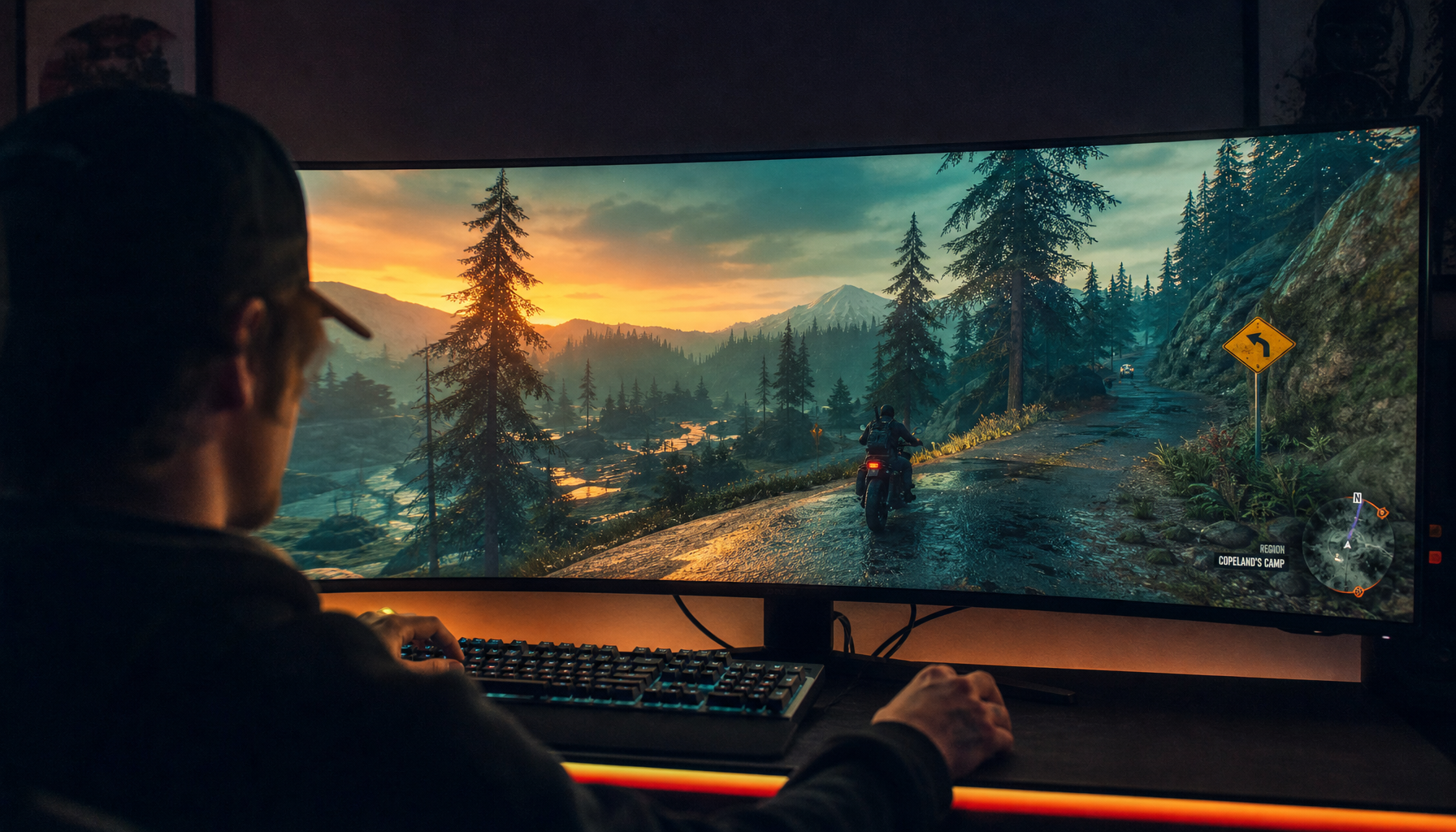
On a 34-inch ultrawide gaming monitor, native resolution matters because stretching a lower-resolution signal can soften the entire wide field of view. At the same time, ultrawide players often care about smooth camera motion, especially in racing games, flight games, RPGs, and first-person shooters. If your GPU struggles, lowering render scale or using a quality upscaling mode is usually cleaner than switching the panel away from native resolution.

Portable gaming monitors need similar care. A compact 1080p portable display can hide some aliasing because the pixels are packed into a smaller physical area, but small UI text can become hard to read if the game is scaled poorly. For a portable monitor, start with native resolution, use light anti-aliasing, and adjust in-game UI scale before dropping the output resolution.
Practical Settings for High-Refresh-Rate Gaming
High-refresh-rate monitors reward consistency. A slightly less perfect image at a stable 144 fps often feels better than a sharper image that swings between 80 fps and 140 fps. That makes anti-aliasing a performance decision, not just a visual one.
For competitive shooters, start with native resolution and use a lighter anti-aliasing mode such as SMAA, low TAA, or the game’s competitive-friendly option. Avoid heavy supersampling unless your GPU can still hold the monitor’s refresh target. If a game’s TAA looks smeary, check for a sharpening slider, disable motion blur, and compare performance with TAA off, SMAA on, or a high-quality upscaling mode.
For single-player games, native resolution plus TAA or a quality reconstruction mode is often a stronger choice. Modern games frequently rely on temporal rendering for foliage, hair, reflections, and fine effects, so turning anti-aliasing off can create shimmer that looks worse than mild softness. If the image is too soft, raise the upscaler quality preset, increase render scale, or add a small amount of sharpening rather than immediately switching the monitor to a lower resolution.
Action Checklist
- Set the monitor and game to the panel’s native resolution first.
- If frame rate is low, reduce heavy graphics settings before lowering display resolution.
- Use SMAA or light TAA for competitive games where clarity and latency matter.
- Use TAA or quality upscaling for modern single-player games with visible shimmer.
- On 1440p and ultrawide monitors, avoid outputting 1080p unless performance is the clear priority.
- On 4K monitors, try quality upscaling before dropping the monitor to 1440p or 1080p.
- Compare settings while moving the camera, not only in still screenshots.
Common Mistakes to Avoid
One common mistake is treating anti-aliasing as a magic sharpness switch. It is better understood as an edge-smoothing tool. It can make jagged lines less distracting, but it cannot fully replace the detail of a native-resolution image.
Another mistake is changing the monitor’s output resolution instead of the game’s internal render resolution. A monitor is sharpest when the source image maps cleanly to its physical pixels, and running below native resolution forces scaling across the full panel. Keeping the display at native resolution preserves text, menus, and HUD clarity even if the 3D scene is rendered internally at a lower resolution.
A third mistake is using the same anti-aliasing setting for every monitor. A 24-inch 1080p esports monitor usually needs more edge smoothing than a 32-inch 4K monitor viewed from the same desk distance. A 34-inch ultrawide may need a different compromise because the wider frame increases GPU load while making edge shimmer visible across a larger field of view.
FAQ
Q: Does anti-aliasing make games look as sharp as native resolution?
A: No. Anti-aliasing can make jagged edges smoother, but native resolution provides the cleanest pixel mapping between the game image and the monitor panel. If a 1440p monitor is fed a 1080p signal, the image still has to be scaled, even if anti-aliasing is enabled.
Q: Why does TAA make my game look blurry on a gaming monitor?
A: TAA blends information across frames to reduce shimmer, which can soften fine detail or leave motion artifacts. The effect is easier to notice on sharp high-refresh-rate monitors because camera movement is clearer. Try a higher render scale, a quality upscaling preset, a small sharpening adjustment, or a lighter AA mode if the game allows it.
Q: Do ultrawide monitors need different anti-aliasing settings?
A: Often, yes. A 3,440 x 1,440 ultrawide renders about 4.95 million pixels, compared with about 3.69 million pixels for standard 1440p. That extra workload can make heavy AA harder to afford, so native resolution plus moderate TAA, SMAA, or quality upscaling is usually a better starting point than supersampling.
Practical Next Steps
For most gaming monitors, the cleanest setup is simple: keep the display at native resolution, then tune anti-aliasing and render scale inside the game. Native resolution protects panel-level sharpness, while anti-aliasing controls edge smoothness and shimmer. If you need more performance, reduce internal render workload instead of making the monitor scale a lower-resolution signal.
A practical starting point is native 1440p with SMAA or moderate TAA for a 27-inch high-refresh-rate monitor, native 4K with quality upscaling for a demanding 32-inch 4K setup, and native 3,440 x 1,440 with balanced reconstruction or moderate TAA for ultrawide gaming. The best setting is the one that keeps HUD text sharp, distant objects readable, camera motion stable, and frame rate close to your monitor’s refresh target.