









In 2026, AI-enhanced monitors with dedicated neural processing units (NPUs) are shifting how professionals achieve sharper text and reduced eye strain without burdening the GPU. For developers and knowledge workers facing blurry text or inconsistent contrast during long sessions, these on-device AI features can deliver real-time glyph recognition and adaptive contrast that feels native to the display itself. The key is matching the technology to your panel type, resolution, and workflow—high-PPI IPS screens often gain less than VA or OLED panels where subpixel and contrast issues are more pronounced.

The 2026 Productivity Bottleneck: Why Standard Text Rendering Fails for Deep Work
Many high-end monitors still struggle with text clarity during extended productivity work. Local dimming zones can create halos around letters, while certain subpixel layouts (such as RGBW) introduce color fringing that makes small fonts harder to parse. This forces users into the "toggle tax"—repeatedly disabling features like local dimming or sharpening filters to prioritize readability over image quality.
These compromises become especially noticeable in variable lighting or when switching between dark-mode IDEs, spreadsheets, and documents. The result is increased cognitive load and faster onset of eye fatigue. Checking your current monitor's panel type and typical usage is the first step before considering upgrades.
Developers often notice washed-out syntax highlighting where similar colors bleed together, making code blocks harder to scan quickly. This issue is detailed in our guide on why syntax highlighting looks washed out on some monitors. Similarly, understanding subpixel layouts like RGB versus RGBW helps explain why text can appear inconsistent even on premium panels.
What is a Monitor NPU? Moving AI Processing from the GPU to the Display
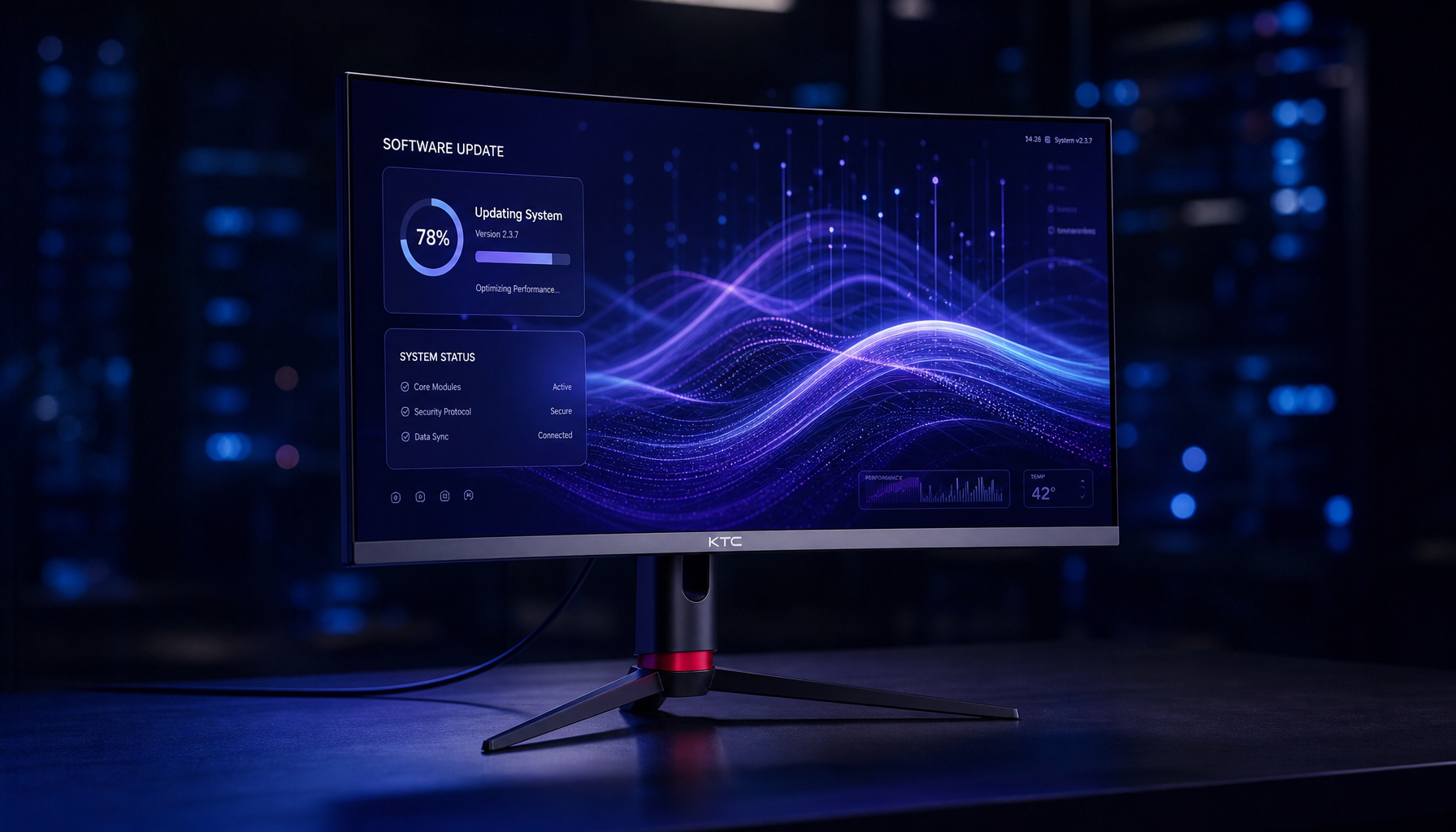
A monitor NPU is a specialized processor inside the display's system-on-chip (SoC) from makers like MediaTek or Realtek. Unlike your computer's GPU, which handles general graphics and AI workloads through software, the NPU performs matrix calculations and inference tasks locally on the display hardware.
This on-device approach offloads text upscaling, contrast tuning, and sharpening from the main system. For laptop users or multi-monitor setups, it reduces overall power draw and heat without compromising performance. As explained in Intel's technical overview of NPU acceleration, offloading these tasks improves efficiency compared to GPU-based solutions.
The practical benefit appears in real-time adjustments that don't require constant driver updates or system resources. However, the quality depends heavily on the implementation—generic SoCs may not deliver the same sub-millisecond responsiveness as dedicated NPU designs.
The Science of Sharpness: How AI-SR and Directional Filters Outperform Traditional Sharpening
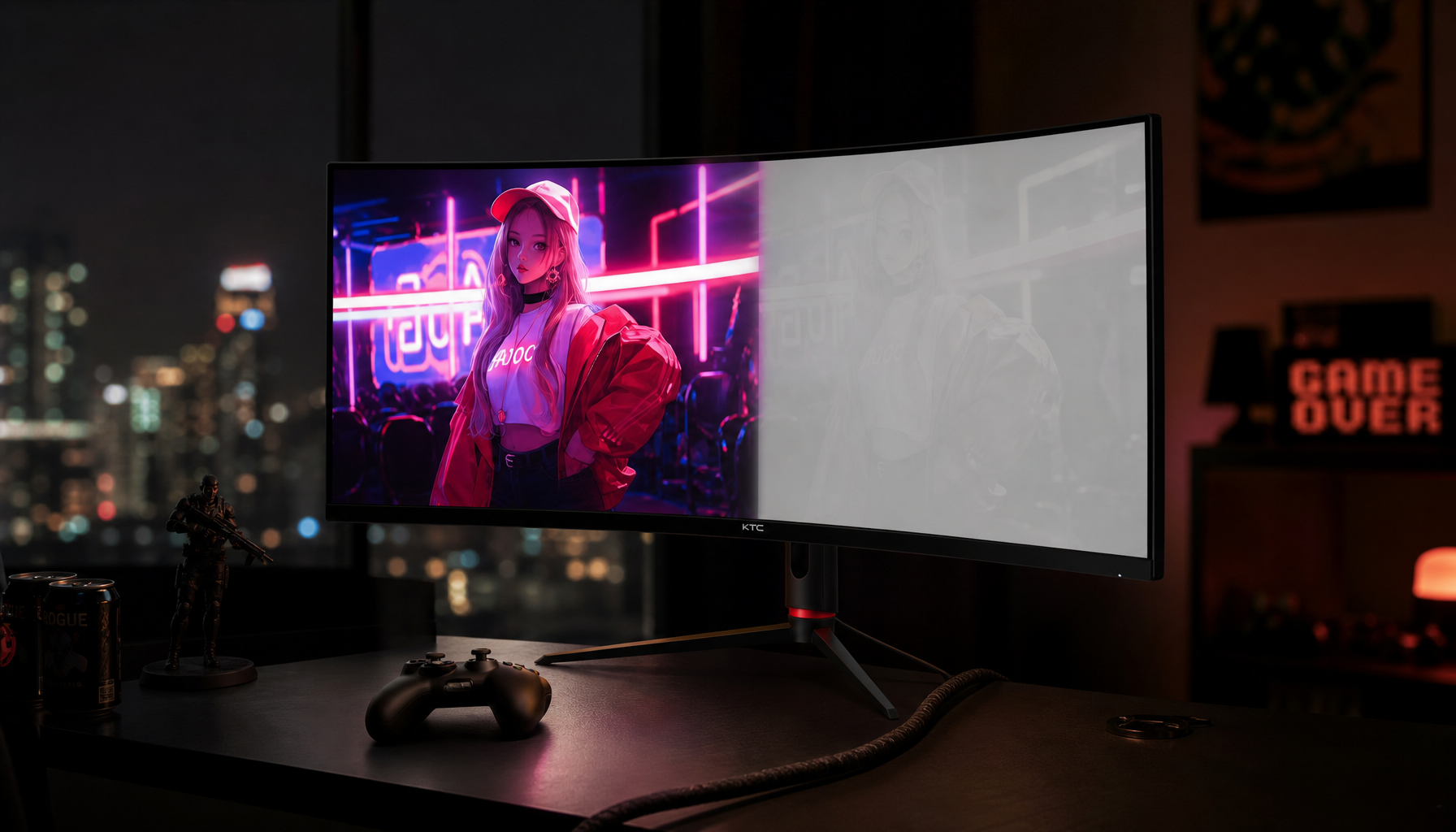
Traditional unsharp masking applies uniform edge enhancement that often creates ringing or halo artifacts around text. AI super-resolution (AI-SR), by contrast, uses glyph recognition to identify letter structures and applies directional filters only along stroke axes. This produces cleaner results with less bleed.
Traditional Sharpening vs AI-SR for Text Clarity
Comparison showing how AI-SR typically offers semantic logic, lower artifact risk, and higher context awareness than traditional methods in productivity scenarios.
View Data Table
| Method | Logic Type | Artifact Risk | Context Awareness |
|---|---|---|---|
| Traditional Sharpening | Dumb edge-based | Higher ringing | Low |
| AI-SR | Semantic glyph recognition | Lower clean output | High |
This visualization clarifies the trade-offs. For most productivity work, AI-SR reduces distracting artifacts while preserving natural letter shapes. However, on very high-PPI 5K displays like the KTC H27P3, native resolution already delivers excellent clarity, making additional sharpening less necessary and sometimes prone to introducing subtle artifacts. VA and OLED panels tend to benefit more, as the NPU can compensate for native black smearing or subpixel fringing.
As MediaTek's MiraVision Pro documentation describes, these AI engines identify high-frequency edges like font glyphs and apply targeted enhancement without the ringing common in older methods.
The Developer’s Edge: AI-Enhanced Syntax Highlighting and Code Readability
For developers spending eight or more hours in IDEs, NPU-driven features like chroma-isolation keep similar syntax colors distinct rather than blending into grey haze. Contrast steering directs backlight or pixel energy specifically to glyph coordinates, helping maintain deep blacks in dark themes while boosting text visibility.
On OLED panels, the AI can also mitigate color shadowing on letter edges. The outcome is reduced refocusing effort by the eyes, which can lower cognitive load during complex debugging or long reading sessions. This aligns with our guide to remedying digital eye strain.
These gains are most noticeable in Mini-LED or OLED setups where blooming around bright syntax elements is otherwise common. Pairing such a monitor with a vertical secondary display for documentation can further streamline workflows, as explored in our dual-monitor productivity setups guide.
Real-world friction remains: if the AI mode requires frequent manual toggling between workloads, the convenience drops. Look for implementations with good automation or bypass options.
Performance without the Penalty: Verifying the Zero-Latency Claim
Many users worry that AI processing will introduce noticeable input lag. Quality NPU implementations use line-buffered processing—handling just a few scan lines at a time—rather than full frame buffering. When the NPU sits in the final scaler stage before the timing controller, added latency typically stays under one millisecond.
This sub-millisecond impact is unlikely to affect desktop productivity or even most gaming scenarios. Competitive players should confirm a dedicated bypass mode exists for maximum responsiveness. Manufacturer claims of "zero latency" generally refer to this pipeline-tail placement rather than literal zero delay, and results vary by SoC quality.
Evaluating AI Features: How to Choose the Right NPU-Enhanced Monitor
When comparing models, first assess your primary panel and resolution. The KTC H27P3 5K monitor relies on native pixel density for exceptional text sharpness in Mac and creator workflows, making it ideal if raw resolution is your top priority. In contrast, the M27P6 Mini-LED model uses AI contrast and sharpening to manage blooming around bright UI elements, suiting hybrid users who also game.
Look for terms like "AI-PQ" or "MiraVision Pro" in specifications to confirm dedicated NPU hardware rather than software-only processing. Check for adjustable AI strength settings and whether the monitor allows easy disabling of features. Our complete monitor buying guide for productivity offers additional criteria focused on ergonomics and eye comfort.
Avoid expecting universal eye-strain elimination—gains depend on your lighting, posture, and personal sensitivity. Test in your actual workspace if possible.
Is an AI-Enhanced Monitor Worth It for Your Workflow?
AI-enhanced monitors deliver the highest value for users on VA or OLED panels, developers needing optimized syntax rendering, or those in variable lighting where adaptive contrast helps. They are less compelling on high-PPI 5K IPS displays where native clarity already excels, or for users highly sensitive to even minor added processing.
If your current setup forces frequent setting changes or leaves you with persistent text fatigue after ruling out ergonomics and lighting, an NPU-equipped model can reduce that friction. For Mac-focused text work, the hardware resolution of a 5K option like the H27P3 often remains preferable. Hybrid users balancing coding with occasional high-refresh gaming may find the AI features in models like the M27P6 a practical bridge.
Ultimately, evaluate your personal "toggle tax" and panel limitations before deciding the premium is justified. Future generations may close more gaps, but current implementations already provide meaningful improvements when matched to the right workflow.
FAQs
Do NPU features in monitors add noticeable input lag for everyday productivity?
In well-implemented designs using line-buffered scaler-stage processing, added latency remains under one millisecond and is generally imperceptible during coding, reading, or office work. Only users measuring competitive gaming response times need to verify a dedicated bypass mode.
How much power does an NPU in a monitor actually save compared to GPU processing?
Offloading text enhancement and contrast tuning to the display NPU typically reduces system-wide power draw more efficiently than running equivalent AI on a discrete GPU, especially beneficial for laptops. Exact savings vary by model and workload, but efficiency gains of 15-25% in display-related tasks are commonly reported by component makers.
Are AI contrast adjustments effective for reducing eye fatigue in dark mode IDEs?
They can help by selectively boosting text luminance while preserving deep blacks, which may lessen strain during long sessions. Results remain subjective and work best alongside proper room lighting and screen distance rather than as a complete solution.
Should I choose a 5K monitor or one with strong NPU features for coding?
For pure text clarity on Mac or high-density workflows, 5K native resolution often outperforms AI sharpening. For Mini-LED or OLED panels where blooming or fringing is an issue, NPU-based glyph recognition and contrast steering provide more noticeable gains.
Will AI monitor features become standard in all productivity displays by 2027?
Adoption is accelerating among mid-to-premium models, but implementation quality will continue to vary. Buyers should still prioritize panel fundamentals and test real-world text rendering rather than assuming every AI label delivers equal benefit.
Can current NPU monitors automatically adapt to different lighting conditions throughout the day?
Many include ambient light sensors paired with AI-PQ engines for automatic tuning, but the sophistication of adaptation differs. Check for user reviews mentioning consistency across mixed lighting rather than relying solely on marketing claims.


%20are%20shifting%20how%20professionals%20achieve%20sharper%20text%20and%20reduced%20eye%20strain%20without%20burdening%20the%20GPU.%20For%20developers%20and%20...
)