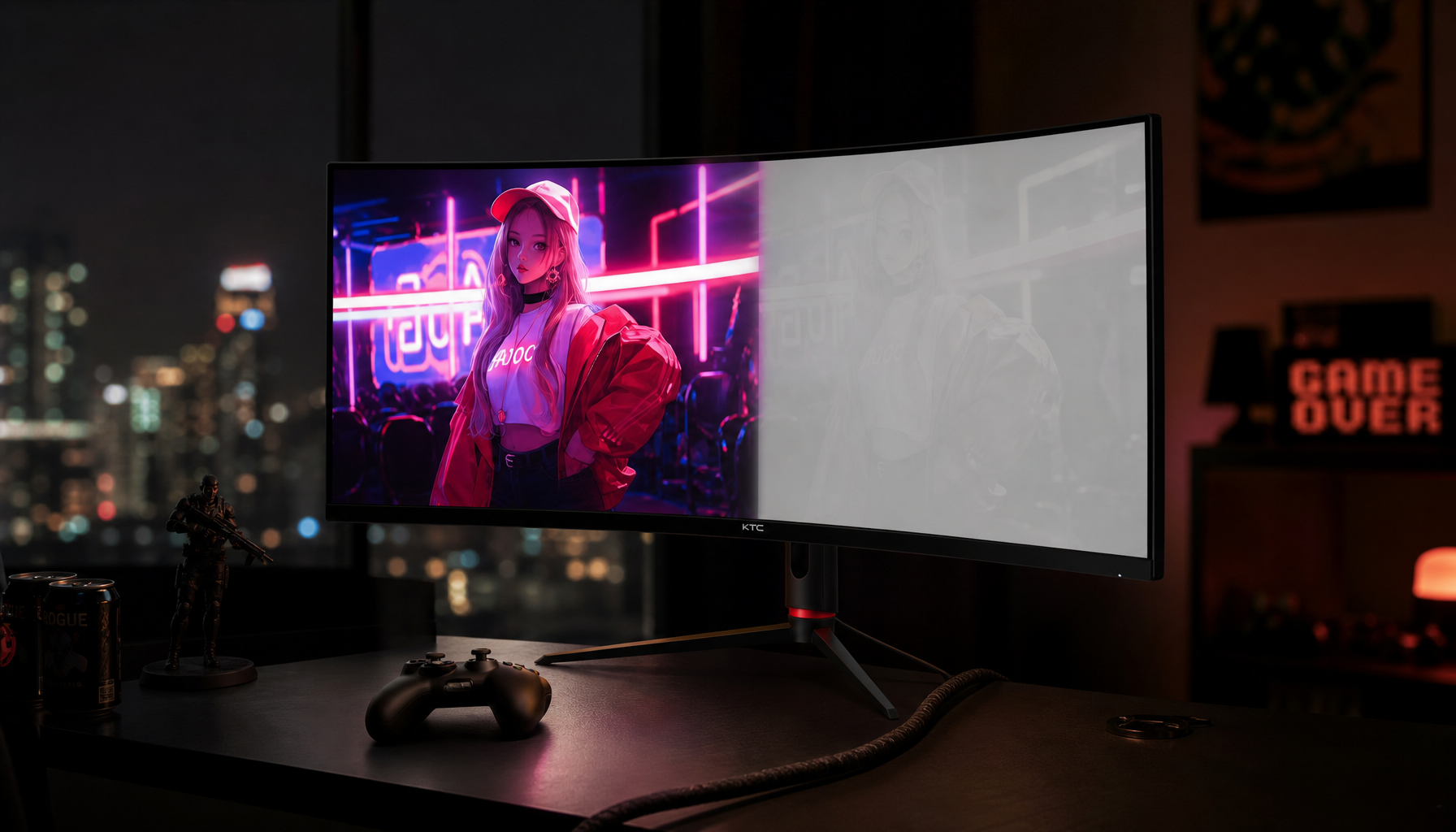
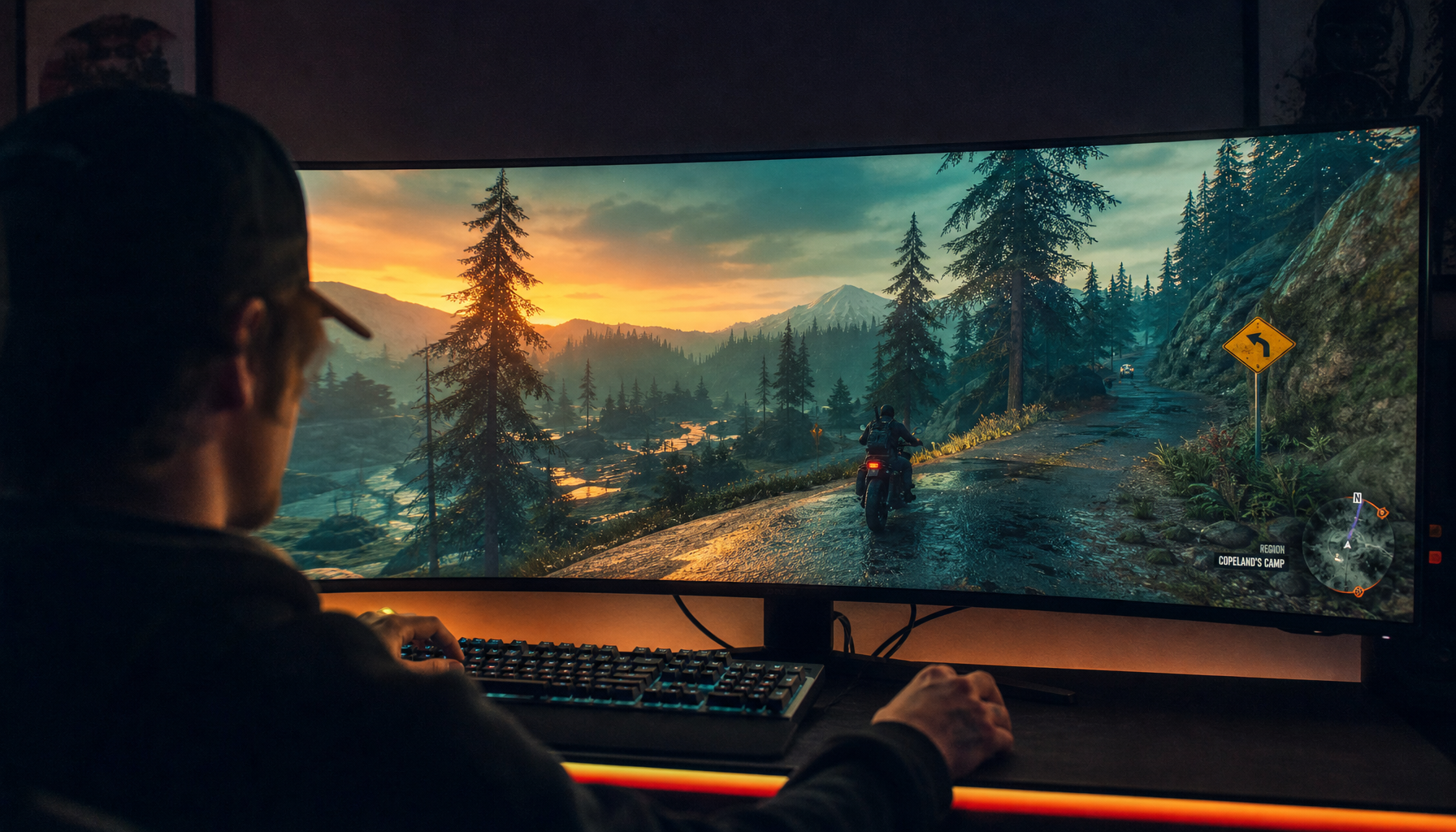
A 1500R curved monitor strikes an effective balance between immersive depth and visual accuracy for many gamers and ultrawide users. The moderate curve aligns better with natural eye movement on 32- to 34-inch screens than shallower or more aggressive options, reducing the need for constant refocusing while avoiding noticeable line warping in most mixed-use scenarios.

What Does 1500R Mean? Decoding Monitor Curvature Specs
The "R" in monitor curvature specifications stands for radius, measured in millimeters. A 1500R curved monitor forms part of a circle with a 1.5-meter radius, creating a deeper arc than an 1800R panel but a gentler one than a 1000R design. Lower R-values produce more pronounced curves because the same screen width is taken from a tighter circle.
This measurement directly affects how the screen wraps around your field of view. For most users sitting at typical desk distances of 60 cm to 1 m, the 1500R radius delivers noticeable peripheral coverage without forcing extreme head movement. As explained in curvature guides, the number tells you both the geometric intensity and the ideal viewing distance for uniform focus.
1500R has become a popular middle-ground choice for mainstream enthusiasts. It offers stronger immersion than 1800R panels while preserving more geometric precision than aggressive 1000R curves. Learn more about curved versus flat monitors to see how curvature impacts overall gaming feel.
The Science of Sight: Why Your Eyes Prefer a Curve
Flat screens force your eyes to constantly adjust focus because the distance from your eyes to the center differs from the distance to the corners. This repeated refocusing, known as accommodation stress, contributes to visual fatigue during long sessions. Curved monitors reduce this effect by keeping more of the screen at a relatively consistent distance from your eyes.

The human visual system follows a natural arc called the horopter. When a monitor curve approximates this arc, your eyes experience less strain when scanning across the display. A PubMed study on curved versus flat monitors found that appropriately curved displays can lower visual fatigue and improve performance on visual search tasks compared to flat equivalents.
This benefit becomes particularly relevant for users sensitive to eye fatigue. The curve does not eliminate strain entirely, but it can meaningfully reduce the workload on your eye muscles during extended gaming or productivity work. For practical tips on managing digital eye strain, see our guide on remedying digital eye strain.
The flat screen distortion paradox further illustrates this point. Flat ultrawide panels create a keystone or trapezoidal effect where corners appear farther away, requiring constant refocusing. A moderate 1500R curve brings those edges into better alignment with your natural focal plane, acting as a corrective arc rather than an added gimmick.
1500R vs. 1800R: Which Curvature is Best for Gaming?
For gaming, the choice between 1500R and 1800R often depends on screen size and your tolerance for curve intensity. An 1800R curve feels subtle and works well for users wary of strong curvature or those running multi-monitor setups. It provides mild immersion with minimal impact on straight-line tasks.
A 1500R curve delivers noticeably stronger peripheral coverage on 32-inch and larger screens. This deeper arc fills more of your field of view during fast-paced games, enhancing depth perception and presence without the extreme wrap of tighter curves. For ultrawide gaming, many players find 1500R strikes a better balance than the shallower 1800R option.
More aggressive 1000R curves maximize immersion for simulation or racing titles but can introduce visible warping in productivity windows or when viewing straight UI elements. Consider your primary workload before choosing. Our ultrawide gaming monitor guide explores how screen format and curvature interact for different play styles.
Monitor Curvature Fit by Screen Size and Primary Task
Goldilocks zone view for 32-34-inch panels: use the tiers to compare which curvature is the safer fit for immersion, accuracy, and eye comfort.
View chart data
| Category | 1500R | 1800R | 1000R |
|---|---|---|---|
| 27" | 2.0 | 4.0 | 3.0 |
| 32" | 4.0 | 5.0 | 3.0 |
| 34" | 4.0 | 4.0 | 2.0 |
This chart illustrates relative suitability patterns based on typical setups. Scores reflect a combined assessment of immersion, visual accuracy, and eye comfort rather than laboratory measurements.
Does a 1500R Curve Cause Image Distortion? Truth vs. Perception
Many users worry that curved monitors will bend straight lines in applications like spreadsheets, web browsing, or CAD software. In practice, perceived distortion on a 1500R panel is often mild and diminishes after an adaptation period of a few days. Your brain adjusts to the new geometry, and what initially looks bowed may soon appear normal.
Flat ultrawide monitors actually introduce their own form of distortion. The corners sit farther from your eyes than the center, creating a trapezoidal or bow-tie effect that forces constant refocusing. As detailed in monitor testing resources, a moderate curve like 1500R can counteract this by bringing edge pixels into a more uniform focal plane.
For precision work requiring perfect geometric accuracy, such as architectural drafting, a flat panel or carefully calibrated 1800R curve may still be preferable. However, for most gaming and general productivity on 32- to 34-inch screens, 1500R rarely causes meaningful issues. The RTINGS curved vs flat monitor analysis explains how curvature can reduce certain edge-related viewing problems on larger panels.
Ideal Use Cases: When to Choose a 1500R Monitor
A 1500R curve shines on 34-inch ultrawide monitors, where it effectively mitigates corner color shift and the bow-tie effect common in flat panels. At typical desk distances, the curve provides immersive gaming without overwhelming mixed-use tasks. Our 34-inch 2K 180Hz 1500R curved gaming monitor is designed specifically for this size and curvature combination.
On 32-inch screens, 1500R adds noticeable depth and improves edge visibility while remaining comfortable for extended sessions. The 32-inch 2K 180Hz 1500R curved gaming monitor demonstrates how this radius works well for both competitive gaming and everyday productivity.
Even on 27-inch panels, 1500R can offer a subtle ergonomic advantage for users sitting relatively close. The curve reduces slight viewing-angle stress at the edges, though the effect is less dramatic than on larger displays. Explore the full range in our curved monitors collection.
VA panels particularly benefit from 1500R curvature because the curve helps compensate for their inherent viewing-angle limitations, delivering more consistent contrast across the screen.
How to Choose Your Perfect Curve: A Final Decision Guide
Before purchasing a 1500R monitor, measure your typical viewing distance. The geometric ideal sits near 1.5 meters, but most users experience strong benefits at standard desk distances of 60 cm to 1 m. Sit too close and the curve may feel exaggerated; sit too far and the immersion benefit decreases.
Assess your primary workload. Mixed gaming and office use represents the strongest use case for 1500R. Pure competitive esports or professional design work may favor different curvatures or flat panels depending on your sensitivity to geometric changes.
Consider panel type as well. VA panels gain more from curvature due to their contrast characteristics, while IPS panels already offer wider viewing angles that pair comfortably with moderate curves. Check your desk depth and whether you use multiple monitors, as tighter curves can complicate alignment.
The key is matching the curve to both your screen size and personal tolerance. 1500R serves as a safe default for most 32- to 34-inch ultrawide buyers seeking better immersion without sacrificing everyday usability. Test in person when possible, as individual perception of curvature varies.
FAQs
Does 1500R curvature affect VA panel backlight uniformity? The curve itself does not change backlight behavior, but by aligning the screen better with your viewing position it can reduce the perception of glow or bleed at the edges compared to a flat VA panel viewed off-center.
Is 1500R suitable for multi-monitor setups? It can be more challenging than 1800R because the deeper curve makes edge-to-edge alignment with adjacent flat or differently curved monitors less seamless. Many users still prefer it for the single-monitor experience.
How long does it take to adapt to a 1500R curved monitor? Most users report that any initial sense of distortion fades within three to seven days of regular use as the visual system recalibrates.
Can 1500R improve competitive gaming performance? It may enhance situational awareness through better peripheral coverage, but response time, refresh rate, and input lag remain more critical factors for pure competitive play.
What screen size makes 1500R curvature most noticeable? The benefits become increasingly apparent above 32 inches, with 34-inch ultrawides showing the clearest improvement in edge consistency and immersion compared to flat alternatives.