Yes. A monitor that sits too close can increase convergence and focusing demand, which may lead to temporary eye muscle fatigue, headaches, blurred vision, and the urge to lean back or rub your eyes.
Do your eyes feel locked in after a ranked match, a spreadsheet sprint, or a long editing session where the display seems to pull you forward? Moving the screen back, enlarging text, and lowering the gaze angle can give you a practical comfort win you can test in one workday. Here is how to set distance, size, height, and breaks so the screen feels immersive without making your eyes do unnecessary work.
Why Close Monitor Placement Strains the Eyes
When you look at a near object, your eyes perform two linked jobs: they focus the lens for clarity and turn inward so both eyes aim at the same point. A recent real-workplace study found that shorter digital viewing distances were associated with more asthenopic symptoms, including eye fatigue, pain, and headache.
Convergence strain is the fatigue that can build when your eyes sustain that inward turn for too long. Accommodation strain is the focusing fatigue that happens when the eyes keep holding a near target sharp. On a monitor, these usually arrive together: tiny UI text, limited desk depth, and a competitive posture can pull you closer until your eye muscles are working harder than the display experience requires.

This does not mean the monitor is damaging your eyes. The American Academy of Ophthalmology notes that long screen use can cause uncomfortable digital eye strain, but it does not permanently damage the eyes. The real issue is performance comfort: fewer headaches, steadier focus, less squinting, and better posture over long sessions.
How Close Is Too Close?
For most desktop monitors, the practical baseline is about arm’s length. OSHA’s workstation guidance places common monitor distance in the broad 20 to 40 inches range, while Harvard Health and the American Academy of Ophthalmology commonly frame computer screens around 20 to 26 inches from the face.
The best distance also depends on size and resolution. A 24-inch 1080p monitor may feel readable around 20 to 30 inches, while a 32-inch 4K display often works better farther back because the screen fills more of your field of view. Larger displays often need more room to avoid excessive eye or neck movement.

Display Type |
Practical Starting Distance |
Why It Works |
22- to 25-inch esports monitor |
20 to 30 inches |
Keeps targets large without overwhelming peripheral vision |
27-inch productivity or gaming monitor |
24 to 36 inches |
Balances readable text, detail, and posture |
32-inch 4K monitor |
26 to 38 inches |
Preserves 4K detail while reducing head and eye sweep |
34- to 49-inch ultrawide |
28 to 50 inches |
Reduces edge scanning and neck rotation |
13- to 16-inch portable monitor |
About 20 inches or more |
Prevents laptop-like hunching and close-focus fatigue |
A simple field test works well: sit in your normal posture, extend one arm, and check whether your fingertips just reach the screen. If you need to bend your elbow sharply to touch it, you are likely too close. If you must lean forward to read body text, the better fix is usually scaling or font size, not dragging the monitor toward your nose.
The 32-Inch 4K Example: Immersion Without Overload
A 32-inch 4K monitor is sharp enough to reward close viewing, but that does not mean closer is always better. KTC’s 32-inch 4K distance guidance describes a useful comfort zone around 26 to 32 inches, with closer placement better suited to detail-heavy creative work and farther placement better for relaxed gaming or media.

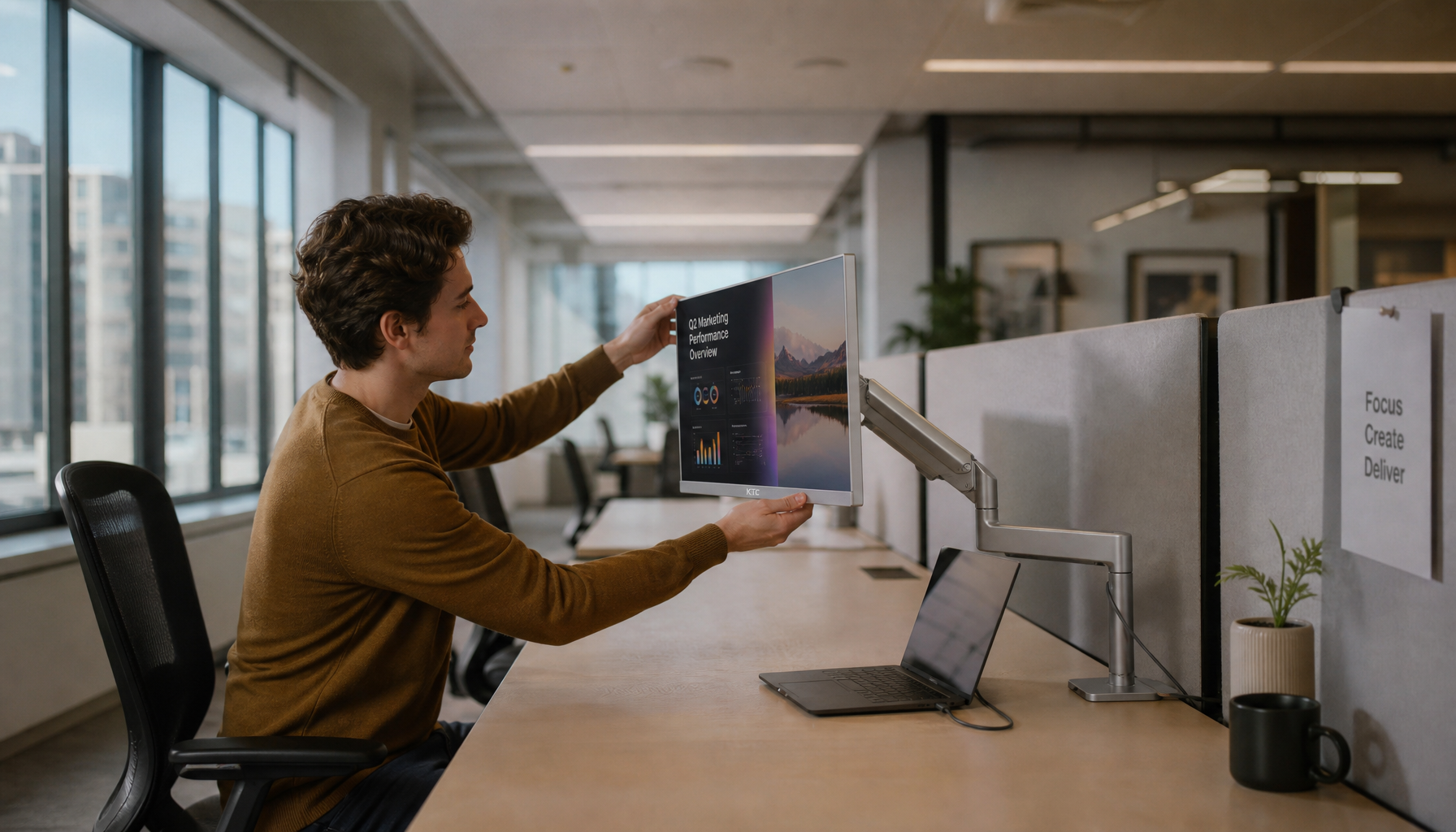
Here is the practical calculation: if your desk is only 24 inches deep and the monitor stand pushes the panel forward by several inches, your eyes may sit closer than 24 inches before you notice it. A monitor arm can reclaim several inches by moving the panel toward the rear of the desk. That often feels like a display upgrade because your eyes stop fighting the setup.
For users on a 32-inch 4K screen, raising scaling can protect comfort. If text looks too small at 100%, do not solve that by moving closer. Increase scaling first, then place the display where the whole screen is visible without head bobbing.
Symptoms That Point to Convergence or Eye Muscle Fatigue
Close-distance strain often feels different from simple brightness discomfort. UCLA’s ergonomics guidance describes computer vision syndrome as a cluster that may include eyestrain, headaches, blurred vision, dry or burning eyes, double vision, light sensitivity, and eye fatigue.

Convergence-related fatigue often shows up as pressure around the eyes, difficulty keeping text single, a headache after near work, or a feeling that your eyes need to reset when you look across the room. You may also notice that symptoms appear faster on a phone or portable display than on a well-positioned desktop monitor because smaller screens tempt closer viewing.
Brightness and glare can mimic the same discomfort, so diagnose the setup in layers. If symptoms improve when you move the monitor back but keep brightness the same, distance was likely a major factor. If symptoms improve only after dimming the panel, blocking reflections, or adding bias lighting, the main trigger was probably visual environment rather than convergence demand.
Height, Tilt, and Gaze Angle Matter Too
Distance alone will not save a monitor that sits too high. Harvard Health recommends placing screens 20 to 26 inches from the face with the center slightly below eye level, which supports a natural downward gaze and reduces the temptation to crane the neck.
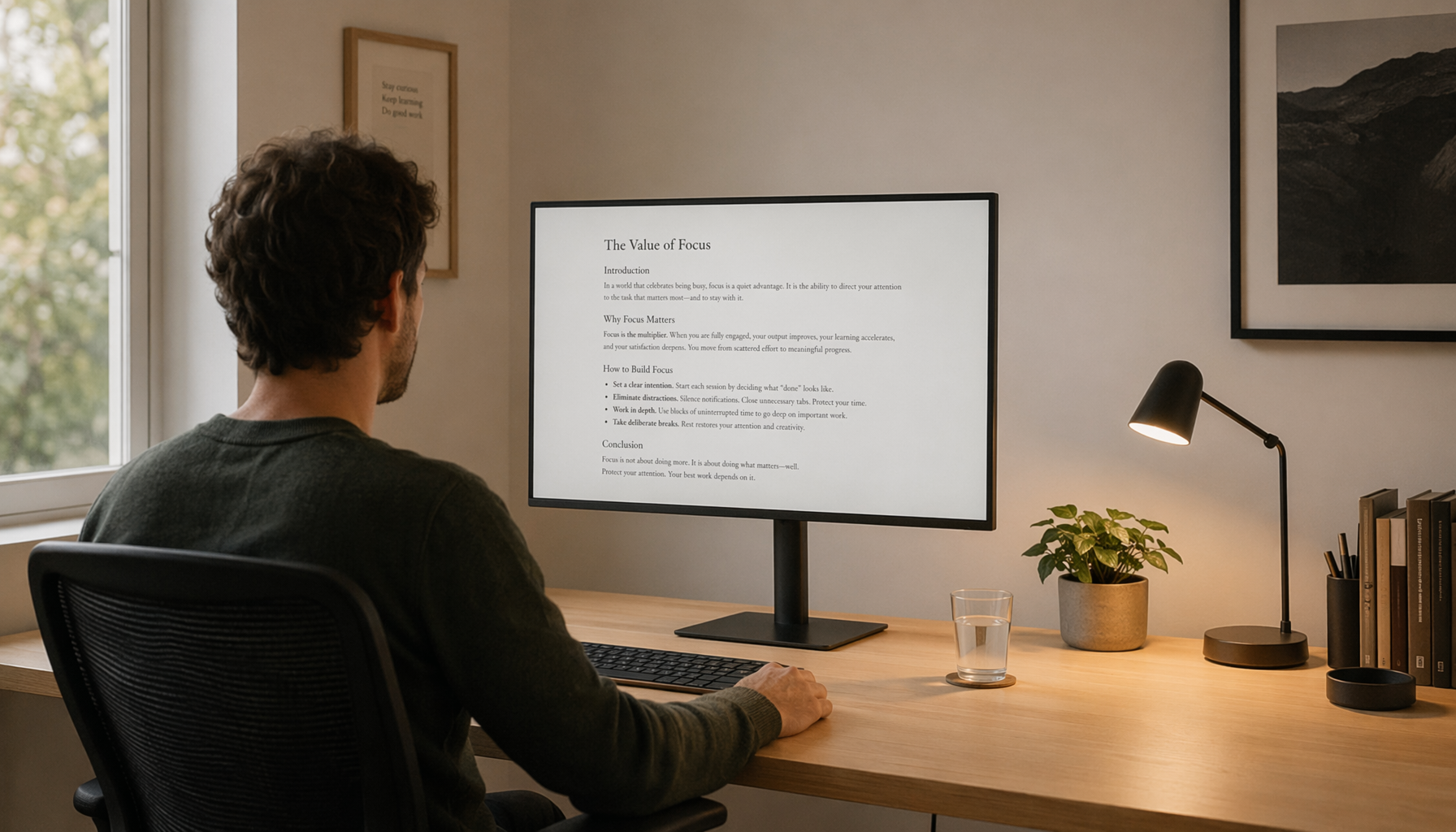
For a performance setup, keep the top edge of a standard monitor at or slightly below eye level. On a larger display, use the top third as the reference point instead of the very top bezel. Tilt the screen slightly upward only enough to face your line of sight and cut reflections.
A real-world check is easy: open a document or browser tab, relax your shoulders, and close your eyes for a moment. When you open them, your gaze should land near the upper-middle content area, not at the taskbar and not above the screen. If you are lifting your chin, lower the display. If you are folding forward, raise the display or improve text size.
Portable Smart Screens Need Extra Discipline
Portable monitors are useful for travel work, hybrid desks, and console-style setups, but they often sit too low and too close by default. Portable monitor comfort depends on resolution, size, and pixel density, while many compact screens still work best at roughly 20 inches for comfort.
The trap is treating a 15.6-inch portable screen like a phone. If you place it beside a laptop at 14 inches from your face, convergence demand rises and your neck often drops with it. Put the portable screen on a stand, match its height to your main screen, and use a separate keyboard and mouse when working longer than a short session.
For gaming, a portable high-refresh screen can feel intensely immersive at close range. Keep that immersion controlled: sit back, scale UI where possible, and make sure the full HUD is visible without scanning from edge to edge.
Pros and Cons of Sitting Closer
Sitting closer is not automatically wrong. It can make small targets easier to see, reveal more fine detail from high-resolution panels, and increase immersion in racing, flight, RPG, or controller-based gaming. For design review, photo editing, and timeline work, a temporary closer posture may help you inspect detail.
The tradeoff is that close viewing increases focusing and convergence demand. It can also enlarge the screen’s apparent field of view so much that your eyes and neck sweep more often. That is why a setup can feel impressive for 10 minutes and punishing after two hours.
The value-oriented move is to separate detail from distance. Use resolution, scaling, sharp text rendering, and panel quality to make content readable. Use distance to keep the eyes relaxed and the whole display comfortably within view.
The Fast Comfort Reset
Mayo Clinic’s eyestrain guidance focuses treatment on habit and environment changes, including blinking, reducing glare, adjusting monitor position, and setting brightness, contrast, and text size for comfort.
Start by moving the monitor to arm’s length, then increase text or UI scaling until you can read without leaning. Lower the screen so your gaze is slightly downward. Match brightness to the room instead of running the panel at showroom intensity. Remove reflections from windows, lamps, glossy desks, and bright wall surfaces. If you use a large ultrawide, center your main window with your body rather than centering the entire physical panel.
Breaks are not a productivity tax; they are a focus maintenance tool. The 20-20-20 rule works because it gives the focusing system a distant target: every 20 minutes, look at something 20 feet away for 20 seconds. Add deliberate blinking, especially during aim-heavy games or deadline work, because screen users blink less often and dry eyes can make fatigue feel worse.

When to Get an Eye Exam
If moving the monitor back, improving lighting, and taking breaks do not improve symptoms, treat that as useful information. Persistent headaches, double vision, blurry vision, dry eye, or focusing trouble deserve an eye exam, because prescription issues, dry eye, binocular vision problems, or contact lens dryness can all amplify screen strain.
Computer glasses may help some heavy screen users because they are prescribed for intermediate viewing distances, not because they are magic gaming accessories. Blue-light filters may improve evening comfort for some people, but they do not fix a monitor sitting too close, tiny text, glare, or poor posture.
FAQ
Can a close monitor permanently damage my eyesight?
No strong evidence says normal computer use permanently damages vision, but it can cause temporary discomfort and reduced performance. The practical goal is not fear; it is a setup that lets your eyes hold focus comfortably.
Is a curved monitor better for convergence strain?
A curved monitor can make large screens feel more natural at the edges, especially ultrawides, but it still needs proper distance, height, tilt, and scaling. Curvature is a refinement, not a cure.
Should I lower brightness or move the monitor back first?
Move the monitor back and enlarge text first if you are leaning in or getting near-focus headaches. Adjust brightness and glare next if your eyes feel dry, dazzled, or irritated by reflections.
A monitor should pull you into the work or the game, not pull your face toward the panel. Set distance first, scale for readability, tune lighting, and let the display deliver immersion without making your eye muscles pay for it.