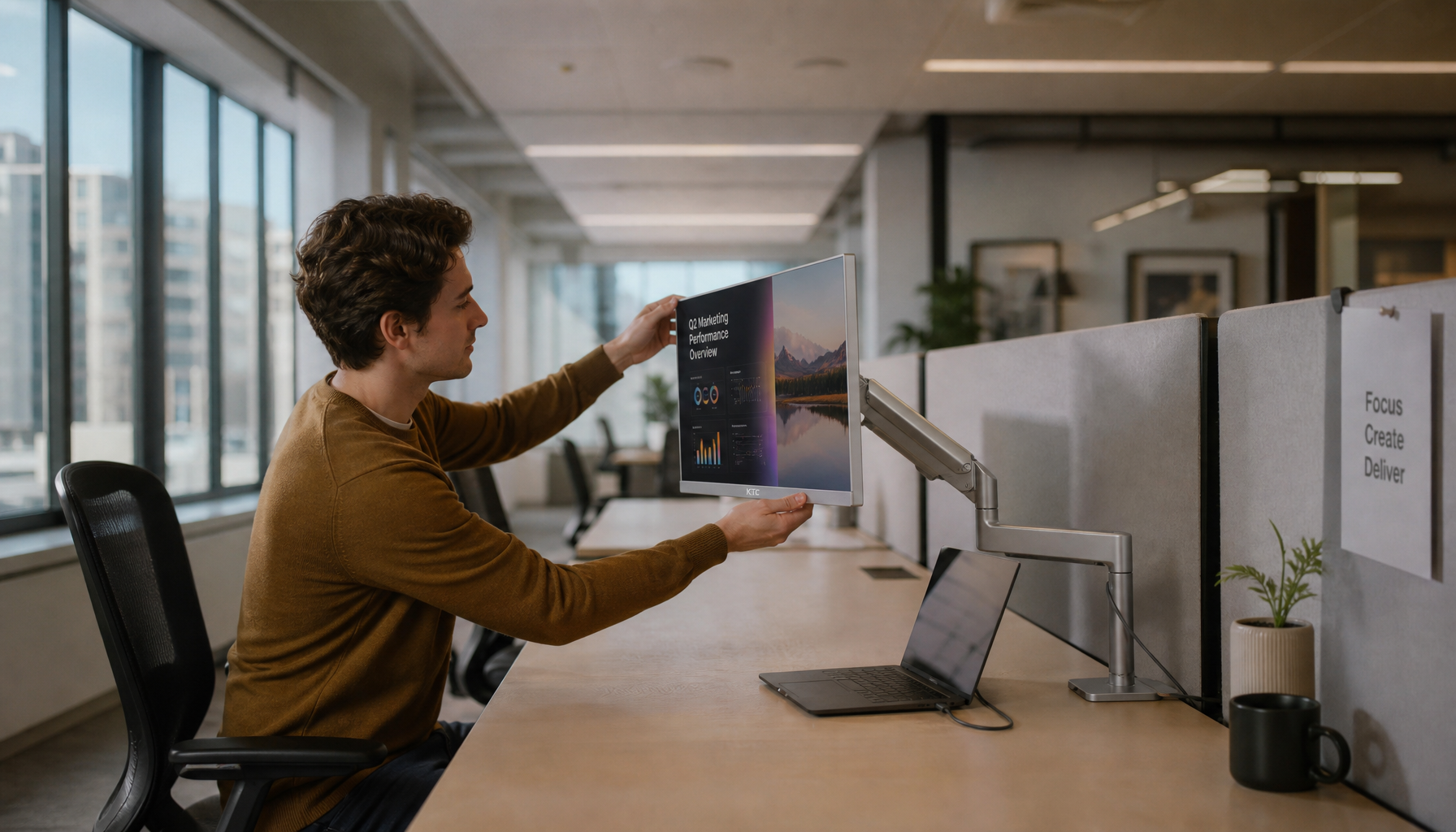
Lower the monitor below a typical eye-level setup, tilt it slightly upward, and keep it far enough away that you can read without lifting your chin or leaning forward.
Do you find yourself raising your chin to read the top of the screen, then dipping your head to check the bottom toolbar? A small height-and-tilt reset can give you a clear top-to-bottom view while reducing the neck extension that progressive lens wearers often fight all day. Here’s how to set your monitor for sharper work, cleaner posture, and less visual compromise.
Why Progressive Lenses Change Monitor Positioning

Progressive lenses are built with different viewing zones for distance, intermediate, and near vision. That is powerful for daily life, but a desktop monitor often sits in the awkward middle: too close for the distance zone, too high for the near or intermediate zone, and too large to read comfortably through one fixed part of the lens.
The ergonomic problem is not the lens itself. It is the mismatch between a standard monitor rule and your actual line of sight. Traditional advice often says the top of the screen should be near eye level, but posture guidance notes that progressive lens users may need a lower monitor position with a slight backward tilt to avoid neck craning.
The performance cost is easy to feel. When the display is too high, you lift your chin to look through the lower portion of the lens. That opens the neck angle, loads the upper shoulders, and turns every spreadsheet, code window, editing timeline, or game HUD into a posture battle.
The Best Starting Position
For most progressive lens users, the best starting point is a monitor placed lower than standard ergonomic advice, with the most-used screen area sitting comfortably inside your clearest intermediate viewing zone. In practical terms, the top edge often lands slightly below eye level, and sometimes several inches below it depending on lens design, monitor size, and desk depth.
A strong rule of thumb is to sit fully back, relax your shoulders, look forward naturally, and lower the monitor until the center-to-upper-middle of your main content looks clear without any chin lift. The screen should meet your eyes; your neck should not hunt for the lens zone.
The core issue is straightforward: bifocal and progressive lens wearers can be forced into neck extension when the monitor is positioned like a standard workstation. A lower monitor position with an upward tilt helps the user keep a more neutral neck.
Height, Tilt, and Distance: The Three Controls That Matter
Monitor Height

Height is the first control to adjust because it determines whether your head stays neutral. Start with your chair, desk, and posture already set: feet supported, back against the chair, shoulders relaxed, and elbows near a comfortable working angle. Then lower the monitor until you can read the top menu, main content area, and lower interface elements without tipping your head back.
For many people, this means lowering the screen by about 2 to 4 inches compared with a standard setup. Similar progressive-lens adjustment range recommendations suggest that bifocal or progressive users may need the monitor lowered and tilted upward to avoid head tipping.
The tradeoff is that a very low screen can tempt you to round your upper back. That is why tilt and distance must be adjusted with height, not treated as afterthoughts.
Upward Tilt
Once the monitor is lower, tilt the screen upward toward your face. A mild upward tilt can make the full display easier to scan through the correct lens zone, especially the upper browser bar, menu ribbon, gaming HUD, or top rows of a spreadsheet.
The useful range is not one fixed number. Standard monitor setups often use a modest upward tilt, while progressive-lens setups may need more. The right angle is the one that lets you read the top and bottom clearly while keeping your chin level and avoiding glare.
If the screen reflects a window, lamp, or bright wall after tilting, adjust lighting before undoing the ergonomic gain. Poor glare control makes people squint, lean, and rotate their necks even when the monitor height is technically correct.
Viewing Distance

Distance decides whether you lean forward or overwork your eyes. A common office starting point is about an arm’s length, often around 20 to 30 inches for typical monitors. Similar arm’s-length positioning advice notes that larger monitors may need more distance.
For a 24-inch or 27-inch productivity display, try 24 to 30 inches first. For a 32-inch 4K monitor, 28 to 36 inches often feels more natural because the screen fills more of your field of view. If the text becomes small, increase scaling or font size instead of pulling the monitor closer. That preserves posture while improving readability.
Monitor Type |
Practical Starting Distance |
Progressive Lens Adjustment |
24-inch office monitor |
22 to 28 inches |
Lower slightly, tilt upward |
27-inch QHD or 4K monitor |
24 to 32 inches |
Lower 2 to 4 inches from standard |
32-inch 4K monitor |
28 to 36 inches |
Use scaling before moving closer |
Ultrawide display |
30 inches or more |
Center the active work area, not the full panel |
How to Tune the Setup in Five Minutes
Sit in your normal working posture and open the task you actually use most, not a blank desktop. A document editor, email inbox, trading dashboard, design canvas, or game settings screen will expose the real problem faster than a generic test screen.
Look at the top toolbar, then the center content, then the lower status bar. If your chin rises for the top, lower the monitor or increase upward tilt. If you lean forward for the bottom text, increase font size or move the monitor slightly closer, but only after confirming you are still sitting back. If your eyes feel as though they are searching left and right for clarity, your lens corridor, screen distance, or prescription may need professional adjustment.
Workplace research found that progressive lens users showed neck extension beyond recommended ergonomic limits when working at a standardized computer setup. That supports a key practical conclusion: do not force your body to fit a generic display height. Build the setup around your clear viewing zone.
Single Monitor, Dual Monitor, and Ultrawide Setups

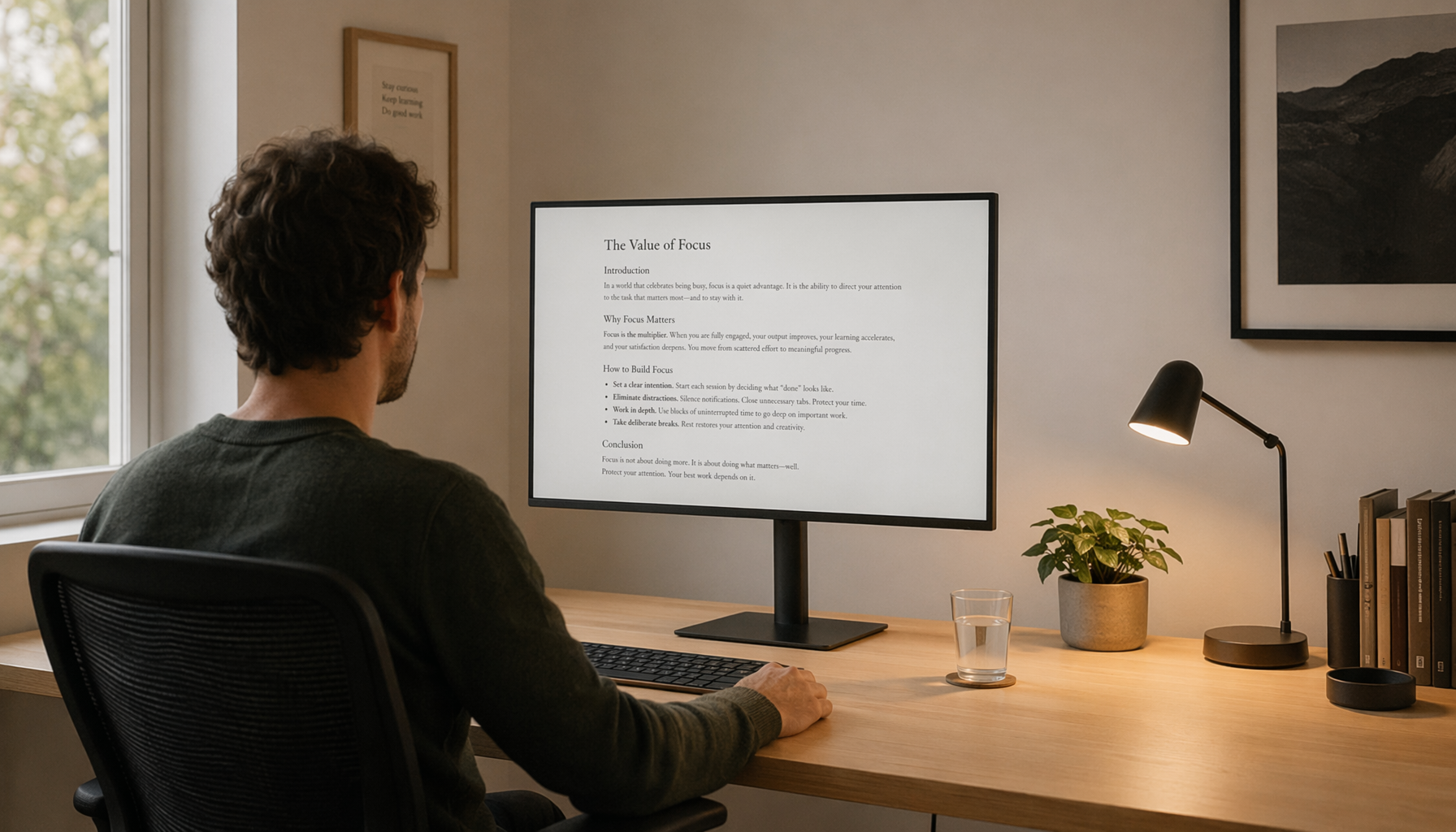
A single monitor is easiest to optimize. Put it directly in front of your nose, lower it until the clearest part of the screen is in your natural gaze path, then tilt it upward. Keep the keyboard and mouse close enough that your shoulders stay down.
Dual monitors require stricter priorities. If one screen is primary, place that display directly in front and tune it carefully for your lenses. Angle the secondary monitor inward and use it for lower-frequency content such as chat, reference windows, preview panels, or monitoring tools. If you use both equally, center yourself between them and keep both at matching height and distance, but accept that very wide dual setups can increase head turning.
Ultrawide monitors are excellent for immersion and productivity, but progressive lenses make center discipline more important. Treat the central active band as your true monitor. Put your main timeline, document, reticle, or spreadsheet columns in the middle, and keep peripheral panels for secondary information. This reduces both neck rotation and lens-corridor searching.
Screen Settings That Help Progressive Lens Wearers
Better positioning solves the posture problem, but screen settings solve the readability problem. Increase operating system scaling until you can read normal interface text from your chosen distance. On a 27-inch or 32-inch high-resolution display, this is usually more effective than sitting closer.
Brightness should match the room, not overpower it. If the monitor is much brighter than the wall behind it, your eyes work harder during long sessions. If the room is dim and the screen is bright, fatigue can show up fast. Balanced lighting, task lighting, and glare control can reduce fatigue and support focus.
For office work, prioritize crisp text, moderate brightness, and high contrast. For gaming, keep HUD elements large enough to read without chin movement. For creative work, avoid pushing the display too close just to inspect detail; use zoom controls and a calibrated viewing distance instead.
When Computer Glasses Are the Better Upgrade
If you spend most of your day at a screen, standard progressives may never feel perfect. They are built for general life, not eight-hour monitor use. Occupational or computer progressive lenses can provide a wider intermediate zone, which may reduce head movement and make the full screen easier to scan.
The downside is specialization. Computer glasses are not ideal for driving or broad distance viewing, so they work best as a dedicated desk tool. If your current setup still causes headaches, blurred vision, dry eyes, neck tightness, or shoulder discomfort after careful adjustment, bring your actual monitor distance and screen height to your eye care professional. Real measurements lead to better lens recommendations.
Common Mistakes to Avoid
The biggest mistake is keeping the monitor high because “eye level” sounds correct. For progressive lenses, that can be exactly what creates chin lift. Another mistake is moving the monitor closer whenever text feels unclear. That often causes leaning, reduces blink comfort, and makes large screens harder to scan.
Laptop-only setups are also a common weak point. A laptop screen and keyboard cannot both be in the ideal place at the same time for long sessions. Use a stand, external keyboard, and mouse so the screen can sit where your lenses need it while your arms stay relaxed.
Finally, do not ignore breaks. The 20-20-20 recommendation is simple and useful: every 20 minutes, look about 20 feet away for 20 seconds. For progressive lens wearers, that reset helps both the eyes and the posture system recover from fixed near-screen work.
Final Setup Check
Your monitor is in the right position when you can read the top menu, main content, and lower controls without lifting your chin, leaning forward, or dropping your shoulders into tension. Lower the screen, tilt it upward, set the distance for posture first, then use scaling for clarity.
A high-performance display should make your work sharper and your play more immersive, not force your neck to negotiate every pixel. The winning setup is the one where the screen, lenses, and body all line up without effort.