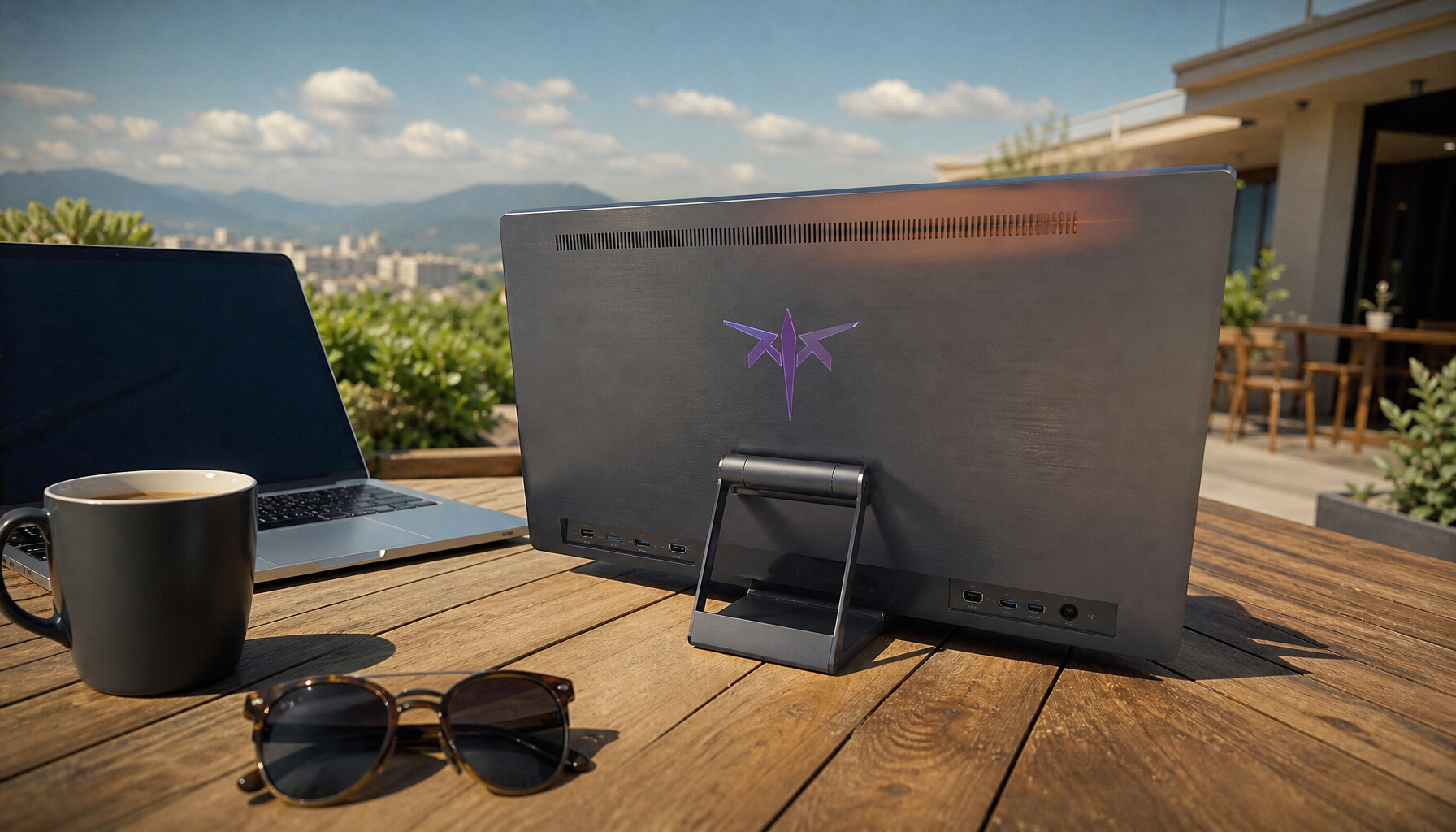
The cleanest setup sends HDMI video to the monitor while splitting audio before, at, or after the display through a compatible USB audio path, HDMI audio extractor, monitor line-out, TV ARC path, soundbar, receiver, or controller jack.
Is your console picture sharp on a gaming monitor, but the sound is trapped in tiny built-in speakers, a weak headphone jack, or no output at all? With the right routing choice, you can keep low-lag video on the monitor and send cleaner, louder audio to desktop speakers, a DAC, a soundbar, or a receiver. This article explains the practical paths that work, where each one compromises, and how to avoid buying the wrong adapter.
Understand the Signal Path Before Buying Anything

Console audio routing is the path your sound takes from the console to the speakers. In professional AV terms, audio routing means directing each audio input to the correct output through a defined signal path. For a console desk setup, that path usually looks like console, HDMI cable, monitor or extractor, audio output, then speakers.
The key is not whether your monitor “has audio.” The key is whether it can receive, decode, convert, and output the audio format you need. Many gaming monitors can accept audio over HDMI or DisplayPort, but their 3.5 mm output is usually stereo analog, not a real surround-sound hub. For competitive or cinematic gaming, that difference matters because a monitor can show 4K at 120 Hz beautifully while still giving you a basic stereo audio path.
A practical example: if your console is connected directly to a 27-inch gaming monitor by HDMI and the monitor has a headphone jack, you can run a 3.5 mm cable from that jack to powered speakers. It is simple and cheap, but the monitor becomes the digital-to-analog converter. If that jack is noisy, quiet, or stereo-only, the monitor is the bottleneck.
The Best Routing Methods for Console-to-Monitor Setups
Use the Monitor’s 3.5 mm Output When Simplicity Matters

The easiest path is console to monitor over HDMI, then monitor headphone-out or line-out to powered speakers. This works best for small desktop speakers, compact soundbars with aux input, or a simple 2.0 or 2.1 setup beside your monitor.
The upside is cost and speed. You probably need only a short 3.5 mm cable, and volume control may be handled through the monitor’s on-screen menu or the speakers. The downside is quality control. Monitor audio outputs are often convenience ports, and some introduce hiss, hum, low volume, or delayed audio. They also usually output stereo only, so they are not the right foundation for object-based surround formats or a full receiver setup.
This method is worth trying first if your speakers are within 3 ft of the monitor and your goal is better sound than built-in speakers. If you hear buzzing when the console or PC is under load, move to a digital route instead of chasing volume settings.
Use an HDMI Audio Extractor for the Most Flexible Monitor Setup

An HDMI audio extractor sits between the console and the monitor. The console sends HDMI into the extractor, the extractor passes video to the monitor, and it sends audio separately to optical, RCA, 3.5 mm, coaxial, or another HDMI output depending on the model. The reason this works so well is that HDMI carries both audio and video, so the extractor can separate them before the monitor limits your options.
For consoles without native optical, USB speaker audio, or Bluetooth speaker output for direct speaker connection, this is often the most practical speaker route. An inline HDMI audio extractor can split the HDMI signal into outputs such as optical or RCA.
The big buying warning is video bandwidth. If your monitor setup depends on 4K at 120 Hz, HDR, VRR, or low input lag, the extractor must explicitly support those features. An older 4K 60 Hz extractor may make your speakers work while quietly downgrading the monitor experience you paid for. In performance-first setups, the extractor should preserve the video mode before you judge its audio features.
Use USB Audio When Your Console and DAC Support It
Some consoles can output audio over USB to compatible devices. That makes direct console-to-DAC or console-to-speaker routing clean because video can stay on HDMI while audio leaves through USB. The catch is compatibility. Some consoles support only specific USB audio classes, so not every modern USB DAC will behave like a plug-and-play console audio device.
A real-world setup might be HDMI from the console to a 144 Hz monitor, plus USB from the console to a compatible desktop DAC, then RCA or 3.5 mm from the DAC to powered speakers. That can sound cleaner than a monitor headphone jack because the DAC, not the monitor, handles conversion.
Use the Controller Jack Only as a Convenience Path
Some wireless controllers can send audio through a 3.5 mm jack when the speakers accept 3.5 mm input. This is handy for headphones or quick speaker testing, but it is rarely the best permanent speaker path. You are routing sound through a battery-powered controller, cable movement can be annoying, and speaker volume control may be awkward.
For a temporary desk setup, controller to powered speaker aux input can get you playing in minutes. For a reliable daily station, an extractor, DAC, receiver, or soundbar path is more stable.
Stereo, Surround, and Object Audio Are Different Goals
Stereo speakers and surround speakers require different routing decisions. A monitor’s 3.5 mm jack can be perfectly acceptable for left-right desktop speakers, but object-based or multichannel audio needs a compatible source, transport path, and playback endpoint. A gaming monitor can receive console audio, yet object-based surround audio still depends on the console, the device chain, and the soundbar, receiver, or headset that finally decodes it.
PCM is often the safest output choice for stereo speakers because it is broadly compatible and preserves the original digital signal without surround expansion. Simulated surround processing can create a more enveloping effect from stereo sources, but PCM is the cleaner choice when accuracy, music playback, or compatibility matters more than simulated spaciousness.
For a 2.0 or 2.1 desktop setup, choose PCM stereo on the console or display when available. For a soundbar or AV receiver, choose the audio format your device explicitly supports, then test game menus, movies, and live gameplay because some failures appear only when the format changes.
Setup Goal |
Best Route |
Main Advantage |
Main Tradeoff |
Simple desktop speakers |
Monitor 3.5 mm out |
Cheapest and fastest |
Stereo only, possible noise |
Console to speakers without native audio output |
HDMI audio extractor |
Works around limited native outputs |
Must match video specs |
USB-capable console to DAC or speakers |
Compatible USB audio |
Clean separate audio path |
USB device compatibility matters |
Surround soundbar or receiver |
Console to soundbar or receiver, then monitor |
Best immersive audio path |
May limit 4K 120 Hz, VRR, or HDR |
Quick headphones or small speakers |
Controller 3.5 mm jack |
No extra box |
Less elegant for permanent speakers |
How to Set It Up Without Losing Video Performance
Start With the Video Target
Before choosing audio hardware, lock down your video requirement. If your monitor is 1080p at 60 Hz, almost any current HDMI extractor is likely to pass the video cleanly. If your target is 1440p at 120 Hz or 4K at 120 Hz with HDR and VRR, the middle device must support that exact signal path.
This is where many otherwise good audio purchases fail. A soundbar, receiver, HDMI switch, or extractor may advertise 4K support but only at 60 Hz, or it may pass HDR but not VRR. For fast monitors, a 100 ms audio delay can feel detached because 144 Hz frames last only about 6.9 ms and 240 Hz frames about 4.2 ms, making sloppy sync obvious in shooters, rhythm games, and racing titles.
Then Choose the Audio Exit
If your speakers have only 3.5 mm input, use monitor out or an extractor with analog output. If your speakers, DAC, or receiver has optical input, use an extractor with optical output or a TV optical output when a TV is part of the chain. Digital optical audio paths are common for stereo or compressed surround, but current consoles may not provide optical directly, which is why extraction or passthrough becomes important.
If the setup includes a TV rather than only a monitor, ARC or eARC may simplify the chain. ARC sends TV audio back to a compatible soundbar or receiver over HDMI, while eARC supports higher-quality formats on compatible gear. That said, ARC and eARC are common on TVs and much less common on gaming monitors, so do not assume your monitor can behave like a living-room TV.
Test One Link at a Time
Build the chain in stages. First connect the console directly to the monitor and confirm the target resolution, refresh rate, HDR, and VRR. Then add the audio device and test again. Finally, test the actual games you play because menus can hide latency or format-switching problems.
Use a simple sync check: fire a weapon, jump in a platformer, or navigate a sharp menu sound while watching for delay. If audio starts in sync but drifts after a few minutes, suspect the adapter, display processing, or format mismatch rather than the speakers themselves.
Troubleshooting Common Problems
No Sound From Speakers
Check the console’s audio output menu first, then confirm the monitor or extractor is set to the correct input and output. In HDMI extractor setups, try PCM stereo before surround formats. If PCM works and surround does not, the chain is alive but one device does not support the selected format.
If you are using a headset or controller path, compatibility matters. A headset that works over USB on a PC may not automatically work through a controller, and a monitor without speakers or audio-out cannot magically output sound just because HDMI carries audio. When the display lacks a usable audio output, an HDMI audio extractor or another supported output path is usually required.
Buzzing, Hiss, or Weak Volume
Analog noise usually points to the weakest conversion or grounding point in the chain. Monitor headphone jacks, long 3.5 mm cables, and PC line-in workarounds are common offenders. A digital path, such as HDMI extractor to optical DAC, often reduces noise because the signal stays digital until it reaches a better converter.
Keep analog cables short, avoid running them beside power bricks, and set speaker gain so you are not amplifying a weak signal to maximum. If a cheap cable path works but hisses at low nighttime volume, it is not a failure; it is a sign that your display audio output is a convenience feature, not a performance audio stage.
Video Drops to 60 Hz After Adding Audio Gear
The middle device is probably limiting bandwidth. Remove the extractor, switch, soundbar, or receiver and reconnect the console directly to the monitor. If 120 Hz, HDR, or VRR returns, the added audio device is the constraint. Replace it with a higher-bandwidth extractor or route audio through USB, optical passthrough, or another path that does not sit between the console and monitor video.
Which Route Should You Choose?
Choose monitor 3.5 mm output when you want cheap stereo sound and your monitor’s jack is clean enough. Choose USB audio when you own a compatible USB DAC or speaker system and want a neat desk setup. Choose an HDMI audio extractor when the console lacks the output your speakers need. Choose a soundbar or AV receiver before the monitor only when immersive audio is the priority and that device can pass the monitor’s full video spec.
The performance-first rule is simple: buy the monitor for motion, clarity, HDR, and input feel; buy the audio path for the speakers and formats you actually use. When video and audio each get a purpose-built route, your console setup stops feeling patched together and starts behaving like a focused gaming station.