A portable monitor supports USB-C Power Delivery passthrough only if it has a USB-C PD input for the charger and a USB-C host/display connection that can forward usable charging power to your laptop while the screen is running.
Is your laptop battery dropping fast even though your portable monitor works over one USB-C cable? A correct PD passthrough setup can turn that same travel screen from a battery drain into a cleaner dual-screen workstation powered by one wall charger or high-output power bank. Here is how to confirm support before you buy, pack, or troubleshoot.
What USB-C PD Passthrough Actually Means
USB-C is just the connector shape; it does not automatically mean charging, video, high-speed data, or passthrough power are supported. A USB-C portable monitor can use the same oval port for power, display signal, touch data, or a mix of those features, but every device in the chain has to support the right capability.
USB Power Delivery is the charging system that lets devices negotiate voltage and current instead of blindly pulling basic USB power. The official USB specification describes USB Power Delivery as flexible power delivery over USB, and PD 3.1 expanded the ceiling beyond the older 100W limit for compatible equipment. For portable monitors, the practical point is simpler: PD gives the monitor and laptop a smarter way to share power without unstable flicker, dimming, or sudden disconnects.
Passthrough adds one more step. A charger plugs into the monitor, the monitor uses part of that incoming power for its own panel, and the remaining power flows through the USB-C host cable to the laptop. A power-device explainer on pass-through Power Delivery makes the key distinction clear: the intermediate device is not creating power; it is forwarding power from an external USB-C PD charger.
The Fast Visual Check: Look for Two USB-C Roles
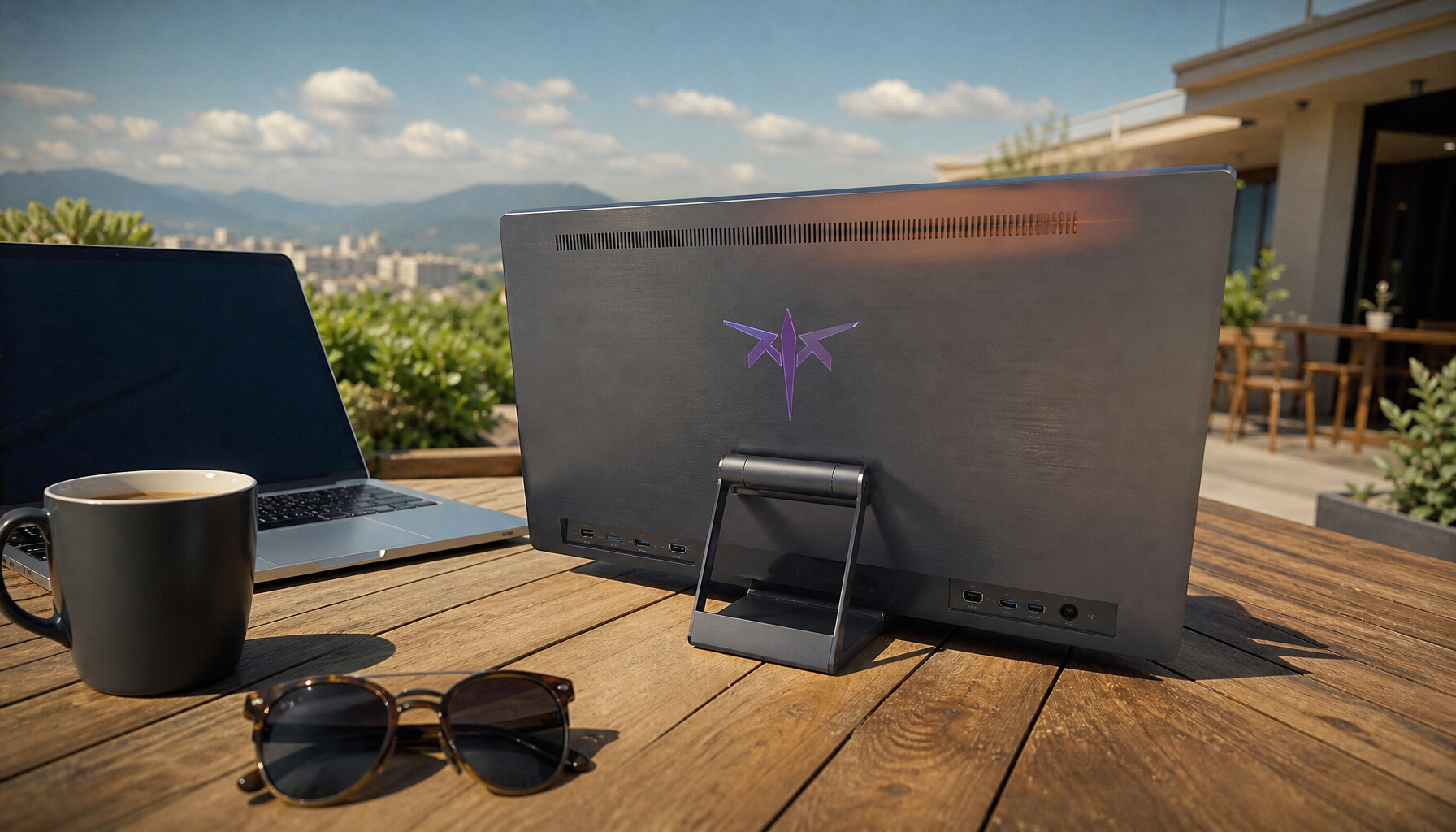
The strongest hardware clue is two separate USB-C ports with different jobs. One port is usually labeled for power input, PD, or charging. The other connects to the laptop for video, data, and upstream power. Some monitors use small icons instead of words, so look for markings near the ports, then confirm them in the spec sheet.

A monitor with only one USB-C port may still run from a laptop, but it usually cannot accept charger power and send video to the laptop at the same time through that same port. There are exceptions in docking-style products, but for slim portable displays, a second USB-C port is often the practical sign that passthrough is possible.
The product page or manual should use direct language such as “USB-C PD passthrough,” “pass-through charging,” “power pass-through,” “PD input,” or “charges laptop while connected.” A vague phrase like “USB-C powered” only means the monitor can receive power over USB-C. It does not prove it can forward power to the computer.
Read the Spec Sheet Like a Power Budget, Not a Feature List
A useful spec sheet tells you three numbers: the monitor’s own power draw, the passthrough rating, and the laptop charging wattage you expect to receive. Most USB-C portable monitors draw modest power, but that power is constant while the screen is on. One portable monitor testing summary places typical USB-C portable monitor consumption around 5W to 15W, with Full HD models often lower and 4K or high-refresh models higher.
That number matters because passthrough is not loss-free. If a monitor draws 10W and your charger is 65W, your laptop will not receive the full 65W. In a real productivity setup, a 45W ultrabook plus a 10W portable screen needs roughly 55W before overhead. A 65W PD charger is usually the safer minimum for mainstream laptops, while creator laptops and high-brightness 4K portable monitors are better matched with 100W-class chargers when the monitor supports it.

Setup |
Practical Reading |
1080p portable monitor drawing about 5W to 8W |
Best for battery efficiency and travel work |
2K/QHD portable monitor drawing about 8W to 12W |
Balanced for sharper text and moderate power use |
4K portable monitor drawing about 12W to 15W or more |
Better detail, but needs stronger PD headroom |
65W charger with a 10W monitor and 45W laptop |
Usually workable if passthrough is rated correctly |
30W charger with a laptop plus monitor |
Likely to charge slowly, flicker, or drain under load |
Do not judge by the charger alone. The monitor’s passthrough rating may cap the downstream charging power. A monitor advertised with 100W passthrough is much more useful for workstation travel than one that only accepts enough power to run its own panel.
Confirm Video Support Separately From Charging Support
A common mistake is assuming that if USB-C charging works, USB-C display will work too. They are separate capabilities. For a one-cable portable monitor setup, the laptop’s USB-C port must support video output, commonly DisplayPort Alternate Mode, and the cable must carry video as well as power.
USB-C monitor output works only when the device port, cable, and display support the necessary video capability. A charge-only USB-C cable can power a device but still fail to show an image. That is why “the monitor turns on but shows no signal” is often a cable or host-port issue, not a defective display.

For laptops, check the manufacturer’s port diagram or spec page for “DisplayPort Alt Mode,” “Thunderbolt 3,” “Thunderbolt 4,” “USB4,” or “USB-C video output.” For the monitor, check whether its USB-C host port supports video input and PD passthrough at the same time. For the cable, use the included cable when possible, or choose a full-featured USB-C cable rated for video and the required wattage.
Test It in Five Minutes
Start with the laptop, monitor, charger, and USB-C cable you actually plan to use. Connect the wall charger to the monitor’s PD input, then connect the monitor’s host USB-C port to the laptop. The display should light up, the laptop should detect the external monitor, and the laptop battery icon should show charging or at least hold steady under light workload.

Next, raise the monitor brightness to your normal working level and open a real workload, such as a browser with several tabs, a video call preview, or a design canvas. If the laptop switches between charging and not charging, the monitor flickers, or the screen disconnects when brightness increases, the setup is short on power headroom or the cable is not up to the job.
For power-bank use, match the bank to the monitor’s input requirement instead of only looking at capacity. Power-bank guidance for portable displays emphasizes that a portable monitor should be powered by a bank that matches or exceeds the display’s power needs, with USB Power Delivery especially important for higher voltage levels. A 20,000mAh bank sounds large, but a bright 4K display and laptop can drain it quickly if the wattage is high.
Signs Your Monitor Does Not Support Passthrough
If the monitor has one USB-C port and a separate Mini HDMI port, it may need USB-C only for power and HDMI for video. That is not PD passthrough. If the manual says “USB-C power input” but never mentions laptop charging, passthrough is not confirmed. If the product page says “compatible with USB-C” without a wattage rating, treat it as unknown until the manufacturer confirms it.
A second warning sign is unstable behavior when the charger is routed through the display. Flickering, dimming, black screens, touch dropouts, or repeated connect sounds often point to an insufficient power budget. A USB-C overview stresses that USB-C cables and ports vary widely, so checking supported features matters before relying on a professional setup.
The final sign is a laptop that runs the monitor but continues draining at the same pace. That usually means the display is being powered by the laptop, not the charger, or the laptop is receiving too little downstream wattage to offset its workload.
Pros and Cons of USB-C PD Passthrough on Portable Monitors
The upside is obvious during real work: fewer cables, fewer chargers, cleaner desk setups, and less laptop battery anxiety. For office productivity, a 15.6-inch Full HD portable monitor with 65W or 100W passthrough can feel like a proper workstation in a hotel room, conference booth, or apartment kitchen table. For gaming and creative work, passthrough helps maintain brightness and stability instead of forcing the laptop to feed the panel from its own battery.

The tradeoff is that passthrough adds compatibility checks. You need the right monitor, a strong enough PD charger, a video-capable USB-C port, and a cable rated for the workload. High-brightness, 4K, touchscreen, HDR, and high-refresh portable monitors consume more power, so they leave less margin for laptop charging. USB-C PD is powerful, but it is still a negotiated system with limits.
FAQ
Can any USB-C portable monitor charge my laptop?
No. A USB-C portable monitor can be powered through USB-C without supporting laptop charging. Look specifically for PD passthrough or pass-through charging, plus a stated wattage such as 65W or 100W.
Is 65W enough for a portable monitor with passthrough?
For many office laptops, yes. A practical setup might use about 10W for the monitor and around 45W for the laptop, leaving modest headroom on a 65W charger. Larger creator laptops, gaming laptops, and 4K high-brightness portable monitors usually benefit from 100W-class power if supported.
Why does my monitor work but my laptop does not charge?
The monitor may not support passthrough, the charger may be too weak, the cable may be charge-only or low-rated, or the laptop USB-C port may not support USB Power Delivery. Test with the included cable and a known-good PD charger before blaming the panel.
Final Word
The most reliable buying rule is simple: choose a portable monitor with clearly stated USB-C PD passthrough, a separate PD input, a host USB-C video port, and enough wattage for both the screen and your laptop. When the power path is confirmed before the first trip, your second screen becomes an advantage instead of another battery problem.