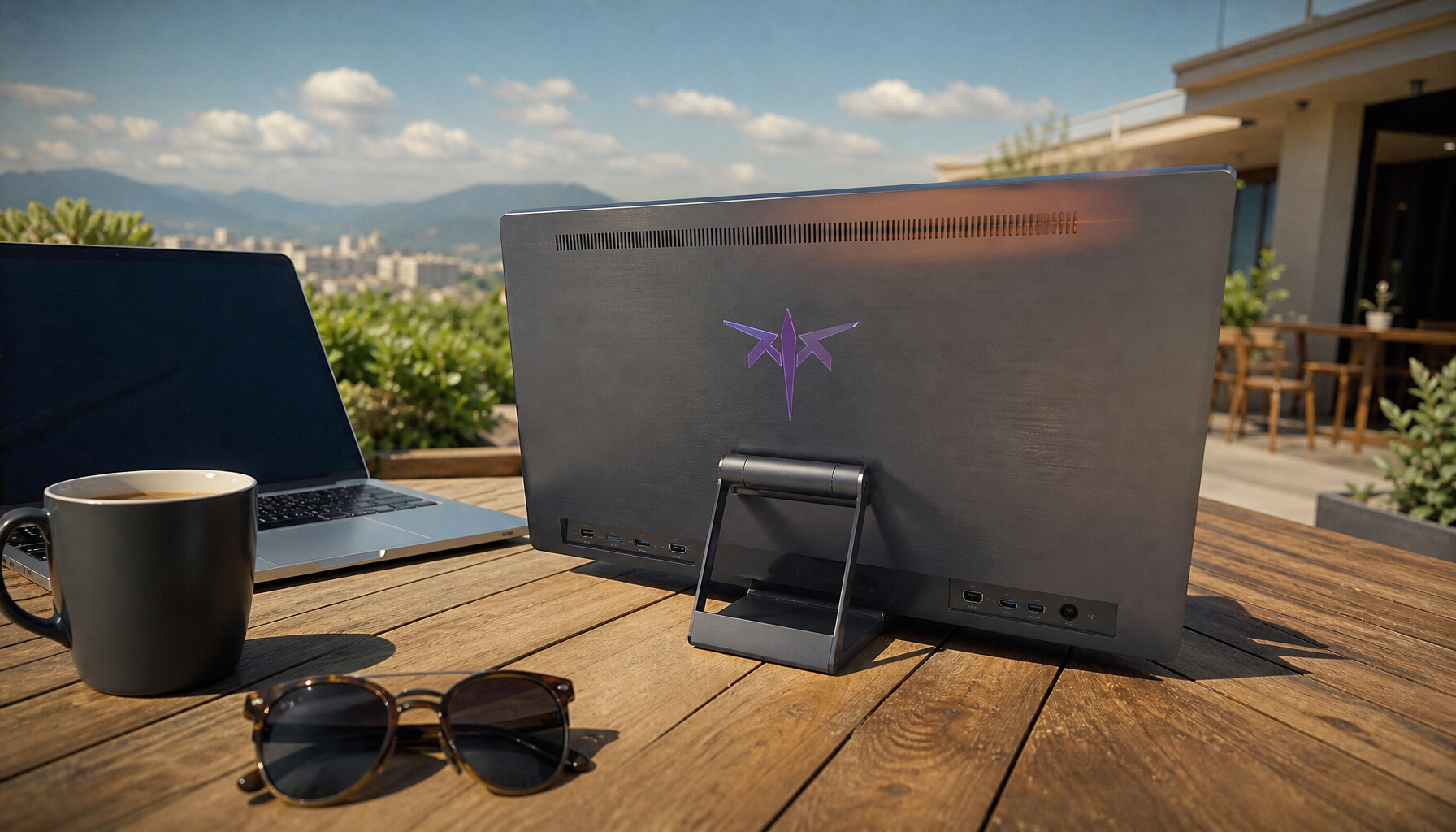
Many portable monitors can run from a car USB-C port or charger, but only when the power output, cable, and video source all match the monitor’s requirements. For road trips, treat the car USB-C connection as power first, not as a guaranteed one-cable display solution.
Your screen lights up for two seconds, shows a logo, then goes black right when you need maps, a spreadsheet, or a handheld console setup in the passenger seat. A 15.6-inch 1080p travel monitor can often run from modest USB-C power, but higher-brightness, 4K, touchscreen, dual-screen, and gaming models can demand much more. Here is how to check your car, cable, and monitor before the trip so the setup works when the engine is running and the miles are adding up.
The Short Answer: It Depends on Power and Signal
A portable monitor needs two things: electricity and a video signal. Your car’s built-in USB-C port may provide charging power, but it usually does not provide DisplayPort Alt Mode video. That means the car USB-C port can often power the screen, while your laptop, phone, handheld PC, console dock, or HDMI adapter still has to provide the image.

Many portable monitors are designed around USB-C simplicity, and mainstream listings commonly advertise USB-C and HDMI support for laptops, phones, tablets, and consoles on portable monitor product pages. The catch is that “USB-C” only describes the connector shape. It does not guarantee enough wattage, video output, Power Delivery negotiation, or compatibility with every display controller.
A practical road-trip setup often looks like this: the monitor gets power from a USB-C PD car charger plugged into the 12V socket, while video comes from a laptop over USB-C or from a console, streaming stick, or camera through HDMI. If the monitor supports USB-C passthrough power, you may be able to route power through the monitor to the source device, but that depends on the monitor design.

How Much Power Does a Portable Monitor Need?
Most basic travel monitors are not power hogs. A common 14- to 15.6-inch 1080p productivity display often sits in a low-power range, while premium or performance-focused models can climb quickly when brightness, resolution, speakers, touch, or high refresh rates enter the mix.
USB-C Power Delivery matters because a standard USB-C connection is not the same as a high-watt charger. USB-C PD is a negotiation standard where the charger, cable, and device agree on voltage and current. Without that shared support, the setup may fall back to lower power. A modern USB-C PD explainer notes that a standard USB-C port commonly supplies about 15W, while PD can negotiate far higher profiles when the hardware supports it.
Monitor Type |
Road-Trip Power Expectation |
Car USB-C Reality |
Small or dim 1080p portable screen |
Low to moderate |
Often possible from a decent USB-C port |
Typical 15.6-inch 1080p productivity screen |
Moderate |
Best with a USB-C PD car charger |
Bright IPS, touchscreen, speakers, or 4K |
Moderate to high |
Built-in car ports may be unstable |
Dual-screen portable monitor |
High |
Usually needs a strong PD charger or second cable |
High-refresh gaming portable monitor |
High |
Use dedicated PD power, not a weak dashboard port |
The simple calculation is useful: if your monitor needs around 10W and your laptop already uses 35W while working, the total mobile workstation load is now about 45W before charging losses. If your car port is a basic 15W outlet, it may power the monitor alone but fail once the monitor requests more brightness or the laptop starts pulling power too.
Built-In Car USB-C Port vs. USB-C PD Car Charger
Factory USB-C ports in cars are often designed for cell phone charging and media connectivity. Some are convenient for topping up a phone, but they may not deliver the steady wattage a display needs. A dedicated USB-C PD car charger is usually the stronger choice because it is built specifically to convert the vehicle’s 12V outlet into higher-output USB-C charging.
Modern USB-C car chargers commonly advertise Power Delivery, multiple ports, and wattage levels from everyday phone charging up to laptop-class output. One charger maker describes car charger wattage as ranging from 12W to 100W or higher, with higher output supporting faster charging when the device is compatible through USB-C car chargers. For a portable monitor, the useful target is not “fastest possible,” but “stable enough that the display does not flicker, dim, or reboot.”
A 30W USB-C PD car charger can be enough for many basic portable monitors. A 45W to 65W model gives more headroom if you are also charging a tablet, handheld PC, or laptop. If you are powering a larger dual-screen display, a bright 4K portable monitor, or a gaming screen, a 65W to 100W charger is the more reliable class.
Why One-Cable USB-C May Fail in the Car
Single-cable USB-C monitor setups are elegant at a desk because one cable can carry power and video from a laptop. In a car, the situation changes. The car charger can provide power, but it cannot create a video signal. Your source device still needs USB-C video output, usually DisplayPort Alt Mode, Thunderbolt, HDMI, or DisplayLink, depending on the monitor.
This is where real-world compatibility gets messy. A July 2024 community discussion describes portable monitors that worked on some machines but failed to receive both power and display from another USB-C laptop, and participants treated it as a USB-C interoperability issue rather than a simple broken-port diagnosis in USB-C power and display. One user reported that switching monitor brands solved the single-cable problem, which is a useful reminder: two portable monitors can advertise similar USB-C features and still behave differently.
For road trips, avoid betting the whole setup on one cable unless you have tested that exact monitor, cable, source device, and charger. If the monitor has both USB-C power and mini-HDMI input, that dual-path setup is often more dependable in a vehicle.
Cable Quality Is Not Optional
A weak cable can make a good charger look bad. Some USB-C cables are charge-only. Some support data but not display. Some support video but not enough wattage. The result is the same from the passenger seat: black screen, flicker, random disconnects, or a monitor that works only at low brightness.
Use the monitor’s original USB-C cable first. If you need a longer cable for the back seat or center console, choose one rated for both the wattage you need and video if it will carry the display signal. For power-only runs from a car charger to the monitor, wattage rating is the priority. For a laptop-to-monitor USB-C connection, the cable must also support video.

The practical test is simple. Before the trip, set the monitor to the brightness you expect to use in daylight, connect the same source device, and let it run for at least 30 minutes. If it power cycles in the driveway, it will not become more reliable at highway speed.
Safety and Battery Drain in a Vehicle
High-output charging in a vehicle is normal when done with decent hardware, but heat and battery drain still matter. Use certified chargers with over-current, over-voltage, short-circuit, and temperature protection. Avoid bargain adapters with vague wattage claims and no safety markings.
Car-charging advice recommends starting the engine for high-watt charging, checking charger temperature during longer sessions, and avoiding overload in older vehicles through fast-charging practices. That advice matters more with portable monitors than phones because a display may draw steady power for hours instead of sipping power during a short top-up.
If the car is off, do not leave the monitor and source device running from the vehicle battery. A USB charger may draw little by itself, but connected devices continue to consume energy. For parked work sessions, a USB-C PD power bank is usually the better buffer, especially if you are editing, gaming, or running a dual-screen setup.
Best Road-Trip Setup by Use Case
For office productivity, a 15.6-inch 1080p portable monitor with USB-C and HDMI is the value sweet spot. Travel-monitor buying advice consistently favors this size because it gives meaningful workspace without becoming awkward to pack, and a 1080p panel keeps power demand modest. Pair it with a 45W or 65W USB-C PD car charger, and use HDMI as a fallback if USB-C video becomes unreliable.
For portable gaming, power headroom matters more. Buying advice for portable gaming monitors notes that many portable gaming monitors lack built-in batteries, so users often need a USB-C power source or power bank for truly mobile setups. A 144Hz or 180Hz display may be excellent for a handheld PC, but it is the wrong place to rely on a weak factory dashboard port.
For creators and color-sensitive work, brightness and resolution raise the stakes. Buying advice for modern portable monitor features highlights 4K resolution, high refresh rates, touch input, wireless connectivity, and built-in batteries on some models. Those features improve the experience, but they also make power requirements and backup connectivity more important.
Pre-Trip Compatibility Check
Start by reading the monitor label or spec sheet for input power. Then check whether your car USB-C port lists wattage; if it does not, assume it may be phone-focused. Test the built-in port first, but pack a USB-C PD car charger with enough overhead for the monitor and at least one source device.

Next, confirm the video path. If your source is a laptop or handheld PC over USB-C, it needs video output support. If your source is a console or streaming device, plan around HDMI and separate USB-C power to the monitor. If the monitor flashes a logo and shuts off, lower brightness and try a stronger charger before blaming the panel.
Finally, keep a short HDMI cable, the original USB-C cable, and a compact wall charger in the bag. Hotels, rentals, and rest stops create different power conditions, and the most reliable portable display kit is the one that has a second way to connect.
FAQ
Can a car USB-C port send video to a portable monitor?
Almost never. A car USB-C port is usually for charging or phone data, not DisplayPort Alt Mode video. Use a laptop, handheld PC, phone with video output, HDMI device, or compatible adapter for the display signal.
Is 30W enough for a portable monitor?
It can be enough for many basic 1080p portable monitors, especially at moderate brightness. For 4K, touchscreen, dual-screen, high-brightness, or gaming models, move to 45W, 65W, or higher depending on the monitor’s rated input.
Can I use a portable monitor while parked?
Yes, but avoid running it from the car battery for long periods with the engine off. A USB-C PD power bank is a cleaner choice for parked work, gaming, or streaming sessions.
A portable monitor can be a strong road-trip upgrade when you separate the problem into power, video, and cable quality. Use a real USB-C PD car charger, test the exact setup before departure, and keep HDMI or a second power path ready so the travel screen stays reliable.