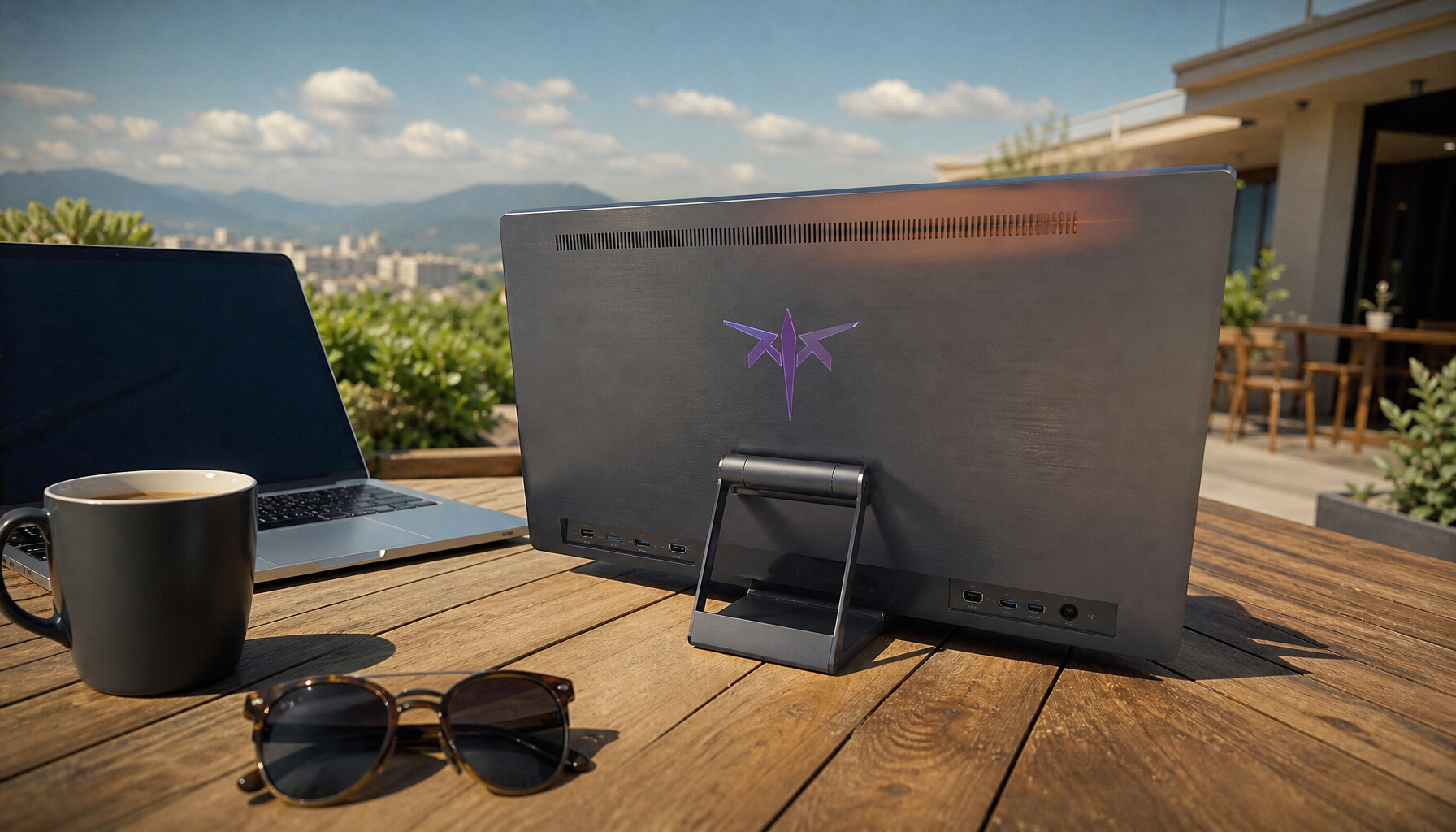
To calculate total bandwidth, add your monitor’s video demand to your SSD’s real data demand, then compare that total with the usable bandwidth of the USB-C path, hub, cable, or USB4 link. Because USB-C can split lanes between display and data, the same port may deliver a sharp picture while quietly slowing your SSD.
Is your 4K monitor stable, but your external SSD suddenly copies like an old hard drive when plugged into the monitor’s USB hub? A practical benchmark can reveal whether a drive expected around 400-550 MB/s is being held near 30-40 MB/s by a low-speed cable, shared hub mode, or display bandwidth pressure. Use the steps below to estimate the load, test the setup, and decide when to plug the SSD directly into the laptop.
Why USB-C Bandwidth Feels Confusing
USB-C is the connector shape, not a speed promise. A USB-C port may support basic USB 2.0 data, USB 3.x, USB4, display output, Power Delivery, or some combination of those features, and the slowest part of the chain determines the real storage speed. That is why a premium external SSD, a high-refresh monitor, and a good-looking cable can still produce disappointing transfers if one link in the chain is underspecified.
The key idea is shared transport. A USB-C monitor setup can carry video, USB data, audio, and charging through one cable, but USB-C bandwidth may be shared between those jobs when display alt mode is active. In practice, this can show up as flicker, black screens, reduced refresh rate, or an SSD that benchmarks far below its direct-to-laptop speed.
Display alt mode lets USB-C carry video. Depending on the device, the connection may use two high-speed lanes for video and leave lanes for USB 3.x data, or it may use four lanes for video and reduce the monitor’s USB hub to USB 2.0-class data. That tradeoff is why a 4K high-refresh display can look great while the downstream USB ports behave like they belong to a much older hub.

The Simple Bandwidth Calculation
The planning method is straightforward: estimate the monitor’s video bandwidth, estimate the SSD’s storage bandwidth, add any other heavy devices, then compare the result with the link available to the monitor hub or dock. Use decimal units for interface planning, because transmission rates are expressed in decimal bits per second. In plain terms, 10 Gbps means 10 billion bits per second, not a binary storage-size conversion.

For video, the main drivers are resolution, refresh rate, color depth, color format, and timing. A video signal bandwidth calculator can estimate whether a chosen resolution and refresh rate fits a specific display mode, including whether video compression is needed. For storage, start with the drive’s realistic measured speed, not only the marketing number on the box.
Here is a practical planning table for common devices.
Device or signal |
Typical bandwidth planning value |
What it means in practice |
USB 3.2 Gen 1 path |
5 Gbps theoretical |
Often enough for SATA-class external SSDs, but shared docks reduce headroom |
USB 3.2 Gen 2 path |
10 Gbps theoretical |
Better match for fast portable SSDs and large project transfers |
Gigabit Ethernet |
Up to 1 Gbps |
Only matters when actively transferring at full network speed |
USB 2.0 device |
Up to 480 Mbps |
Usually fine for keyboard, mouse, basic receivers, and light peripherals |
SATA-class external SSD |
About 400-550 MB/s |
Needs real USB 3.x data, not USB 2.0 fallback |
NVMe external SSD |
Around 1,000 MB/s or higher |
Often best on direct USB4 for heavy work |
A quick conversion helps: 500 MB/s is roughly 4 Gbps before protocol overhead. If your monitor hub only has 5 Gbps upstream for USB data, a SATA-class SSD can use most of that budget by itself during a large write. If the same USB-C connection is also carrying a demanding display signal and the monitor falls back to a restricted hub mode, the SSD may never get close to that number.
Example: 4K Monitor Plus External SSD
Imagine a laptop connected to a 4K 60 Hz USB-C monitor, with a 1 TB external SSD plugged into the monitor’s downstream USB-C or USB-A port. The SSD normally benchmarks near 500 MB/s when connected directly to the laptop, which is about 4 Gbps. If the monitor’s hub provides real USB 3.x data while video is active, that setup may be perfectly usable for photo libraries, office documents, code projects, and ordinary backups.

Now raise the load. If the monitor is running 4K at a higher refresh rate, using 10-bit color, or relying on a lane mode that prioritizes display bandwidth, the USB hub may have less usable data capacity. Resolution and refresh rate are major bandwidth drivers, and color depth or chroma format can push the requirement higher. The monitor may preserve the display experience first, while storage transfers become the flexible part of the system.
That behavior is not a failure of USB-C itself. It is a design tradeoff. A single-cable setup is excellent for a clean desk and fast docking, but the connection has to divide finite lanes between visual performance and data throughput. For competitive gaming, high-refresh creative work, or editing directly from an external NVMe SSD, the performance-driven choice is often to keep the display on USB-C or a dedicated display connection and connect the SSD to the laptop’s fastest separate USB-C or USB4 port.
How to Check the Specs Before You Buy
Start with the laptop port. Look for exact language such as USB 3.2 Gen 2 or USB4. A USB-C icon alone is not enough. Then check the monitor manual for the downstream hub speed while USB-C video is active, because some monitors advertise USB-C docking but provide different hub speeds depending on the display mode.
Next, check the cable. Some USB-C charging cables provide high wattage but only USB 2.0-class data, which can cap transfers near old hard-drive territory. For serious external SSD use, choose a cable rated for at least 10 Gbps data transfer. For high-refresh 4K displays, do not infer display capability from “USB-C” printed on the cable; verify display support, bandwidth rating, and power support.

External SSD specs matter too. Mainstream SATA-based portable SSDs tend to sit around 400-550 MB/s, while PCIe/NVMe models are faster and better suited for large video files, game libraries, and active project work. High-end SSDs using fast external storage standards can reach much higher speeds, and USB Type-C shape still does not guarantee the port, cable, and drive all support the same performance tier.
Pros and Cons of Using the Monitor as the SSD Hub
The biggest advantage is convenience. One cable can connect the display, charge the laptop, and bring storage, webcam, keyboard, mouse, and Ethernet into the workstation. For office productivity, writing, spreadsheets, light creative work, and moderate file movement, that simplicity is often worth more than chasing maximum benchmark numbers.
The downside is predictability. A monitor hub may share bandwidth with video, and demanding display modes can leave less room for storage. A USB-C hub expands a laptop’s ports, but every attached device still depends on the original connection’s bandwidth and power budget. That is why keyboards and mice belong on the monitor hub, while a high-speed SSD used for capture, game installs, virtual machines, or video editing deserves the fastest direct port unless the monitor clearly supports equivalent data speed.
A Reliable Test Procedure
The fastest way to move from guessing to knowing is to benchmark the exact setup you use every day. Test the SSD directly on the laptop first, then test it through the monitor with the same cable, same monitor resolution, same refresh rate, and same downstream port. If a SATA-class SSD expected around 500 MB/s still lands near that range through the monitor, the setup is fit for purpose.

If the same drive drops near 30-40 MB/s, isolate one variable at a time. Swap in a certified high-speed cable, lower the monitor refresh rate if the monitor offers USB priority modes, try another laptop USB-C port, bypass the monitor hub, and retest. Keep the display settings constant while testing storage, because changing resolution or refresh rate can change lane allocation and make results look inconsistent.
For backup planning, remember that speed is not the same as data safety. External drives are convenient, but hard drives and SSDs can fail, and a 3-2-1 backup strategy keeps multiple copies across local and offsite storage. A fast single-cable desk is useful; a recoverable workflow is essential.
When You Need USB4
Choose USB4 when you want high-resolution or high-refresh display output and high-speed external storage at the same time. This is especially relevant for 4K high-refresh gaming monitors, ultrawide productivity displays, raw media workflows, large game libraries, and external NVMe drives used as active working disks.
The value-oriented answer is not always “buy the fastest dock.” If your SSD is a SATA-class drive and your monitor hub truly provides USB 3.x data while running your chosen display mode, the monitor can be a reliable hub. If your SSD is NVMe, your monitor is high-refresh, or your files are large enough that transfer time affects your day, reserve a direct high-speed port for storage and let the display connection focus on pixels.
Final Verdict
Calculate the total load by treating video and storage as competing demands on the same USB-C path, then validate with a real benchmark. For a clean office desk, the monitor hub is usually fine for light devices and moderate storage; for immersive displays plus serious SSD work, separate the SSD onto the fastest direct USB-C or USB4 connection and let the screen run without compromise.