Finding the best rolling smart display for home office mobility comes down to one question: do you need a screen that moves with you, or a screen that only needs to be easy to reposition? If you switch rooms often, care about screen height, and want less stand readjustment, a rolling smart display is usually the better fit. If your screen mostly stays parked, a tablet-plus-stand setup can still make sense.

Which Mobility Setup Fits Your Workspace?
The best rolling smart display for home office use is the one that matches how often you move, not the one with the biggest spec sheet. If you work across a desk, kitchen counter, and couch in the same day, a rolling display keeps the screen with you instead of making you rebuild the setup each time. If you mostly stay in one room, a tablet on a stand can still be enough.
A good first check is whether the screen is replacing a laptop display, a second monitor, or just a quick-capture screen for short tasks. For longer calls and document work, a full-size screen is easier to keep at a comfortable height. Mayo Clinic's office ergonomics guidance and OSHA's monitor positioning guide both point toward screen placement that supports a more neutral neck position.
In practical terms, this means the rolling setup is the stronger choice when posture consistency matters more than bag portability. A tablet-plus-stand setup is still useful when you want a lighter, simpler device and do not mind adjusting it more often.
If you want a deeper buying framework, Are Rolling Smart Displays Worth the Investment helps as a follow-up read. It is most useful when you are still deciding whether the category itself is worth the space.
Ergonomics Change the Daily Experience
For most people, ergonomics is where the difference between MegPad vs tablet becomes obvious. OSHA recommends placing the top of the monitor at or slightly below eye level, with the center about 15 to 20 degrees below your horizontal gaze. That keeps you from spending the whole day looking down. In plain language, the screen should meet your eyes, not make your neck do the work.

A tablet stand often lands lower than that, especially when you are trying to keep the device stable on a desk or side table. The University of Virginia's ergonomics guidance notes that tablet stands commonly force a lower viewing angle, which can increase neck flexion during extended use. That matters most during back-to-back video calls, document review, and email catch-up sessions.
A rolling display changes the experience because the screen height can stay more consistent as you move. That does not make it magically ergonomic in every room, but it reduces the constant reset cycle. If you alternate between seated and standing work, consistency matters more than a small convenience gain.
A wider mobile screen can also reduce the amount of zooming and scrolling you do in spreadsheets or long notes. Touch input feels easier on a larger panel because the targets are larger and the screen sits farther away at a more natural distance.
For readers who want a practical setup article, How to Adapt Your Monitor Setup When Switching Between Sitting and Standing is the closest internal match. It is especially relevant if your workday flips between standing desk and couch use.
Decision sentence: if your main complaint is neck strain from looking down, a rolling display is usually the better direction, but only if you can set it at a consistent height. Decision sentence: if your screen usage is short, casual, and mostly stationary, a tablet-plus-stand setup can be good enough. Decision sentence: if you keep changing rooms and re-tilting the screen, the convenience advantage starts to disappear.
Battery Life and App Stability Matter Together
Battery runtime only matters when you actually leave the charger behind. For room-to-room mobility, what matters is whether the screen can survive the tasks you do unplugged, not whether the spec sheet lists a big number. Brightness, app load, wireless use, and video calls all change how long a battery really lasts in a workday.
That is why MegPad vs tablet is not just a size comparison. A tablet ecosystem can feel smoother for app switching and quick check-ins, but the stand, angle, and charging cable can become the thing you notice most during longer sessions. A rolling smart display tries to solve a different problem: keep one larger screen usable as you move around the home without restarting your whole setup.
KTC's Mobile Touch Screen collection is the broader browsing path if you are comparing the category rather than one exact model. The product mix includes battery-powered mobile displays, which makes it easier to judge size and mobility trade-offs side by side.
For a concrete example, the KTC MEGAPAD 32" 4K Android 14 Google EDLA Smart Touch Monitor with 8550mAh Battery has a 31.5-inch 4K panel, built-in battery, and rolling stand. That makes it a natural reference point when you want one screen to move from desk to living room without turning into a full teardown-and-reset project.
A few practical boundaries help here. If you only need the screen for a quick email check or short call, battery life is less important than ease of placement. If you expect long unplugged sessions, runtime becomes a real decision factor. The workstation setup tips from Colorado State also reinforce the value of consistent screen height across seated, standing, and couch positions.
Decision sentence: if you regularly unplug and move the screen, battery-backed mobility is worth more than a slightly lighter setup. Decision sentence: if your workflow depends on long app sessions without interruptions, verify brightness and runtime claims by use case, not by headline number alone. Decision sentence: if you mainly use the screen docked in one place, a tablet can be the simpler choice.
| Setup | Best When | Main Trade-Off | What Usually Causes Regret |
|---|---|---|---|
| Rolling smart display | You move between rooms and want a full-size screen | More space, more weight, more cost | Buying one that is too tall, too heavy, or awkward to roll where you work |
| Tablet plus stand | You stay in one room and want compact flexibility | Lower screen height, more readjustment | Neck angle, wobble, and charging cable clutter during longer sessions |
| Tablet without a stand | You want the smallest portable option | Hardest to keep at eye level | Looking down too long during calls or document review |
How to Set Up a Mobile Work Screen
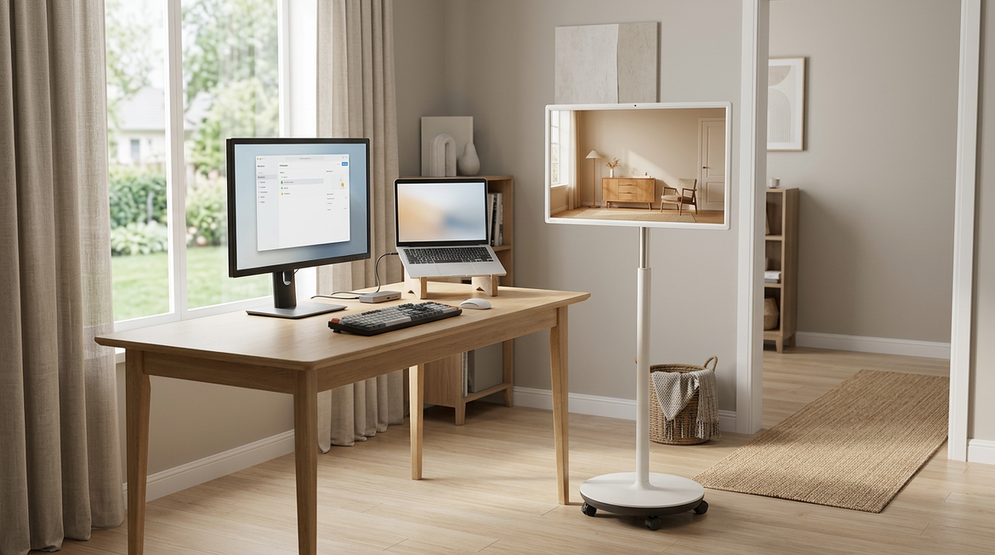
A mobile work screen only feels effortless if the room setup supports it. Before buying, check the path from the outlet to the chair, standing desk, or couch. You want enough clearance to roll the stand without snagging cables or bumping into furniture. This is where the rolling setup wins for multi-room homes: the path matters, but once it is clear, the screen can travel with you.
- Map the rooms first. If you will move the screen from office to kitchen to living room, measure the narrowest doorway and the tightest turn before you buy.
- Set height before tilt. The right height matters more than a slight angle change, because that is what keeps the screen useful in both seated and standing positions.
- Use wired input for longer work blocks. Wireless features are handy for light transitions, but they are not always the best base for an all-day desk workflow.
- Check where the power lives. A mobile screen is only truly mobile if you are not constantly hunting for an outlet.
- Test the use case you actually care about. Video calls, document review, and casual streaming can each feel different on the same screen.
If you are considering one product that matches this use case, the A32Q7 Pro is worth checking as a reference point because it combines a 32-inch 4K touch display, wheels, a built-in battery, and an adjustable stand. The fit is strongest when you want a larger screen that can roll between rooms without losing the ergonomic setup you already tuned.
For more browsing in the same category, the Mobile Touch Screen collection is the cleanest internal path. If your decision is drifting toward a more monitor-like desk setup, the Smart Monitor collection is a better place to compare fixed-screen alternatives.
The natural boundary is simple: do not buy a rolling display just because it looks flexible. Buy it if you actually use the mobility. If the screen will sit in one room 90% of the time, you may be paying for convenience you rarely use.
What Should You Choose If Your Day Keeps Changing Rooms?
If your workday moves from standing desk to kitchen counter to couch, a rolling smart display is usually the safer fit. It reduces the number of times you rebuild posture, power, and screen height. If you move mainly for one quick meeting or one quick check-in, a tablet can still be the easier device to live with.
The point is not that the tablet is bad. It is that a tablet-plus-stand setup solves a different problem. It excels when portability and compact storage matter more than a consistently eye-level screen. A rolling display excels when the screen itself is part of your workspace, not just an accessory.
If you want a broader category view, Ultrawide & Portable Displays can help you compare other flexible-screen formats. It is more useful if you are still deciding whether you want mobility, width, or compact portability to be the top priority.
FAQs
Q1. How Long Does a Rolling Smart Display Usually Stay Useful Without Plugging In?
Useful runtime depends on brightness, app load, and whether you are doing calls or light browsing. In practice, short room changes are easier than all-afternoon unplugged use. If you want full-day mobility, treat runtime as workload-dependent rather than assuming the headline battery number will hold in every case.
Q2. Can a Tablet Plus Stand Work for Video Calls All Day?
It can work for lighter meeting days, but long call blocks often expose the trade-offs: lower viewing angle, more charging dependence, and more small-screen fatigue. It is most comfortable when the stand is stable, the screen stays close to eye level, and the tablet is not constantly being moved.
Q3. What Screen Size Feels Best for Hybrid Home Office Work?
For reading and multitasking, a larger screen usually reduces zooming and scrolling. For true portability, smaller screens are easier to store and carry. The right size depends on whether the screen stays at a desk or needs to move through a small apartment without feeling bulky.
Q4. Why Does Stand Stability Matter More Than Screen Resolution?
A sharper screen still feels annoying if it wobbles or sits too low during typing and touch use. Stability affects comfort every minute you use it, while resolution only helps if the screen is already in the right place. If the stand moves a lot, the whole setup becomes harder to trust.
Q5. Can One Mobile Display Replace Both a Tablet and a Second Monitor?
Sometimes, yes. A larger mobile display can handle calls, document review, streaming, and casual work in one home setup. But a tablet still wins when you need bag portability, quick errands, or a small device you can carry anywhere. The best choice depends on whether home mobility or travel portability matters more.
The Best Choice Depends on What You Move More Often
MegPad vs tablet for home office mobility is really a question of what kind of movement matters in your routine. If you move rooms often and want to keep a full-size screen at a workable height, the rolling smart display is the stronger fit. If you mostly stay put and want a smaller, simpler device, a tablet-plus-stand setup still makes sense. Check doorway clearance and typical session length before deciding. The best rolling smart display for home office use rewards consistent height over raw portability when your day spans multiple rooms.