MegPad can be a strong fit for the best smart display for hybrid work when you want one touch screen that moves between a desk, a meeting, and a shared room without feeling tied to a fixed setup. The right choice depends less on marketing claims and more on three checks: how often you move it, whether you need standalone app use, and how much battery flexibility you actually need in real workdays.

Why Hybrid Work Needs a Better Screen
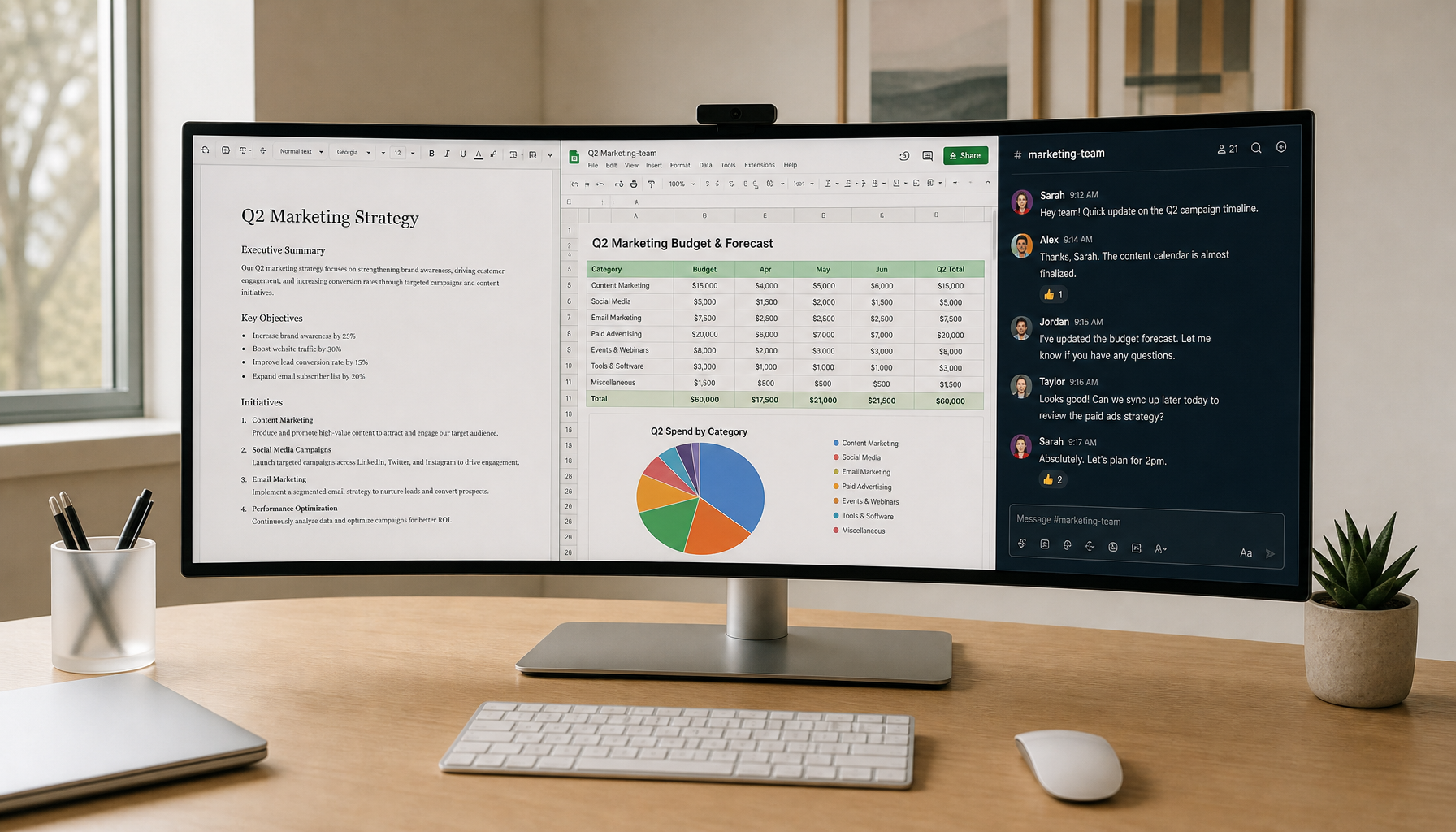
Hybrid work breaks down when a display is useful in one room but inconvenient everywhere else. A fixed monitor is fine if your workflow stays in one place, but it becomes less helpful when the same screen has to support a solo desk session, a Zoom call, and a quick team review in different parts of the home.
That is why the best smart display for hybrid work is usually the one that reduces reset time. The main question is not just screen size, but whether the display can follow the work instead of forcing the work to adapt to the room.
A large touch display also changes the decision for people who want to write, tap, or annotate without always living on a laptop. If your day includes note-taking, client reviews, or whiteboarding, a mobile smart display can be more practical than a fixed screen, as long as the setup stays easy enough to move.
For a broader definition of this category, the overview in Defining the Smart Touch Monitor is a useful starting point before you narrow down the hardware.
Decision sentence: If the screen will stay in one room most of the time, a fixed monitor may be simpler; if it needs to move daily, a mobile smart display starts to make more sense.
Mobility and Setup Friction in Real Workdays
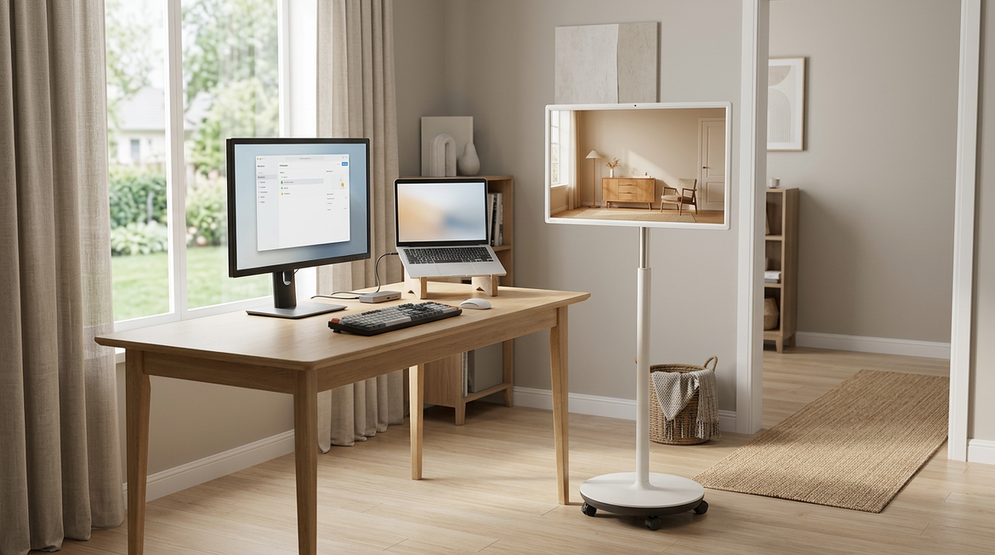
The biggest advantage of a rolling display is not novelty. It is the way it removes repeated setup steps when you move from desk to kitchen counter to living room. That matters most in hybrid routines where the same display has to be ready for a short review at 10 a.m. and a longer call at 3 p.m.
For room-to-room movement, the practical test is simple: can you roll it, power it, and start working without rebuilding your whole cable path? If the answer is no, the convenience story falls apart quickly. This is also where category browsing can help, and the Mobile Touch Screen collection is the best place to compare the broader range.
Touch input matters here because it reduces dependence on a keyboard and trackpad for quick edits, note markups, and whiteboard-style sessions. That does not replace a laptop for every task, but it can cut down the friction that usually makes spontaneous collaboration feel clumsy.

Built-in camera support and self-contained apps also matter when you want the screen to behave more like a meeting hub than a dumb display. In practice, though, that convenience is only useful if your room layout gives you enough clearance to roll the unit where you actually work. Reviews of similar rolling displays note that flat, clear floor surfaces are essential for smooth daily movement.
Decision sentence: If your space has narrow paths, thick rugs, or cramped corners, a rolling display can become more annoying than helpful even when the spec sheet looks right.
What Makes a Touch Display Feel Work-Ready
| Decision factor | Why it matters for hybrid work | What to check |
|---|---|---|
| Screen size | Bigger screens make shared calls and side-by-side documents easier to read | Match it to room size and viewing distance |
| Resolution | Sharper text matters more when you read docs, decks, and spreadsheets | Check whether FHD is enough or whether 4K is worth it |
| Touch support | Useful for quick reviews, markups, and tabletop collaboration | Confirm the touch layer is responsive in the apps you use |
| Camera | Simplifies video calls when you want fewer add-ons | Verify lens placement and privacy behavior |
| Battery | Determines whether the screen can move away from an outlet for long enough | Treat runtime as workload-dependent, not fixed |
| Ports | Affects cable simplicity when you swap between laptop and standalone use | Confirm USB-C, HDMI, and any adapters you need |
| Stand movement | Height, tilt, and rotation change comfort in shared spaces | Check whether you need more than basic tilt |
| App support | Makes the device less dependent on a laptop | Verify your exact meeting and collaboration apps |
The main takeaway is simple: larger and sharper is not always better if it makes the unit harder to move. A 4K panel can help text-heavy work, but only if the room, stand, and daily workflow justify the extra size and weight.
If you mostly split time between reading, quick comments, and short calls, touch responsiveness and app convenience often matter more than chasing a spec win. If you spend more time in shared living-room sessions or group reviews, screen presence and height adjustability start to matter more.
For a lighter background read on how Android smart displays are used for mixed workflows, Android Smart Display for Study, Streaming, and Cloud Gaming is a helpful context link.
Decision sentence: If your use is mostly text-heavy and desk-bound, prioritize resolution and ergonomics; if your use is mostly quick collaboration, prioritize touch, camera, and easier repositioning.
Port, Battery, and App Trade-Offs
Battery is the feature most likely to disappoint buyers who read it too literally. The practical rule is to treat runtime as a range that changes with brightness, volume, app load, and how often the screen stays active. That warning shows up in third-party reviews of portable smart displays, and it matches how these devices are typically used in real rooms.
The charger and port story matters just as much. USB-C is usually the cleanest way to reduce cable clutter, but you still need to confirm what your laptop or meeting device actually supports. A port that looks convenient on paper is not useful if your device needs a specific video-output mode or adapter.
App access is the other hidden trade-off. A smart display can reduce laptop tethering, but only if your meeting tools, sign-in flow, and cloud access behave the way you expect. The buyer check is not "does it have apps," but "does it have the apps I actually use without adding setup friction?"
Decision sentence: If you need a guaranteed all-day screen for bright, high-volume, app-heavy use, assume the battery will be shorter than the best-case number and plan for power access.
How the MegPad Fits Hybrid and Collaborative Spaces
The MegPad line makes the most sense when you decide by room size and movement frequency first, then choose screen size second. The 25-inch model is the easiest to justify if your main need is lighter portability and quick room changes. The 27-inch and 32-inch models are better when the display needs to feel more like a shared canvas for calls, reviews, or living-room work sessions.
The 25-inch model is the clearest fit for users who want a lighter, more flexible screen for frequent moving. It has a built-in camera, Type-C, and a 5.5 kg chassis, which helps if the display travels more often than it sits in one place. The product page for the 25-inch portable touch monitor shows the matching details, including Android 14, a 5,000 mAh battery, and runtime that varies by brightness and workload.
The 27-inch option sits in the middle. It adds wheels, a built-in 8MP camera, and a 9,500 mAh battery with up to about 6 hours of runtime, which makes it a practical middle ground when you want room-to-room use without jumping to the largest chassis. For buyers who want a balance of size and mobility, the 27-inch mobile touch screen is the model that most clearly fits that middle path.
The 32-inch models are the better choice when the screen needs to serve a larger shared space. One version adds wheels and height adjustment from 1131 mm to 1331 mm, while the other adds height, tilt, and rotate on a 31.5-inch 4K panel. Those features make them better for more presentable meetings and bigger collaborative use, but they are less compact and less convenient to move than the smaller unit.
If you want to browse the broader category after narrowing your size preference, the Smart Monitor collection and Featured Product collection are the most direct store-side paths.
Which MegPad Size Fits Which Scenario?
| Scenario | 25-inch | 27-inch | 32-inch |
|---|---|---|---|
| Lighter portability | Strongest | Good | Limited |
| Room-to-room hybrid work | Good | Strongest | Good |
| Video calls | Good | Strongest | Good |
| Shared collaboration | Limited | Strongest | Strongest |
| Large shared canvas | Limited | Good | Strongest |
Decision sentence: If you want the most compact room-to-room option, start with 25 inches; if you want the best balance for calls and shared use, 27 inches is the safer middle ground; if you want the biggest shared canvas, 32 inches is the better fit even though it is less easy to move.
A Practical Checkout Checklist
Before you add a mobile smart display to cart, check the room path, the device ports, and how often the screen will move. Then match battery expectations to your real workload, not to the most optimistic runtime number. The 25-inch portable touch monitor is worth a closer look only if those conditions line up with your day-to-day use.
- Confirm the screen size fits your desk depth and the room where it will move most often.
- Check the port list against the laptop or meeting devices you already use, especially USB-C and any adapter you may need.
- Treat battery numbers as planning guides, not guarantees, unless your workload closely matches the test conditions.
- Verify the apps and services you rely on before you buy.
- Review warranty, returns, and shipping terms so the purchase risk fits your budget.
If those checks still point to a mobile screen, the MegPad line is a reasonable candidate for hybrid work. If they do not, a simpler fixed monitor may be the less frustrating choice.
Related Resources
Compare rolling-display options in the 2026 audit of LG StanbyME alternatives to see how MegPad models stack up on battery, resolution, and mobility for hybrid setups. The Best LG StanbyME Alternatives guide walks through real-world trade-offs for room-to-room use. For agile-team workflows, the MegPad rolling-display post shows practical Jira dashboard setups that keep hybrid stand-ups moving without extra cables.
FAQs
Q1. How Long Does a Battery-Powered Smart Display Usually Last for Hybrid Work?
Battery life usually shifts with brightness, volume, app load, and whether the screen is mostly idle or actively streaming and touching. For hybrid work, a conservative plan is smarter than relying on the best-case number, especially if you want the display to last through calls and short collaboration sessions.
Q2. What Ports Matter Most for a Laptop-And-Meeting Setup?
USB-C is usually the simplest starting point because it can reduce cable clutter, but you still need to confirm video output support on your laptop or tablet. If your device needs an adapter or a special output mode, that changes the setup more than the port label itself.
Q3. Can a Touch Display Replace a Laptop During Video Calls?
It can reduce laptop dependence for some call workflows, but it does not replace every laptop task. The key checks are the exact meeting app, your sign-in flow, and whether the built-in camera and audio match how you actually join calls.
Q4. What Room Layout Works Best for a Rolling Display?
Open paths, firm flooring, and enough clearance around desks or tables make daily movement easier. If you have thick rugs, tight corners, or cluttered walkways, rolling the screen can become a daily annoyance instead of a convenience.
Q5. Why Does App Compatibility Need a Separate Check?
Because app access and sign-in behavior can vary even on smart displays that look similar. You should verify the exact tools you use, not just whether the device has an app store or a browser, since that difference can change how standalone the setup really feels.