MegPad telehealth display choices make the most sense when the device fits the workflow first and the spec sheet second. For most clinics, the key checks are stability, privacy controls, software integration, and runtime. If any one of those breaks down, the convenience of a rolling screen usually stops being worth it.

What Clinical Teams Need Before Choosing a Rolling Display
For bedside education, telehealth consults, and exam-room collaboration, start with the operational questions, not the headline screen size. The HHS telehealth privacy guidance makes the basic point clearly: covered entities remain responsible for safeguards, so no display category makes a workflow compliant by itself.
That is why a MegPad telehealth display should be judged as part of a controlled setup, not as a privacy solution on its own. Check who can sign in, whether the camera and microphone are easy to disable or cover, and how fast the screen can be reset between patients. In shared rooms, a good fit is a device that reduces friction for staff without creating new steps for IT or nursing.
Runtime matters for the same reason. If the unit is expected to move between rooms, battery life needs to match your real round pattern, not the marketing headline. The practical rule is simple: if the device cannot cover a typical encounter block with room to spare, it becomes a charging plan, not a mobile workflow tool.
Rolling smart displays for healthcare and education is a useful follow-up if your team is still mapping the procurement criteria before comparing models.
Stability, Height, and Bedside Visibility
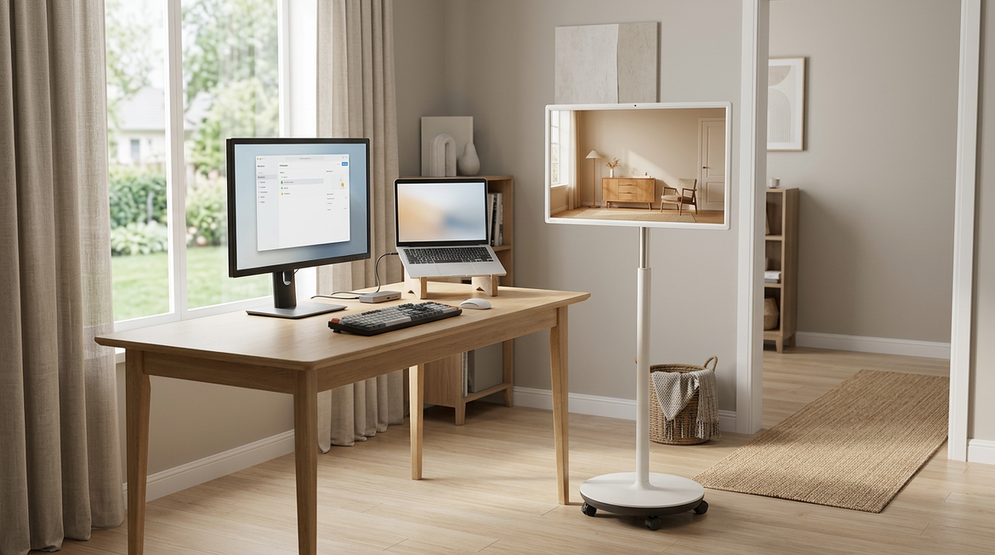
A rolling display for clinical use only helps if it stays steady enough for touch input, chart review, and conversation. In bedside patient education, the screen should feel easy to position without constant correction. If staff have to keep re-aiming it, the device adds distraction instead of support.
Height and tilt are especially important in mixed-height rooms. A seated patient, a standing clinician, and a family member all see the screen differently, so adjustability matters more than it would on a fixed desk setup. The first decision sentence here is straightforward: if the room uses the screen for face-to-face teaching, choose the model that gives the clearest viewing angle for the widest range of users.
The KTC MEGAPAD 27" FHD Android 14 Google EDLA Smart Touch Monitor with 9500mAh Battery is the more compact moving option in the current lineup, with built-in wheels, a 27-inch FHD panel, Android 14 with Google EDLA, and a battery rated for up to 6 hours. That makes it a more natural check point for rooms where mobility matters more than large-screen presence.
By contrast, the KTC MEGAPAD 32" 4K Android 14 Google EDLA Smart Touch Monitor with 8550mAh Battery gives teams a larger 31.5-inch 4K display, adjustable height, tilt, and rotate, plus a built-in battery and rolling stand. That makes it easier to consider for larger patient-facing rooms, but only if the added size does not crowd the clinical space.

Privacy and Access Controls in Shared Care Spaces
HIPAA telehealth use is allowed, but the burden stays on the covered entity, so privacy on a shared rolling device has to be designed into the workflow. That means camera visibility, account switching, sign-out behavior, and screen placement all matter.
The CDC core infection prevention practices also reinforce a related point for shared care spaces: high-touch patient-care equipment should be cleaned and disinfected according to facility-approved protocols. A device can be useful and still be a bad fit if the team has no simple way to clean it and return it to service.
A practical privacy check is easy to use before procurement:
- Confirm how the camera is physically covered or disabled.
- Verify whether the microphone can be muted or controlled visibly.
- Test sign-in and sign-out between users.
- Make sure no patient data remains visible after a session ends.
- Position the display so hallway traffic and family members cannot casually read the screen.
If your clinic wants a privacy-forward camera workflow, the KTC MEGAPAD 25" FHD Google EDLA Portable Touch Monitor built in Camera is the relevant navigation target to review, but only after you confirm the room's access-control rules and camera expectations. Do not treat the category as automatically compliant.
Software Fit for Telehealth and Clinical Collaboration
For telehealth coordinators, software fit is usually the real make-or-break issue. The screen has to work with the approved telehealth stack, document review flow, and any casting or wired projection habits already in place. If it introduces extra adapters or extra login steps, staff will avoid it.
Google EDLA is useful here because it points toward managed Android features such as app management and updates, which is helpful in professional environments (Google Android Enterprise), but IT still has to validate the deployment. Put differently, EDLA can support a managed rollout, but it does not replace the clinic's own approval process.
The Google EDLA Security Guide: Protecting 2026 Smart Offices is a useful background read if your team wants a cleaner explanation of why managed Android matters in shared-device environments.
The product decision flips based on how the team works:
- If staff mainly need native apps and a shared Android environment, the EDLA-based MegPad approach is easier to justify.
- If the team mostly relies on a locked-down laptop plus wired projection, the device is still useful, but only if source switching stays simple.
- If IT cannot approve app installation, sign-in behavior, or update handling, the screen should be treated as a display first and a smart platform second.
The 32-inch 4K model is the featured 4K option for teams that need Android 14, Google EDLA, 8GB RAM, 128GB storage, HDMI, Type-C, USB, and a built-in battery in one mobile unit. That fit makes sense for collaboration-heavy rooms, but only after the software stack is approved.
Battery Runtime, Cleaning, and Daily Handoff
Battery runtime is best judged against the actual day, not the spec sheet. Brightness, volume, touch activity, and session length all affect how long the unit lasts, so the question is whether the display can survive real room turnover with charging windows that fit your workflow.
The MegPad battery life audit is a helpful context piece if your team wants to think through why brightness and usage pattern change real endurance. For clinical planning, the useful takeaway is not a promise of exact hours. It is a reminder to test the device under the same brightness and handoff habits your staff will actually use.
Daily handoff should be operational, not improvised:
- Decide where the device parks when idle.
- Assign who checks charge status.
- Make one person or team responsible for cleaning after use.
- Confirm that volume, source input, and camera visibility are ready before the next room.
That is the main reason a MegPad telehealth display can fail even when the hardware looks strong. If the handoff is sloppy, the mobility becomes a burden instead of a benefit.
A Practical Deployment Checklist for Clinical Buyers
Before you order, use a clinic-first filter rather than a spec-first filter. If you can answer the steps below with confidence, the screen is much more likely to fit daily use.
- Define the primary workflow first: bedside education, exam-room telehealth, or multi-provider collaboration.
- Verify privacy controls, camera coverage, and sign-out behavior before patient-facing use.
- Match screen size and stand behavior to the room so the display helps without crowding the space.
- Compare battery runtime to real room turnover, not just a headline number.
- Confirm app management, source switching, and IT approval for the planned setup.
- Review warranty, returns, and shipping terms before procurement.
If your team wants to browse the broader category, the Mobile Touch Screen collection is the safest navigation path. If your use case centers on rolling clinical deployment, the KTC MEGAPAD 32" 4K Android 14 Google EDLA Smart Touch Monitor with 8550mAh Battery is the most direct model to verify against your room, privacy, and IT requirements.
When a MegPad Rolling Display Is Not the Right Fit
A MegPad telehealth display is not the best choice if the room needs a permanently fixed, wall-mounted endpoint, if IT will not allow shared Android sign-in, or if cleaning and storage will be left to whoever is on shift. In those cases, the easier-looking option often becomes the harder one to manage.
Common scenarios where it falls short include fixed-wall telehealth carts already installed, strict no-shared-account policies that block Android sign-in, or high-turnover cleaning without a dedicated staff role. The strongest fit is a clinic that wants mobile collaboration but is willing to define privacy, cleaning, and charging routines up front. If that workflow is clear, the device can be a practical fit. If the workflow is still loose, a simpler setup is usually safer.
FAQs
Q1. How Should Clinics Configure Privacy on a Shared Rolling Display?
Treat privacy as a workflow, not a feature list. Cover or disable the camera, confirm mic control, and test sign-out behavior between users. HIPAA responsibility stays with the covered entity, so the device must fit a policy the clinic can actually enforce.
Q2. What Cleaning Routine Is Safest for a Mobile Touch Display in Healthcare?
Power the device down first, then use facility-approved cleaning methods that match your infection-control policy. Avoid direct spray on the screen, and make sure staff know who cleans the unit after each patient-facing use. The goal is repeatability, not a one-off deep clean.
Q3. Can MegPad Support Telehealth Apps and Casting Workflows?
It can fit managed Android workflows, wired projection, and casting use cases, but only if IT approves the setup and the app stack matches your clinic's policy. The practical test is whether staff can move between laptop, app, and remote session without extra friction.
Q4. How Long Can the Battery Last During Multi-Room Rounds?
Use the published runtime only as a planning starting point. Real-world endurance changes with brightness, volume, and how long the display stays active between rooms. The safest approach is to match the battery to your actual round length and charging window.
Q5. What Procurement Questions Should Healthcare Buyers Ask Before Ordering?
Ask about warranty, returns, shipping timing, privacy controls, stand behavior, and IT approval before you buy. Those details matter more than a polished spec sheet because replacement speed, deployment approval, and room fit affect whether the unit is usable on day one.