In 2026 boardrooms, an integrated 4K webcam on a smart display must deliver sharp video while meeting strict hardware-level privacy standards. The strongest setups combine an EDLA-certified Android platform, a physical privacy shutter with hardwired indicator LED, and careful attention to room depth—integrated cameras work best in huddle spaces under 4.5 meters, while deeper rooms often require an external PTZ camera to preserve true 4K clarity and natural eye contact.

Judging Video Quality: Beyond the 4K Spec Sheet
A 4K sensor alone does not guarantee usable boardroom video. What matters more is how the camera handles variable lighting, maintains focus on moving speakers, and avoids excessive digital noise. In typical office environments with mixed daylight and LED panels, larger physical sensors reduce the need for aggressive digital gain, delivering cleaner images at 4K resolution.
AI-powered auto-framing has become a baseline expectation for business webcams. These features use real-time detection to keep the active speaker centered without manual pan-tilt-zoom adjustments, which is especially useful during hybrid meetings where participants stand or shift positions. Low-light optimization further improves face visibility without introducing motion blur or color shifts that can distract viewers.
As AI-Powered 4K Webcam Market Trends 2026 notes, modern 4K conferencing standards emphasize AI-driven auto-framing and low-light performance as critical metrics beyond raw pixel count. For IT teams standardizing equipment, test these capabilities in your actual meeting rooms rather than relying on showroom demos.
Privacy Controls in 2026: Shutters, Kill Switches, and the End of Software Mutes
Enterprise security audits in 2026 treat software-only privacy toggles as convenience features rather than true controls. A visible, hardwired indicator LED that activates whenever the sensor is powered has become a Microsoft hardware requirement; if the light is off, the sensor cannot be capturing data regardless of OS-level commands.
Physical shutters provide a visible mechanical barrier, but many executive environments now prefer a full hardware kill switch that interrupts the power or data line to the camera module. This approach prevents any possibility of software-based bypass, which remains a concern in high-security deployments.
According to Microsoft documentation on camera privacy controls, the indicator LED must be active whenever the sensor is capturing, irrespective of shutter position. Industry guidelines further recommend physical disconnects for sensitive spaces, even alongside shutters.
The chart below helps visualize which privacy tier aligns with different room types and security needs.

Android EDLA and SoC Performance: The True Bottleneck for 4K Meetings
Many buyers assume any Android smart display can handle 4K video conferencing. In practice, the System-on-Chip (SoC) and certification level determine whether 4K streams remain stable or degrade into choppy video and audio desynchronization—often called the “ventriloquist effect.”
EDLA (Enterprise Devices Licensing Agreement) certification from Google provides native access to the full Play Store, verified security patches, and hardware acceleration that sideloaded apps typically lack. Without it, meeting applications may fall back to mobile-optimized versions that cannot sustain 4K frame rates, frequently dropping to 10–15 FPS under load.
Google’s Android Enterprise overview positions EDLA as the 2026 benchmark for secure, compatible business deployments. Similarly, Zoom’s certified hardware standards require specific sensor-to-processor latency thresholds to maintain meeting stability on Android platforms.
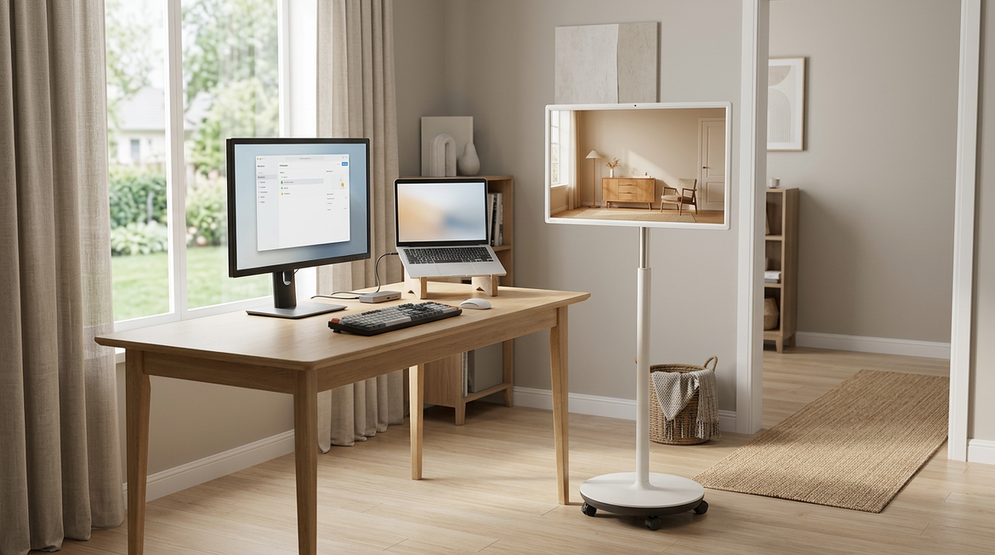
For procurement teams, EDLA certification combined with validated meeting-app performance is a more reliable indicator than marketing claims about 4K support. KTC’s MEGAPAD 32" 4K Android 14 Google EDLA Smart Touch Monitor with 8550mAh Battery and the similar Android 13 variant both carry this certification, making them practical choices for hybrid meeting rooms where native app support and battery-backed mobility matter.
Integrated vs. External Webcams: The 4.5-Meter Rule
Integrated 4K webcams deliver a clean, cable-free aesthetic that many IT managers prefer for huddle rooms and smaller conference spaces. When all participants sit within roughly 3–4 meters of the display, the wide-angle lens can capture the entire group at native resolution without heavy digital cropping.
Beyond approximately 4.5 meters, however, the fixed wide-angle optics force significant digital zoom. This cropping reduces effective resolution well below 1080p, introduces visible artifacts, and can make distant faces appear soft or pixelated even on a 4K sensor. Larger displays (75 inches and up) compound the problem by placing the top-mounted camera too high, creating an unflattering “looking-down” angle that undermines perceived eye contact.
U-shaped tables present additional challenges for integrated solutions, as side-seated participants fall outside the optimal field of view. External PTZ or center-of-table cameras allow flexible mounting at eye level and optical zoom that preserves detail across greater distances.
This optical breakpoint explains why many organizations treat integrated cameras as ideal for huddle spaces but default to dedicated external 4K cameras in deeper executive rooms. The scenario split is not about brand preference but about matching camera physics to room geometry.
Choosing the Right Smart Display Setup for Your Team
Huddle and focus rooms under 4.5 meters benefit most from EDLA-certified smart displays with integrated 4K cameras and physical shutters. The zero-cable design reduces setup time and visual clutter while delivering the video quality and privacy controls most teams need.
Standard boardrooms with moderate depth should verify that the display’s SoC can sustain 4K streams without audio drift or frame drops during hour-long meetings. EDLA certification plus tested Zoom or Teams performance provides the clearest signal of real-world reliability.
Deep executive rooms or spaces with U-shaped layouts usually perform better when the smart display acts as a central hub paired with a dedicated external PTZ camera and stronger hardware privacy controls. In these cases, the integrated webcam can remain available for quick huddle use while the external unit handles primary conferencing.
The KTC MEGAPAD 25" FHD Google EDLA Portable Touch Monitor built in Camera offers a compact, battery-powered option for smaller or mobile setups where full 4K may not be required. For teams balancing multiple room types, start by measuring typical participant distance and required privacy tier before narrowing product choices.
How Do Hardware Privacy Shutters Differ from Software Toggles in 2026?
Hardware shutters physically block the lens and are paired with a hardwired LED that cannot be overridden by software. Software toggles only disable the feed at the OS level and remain vulnerable to malware or administrative bypass. For executive or regulated environments, physical solutions provide auditable assurance that the sensor is truly inactive.
What Is the Practical Depth Limit for Integrated 4K Cameras in Meeting Rooms?
Most integrated wide-angle cameras maintain usable 4K quality up to about 4.5 meters. Beyond that distance, digital cropping typically reduces effective resolution below 1080p. Test your specific room layout; some newer dual-lens systems may extend this range slightly, but optical zoom on an external camera remains more reliable for larger spaces.
Why Does EDLA Certification Matter More Than Raw 4K Resolution for Android Smart Displays?
EDLA ensures native Google Play access, verified security updates, and hardware acceleration for meeting apps. Without it, sideloaded applications often default to mobile versions that cannot maintain stable 4K performance, leading to dropped frames and audio-video desynchronization during extended calls.
When Should Procurement Teams Choose an External Webcam Over an Integrated One?
Choose external when rooms exceed 4.5 meters, use large displays over 75 inches, or require precise eye-level framing for executive presentations. Integrated solutions remain preferable for compact huddle spaces where simplicity and a clean aesthetic are priorities.
How Can IT Managers Verify Real-World 4K Performance Before Deployment?
Run extended test calls in the actual meeting room using your organization’s standard platforms. Check for consistent frame rates, audio sync after 20–30 minutes, and effective resolution at typical seating distances rather than relying on manufacturer specifications alone.