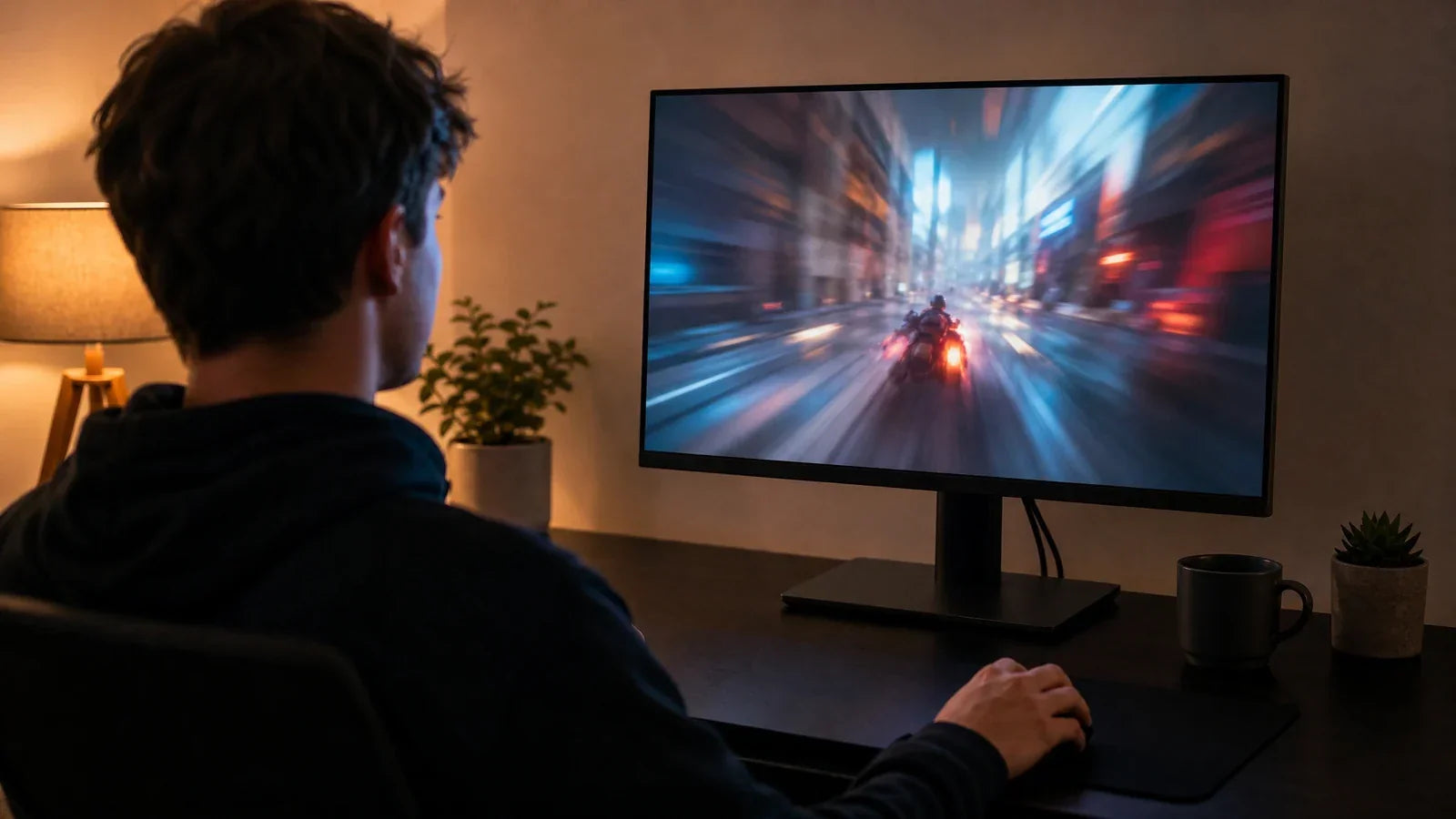
Experiencing horizontal splits across your monitor during fast-paced games can ruin your visual experience. This visual glitch, known as screen tearing, occurs when your hardware components fall out of synchronization. Fortunately, resolving this issue does not require buying a new computer. This guide explains the technical causes behind this problem and provides actionable software and hardware solutions to fix screen tearing permanently, ensuring your gameplay remains smooth and visually flawless.

What Exactly Is Screen Tearing?
Screen tearing is a specific visual artifact that appears on a display device, most commonly during video playback or 3D gaming. It manifests as a distinct horizontal line that splits the image into two or more mismatched sections.
When you look at the screen, the top half of the display shows one frame, while the bottom half displays an entirely different frame. Because the two frames represent different moments in time, the edges of objects, architecture, and characters do not align vertically. The image literally appears torn in half.
This visual error is most noticeable during fast horizontal camera movements. When you quickly pan your view in a first-person shooter or a racing game, the difference between consecutive frames is drastic. If a tear occurs during this rapid movement, the misalignment becomes highly visible and distracting to the user.
Why Does Screen Tearing Happen During Gameplay?
To understand how to fix screen tearing, you must first understand the relationship between your computer's internal hardware and your external display. The error is strictly a synchronization failure between these two components.
The Role Of The Graphics Processing Unit (GPU)
Your graphics card is responsible for rendering images. Depending on the complexity of the game and the power of the hardware, the GPU renders these frames at varying speeds. One second it might render 80 frames, and the next second it might render 120 frames. This variable output is known as your frame rate or FPS.
The Role Of The Monitor Refresh Rate
Unlike the GPU, a standard monitor operates at a fixed interval. The refresh rate, measured in Hertz (Hz), dictates exactly how many times per second the monitor redraws the screen. A 60Hz monitor draws a new image exactly 60 times per second, regardless of what the computer is doing.
The Synchronization Failure
Screen tearing happens when the GPU sends a new frame to the monitor while the monitor is currently in the middle of drawing the previous frame. Because the monitor cannot process two frames at once, it simply overwrites the bottom half of the screen with the new data. The result is two different frames displayed simultaneously on one screen.
How To Fix Screen Tearing Using VSync
Vertical Synchronization, commonly known as VSync, is the oldest and most widely available software solution to fix screen tearing. It is built into almost every modern PC game and graphics driver.
What Is Vertical Synchronization?
VSync forces your graphics card to wait for the monitor. When VSync is active, the GPU renders a frame and holds it in a buffer. The GPU will not send that frame to the display until the monitor begins its next refresh cycle. This guarantees that only one complete frame is drawn at a time, completely eliminating the visual tearing artifact.
Enabling VSync In-Game
You can enable VSync directly within the video or graphics settings menu of your video game. Simply navigate to the display options, locate the VSync toggle, and switch it to "On". Alternatively, you can force VSync globally for all applications through the NVIDIA Control Panel or AMD Adrenalin software.
The Drawbacks Of VSync
While VSync is an effective way to fix screen tearing, it introduces input lag. Because the GPU holds frames in a buffer waiting for the monitor, there is a slight delay between your mouse movement and the action appearing on the screen. Additionally, if your GPU cannot maintain a frame rate equal to the monitor's refresh rate, VSync will cause the game to stutter heavily.

Fix Screen Tearing With NVIDIA G-Sync
Hardware manufacturers developed Variable Refresh Rate (VRR) technologies to solve the input lag and stuttering problems caused by standard VSync. For users with NVIDIA graphics cards, G-Sync is the premier solution.
How G-Sync Works
G-Sync fundamentally reverses the traditional display relationship. Instead of forcing the GPU to wait for the monitor, G-Sync forces the monitor to wait for the GPU. The monitor dynamically adjusts its refresh rate in real-time to match the exact frame rate output of the graphics card. If the GPU outputs 73 frames per second, the monitor operates at 73Hz.
Hardware Requirements For G-Sync
To utilize this feature, you must own a compatible NVIDIA graphics card and a G-Sync certified monitor. Furthermore, you must connect the monitor to the graphics card using a DisplayPort cable. G-Sync does not function over older HDMI connections on PC monitors.
How To Enable G-Sync In The Control Panel
Right-click your desktop and open the NVIDIA Control Panel. Navigate to the "Display" section and select "Set up G-SYNC". Check the box that says "Enable G-SYNC, G-SYNC Compatible". Apply the settings. You should also go to "Manage 3D Settings" and ensure the Monitor Technology is set to G-SYNC to guarantee smooth, tear-free gameplay.
Fix Screen Tearing With AMD FreeSync
If you use an AMD graphics card, FreeSync is your equivalent solution to fix screen tearing. It utilizes the same Variable Refresh Rate (VRR) principles as G-Sync but relies on the open VESA Adaptive-Sync standard.
How FreeSync Functions
FreeSync synchronizes the display's refresh rate with the AMD Radeon graphics card's frame rate. By dynamically altering the refresh cycle to match the render time of each frame, FreeSync eliminates tearing without introducing the heavy input lag associated with traditional software VSync.
FreeSync Tiers Explained
AMD categorizes its technology into three tiers. Standard FreeSync eliminates tearing and reduces latency. FreeSync Premium adds Low Framerate Compensation (LFC), which maintains smooth visuals even if your frame rate drops below the monitor's minimum refresh range. FreeSync Premium Pro includes all previous features while adding strict color and luminance requirements for High Dynamic Range (HDR) gaming.
Enabling FreeSync In AMD Adrenalin
Open the AMD Radeon Software Adrenalin application. Click the gear icon to access settings, then navigate to the "Display" tab. Locate the AMD FreeSync option and toggle it to "Enabled". Ensure your monitor's internal hardware menu also has the FreeSync or Adaptive-Sync feature turned on.
How Capping Your Frame Rate Prevents Visual Glitches
If your graphics card generates 200 frames per second on a 60Hz monitor, the excess frames will inevitably cause screen tearing. Limiting your frame rate manually is a highly effective way to stabilize your display.
Using In-Game Frame Limiters
Most modern video games include a maximum frame rate slider in their video settings. By capping your frame rate exactly at your monitor's maximum refresh rate (for example, setting the cap to 60 FPS on a 60Hz monitor), you prevent the GPU from sending excess frames. This drastically reduces the occurrence of tearing.
Using Third-Party Software
If a game lacks an internal limiter, you can use external software. The RivaTuner Statistics Server (RTSS) is widely considered the most accurate frame rate limiter available. Alternatively, you can use the Max Frame Rate setting located within the NVIDIA Control Panel or the Radeon Chill feature in the AMD Adrenalin software.
Setting The Optimal Limit For VRR
If you are using G-Sync or FreeSync, capping your frame rate is still necessary. You should always cap your frame rate at least three frames below your monitor's maximum refresh rate (e.g., 141 FPS on a 144Hz monitor). This keeps the frame rate within the active VRR window and prevents standard VSync from taking over and causing input lag.
Update Your Graphics Drivers And Windows Settings
Sometimes, screen tearing persists despite using VSync or VRR technologies. In these cases, outdated software or incorrect operating system configurations are the root cause.
Installing Clean GPU Drivers
Corrupted or outdated graphics drivers fail to communicate properly with the monitor. Download the latest drivers directly from the NVIDIA or AMD website. During installation, select the "Clean Install" option. This removes old driver profiles and resets all 3D settings to their defaults, effectively resolving deep-seated synchronization errors.
Configuring Windows Display Settings
Windows does not always detect your monitor's maximum refresh rate automatically. If Windows sets your 144Hz monitor to 60Hz, you will experience severe tearing. Go to Windows Settings, select System, and click Display. Scroll down to Advanced Display Settings and locate the Refresh Rate dropdown menu. Select the highest available number to ensure Windows utilizes your monitor's full hardware capabilities.
Checking Your Display Cable Capabilities
Physical hardware limitations cause data bottlenecks. Older cables, such as HDMI 1.4 or standard VGA, lack the bandwidth to transmit high refresh rates at high resolutions. To utilize high frame rates and VRR technologies, you must use a DisplayPort 1.2 (or higher) cable or an HDMI 2.1 cable directly connected to your graphics card.
Stop Screen Tearing for Good
Understanding hardware synchronization is the key to achieving a flawless display. Whether you choose software limiters, traditional VSync, or variable refresh rate technologies like G-Sync and FreeSync, you now have the knowledge to fix screen tearing effectively. By matching your graphics card output to your monitor capabilities, you eliminate visual distractions and guarantee a smooth, responsive computing experience for both competitive gaming and daily tasks.
FAQs about screen tearing causes and fixes
Does a higher refresh rate monitor eliminate screen tearing?
A higher refresh rate monitor (such as 144Hz or 240Hz) does not completely eliminate the issue, but it makes the tearing much less noticeable. Because the screen updates so rapidly, the torn frames remain on the screen for a much shorter duration, making them harder for the human eye to detect. However, you still need to use VRR or VSync to eliminate it entirely.
Does screen tearing damage my monitor?
No, screen tearing cannot cause physical damage to your monitor or your graphics card. It is purely a visual anomaly caused by a software and hardware communication delay. While it is distracting and can cause eye strain or headaches during long sessions, your hardware components remain perfectly safe.
Can a bad HDMI or DisplayPort cable cause screen tearing?
A faulty cable typically causes total signal loss, black screens, or colored static (snow). While a bad cable does not directly cause screen tearing, using an outdated cable specification that restricts your monitor's refresh rate to 60Hz will indirectly increase the frequency of tearing. Upgrading to a high-bandwidth DisplayPort cable ensures proper hardware synchronization.