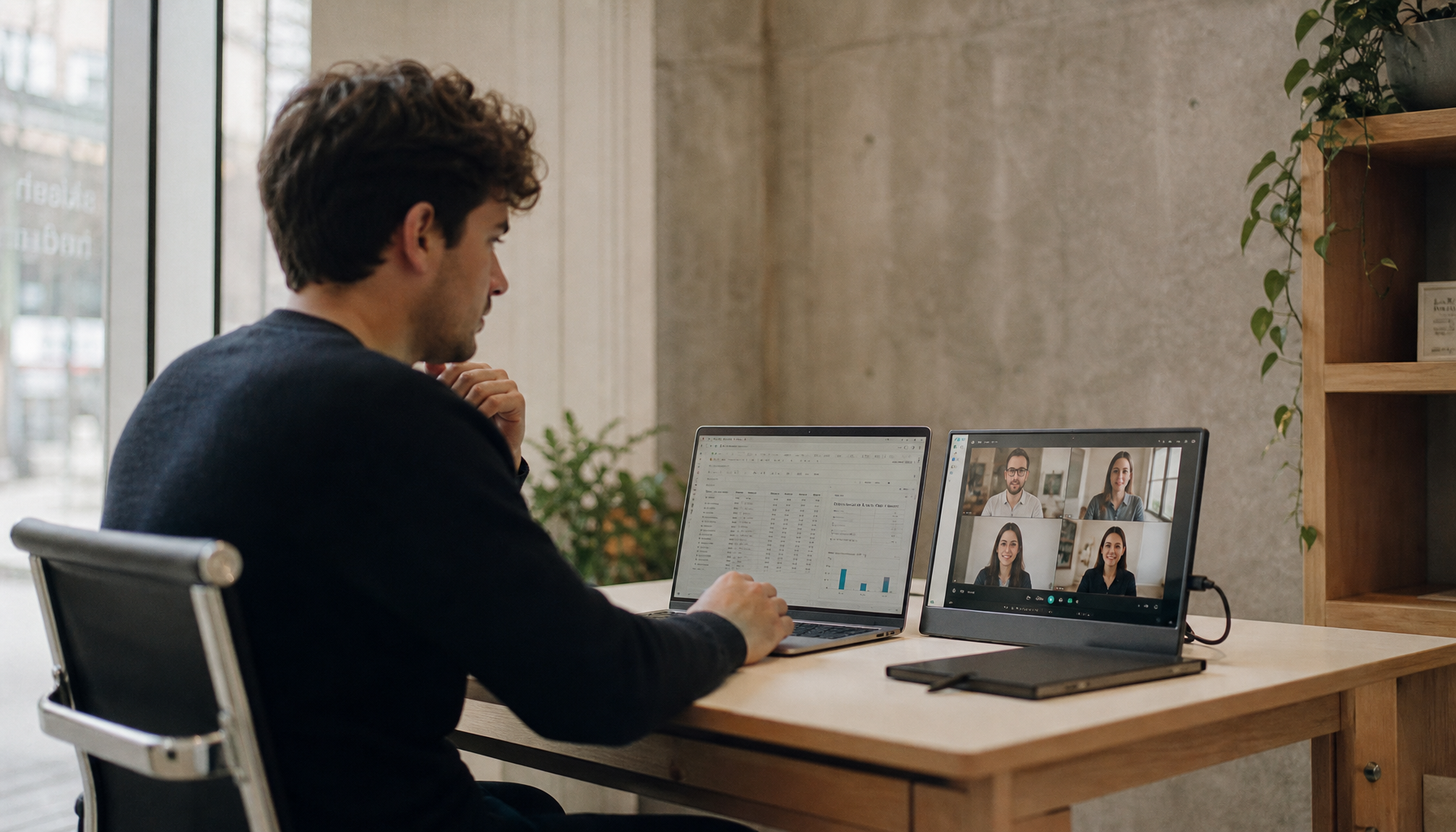
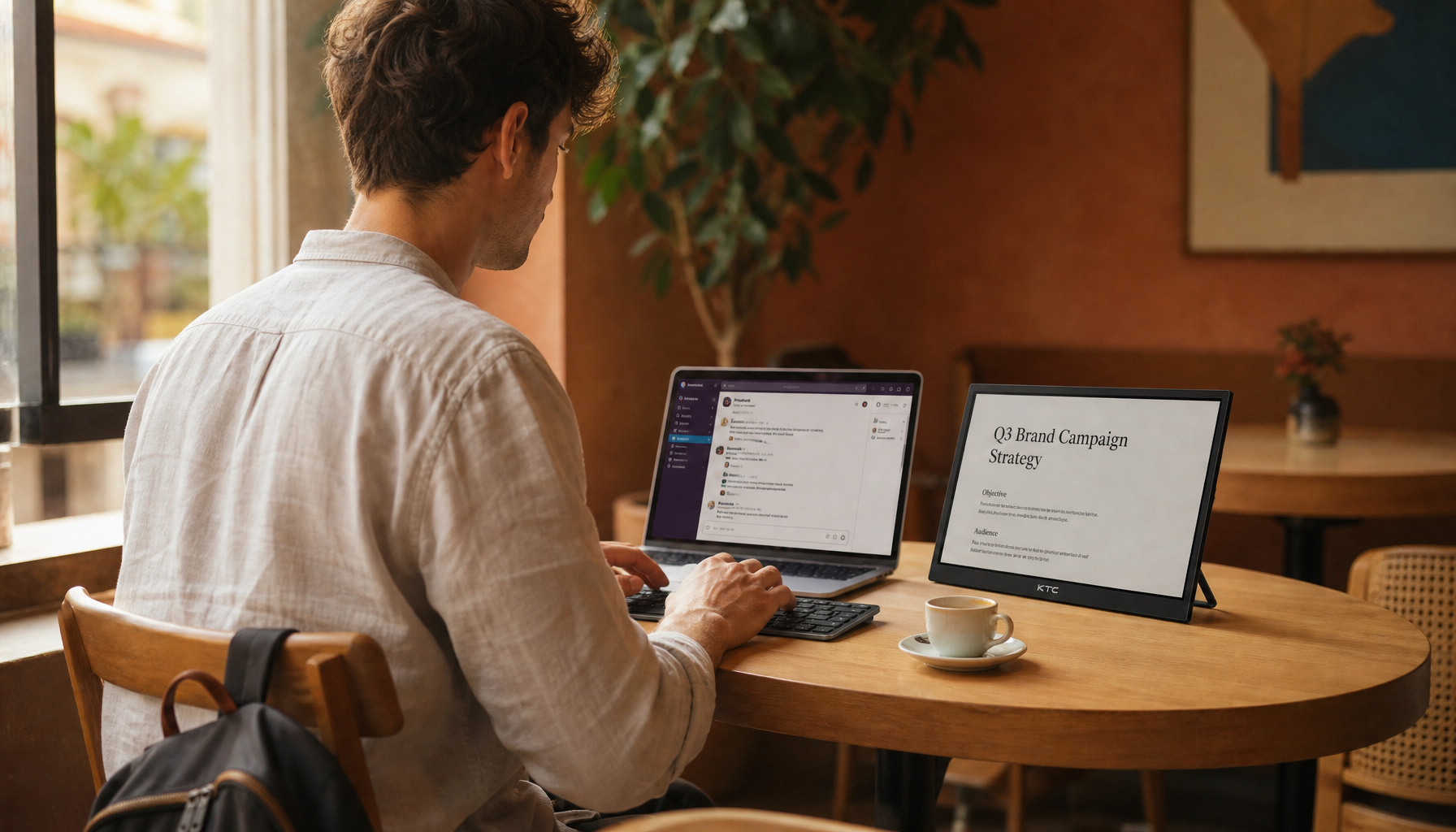
Sharing one monitor between a work MacBook and a gaming PC is entirely possible in 2026 and delivers a clean hybrid hot desk for prosumer users who switch between productivity and high-performance gaming. The key is matching your specific Mac chip tier and PC GPU outputs to a monitor with strong USB-C Power Delivery, multiple high-bandwidth inputs, and a reliable switching method—while accepting that perfect seamlessness often requires a few workflow adjustments rather than pure plug-and-play.

Planning Your Hybrid Desk: Hardware Limits and Expectations
Can your specific Mac and PC even share one monitor without losing performance? The answer depends first on your Mac’s silicon. Apple Silicon MacBooks have strict limits on the number of external displays they can drive natively: base M1/M2/M3 chips typically support only one external monitor, while Pro and Max variants support between two and four depending on the generation and whether the laptop lid is closed. This Apple support document on display limits sets the realistic boundary before you invest in any shared-monitor hardware.
Your gaming PC’s GPU output must also align with the monitor. Modern RTX 40- and 50-series cards favor HDMI 2.1 for full 4K at 144 Hz+ with Variable Refresh Rate (VRR). On the Mac side, M2 Pro and later chips can drive 4K at up to 240 Hz over HDMI 2.1, so a capable monitor does not waste the PC’s refresh-rate advantage. The practical goal is one-cable USB-C docking for the MacBook while preserving full gaming performance on the PC.
Most users in a compact apartment or shared workspace will benefit from this setup, but those with base-model Macs that cannot drive even one high-refresh external display should consider a dedicated work monitor instead. This home office ergonomic monitor guide helps evaluate whether your current desk and posture support a single large shared panel.
The Connection Blueprint: USB-C vs. HDMI and DisplayPort
Which cables should you use to connect your Mac and PC to the same screen? USB-C with Power Delivery (PD) is the closest thing to a one-cable solution for the MacBook. Monitors such as the KTC H27P6 and G27P6 supply 90 W USB-C PD, which is sufficient for most 14-inch MacBook Pro workflows and all MacBook Air models. However, a 16-inch MacBook Pro under heavy load prefers 140 W for fast charging; 90 W often results in slow battery drain during sustained 100 % CPU or GPU use. This Apple fast-charge guidance explains the exact wattage thresholds.
HDMI 2.1 remains essential for the gaming PC when targeting 4K at 144 Hz or higher with VRR and HDR. DisplayPort 1.4 or 2.0 works equally well if your GPU and monitor support it. USB-C Alt Mode shares lanes among video, data, and power, so driving 4K video can sometimes drop peripheral USB speeds to 2.0 levels—an acceptable compromise for most users but worth testing if you rely on high-speed external storage.
The DisplayPort Alternate Mode over USB-C explainer and USB-C monitor workspace guide provide deeper lane-sharing details that help you avoid unexpected bandwidth bottlenecks.

Built-in Monitor KVM vs. Dedicated Hardware: Choosing Your Switch
Is the built-in KVM in your monitor enough, or do you need an external switch? For minimalist mid-range setups the built-in KVM found on models like the KTC G27P6 offers real convenience. It lets you toggle between sources with one button or joystick and often includes integrated USB hubs for peripherals.
However, many built-in monitor KVMs lack full EDID emulation. When you switch inputs, macOS can treat the monitor as disconnected, causing all windows to snap back to the laptop screen in what users call “window vomit.” Dedicated KVMs from brands such as AV Access or Plugable maintain a constant EDID signal, preventing layout scrambling. They also better support the bandwidth and handshake demands of RTX 50-series cards using VRR and Display Stream Compression (DSC).
When Built-In Monitor KVM Stops Being Enough for a Mac + PC Hot Desk
A threshold view of the conditions that usually push a built-in monitor KVM from “good enough” toward dedicated hardware.
View chart data
| Category | Fit for built-in monitor KVM | Need dedicated hardware |
|---|---|---|
| Single 4K60 office setup | 1 | 0 |
| 2×4K60, Mac + PC | 1 | 0 |
| 14-inch MBP + high refresh | 0 | 1 |
| 16-inch MBP + sustained charging | 0 | 1 |
| RTX gaming PC + VRR/DSC | 0 | 1 |
| EDID-sensitive layout stability | 0 | 1 |
The chart above visualizes the decision thresholds. Users running a single 4K 60 Hz productivity workload or a 14-inch MacBook with moderate refresh needs usually stay happy with a monitor’s built-in KVM. Once you add a 16-inch MacBook Pro under sustained load, an RTX gaming PC demanding VRR/DSC, or multi-window layouts that cannot tolerate rearrangement, dedicated hardware becomes the safer choice. This insight module on the 2026 KVM breaking point highlights that 90 W PD may suffice for lighter machines yet leads to battery depletion on 16-inch models, and wake-from-sleep handshake failures remain common with some built-in controllers.
Beyond the Switch: Sharing Peripherals Without the Friction
How do you use one keyboard and mouse across both systems seamlessly? A hardware KVM handles video and peripherals together, but software solutions can sometimes suffice if you only need to share input devices. Synergy (and its open-source fork Input Leap) lets you move a single mouse and keyboard between the Mac and PC over your local network. This Synergy project page details the cross-platform workflow that works for most hybrid users.
Multi-device mice such as Logitech’s Flow series offer another low-friction path: the cursor flows naturally between screens when the computers sit on the same network. Avoid Microsoft’s Mouse Without Borders; the utility is currently limited to Windows-only environments and cannot bridge macOS and Windows. This Microsoft documentation confirms the platform restriction.
For many prosumer setups the cleanest experience still comes from routing peripherals through a KVM that also switches the video feed, eliminating any network dependency or slight input lag that software sharing can introduce.
Eliminating the 'Toggle Tax': Automating HDR and Productivity Modes
How do you stop manually fiddling with monitor settings every time you switch systems? The daily “toggle tax” of opening the on-screen display (OSD) to change HDR, local dimming, or brightness becomes noticeable on Mini-LED or OLED panels. On Windows 11 the native Win+Alt+B shortcut toggles HDR without touching the monitor. On macOS, BetterDisplay is nearly mandatory; it enables XDR brightness emulation on SDR content and removes the washed-out look that can appear when the monitor’s HDR mode is left permanently on.
For monitors with aggressive local dimming, the pragmatic approach is to leave that hardware feature enabled globally and control only the OS-level HDR signal. This insight module on automating the KTC hybrid gap notes that DDC/CI commands can be unreliable across certain firmware versions, so mapping your workflow to OS hotkeys reduces frustration. The same USB-C monitor workspace guide that helped with cabling also covers software tools that streamline daily mode switching.
Troubleshooting the Hybrid Gap: Wake Failures and Signal Handshakes
What do you do if your monitor won’t wake up or your windows keep scrambling? Apple Silicon Macs occasionally fail to wake certain monitor controllers, requiring a cable reseat or power cycle. Keeping the monitor’s firmware current is the first and most reliable fix. EDID ghosting—where the operating system believes the display has been physically unplugged—remains the leading cause of window rearrangement; dedicated KVMs with proper EDID emulation largely eliminate it.
If you experience repeated “no signal” loops, verify that the USB-C cable supports full Alt Mode and that the monitor’s USB hub is not drawing excessive power. Most of these issues are firmware- or handshake-dependent rather than fundamental incompatibilities, but they underscore why the article’s decision frame treats built-in convenience as sufficient only when your workflow tolerates occasional manual intervention.
The 2026 Hybrid Desk Decision: Which KTC Monitor Fits Your Workflow?
Which KTC model should you buy for your specific Mac and PC setup? The choice hinges on whether your day is gaming-primary or productivity-primary and how much burn-in risk you are willing to accept.
The KTC OLED 27" 2K 240Hz/0.03ms USB-C Gaming Monitor | G27P6 suits users who spend most hours in Windows gaming and treat the MacBook mainly as a secondary productivity device. Its perfect blacks and ultra-low response time shine for immersive titles, while 90 W USB-C handles lighter Mac workloads.
For balanced 8-hour productivity sessions plus HDR gaming, the KTC Mini LED 27" 4K 160Hz HDR1400 Gaming Monitor | M27P6 removes burn-in worry thanks to its 1,152-zone backlight and still delivers excellent contrast. The KTC 27" 4K 160Hz/320Hz 90W Gaming Monitor | H27P6 offers a flexible refresh-rate toggle that works well when the same panel must serve both crisp text editing and high-frame-rate gaming.
Those needing maximum screen real estate for Mac multitasking and immersive PC gaming should consider the KTC 49" DQHD 180Hz 1000R Curved Gaming monitor丨H49S66. Its ultra-wide canvas turns the single monitor into a virtual dual-screen environment without the bezel gap, though the curve may require slight adjustment for text-heavy Mac work.
Check your exact Mac model’s power and display requirements before purchase. A 16-inch MacBook Pro under heavy load or an RTX 50-series PC pushing maximum VRR may still benefit from adding a dedicated KVM even when paired with these monitors.
Frequently Asked Questions
Can One Monitor Truly Serve Both a MacBook and a Gaming PC? Yes, provided your Mac chip supports the desired external resolution and refresh rate and your monitor offers compatible inputs. Base M-series chips limit you to a single display, while Pro/Max chips give more flexibility. The main remaining friction is usually EDID behavior or power delivery rather than raw video compatibility.
Does USB-C Power Delivery on KTC Monitors Fully Charge a 16-inch MacBook Pro? It maintains the battery for most mixed workloads at 90 W, but sustained maximum loads can cause gradual drain because Apple recommends 140 W for fastest charging on the 16-inch model. Users who keep the laptop plugged in during light tasks rarely notice an issue.
Will a Built-in Monitor KVM Cause Window Rearrangement on macOS? Often yes, because many built-in KVMs do not emulate EDID. macOS sees the signal drop and resets window positions. Dedicated KVMs with EDID emulation largely prevent this; software tools like BetterDisplay can also help stabilize layouts.
Is Software KVM a Good Alternative to Hardware Switching? For peripheral sharing only, tools like Synergy or Input Leap work well and remove extra cables. They cannot switch the video feed, so a hardware KVM or manual source button on the monitor is still required if you want one shared display.
How Do I Minimize the Daily Toggle Tax on HDR and Local Dimming? Use OS-level hotkeys—Win+Alt+B on Windows and BetterDisplay on macOS—rather than the monitor’s OSD. Leave hardware features such as local dimming set to “On” globally and control only the signal type from the operating system.
Do I Need to Update Monitor Firmware for Reliable Mac Wake-from-Sleep? Yes. Many reported wake failures with Apple Silicon improve after firmware updates. Check the manufacturer’s support page regularly and keep the monitor on the latest controller version.
Which Setup Is Better for a Small Apartment: Ultra-Wide or Standard 27-Inch? An ultra-wide like the KTC H49S66 replaces two monitors in limited space and gives a continuous canvas for Mac multitasking. A standard 27-inch 4K model paired with a dedicated KVM is simpler if you prefer sharper pixel density for long text-editing sessions.