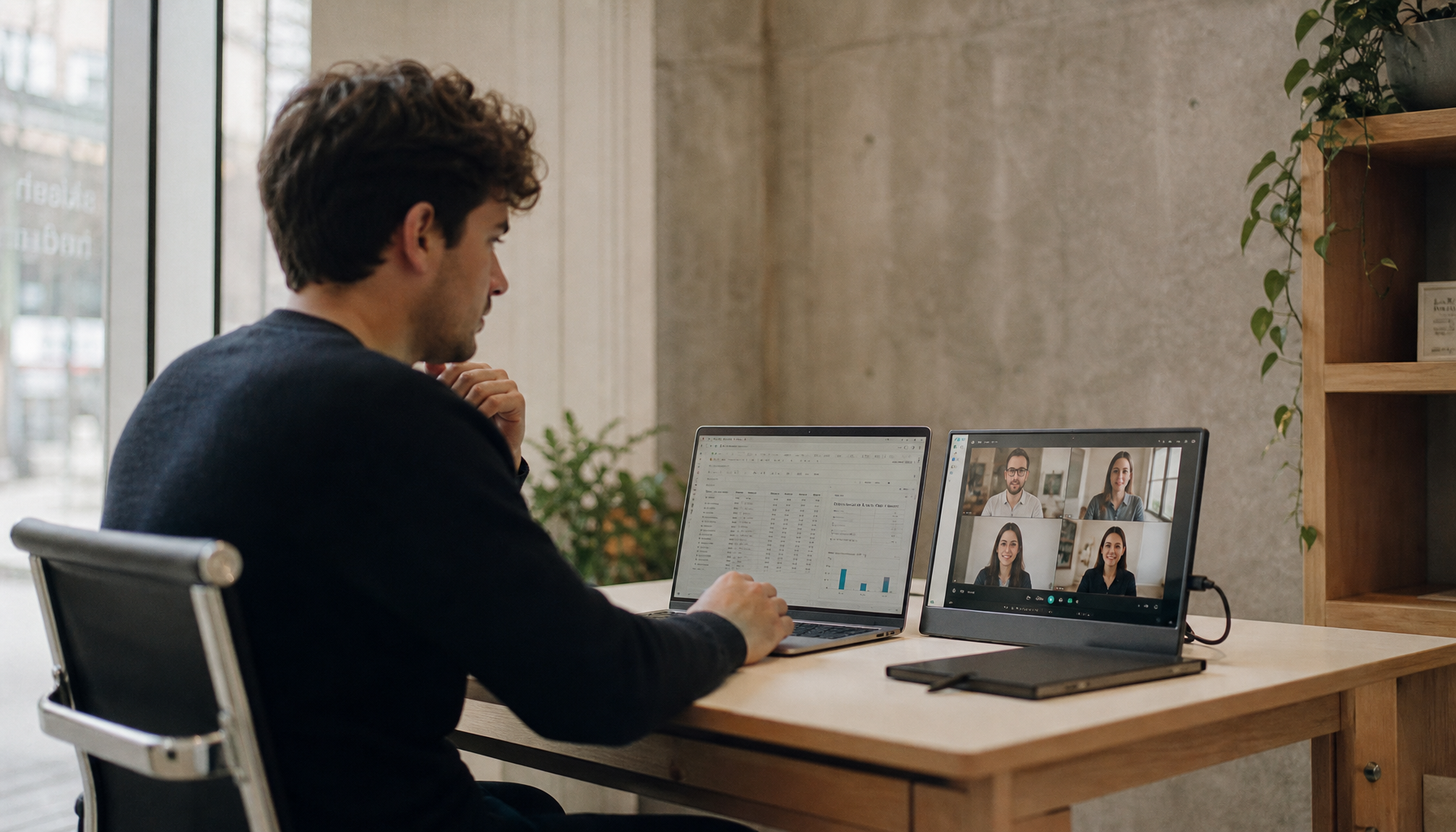
Dual 4K monitors deliver measurable productivity gains for coding and graphic design professionals by reducing tab switching and enabling simultaneous reference views. Research indicates productivity can rise by 42-50% in complex multitasking scenarios, especially when using high-PPI panels that keep syntax crisp and colors faithful. The key decision is matching panel type and layout to your specific ratio of dark-mode coding versus HDR design work while maintaining ergonomics that prevent neck strain over long sessions.

Why Dual 4K Monitors Define the 2026 Professional Workspace
Professionals who split time between code and creative tools often experience tab-switching fatigue that slows output. A dual-monitor configuration addresses this directly by providing dedicated real estate for IDEs, documentation, design canvases, and reference palettes at the same time. Studies suggest these setups can boost productivity by up to 42-50% for complex multitasking, making the investment worthwhile for developers and designers who bill by the hour or juggle tight deadlines.
At 27 inches, 4K resolution delivers approximately 163 PPI, which keeps text sharp and syntax highlighting distinct without the blur common in lower-resolution panels on macOS or Windows scaling. This clarity matters because 1440p panels frequently force users into suboptimal scaling that softens fonts and reduces readability during long coding sessions. The result is less eye strain and fewer context switches, directly translating to faster workflow completion.
For hybrid users, the ROI appears in reduced physical fatigue and improved accuracy. Designers benefit from side-by-side color-accurate previews, while coders maintain full documentation visibility without constant window juggling. However, these gains only materialize when the monitors match your primary tasks—mismatched scaling or poor ergonomics can negate the benefit.
Balancing Color Accuracy and Text Clarity: The Mini-LED vs. IPS Decision
Choosing between Mini-LED and IPS comes down to whether your workflow prioritizes high-contrast design visuals or halo-free text in dark-mode coding environments. Mini-LED panels deliver strong HDR impact for design work through local dimming zones, yet they can introduce blooming around bright UI elements on dark backgrounds. IPS panels trade some contrast for uniform color consistency and wider viewing angles, which often feels more natural across a dual-monitor V-shape.

Many professionals with burn-in concerns prefer Mini-LED as a safer long-term option for static IDE toolbars and taskbars compared to OLED. Delta E < 2.0 serves as the professional benchmark for color accuracy in graphic design, with ΔE ≤ 1.0 representing the ideal tier for commercial-grade consistency. This LinkedIn post on color accuracy standards highlights why designers target these thresholds.
A common friction is the SDR toggle tax on many Mini-LED models: users must manually disable local dimming for clean dark-mode coding, then re-enable it for HDR design reviews. Light-mode users notice almost no blooming, while dark-mode developers may find the effect distracting. IPS avoids this adjustment entirely and maintains better color consistency when viewing both screens at slight angles.
Panel Fit for Coding Comfort vs HDR Design Impact
A decision aid for choosing among IPS, Mini-LED, and OLED when your work mixes dark-mode coding with HDR-focused design review.
View chart data
| Panel Technology | Dark Mode Coding Comfort | HDR Design Impact | Viewing-Angle Consistency | Burn-in Risk Tolerance Need |
|---|---|---|---|---|
| IPS | High | Low | Medium | Low |
| Mini-LED | Medium | Medium | Medium | Medium |
| OLED | Medium | High | High | High |
This chart helps visualize the trade-offs. Switch to IPS if your day is mostly dark-mode coding and you prefer zero adjustments. Choose Mini-LED if HDR design impact outweighs occasional blooming and you want to avoid OLED burn-in concerns for static UI elements.
Ergonomic Positioning: How to Arrange Dual 27-Inch Monitors for Maximum Comfort
Neck pain and eye strain often appear after weeks of suboptimal monitor placement. The V-shape arrangement creates a semi-circular viewing arc that keeps both screens at roughly equal focal distance, reducing the need for constant head turning. Angle each monitor inward by 10-30 degrees so your eyes travel naturally across the workspace.
A vertical stack works better for reference-heavy design workflows, placing mood boards or palettes on the upper screen and the active canvas below. This layout reduces horizontal head movement but requires careful height adjustment to avoid tech neck. OSHA recommends positioning the top of the primary screen at or slightly below eye level so you view the display without tilting your head upward. The OSHA monitor guidance provides clear baselines for workplace safety.
CCOHS suggests a viewing distance of 40-70 cm (roughly arm's length) to minimize fatigue. With 163 PPI 4K panels, you may need slightly more depth on the desk to maintain comfortable angles in the V-shape. Our guide to vertical versus horizontal dual monitor setups explores these arrangements in detail.
Streamlining Your Workflow with USB-C Power Delivery and Proper Calibration
One-cable USB-C setups promise simplicity but introduce real-world friction for Mac users. Many KTC monitors deliver 90W power delivery that can simultaneously charge a laptop while driving dual 4K displays. However, heavy rendering or high-brightness HDR workloads can cause power sag, leading to gradual battery drain on some 16-inch MacBook Pros.
Wake-up issues on Apple Silicon often require replugging the cable or using tools like BetterDisplay for reliable EDID handshakes. These problems remain intermittent and usually fixable with software workarounds rather than hardware limitations. Factory calibration to Delta E < 2.0 gives a strong starting point for design work, yet periodic hardware calibration helps maintain accuracy over years of use.
Learn more about single-cable convenience in our USB-C monitor guide. Proper calibration also ties into understanding color metrics, as explained in our article on what Delta E values mean for creative work.
Selecting the Right KTC Hardware for Your Coding and Design Needs
Your specific coding-to-design ratio should drive the final hardware choice. For users who need exceptional color volume and high-resolution text, the KTC H27P3 offers 5K@60Hz capability on an IPS panel with 99% DCI-P3 coverage and 90W USB-C. This model suits Mac-centric professionals who value pixel density for sharp syntax and accurate design previews.
Designers who prioritize contrast for HDR review while maintaining burn-in safety often prefer the KTC M27P6 Mini-LED model. Its 1152 local dimming zones deliver strong HDR performance without the static-image risks of OLED. For budget-conscious users who still want 4K sharpness, the KTC H27P27 provides solid IPS performance with low blue light features and flicker-free operation.
Explore the full range in our office monitor collection or the dedicated 4K monitor collection. The 27 inch monitors collection makes size comparison straightforward.
Before purchasing, verify that your chosen model matches your dominant workflow. If most of your day involves dark-mode coding with occasional design, an IPS panel like the H27P27 or H27P3 typically creates fewer daily adjustments. Mini-LED models shine when HDR impact is a regular requirement.
Our home office ergonomic monitor guide and productivity monitor buying guide offer additional checklists for final selection.
FAQs
What resolution is best for a dual monitor coding and design workspace in 2026?
4K at 27 inches (163 PPI) is the practical baseline for most professionals. It delivers sharp text for code without the scaling artifacts common in 1440p on macOS, while providing enough pixel real estate for detailed design work. Higher resolutions like 5K add value primarily for users who frequently view intricate vector files or need extreme font clarity.
Should I choose IPS or Mini-LED panels for mixed coding and graphic design?
Choose IPS if your workflow is predominantly dark-mode coding and you want zero daily adjustments for blooming. Select Mini-LED when HDR design impact is equally important and you prefer avoiding OLED burn-in risks with static UI elements. The decision ultimately depends on how often you switch between light and dark interfaces.
What is the best ergonomic arrangement for two 27-inch monitors?
A slight V-shape with monitors angled inward usually minimizes neck rotation for most users. Vertical stacking works better when one screen primarily holds static references such as mood boards or documentation. Keep the top of your primary screen at or just below eye level and maintain 40-70 cm viewing distance.
How do I fix USB-C wake issues with dual monitors on Mac?
Many users resolve intermittent wake problems with BetterDisplay or by adjusting sleep settings. While 90W USB-C PD works reliably for most tasks, heavy workloads may still require a separate charger to prevent battery sag. Test your specific laptop-monitor combination before relying on single-cable operation.
Do I need hardware calibration for professional design work?
Factory Delta E < 2.0 provides a strong foundation, but periodic hardware calibration helps maintain consistency over time, especially in color-critical projects. For most freelancers and in-house designers, factory calibration plus proper room lighting delivers sufficient accuracy without specialized tools.
Can a dual monitor setup replace a single ultrawide for developers?
Yes for many workflows. Dual 27-inch 4K panels give more flexible window positioning and easier portrait orientation for documentation. Ultrawides can feel more seamless for certain video or spreadsheet tasks, but separate monitors often prove more practical when running different applications side by side.