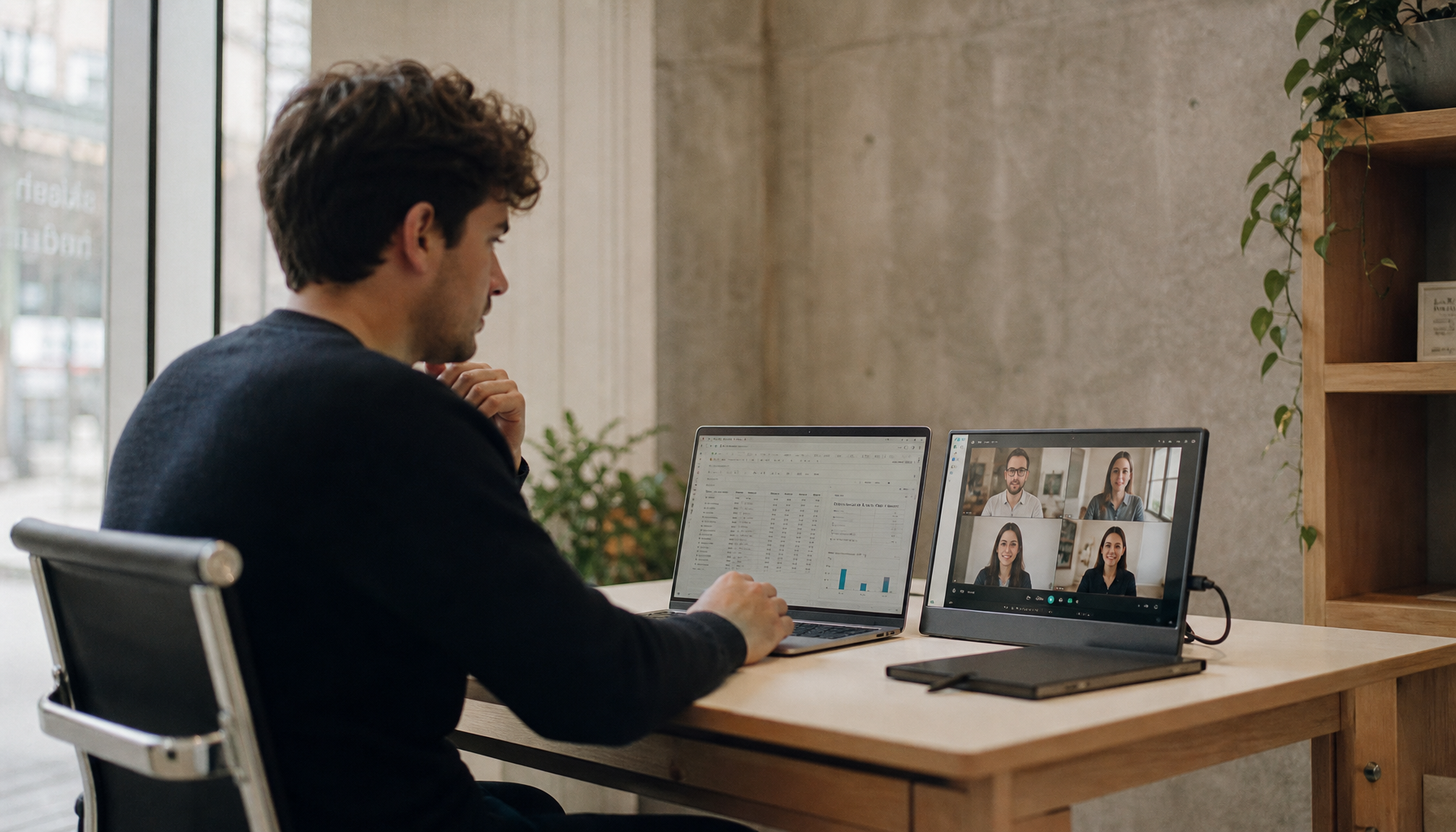
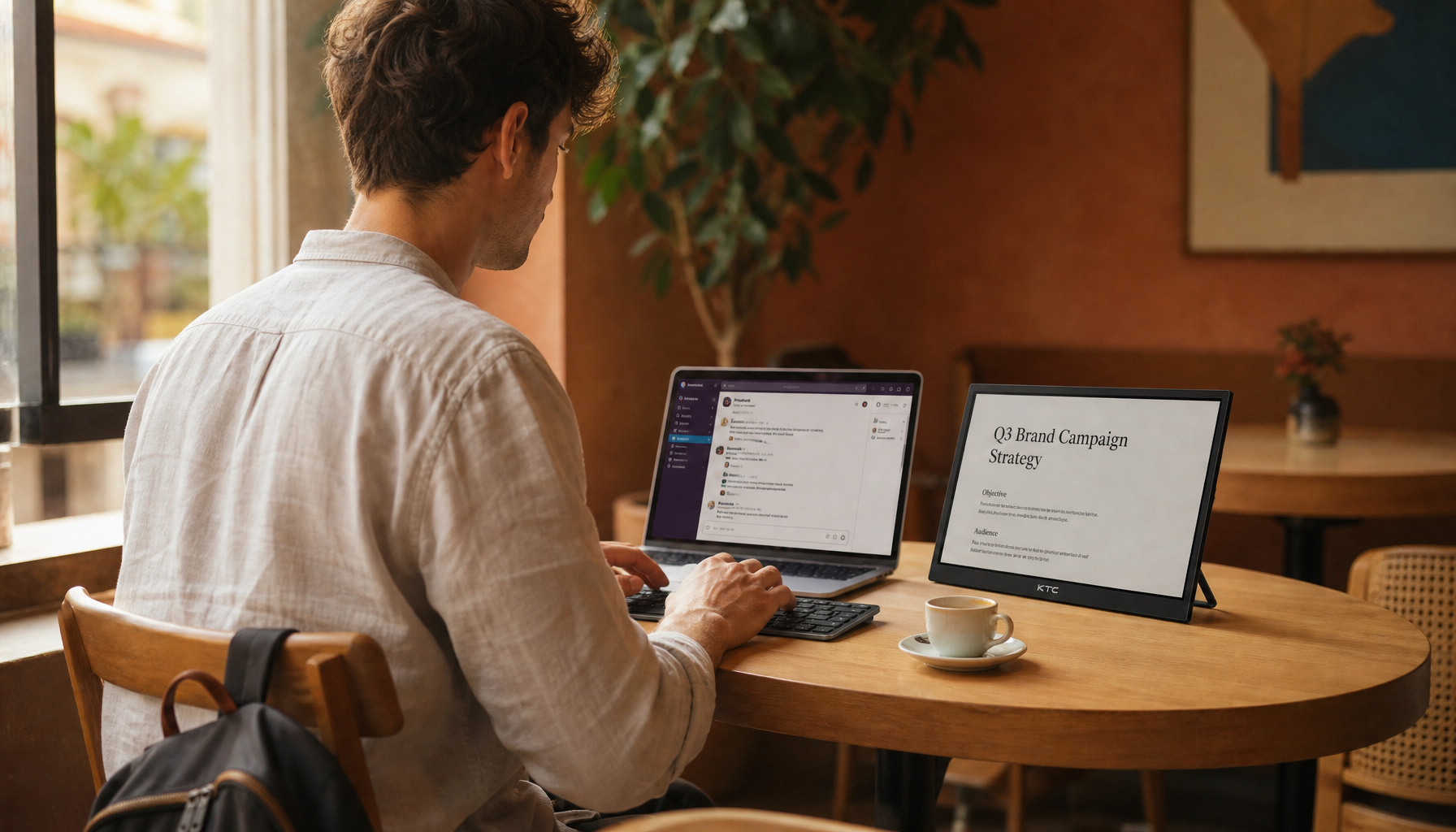
Building a hybrid desk that seamlessly switches between MacBook productivity work and high-end PC gaming is a common goal for prosumers. A single high-quality monitor with integrated KVM switching serves as the central hub, letting you share one display, keyboard, mouse, and peripherals while preserving color accuracy for creative tasks and high refresh rates for responsive gameplay.

The core challenge is balancing competing needs without cable clutter or workflow friction. Traditional office monitors often lack the refresh rate and low input lag needed for smooth gaming, while many gaming monitors compromise on text clarity, color accuracy, or risk burn-in during long static work sessions. The solution lies in selecting a versatile display that acts as the brain of your desk, handling both systems intelligently.
The Hybrid Desk Challenge: Productivity vs. Play
Managing two distinct systems on one desk quickly creates friction. You face repeated cable swapping, peripheral reconfiguration, and display compromises that disrupt focus. A MacBook workstation typically demands sharp text rendering, wide color gamut for accurate creative work, and stable power delivery. A gaming PC, on the other hand, prioritizes high refresh rates, low latency, and HDR contrast for immersive play.
Many users start with separate monitors, but this doubles desk space and input devices. A single-monitor hybrid setup resolves this by routing everything through one display that supports multiple inputs and automatic switching. The key is choosing a monitor whose panel technology and ports match both worlds without major trade-offs.
Office-oriented displays frequently top out at 60-100Hz, which feels limiting in fast-paced games where higher refresh rates reduce motion blur and improve perceived smoothness. Gaming displays, particularly OLED models, can suffer from text fringing or permanent burn-in risk when left on spreadsheets or code editors for hours. This tension makes a purpose-built hybrid monitor essential for users who split their day between professional applications and evening gaming sessions.
Choosing Your Hub: Color for Work, Speed for Play
The right monitor for a hybrid MacBook and PC setup must deliver professional-grade color accuracy during the day and gaming-grade speed at night. Mini-LED technology stands out here because it offers high peak brightness—often exceeding 1000 nits in HDR—along with precise local dimming zones that maintain deep blacks without the burn-in risks associated with OLED panels in static productivity environments.
For most hybrid users, a 27-inch 4K panel strikes the best balance. Models like the KTC M27P6 provide ΔE<2 color accuracy, 99%+ DCI-P3 coverage for creative work, and a 160Hz refresh rate that supports smooth gaming on both systems. Its 1152 local dimming zones deliver HDR1400-level contrast, making it suitable for both photo editing and immersive titles. The built-in 90W USB-C Power Delivery further simplifies the MacBook connection.
If your workflow leans toward multitasking or simulator-style games, consider a super-ultrawide option such as the KTC H49S66. This 49-inch 5120x1440 curved display offers a panoramic workspace that replaces dual monitors for productivity while delivering 180Hz performance for racing or flight sims. Its integrated KVM and strong color performance make it a strong all-in-one hub.
For text-heavy professionals who game casually, the KTC H27P3 delivers 5K resolution at 60Hz (or 1440p at 120Hz in dual-mode). The ultra-sharp pixel density benefits macOS scaling and design applications, while the 120Hz option provides acceptable smoothness for lighter gaming without sacrificing color fidelity. Whichever model you choose, prioritize Mini-LED or high-quality IPS panels over OLED for long work sessions to minimize burn-in concerns.
This high refresh rate monitor gaming guide explains how higher frame rates improve responsiveness, a benefit that carries over when your MacBook drives external displays at 120Hz or above.
Connection Logic: Eliminating the External Dock
Wiring your devices to share one monitor and peripherals removes the need for a separate KVM switch or docking station, saving both money and desk space. The key lies in understanding each system's optimal connection path.
For the MacBook, a single high-quality USB-C cable often handles everything. As the VESA DisplayPort Alternate Mode specification details, USB-C can simultaneously carry video, data for peripherals, and up to 90W of Power Delivery charging. This creates a true one-cable docking experience for most daily tasks, though heavy rendering workloads on 16-inch models may still benefit from the original charger at peak loads.
The gaming PC typically requires a two-cable approach for full performance. Connect via DisplayPort 1.4 or HDMI 2.1 to achieve maximum refresh rates—HDMI 2.1's higher bandwidth is particularly important for 4K at 120Hz or above, per the official HDMI 2.1 specification overview. Pair this with a USB-B upstream cable to the monitor's KVM port so keyboard, mouse, webcam, and other USB-A hub devices switch automatically.
Connection Logic: Eliminating the External Dock
A simple fit map for a hybrid desk: MacBook can usually use a full one-cable USB-C path for video, peripheral data, and up to 90W charging, while a gaming PC more often needs a dual-cable display path plus USB-B upstream for the same KVM setup. The chart shows connection fit, not a universal performance ranking.
View chart data
| Scenario | MacBook | PC Gaming |
|---|---|---|
| One-Cable USB-C | 3.0 | 1.0 |
| Dual-Cable DP/HDMI + USB-B | 1.0 | 3.0 |
Set the monitor's KVM to "Auto" mode in the OSD so it follows the active video signal. Route your peripherals into the monitor's built-in USB hub rather than directly to either computer. This approach eliminates most external docks for many users, though you should verify your specific MacBook model's USB-C capabilities and use certified cables for reliable performance.

Our USB-C monitor guide covers additional benefits of this one-cable approach for home office setups.
Mastering the Switch: Killing the 'Toggle Tax'
Even with the right connections, switching between work and gaming modes can introduce friction if you must manually adjust monitor settings each time. The "Toggle Tax" refers to the 10-15 seconds spent navigating on-screen display menus via a joystick to change HDR, local dimming, or brightness—settings that ideally differ between spreadsheet work and fast-paced games.
For Mac users, the free BetterDisplay app supports DDC/CI commands, allowing keyboard shortcuts to adjust brightness, contrast, and even local dimming without touching the monitor. On Windows, ControlMyMonitor lets you create simple batch files that send the same commands with one click. These tools significantly reduce disruption once configured.
Configure the monitor's internal KVM to automatic switching so peripherals follow the active video input. Leave local dimming and HDR off during extended productivity sessions to avoid blooming around static UI elements and reduce eye strain. Enable them for gaming sessions where the dynamic contrast enhances immersion.
Reliability of software control can vary with cable quality and OS updates, so test your setup thoroughly. High-quality certified cables improve consistency. This automation turns the hybrid desk from a compromise into a fluid daily driver.
Refining Your Workflow: Troubleshooting and Optimization
Hybrid setups occasionally encounter minor hiccups that are easy to resolve with a few targeted checks. One common issue is the MacBook failing to wake the monitor from sleep over USB-C. A quick unplug and replug of the cable usually restores the handshake; keeping firmware updated on both the monitor and Mac helps prevent recurrence.
Regarding charging, 90W USB-C Power Delivery covers most MacBook Pro workloads, but sustained maximum loads on larger 16-inch models may cause gradual battery drain. Keep the original charger nearby for those heavy rendering or compilation tasks. This is a practical boundary rather than a limitation for typical mixed use.
Maintain a clean desk by using cable sleeves or under-desk routing for the few necessary wires. Position the monitor at arm's length with its top edge at or slightly below eye level to support comfortable ergonomics for both long work sessions and evening gaming. Full-adjustment stands on models like the M27P6 or H49S66 make fine-tuning straightforward.
A practical checklist includes:
- Verify all cables are high-quality and certified for the required bandwidth.
- Test KVM auto-switching with your specific peripherals.
- Create shortcut profiles in BetterDisplay or ControlMyMonitor for work vs. gaming modes.
- Schedule periodic firmware checks for the monitor.
- Adjust room lighting to complement the display's brightness capabilities.
Following these steps minimizes friction and maximizes the hybrid desk's potential.
Common Questions About Hybrid MacBook and PC Desk Setups
Can MacBooks Reliably Support High Refresh Rates on External Monitors for Gaming?
Recent MacBook Pro models with M-series chips can drive 4K at 120Hz or higher on compatible monitors using HDMI 2.1 or DisplayPort connections, provided you use certified cables. Performance depends on the specific chip and resolution, but many users successfully game at 120-160Hz without issues. Always confirm your model's capabilities in System Settings > Displays.
Do I Need an External KVM Switch or Dock With a Monitor That Has Built-in KVM?
Most hybrid users can eliminate a separate dock or KVM when the monitor includes integrated switching and sufficient USB ports. The built-in KVM handles automatic peripheral sharing between MacBook and PC. Only very complex setups with many USB devices or specialized requirements may still benefit from an external solution.
How Do I Switch Monitor Settings Quickly Between Work and Gaming Modes?
Use apps like BetterDisplay on macOS or ControlMyMonitor on Windows to control settings such as brightness, HDR, and local dimming through keyboard shortcuts or batch files. This eliminates manual OSD navigation and the associated "toggle tax." Configure separate profiles for productivity and gaming to optimize each workflow.
What Should I Do if the MacBook Doesn't Wake the Monitor From Sleep?
This handshake issue is relatively common with USB-C connections. Unplug and replug the cable, or wake the Mac first and then the monitor. Keeping both devices on the latest firmware reduces occurrences. In rare persistent cases, a dedicated HDMI connection for the MacBook can serve as a stable alternative.
Is a 90W USB-C Monitor Sufficient to Charge a 16-inch MacBook Pro?
For most daily productivity and moderate creative tasks, 90W charging works well and maintains battery levels. However, under sustained maximum CPU/GPU loads such as video rendering or heavy compilation, the battery may slowly discharge. Keep the original MagSafe charger available for those intensive sessions.
Which Monitor Technology Is Best for Long Work Sessions Followed by Gaming?
Mini-LED panels currently offer the strongest balance. They deliver high brightness, excellent contrast through local dimming, and strong color accuracy without the burn-in risk that can affect OLED screens during prolonged static desktop use. IPS-based models with good factory calibration remain a solid alternative for users prioritizing text clarity over peak HDR performance.