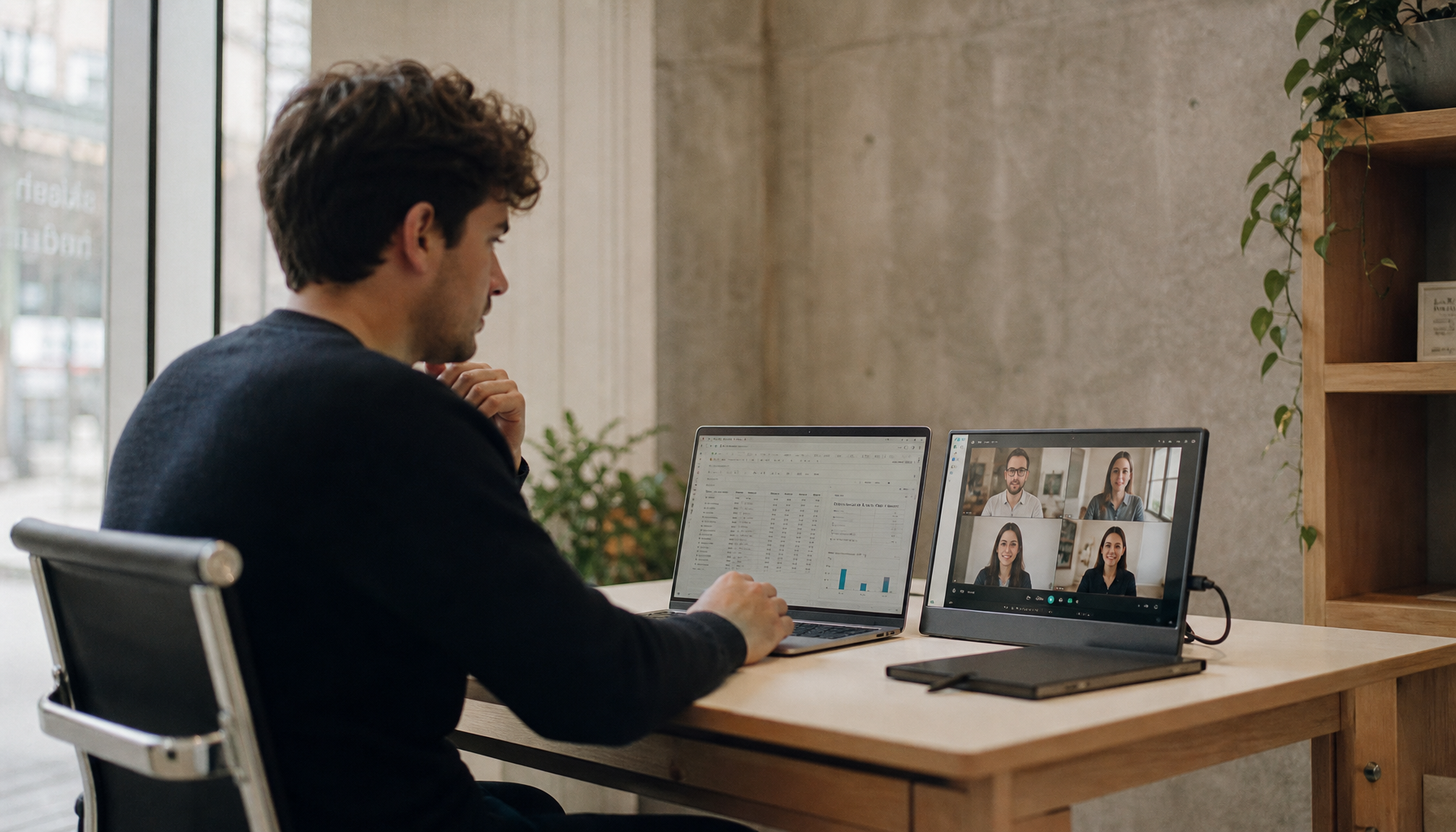
In 2026, AI researchers and software developers routinely manage Jupyter notebooks, TensorBoard dashboards, live training logs, documentation, and multiple IDE panes at once. A standard 27-inch 1440p office monitor often forces constant tab-switching and information clipping, which breaks focus and increases cognitive load. High-PPI 4K or 5K displays paired with ergonomic stands and proper panel technology let you maintain a stable three-column layout—code on the left, visualizations in the center, terminal and docs on the right—reducing the mental friction that slows complex workflows.

Why AI and Developer Workflows Demand More Screen Real Estate in 2026
AI development is inherently multi-pane. You might keep a Jupyter notebook open for experimentation, TensorBoard running live metrics, a terminal streaming logs, and reference documentation or a debugger sidebar all visible simultaneously. Traditional 1440p setups frequently compress or hide parts of these views, leading to repeated alt-tabbing that disrupts the flow state many engineers rely on for deep work.
Studies on screen real estate show that increasing available pixels and display area allows developers to keep code, console logs, and documentation in view at the same time, which is linked to measurable productivity gains (https://plugable.com/blogs/news/productivity-impact-of-multiple-monitors). For AI researchers specifically, persistent screen space for visualization tools like TensorBoard prevents missing subtle signals during long training runs (https://www.tensorflow.org/tensorboard/tensorboard_in_notebooks).
A 3-column layout has become the practical baseline for many AI practitioners. When your display provides enough sharp, usable real estate, you stay in context instead of hunting for hidden windows. This is one reason high-resolution monitors have moved from luxury to baseline for technical roles.
For a deeper look at optimizing any productivity workstation, see our Complete Guide to Finding the Best Monitor for Productivity & a Healthier Workspace.
Mapping the Visual Demands of Modern Coding and Model Training
Different technical tasks place different loads on a display. Pure coding sessions prioritize text sharpness and fast scrolling so syntax highlighting remains distinct even at high speeds. AI visualization work adds requirements for accurate color gradients in heatmaps and training curves, plus enough horizontal space to compare multiple plots without overlap.
Syntax highlighting clarity is often the first element to suffer on lower-contrast or lower-PPI panels. Washed-out or shifting colors make it harder to distinguish comment blocks, function names, or error states at a glance. Our guide on Why Some Monitors Make Syntax Highlighting Look Washed Out or Hard to Tell Apart explores the role of gamma, contrast, and panel type in preserving readable code.
Dashboard monitoring during model training benefits most from persistent horizontal real estate. Keeping TensorBoard, system metrics, and a notebook in view simultaneously reduces the chance of missing an early divergence or convergence signal. The insight module on resolution versus utility shows that 110 PPI (typical 27-inch 1440p) often feels like a bottleneck for side-by-side code and high-dimensional plots, while 140–160 PPI (27- to 32-inch 4K) hits the practical sweet spot where text scales cleanly and axis labels stay legible.
Decoding Resolution and Panel Technology for Text-Heavy Work
Resolution alone does not tell the full story—pixel density (PPI) determines how sharp text appears at normal viewing distances. A 27-inch 4K panel reaches roughly 163 PPI, delivering crisp characters and reduced eye fatigue during extended debugging. A 32-inch 4K drops to about 140 PPI; the difference is noticeable when reading small variable names or dense log output.
Panel type further shapes the experience. IPS panels maintain consistent color and brightness from typical desk viewing angles, which helps syntax colors stay true even when you shift posture. VA panels can offer deeper blacks and higher contrast but often exhibit black smearing during rapid scrolling through long code files or logs. For developers who spend most of their day in light-mode editors or need reliable color for data visualizations, IPS remains the safer default.
Higher bit depth (10-bit versus 8-bit) improves smoothness in gradient-heavy dashboards and reduces banding in complex plots, though the benefit is most visible in scientific visualization rather than everyday code editing. To understand the practical difference, read What Does Bit Depth Mean, and How Does 8-bit Differ From 10-bit Display?.
Ergonomic flexibility is equally important for text-heavy work. Monitors that allow height, tilt, and swivel adjustment help maintain neutral neck and shoulder posture, reducing the risk of musculoskeletal strain during long sessions (https://www.osha.gov/etools/computer-workstations/components/monitors). OSHA guidance also emphasizes flicker-free backlighting and low blue light options to limit digital eye strain (https://blog.oshaeducationschool.com/ergonomics-in-the-modern-workplace-osha-s-guidance-for-reducing-strain-and-injury/).
Evaluating Single Ultrawide vs. Dual-Monitor Productivity for Engineers
The choice between one large ultrawide and multiple discrete monitors often comes down to workflow shape and tolerance for bezels.
Single ultrawide (21:9 or 32:9) displays excel at panoramic monitoring—timeline-style data views, wide dashboards, or side-by-side experiment comparisons without a center seam. A 49-inch super-ultrawide can replace two 27-inch screens for horizontal-heavy tasks while using a single cable and stand.
Dual-monitor setups remain popular for the classic “code on left, documentation or terminal on right” arrangement. Many engineers rotate the secondary monitor to portrait orientation, which is ideal for reading long log files, stack traces, or documentation without excessive scrolling. Our article on Vertical vs. Horizontal: How to Build the Ultimate Dual Monitor Productivity Setup details the trade-offs in practice.
The chart below visualizes how different display sizes and aspect ratios support typical developer scenarios.

Managing the 'Toggle Tax' and Digital Eye Strain in High-Performance Setups
Mini-LED panels deliver excellent contrast for media and occasional HDR content, but in pure SDR productivity work they can produce noticeable blooming or halos around bright text on dark backgrounds. Many users adopt a “high-quality SDR” workflow—keeping local dimming disabled or moderated during coding sessions—to preserve text clarity. Software tools that automate brightness and dimming profiles can reduce the manual toggle tax, although compatibility varies across monitor models and operating systems.
Digital eye strain becomes a genuine risk after 8+ hour days. Flicker-free backlighting, hardware-level blue-light filters, and proper ergonomic positioning are the most evidence-based mitigations. OSHA-aligned guidance stresses adjustable height and tilt to keep the top of the screen at or slightly below eye level, reducing neck strain (https://www.osha.gov/etools/computer-workstations/components/monitors).
USB-C docking further simplifies the desk. A single cable that carries video, up to 90 W charging, and peripheral data removes cable clutter and makes laptop-to-monitor transitions seamless. Our guide How a USB-C Monitor Can Streamline Your Workspace explains the practical benefits for remote and hybrid setups.
For ongoing eye comfort strategies, review The Secret Productivity Issue: How to Remedy Digital Eye Strain.
How to Select Your Next Developer Station Based on Role and Workspace
Match the display to your dominant daily tasks and physical environment rather than chasing peak specifications.
AI researchers who keep multiple notebooks, live dashboards, and high-resolution plots open simultaneously usually benefit from 27-inch or 32-inch 4K or 5K IPS panels. Models such as the KTC H27P3 27" 5K Professional Monitor or the KTC M27P6 27" 4K Mini-LED provide the pixel density and contrast needed for clear multi-pane layouts while avoiding burn-in concerns associated with OLED in static IDE environments.
Software engineers focused primarily on code review, debugging, and documentation often find a 27-inch 4K IPS monitor with full ergonomic adjustment sufficient. The KTC H27P27 27" 4K Home & Office Monitor or KTC H27P22S deliver sharp text, low blue light modes, and height-adjustable stands that support healthy posture during long sessions.
Multi-taskers who need maximum horizontal context—timeline views, wide dashboards, or simultaneous terminals—may prefer a super-ultrawide. The KTC H49S66 49" Super Ultrawide offers a 32:9 canvas that can replace two separate monitors for many panoramic workflows.
A practical final checklist includes: at least 140 PPI for comfortable text scaling, full or near-full ergonomic adjustment if you sit more than six hours daily, USB-C with adequate power delivery for your laptop, and IPS panel technology unless your workflow is almost entirely dark-mode monitoring. Verify that any monitor you consider actually supports your required resolution, refresh behavior, and connectivity before purchase.
Is 4K Worth It for Coding in 2026?
Yes, when your workflow routinely involves three or more panes or dense text. The jump from 1440p to 4K at 27–32 inches typically lands in the 140–163 PPI range that keeps small fonts and UI elements crisp without forcing aggressive OS scaling. If your work is mostly single-window text editing on a 24-inch display, the upgrade may deliver diminishing returns.
Should AI Researchers Prefer IPS or Mini-LED Panels?
Most AI researchers benefit from IPS for consistent off-angle color accuracy in heatmaps and syntax highlighting. Mini-LED adds valuable contrast for dark-mode interfaces and occasional media consumption but should be evaluated for any blooming around bright UI elements. Avoid OLED for workstations that display static toolbars or code windows for eight-plus hours due to persistent burn-in risk in 2026 panels.
What Is the Best Monitor Setup for Dual Coding and Dashboard Monitoring?
A 27- or 32-inch 4K IPS monitor in landscape with a secondary vertical 27-inch panel is a common high-productivity configuration. The vertical screen handles long logs and documentation efficiently, while the primary 4K display maintains sharp, readable code and visualizations. Ultrawide alternatives work well if your primary need is uninterrupted horizontal space rather than portrait document viewing.
How Can I Reduce Eye Strain on a High-Resolution Developer Monitor?
Combine hardware features (flicker-free backlight, low blue light filter) with ergonomic positioning (top of screen at or below eye level, 20–30 inches viewing distance) and software habits (regular 20-20-20 breaks, SDR mode for coding). Full-height-adjustable stands make it easier to maintain neutral posture throughout the day.
When Does a Super Ultrawide Make More Sense Than Dual Monitors?
When your work involves wide timelines, panoramic data comparisons, or single-application immersion and you prefer to avoid bezels. Developers who frequently reference portrait-oriented documents or need independent window management across two discrete inputs usually prefer a dual-monitor or hybrid setup.
Which Resolution Is Ideal for Jupyter Notebooks and TensorBoard Side by Side?
27-inch or 32-inch 4K (approximately 140–163 PPI) is the practical sweet spot for most users. It allows 100 % scaling while keeping axis labels and code readable across three columns. 5K at 27 inches offers extra headroom but may require fractional scaling on some operating systems, which can slightly soften text depending on font and renderer.