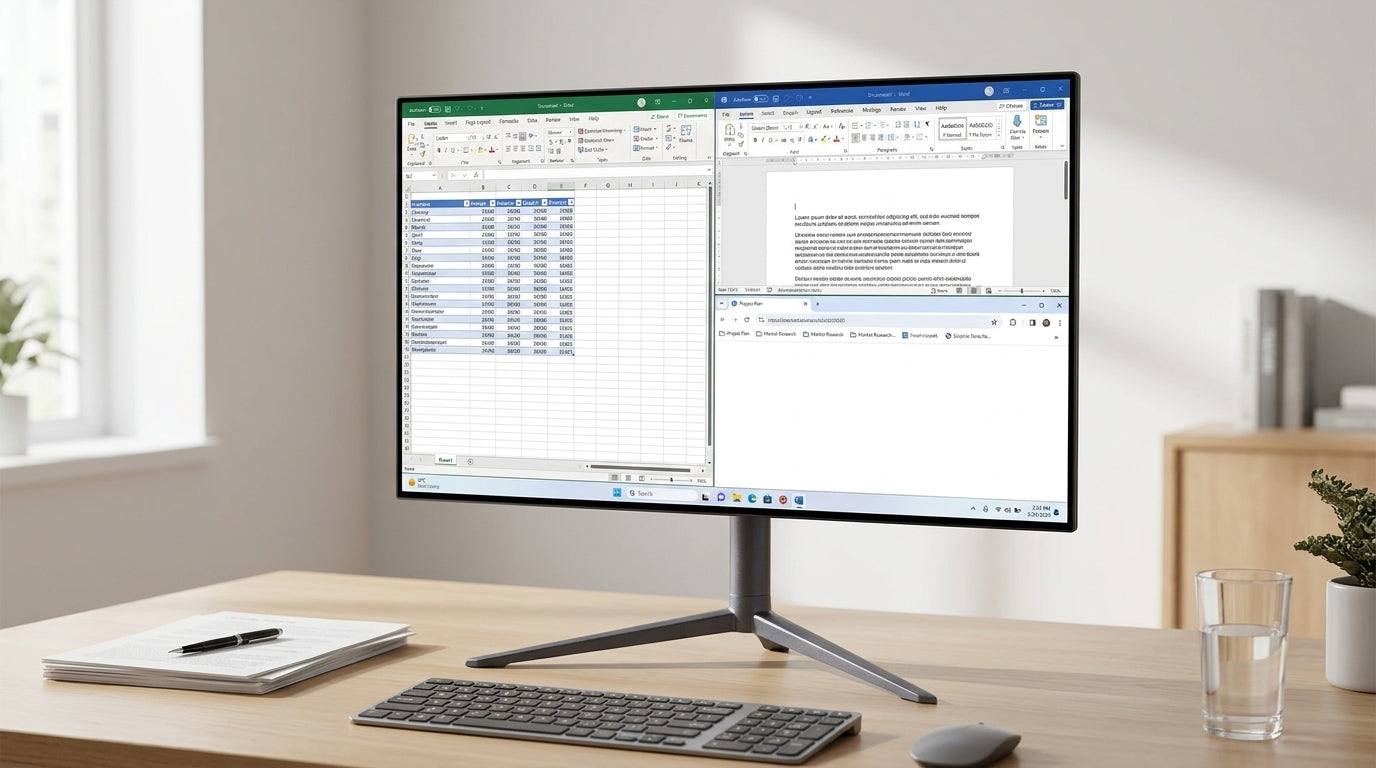
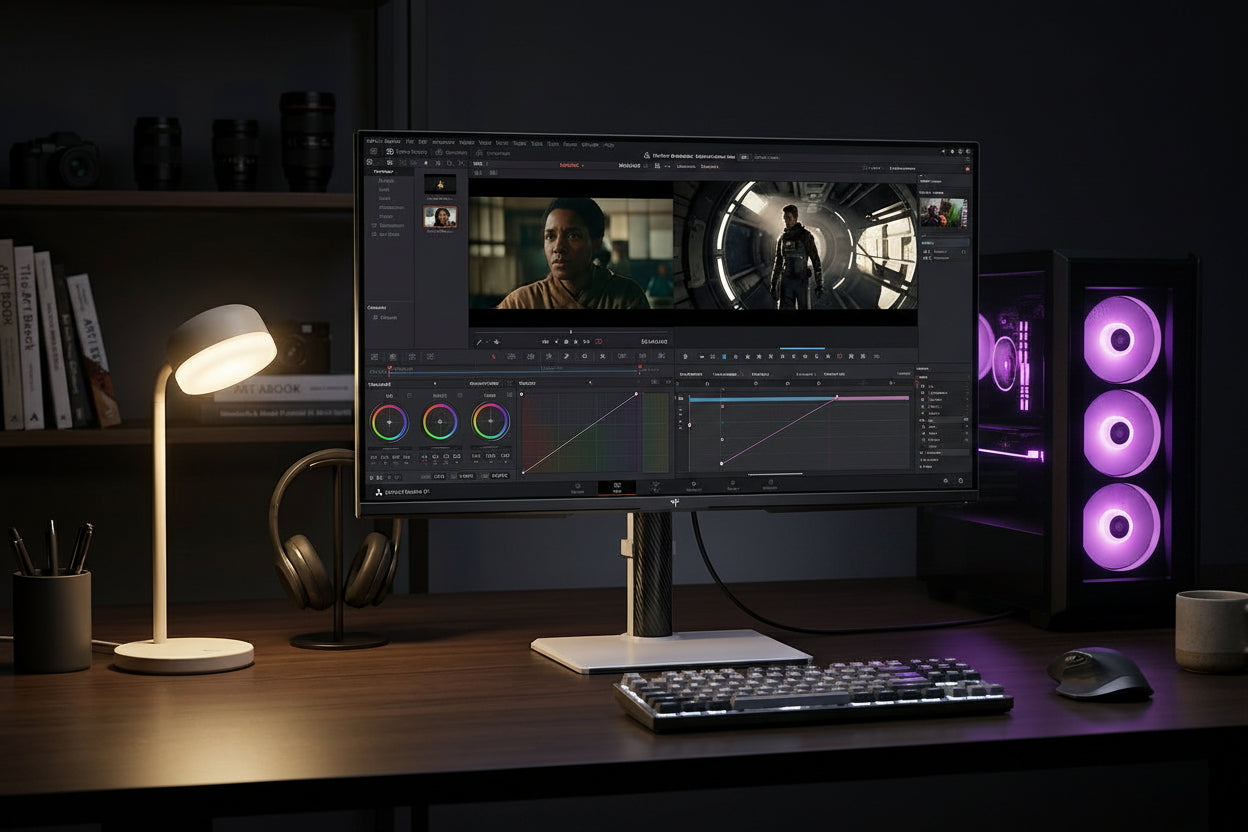
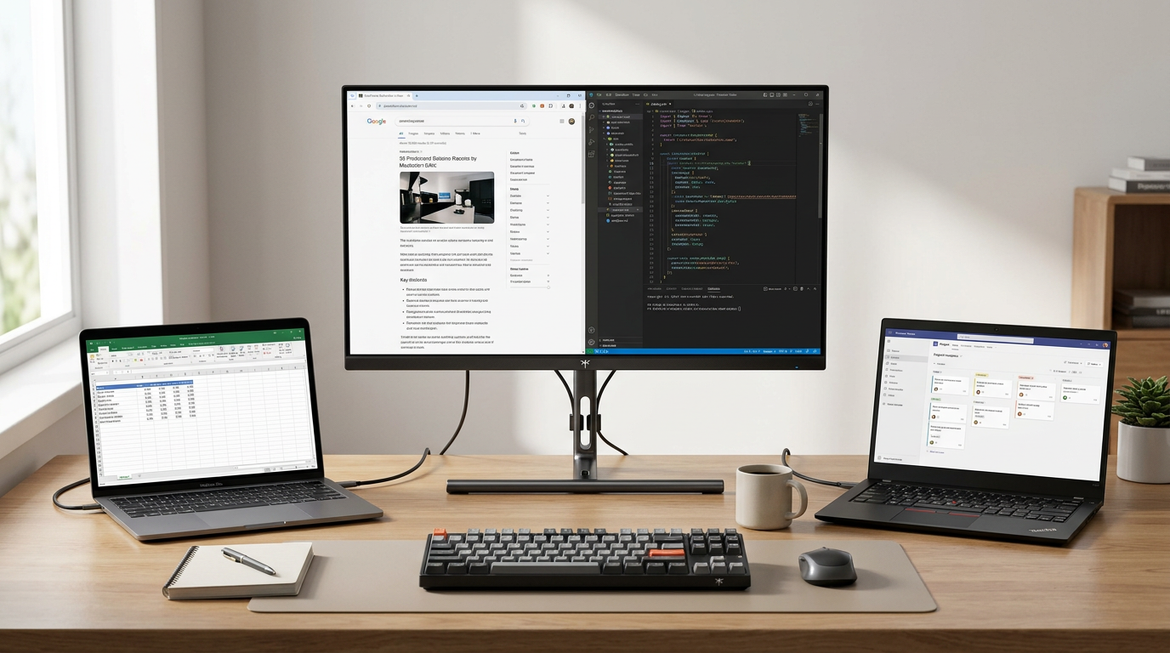
Bright-room use changes what matters most in a mini-LED monitor bright room setup. The best pick is not the one with the biggest peak brightness number, but the one that stays readable, controls reflections, and keeps contrast from collapsing when daylight hits the screen. For a 27- to 32-inch desk near a window, start with glare control and stand positioning, then compare brightness and dimming behavior.

What Bright Rooms Change
Bright rooms make weak contrast easier to notice. Blacks look lifted, bright text can feel less crisp, and the screen starts competing with windows and ceiling lights instead of supporting the image.
That is why room light matters as much as panel type. RTINGS' monitor reflection testing exists because ambient light and reflections change how a screen behaves in real rooms, not just in spec sheets. In practice, a monitor that looks fine in a dark room can feel flat beside a sunlit window.
Mini-LED helps because it uses zone-based backlighting instead of one uniform backlight, so it can hold contrast better than basic panels. But it does not cancel glare. If your desk sits beside glass or under bright overhead lighting, the setup still has to do part of the work.
A useful rule of thumb is simple: if you can already see your window or ceiling lights clearly in the panel, brightness alone will not solve the problem. In that case, the screen finish, stand range, and desk angle matter almost as much as the display spec.
For a deeper background read, see How Ambient Light Changes HDR Viewing Quality.
Brightness and Dimming Specs That Matter
Peak Brightness and SDR Headroom
For bright-room buying, SDR brightness comes first. SDR is the normal desktop picture mode, so if text and menus are hard to read there, HDR will not save the setup.
A monitor with stronger SDR headroom is easier to use for email, spreadsheets, and web pages in daylight. HDR peak brightness matters too, but mainly for highlights and contrast in supported content. Do not read the HDR number as a universal daylight guarantee.
Local Dimming Zone Count
Local dimming is what lets a Mini-LED monitor darken one part of the screen while keeping another part bright. That is why the zone count matters alongside peak brightness.
VESA's DisplayHDR standard ties higher tiers to both luminance and local dimming requirements, which is a good reminder that peak brightness alone does not define HDR quality. On a bright desk, zone control helps keep image depth from turning into a washed-out glow.
Black Levels and HDR Contrast
Black levels are the part buyers often underestimate. In daylight, the eye notices weak blacks faster because ambient light already pushes the image toward gray.
That is why a monitor with strong HDR claims can still look bland if it cannot hold shadow detail and control blooming. The contrast story has to work with the room, not against it.
Anti-Glare Coating and Room Setup
Anti-glare treatment helps, especially beside a window or under a light bar, but it is not a full fix. A matte-friendly finish can reduce mirror-like reflections, yet the angle of the room light still decides how much annoyance remains.
If you want the safer path, favor a flat panel, a coating that softens direct light, and a stand that can move the screen away from your brightest reflection source. In a bright office, that combination usually matters more than chasing a single headline number.
If you want more context on blooming trade-offs, see What Causes Blooming Around Bright Objects on Mini-LED Monitors.

A Quick Spec Check You Can Use
Before you compare models, ask three questions:
- Is SDR bright enough to read comfortably before HDR is even involved?
- Does the model have local dimming or only a bright backlight?
- Can the screen finish and stand help you avoid direct reflections?
If the answer to any of those is weak, the monitor may still be fine for a dark room, but it is not a strong bright-room buy.
Why Stand and Positioning Matter
A bright-room monitor can fail for a simple reason: the panel is in the wrong place. A good stand gives you more ways to dodge glare before you start lowering brightness or accepting a dimmer image.
Look for height, tilt, swivel, and pivot if you often sit near windows or share a desk with a lamp. Height adjustment helps you lower the top edge when ceiling lights hit the glass. Tilt and swivel help you steer reflections away from your main viewing angle.
This is where the KTC Mini LED 27" 4K 160Hz HDR1400 Gaming Monitor | M27P6 becomes relevant as a fit check. It includes 1,152 local dimming zones, HDR1400 support, 600 cd/m² SDR brightness, and a full ergonomic stand with height, swivel, pivot, and tilt. That makes it a stronger candidate when you want both bright-room flexibility and a sharper 4K canvas.
The model still is not a cure for bad lighting. If your window reflects directly into the screen at your normal sitting position, even a strong Mini-LED display will need help from placement or a monitor arm.
A flat panel is usually easier to manage than a curved one in this kind of setup. A quick-release stand or VESA mount is useful if you need to push the display closer to a wall or lift it onto an arm for a better angle.
Match the Monitor to Your Use Case
The easiest way to choose is to match the screen to the room and the main task, not just the spec sheet. In bright rooms, the best model is often the one that balances readability, glare control, and the kind of motion speed you actually need.
| Use Case | What Matters Most | Best-Fit Trait | Example Model |
|---|---|---|---|
| Window-side home office | Text clarity, glare control, and comfortable SDR brightness | 4K sharpness plus full stand adjustment | KTC Mini LED 27" 4K 160Hz HDR1400 Gaming Monitor |
| Bright-room gaming | Motion speed, HDR depth, and daytime contrast | 1440p with strong local dimming and fast refresh | [KTC Mini LED 27" 180Hz 2K HDR1400 Gaming Monitor |
| Creator work with daytime color checks | Stable color, readable UI, and placement flexibility | 1440p Mini-LED with wide color and ergonomic stand | [KTC Mini LED 27" 200Hz 2K HDR1000 Gaming Monitor |
| Higher-detail mixed use | Text density, HDR headroom, and console or PC versatility | 4K panel with strong HDR and adjustable stand | KTC Mini LED 27" 4K 160Hz HDR1400 Gaming Monitor |
This is the key flip point: if your room is bright and your desk is shallow, a 27-inch flat Mini-LED with a strong stand is usually easier to live with than a larger or less adjustable screen. If your room is bright but you care more about HDR gaming, then stronger local dimming and higher peak brightness become more useful.
The All-Mini-LED Monitors collection is the cleanest browsing path if you want to compare the Mini-LED range without jumping between unrelated panel types. The All Monitors collection offers additional options for broader comparisons.
Final Checklist Before You Buy
- Confirm the model has local dimming, not just a bright backlight with a single peak number.
- Check the SDR brightness spec first, because that is what you will use most of the day.
- Make sure the stand can lower, tilt, or swivel the panel enough to move glare out of your line of sight.
- Match resolution and refresh rate to your actual PC or console plan so you do not overbuy.
- If you expect daytime gaming or mixed office use, compare the HDR tier and ergonomics together.
- Use the return window to test the screen in your own room lighting before you commit.
If you are choosing between Mini-LED models, the KTC Mini LED 27" 180Hz 2K HDR1400 Gaming Monitor | M27T6 is the more value-oriented bright-room option, while the M27P6 is the sharper 4K choice. The KTC Mini LED 27" 200Hz 2K HDR1000 Gaming Monitor | M27T6S makes sense when refresh speed and color coverage matter more than the highest HDR tier.
The Gaming Monitor collection is useful if you want to compare Mini-LED against other gaming-display options after you decide how much brightness and stand flexibility your room really needs.
Related Resources
- What Is the Relationship Between Display Brightness and Perceived Contrast Ratio
- Local Dimming Firmware Audit: How 2026 Updates Solve Mini-LED Blooming
FAQs
Q1. How Much Brightness Do I Need for a Bright Room?
There is no single safe number that works in every room. Look for enough SDR brightness to keep text readable at your usual desk time, then use HDR brightness as a bonus rather than the main decision factor. If reflections are the bigger problem, placement and coating matter more than chasing more nits.
Q2. What Is More Important: Peak Brightness or Local Dimming?
Both matter, but local dimming usually decides whether HDR still has depth in daylight. Peak brightness helps highlights stand out, yet without good zone control, the image can look flatter than the spec sheet suggests. For bright rooms, the two specs work together.
Q3. Can a Matte Screen Solve Window Glare?
A matte or anti-glare finish helps reduce distracting reflections, but it does not remove them completely. The direction of the window, the height of the monitor, and the angle of the screen still affect what you see. Think of the coating as a helper, not a full fix.
Q4. Which Mini-LED Monitor Size Works Best on a Bright Desk?
For many desk setups near a window, 27 inches is easier to place and angle than 32 inches. A 32-inch display can still work, but it needs more desk depth and more careful positioning to avoid reflections and neck strain. Size should follow room layout, not the other way around.
Q5. How Can I Test a Monitor in My Own Lighting?
Test it at the same time of day you will normally use it. Check text readability, white-page glare, dark-scene detail, and whether the stand lets you move reflections out of your line of sight. If the screen only looks good after you darken the room, it may not be the right bright-room fit.
The Best Bright-Room Buy Is the One You Can Actually Place
A good mini-LED monitor bright room choice is usually the one that balances SDR readability, glare control, and local dimming before you worry about a headline HDR number. If your desk sits near windows, prioritize the stand and finish first, then compare brightness and zones. That is the fastest way to avoid a monitor that looks great on paper but frustrating in real daylight.