A USB-C cable supports DisplayPort Alt Mode only if its product specs, packaging, or certification clearly say it supports video through DP Alt Mode, USB4, or Thunderbolt. If it is marketed only for charging, assume it will not drive your monitor.
Ever plug a sleek USB-C cable into a laptop and monitor, only to get charging with a black screen? A careful pre-buy check can spare you the most common failure: buying a charge-first cable that lacks the data paths needed for video. You’ll learn how to read listings, labels, and specs before spending money.
Why DisplayPort Alt Mode Matters
DisplayPort Alt Mode, often shortened to DP Alt Mode, lets a USB-C connection carry DisplayPort video and audio from a laptop, tablet, phone, or handheld gaming device to an external display. The key point is that USB-C is only the connector shape; video support depends on the electronics behind the port and the cable design.
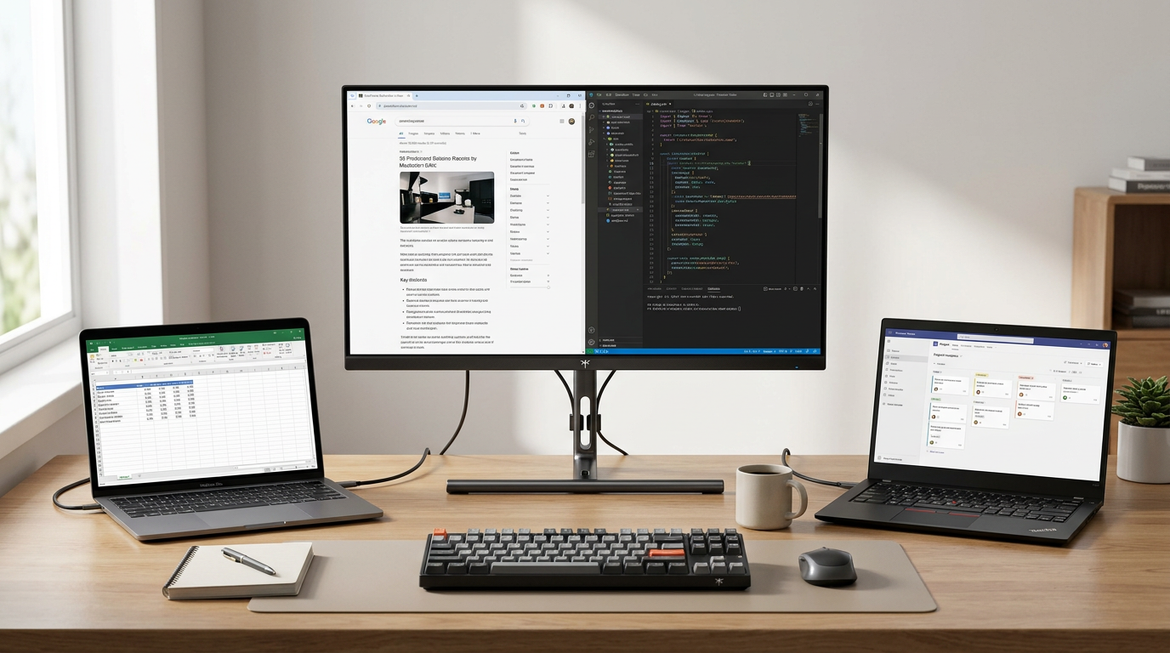
For gaming monitors, productivity displays, and portable smart screens, DP Alt Mode is what makes the clean one-cable setup possible. With the right cable and compatible devices, one USB-C line can handle display signal, power, and data, which is why many modern USB-C monitors are built around this workflow. DisplayPort guidance notes that DisplayPort signals can run over USB-C on devices that support DisplayPort Alt Mode.

The practical upside is desk simplicity and performance. A 16-inch laptop feeding a 27-inch 1440p monitor, or a handheld console connected to a portable display, feels much cleaner when you avoid separate HDMI, power, and adapter chains. The downside is buyer confusion: two USB-C cables can look identical while supporting very different features.
The Fastest Pre-Buy Test: Read the Exact Feature Claim
The safest cable listing will explicitly say “DisplayPort Alt Mode,” “DP Alt Mode,” “USB-C video,” “USB-C to DisplayPort,” “USB4,” or “Thunderbolt 3/4.” If the listing only says “USB-C charging cable,” “fast charging,” or “sync and charge,” that is not enough for monitor use.
Cable compatibility guidance often separates USB-C cables into charging, data, and adapter categories, with one blunt rule: charging cables lack video capability. That matters because many cables bundled with phones, tablets, and laptop chargers are optimized for power, not display bandwidth.
A real-world shopping example is simple. If one cable says “100W USB-C fast charge, 480 Mbps,” and another says “USB-C 3.2 Gen 2, 10 Gbps, supports video/DP Alt Mode,” the second one is the monitor candidate. The first may be excellent for a charger brick, but it is a poor bet for a 4K monitor or a portable screen.

Look for Full-Featured USB-C, Not Just USB-C
A full-featured USB-C cable has the conductors needed for high-speed data and alternate modes. That is why “USB-C” alone is not a specification. It is the connector, not the promise.
USB-C data cables rated at 5 Gbps or higher can support the high-speed data paths used by USB 3 and USB-C DisplayPort Alternate Mode, while USB 2.0 charging cables are limited to 480 Mbps and do not support video. In practical monitor terms, USB-C DisplayPort Alternate Mode requires at least a USB-C data cable, not a charge-only cable.
Here is the quick comparison that prevents most bad buys.

Cable wording on listing |
Likely monitor result |
Buy for DP Alt Mode? |
USB-C charging, 480 Mbps |
Charges only, no video |
No |
USB-C 3.2 Gen 1, 5 Gbps |
Possible video support if DP Alt Mode is stated |
Maybe |
USB-C 3.2 Gen 2, 10 Gbps, video supported |
Strong candidate |
Yes |
USB4 certified |
Strong candidate for modern displays |
Yes |
Thunderbolt 3 or Thunderbolt 4 certified |
Strong candidate, usually premium |
Yes |
The “maybe” row deserves attention. A 5 Gbps or 10 Gbps cable can be built for the right lane structure, but you still want the product page to say video or DP Alt Mode. If the seller avoids any display claim, do not reward the ambiguity.
Check the Cable Length Before You Chase Maximum Refresh Rate
Length affects reliability, especially when you expect high bandwidth. A short cable is usually the better performance play for a gaming monitor or high-resolution workstation display.

Common maximum lengths are about 6.6 ft for USB 3.2 Gen 1, 3.3 ft for USB 3.2 Gen 2, 2.6 ft for USB4 40 Gbps, 3.3 ft for Thunderbolt 3 40 Gbps, and 6.6 ft for Thunderbolt 4 40 Gbps. That does not mean every longer cable fails, but higher-speed USB-C cables have shorter typical lengths, so a bargain 10-ft cable claiming top-tier video deserves extra skepticism.
For a practical desk setup, a 3.3-ft cable is often enough from laptop to monitor when the laptop sits beside or under the display. If you need 6.6 ft across a sit-stand desk, prioritize certified Thunderbolt 4 or a reputable USB-C video cable with the exact resolution and refresh rate stated.
Match the Cable to the Monitor You Actually Use
Do not buy only for “video works.” Buy for the display mode you expect. A portable 1080p smart screen is forgiving. A 4K productivity monitor at 60 Hz needs more headroom. A 1440p or 4K high-refresh gaming monitor is where weak cables expose themselves with flicker, blackouts, or reduced refresh options.
DisplayPort’s own cable guidance explains that certified DisplayPort cables are designed for reliable performance, and poor cable quality can create visible audio or video errors rather than improving picture quality through “premium” magic. The useful takeaway is that certified DisplayPort cables reduce reliability risk, especially when the setup pushes bandwidth.
A smart buying move is to compare the listing’s stated output against your monitor. If your monitor is 4K 60 Hz, the product page should say 4K 60 Hz or better. If your monitor is 1440p 144 Hz, look for a stated high-refresh claim, not just “HD.” If your display is USB-C native, confirm the cable is USB-C to USB-C with video support; if your monitor uses DisplayPort input, a USB-C to DisplayPort cable with DP Alt Mode support is the cleaner choice.
Confirm Your Device Port Supports Video Too
A DP Alt Mode cable cannot create video from a USB-C port that lacks video output. The laptop, tablet, phone, or handheld device must also support DP Alt Mode, USB4, or Thunderbolt display output.
Technical guidance emphasizes that DP Alt Mode is optional and must be supported by the device’s USB-C port and the cable. This is why one USB-C port on a laptop may drive a monitor while another USB-C port on a budget tablet only charges and transfers files.
Before buying, check the device spec page for phrases like “DisplayPort over USB-C,” “DP Alt Mode,” “Thunderbolt,” “USB4,” “video output,” or a small DisplayPort icon near the port. If your laptop has two USB-C ports and only one has a Thunderbolt symbol, use that one for the monitor. If a phone supports charging but not video output, even the best cable will not turn it into a desktop display source.

Packaging and Logo Clues That Actually Help
Good packaging removes doubt. Look for a DisplayPort logo, Thunderbolt logo, USB4 mark, or written claims such as “supports DisplayPort Alt Mode” and “supports video output.” A vague icon of a monitor is weaker than a named technical claim.

Some cables show the DisplayPort logo or DP Alt Mode on the cable or packaging. Monitor-connection guidance also points shoppers toward cables that specifically support DisplayPort Alt Mode or Thunderbolt 3, because not all USB-C cables support video.
If you are shopping online, zoom into package photos and read the manufacturer spec table, not just the title. Marketplace titles can be overloaded with keywords; the spec table is where reputable manufacturers usually state resolution, refresh rate, data rate, power rating, and compatibility.
Pros and Cons of Buying a DP Alt Mode-Capable Cable
The main advantage is capability per inch of cable. A proper USB-C video cable can replace an HDMI cable, a charging cable, and sometimes a USB data cable in one clean run. For a productivity display, that means faster docking. For a gaming monitor, it means fewer connection points that can fail. For a portable smart screen, it means the setup becomes genuinely portable instead of adapter-dependent.
The tradeoff is cost and specificity. A cable that supports DP Alt Mode, USB4, or Thunderbolt usually costs more than a basic charging cable. It may also be shorter than a cheap charging cable because high-speed signal integrity is harder over longer distances. That extra cost is still usually less expensive than buying the wrong cable twice.
Before You Buy: The Plain-English Decision
Buy the cable only when the product page gives you three confirmations: it says video or DP Alt Mode, it matches your needed resolution and refresh rate, and it comes from a maker that publishes real specifications. If one of those is missing, choose a better-documented cable.
For a value-oriented setup, USB-C 3.2 Gen 2 with explicit DP Alt Mode support is often the sweet spot. For maximum confidence with high-end gaming, docking stations, and premium portable displays, USB4 or Thunderbolt-certified cables are the stronger bet. For charging a laptop in your bag, a charge-only cable is fine; for driving pixels, it is the wrong tool.
FAQ
Can any USB-C cable connect a laptop to a monitor?
No. A USB-C cable must support video through DP Alt Mode, USB4, or Thunderbolt, and the laptop’s USB-C port must support video output too. A charge-only USB-C cable may power the laptop but leave the monitor black.
Is Thunderbolt the same as DP Alt Mode?
No. Thunderbolt uses the USB-C connector and can carry display signals, but it is a broader high-speed technology. For buying purposes, a certified Thunderbolt 3 or Thunderbolt 4 cable is usually a strong choice for display use, while a non-Thunderbolt USB-C cable must explicitly claim DP Alt Mode or video support.
Does a 100W USB-C cable support video?
Not necessarily. Power rating tells you how much charging power the cable can handle, not whether it carries display signals. A 100W cable that only supports USB 2.0 data is still a poor monitor cable.
A reliable display cable is not about the flashiest packaging; it is about verified capability. Choose a cable that clearly says DP Alt Mode, USB4, or Thunderbolt, match it to your monitor’s resolution and refresh rate, and your screen setup becomes faster, cleaner, and far less frustrating.