

For data scientists and researchers working with complex heatmaps, contour plots, or dense gradients, 10-bit color depth is often a practical requirement rather than a luxury. It reduces visible banding that can be mistaken for real data discontinuities, helping preserve analytical accuracy when your workflow involves subtle tonal transitions that 8-bit displays frequently distort.

The difference becomes most noticeable in high-density visualizations where perceptual errors can lead to misinterpretation. This article examines when 10-bit class color materially improves chart fidelity, how to verify your full signal chain actually delivers it, and which workstation setups make the upgrade worthwhile.
Why Standard 8-Bit Displays Compromise Complex Data Visualization
Many analysts first notice the issue when smooth gradients in heatmaps or density plots suddenly show distinct steps or “lines” that do not exist in the underlying data. This phenomenon, known as banding or posterization, occurs because standard 8-bit displays offer only 256 discrete shades per color channel. In dense visualizations, these limited steps create visible boundaries that the human visual system exaggerates through a process called Mach banding.
The risk is more than aesthetic. In scientific or machine-learning debugging sessions, these false contours can be mistaken for actual data clusters or discontinuities, potentially altering interpretation of subtle patterns. Simple bar or line charts with high-contrast categorical colors are far less affected, which is why many everyday dashboards appear fine on 8-bit panels. Complex gradient-heavy or contour-based plots, however, expose the limitation quickly.
As this official medical-display knowledge base explains, 8-bit banding in dense visualizations like heatmaps or contour plots can produce posterization where smooth gradients break into visible steps, causing false contouring that leads analysts to perceive boundaries that do not exist in the data.
Understanding the Math: How 10-Bit Color Depth Eliminates Chart Banding
A 10-bit color system provides 1,024 discrete values per channel, delivering 1.07 billion total colors—64 times more than the 16.7 million available in 8-bit. This expanded resolution allows perceptually smooth transitions across the subtle tonal steps common in modern colormaps such as Viridis or Magma.
High-bit-depth rendering becomes the final link in the chain for perceptually uniform colormaps used in scientific plotting libraries. Without it, even carefully designed gradients can truncate and reintroduce the very artifacts the colormap was meant to avoid. Standards developed for medical imaging illustrate the principle clearly: the DICOM Grayscale Standard Display Function requires at least 10-bit depth to map pixel values to perceptually linear luminance steps and prevent diagnostic or analytical errors.
This medical display comparison notes that high-precision visualization standards such as DICOM GSDF require at least 10-bit grayscale depth to ensure digital pixel values map to perceptually linear luminance steps.
The practical takeaway is straightforward. When your analysis depends on identifying faint gradients or low-contrast transitions, the extra tonal resolution provided by 10-bit color removes a source of visual noise that cannot be fixed by better chart design alone.
High-Density Visualization Scenarios Where 10-Bit Color is Essential
10-bit depth proves most valuable in static or semi-static workflows that rely on continuous color mapping. Heatmaps of large datasets, density plots in model debugging, and contour lines in multivariable scientific modeling all benefit because small perceptual differences can correspond to meaningful signals. In low-light lab environments or dark-themed dashboards, the improved shadow detail and smooth gradation further reduce the chance of mistaking display artifacts for data features.
Conversely, 10-bit adds little value for simple categorical bar charts, basic line graphs with distinct colors, or dashboards built primarily from high-contrast blocks. These use cases rarely stress the tonal resolution that 10-bit provides, and the hardware investment may deliver minimal analytical return.
Many researchers therefore begin their evaluation by asking a simple self-check: does my most common chart type rely on smooth gradients or subtle density variations? If the answer is yes and the data volume is high, 10-bit class color moves from optional to recommended.

Native 10-Bit vs. 8-Bit + FRC: Choosing the Right Panel for Analytics
Many affordable monitors advertise “10-bit” through 8-bit + Frame Rate Control (FRC), a temporal dithering technique that rapidly alternates pixels to simulate additional shades. While effective for video and motion content, FRC can introduce subtle shimmer or flickering that static scientific charts make more apparent. In high-stakes research or medical-grade visualization, this temporal noise risks being misinterpreted as statistical variance.
Native 10-bit panels avoid dithering entirely by driving each pixel with true 10-bit precision, delivering stable output ideal for prolonged inspection of fixed plots. Manufacturer guidance and practical testing both indicate that native 10-bit is the clearer choice when pixel-to-pixel consistency matters more than cost.
This KTC technology explainer states that while 8-bit + FRC uses temporal dithering to simulate more colors and is often sufficient for motion, native 10-bit panels provide superior pixel stability for static, high-density charts where flickering could interfere with fine-detail analysis.
For data scientists, the decision often comes down to workflow stability. If you frequently present or publish static figures, native 10-bit reduces one source of visual uncertainty. If your work is primarily interactive or web-based, the benefit narrows and 8-bit + high-quality FRC may suffice.
Verifying Your 10-Bit Signal Chain for Professional Analytics Workflows
Owning a 10-bit capable monitor is only the first link. True 10-bit rendering requires an unbroken 30-bit signal chain from GPU through drivers, operating system, cable, and application backend. A single 8-bit step anywhere in that pipeline collapses the benefit.
Start by confirming your GPU and driver support 10-bit output—NVIDIA workstations, for example, need specific settings under Advanced Display Configuration. Next, verify that your analysis tools are configured for 10-bit buffers: Matplotlib users often switch to Qt5Agg or similar backends, while Tableau, GIS packages, or custom dashboards may need explicit flags.
A practical verification test uses a 1024-step grayscale ramp chart. Generate the test image in your software and display it at native resolution. If you see distinct bands instead of a smooth transition, somewhere in the chain the signal is being truncated to 8-bit. This “canary chart” quickly reveals configuration gaps that many users discover only after purchasing new hardware.
The NVIDIA support article details that the entire signal chain—including GPU, OS settings, cable, and software—must be configured to support 30-bit color output to achieve a true 10-bit workflow.
Web-based tools introduce additional variability because browser support for 10-bit canvas and CSS rendering remains inconsistent even in 2026. For dashboard-heavy teams, desktop-native applications paired with verified native 10-bit panels usually provide the most reliable results.
Selecting a High-Bit-Depth Display for Your Data Science Workstation
Does Your Visualization Workflow Require 10-Bit Depth?
A tiered decision aid: native 10-bit is most useful when the workflow is static, gradient-heavy, and high-density; 8-bit or 8-bit+FRC is often sufficient for simpler, categorical charts with lower perceptual risk.
View chart data
| Tier | Chart Type | Data Density | Perceptual Risk | Practical Read |
|---|---|---|---|---|
| Usually yes | Gradient | High | Smooth transitions matter | Native 10-bit is the safer fit for static, gradient-heavy work. |
| Usually no | Categorical | Low | Banding risk is limited | 8-bit or 8-bit+FRC is often sufficient for simple charts. |
| Depends / borderline | Mixed | Moderate | Risk depends on display and content | Use 10-bit when preserving subtle tonal steps is important. |
The decision tree above summarizes practical pairings for common 2026 analytics setups. When your primary charts are gradient-heavy and high-density, displays with native or well-implemented 10-bit pipelines reduce perceptual risk most effectively.
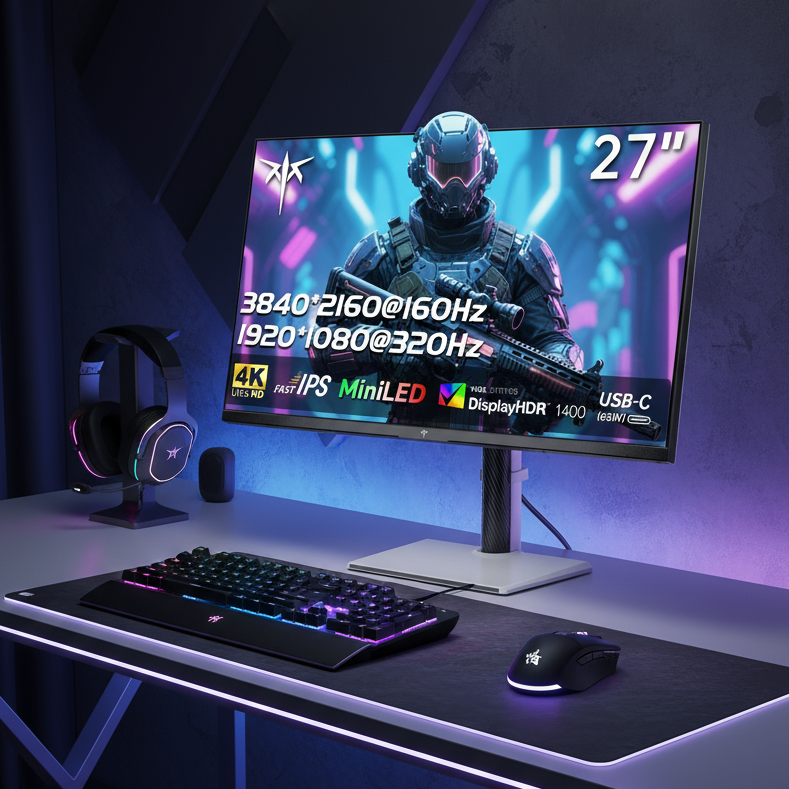
For professional 5K resolution and color-critical productivity, the KTC H27P3 offers 99% DCI-P3 coverage and ΔE<2 accuracy, making it a strong fit for researchers who prioritize sharpness and tonal precision over refresh rate. Those needing strong contrast for dark-themed dashboards may prefer the KTC M27P6, whose Mini-LED local dimming and high-bit-depth implementation support both analytical and occasional high-refresh tasks. The versatile KTC H27P6 provides dual-mode operation for users who switch between detailed 4K visualization and faster diagnostic workflows.
Before purchasing, run the 1024-step ramp test on your current software stack and confirm that your GPU, drivers, and analysis tools can sustain a full 10-bit pipeline. This verification step prevents the common regret of acquiring capable hardware that never actually renders in 10-bit.
How Can I Test If My Current Setup Is Rendering in True 10-Bit?
Generate a 1024-step grayscale ramp in your plotting library and inspect it at native resolution. Visible bands indicate truncation somewhere in the chain. Combine this with driver and backend checks to isolate the bottleneck.
Does 10-Bit Color Improve All Types of Data Charts Equally?
No. Categorical bar and line charts with distinct high-contrast colors gain little, while heatmaps, density plots, and contour visualizations that rely on smooth gradients see the clearest reduction in misleading artifacts.
Is 8-Bit + FRC Sufficient for Most Research Dashboards?
For many interactive or web-based dashboards it can be, provided the content does not involve prolonged static inspection of subtle gradients. Native 10-bit remains preferable when pixel stability is critical or when publishing figures for external review.
What Is the Most Important Step When Upgrading to 10-Bit for Analytics?
Validate the complete signal chain—GPU output, OS settings, cable standard, and software backend—before assuming the monitor alone will deliver 10-bit color. The verification ramp test is the fastest way to confirm success.
When Should Data Scientists Skip 10-Bit Displays?
When your primary work involves simple categorical charts, web dashboards with inconsistent browser support, or when budget constraints make the full verified pipeline impractical. In those cases, a well-calibrated 8-bit panel paired with careful colormap choices often meets analytical needs.