Yes, you can use a wireless keyboard and mouse with a monitor’s built-in KVM without drops, but the most reliable setup is usually a 2.4 GHz USB receiver plugged into the monitor’s USB hub, not Bluetooth routed through multiple devices.
Does your mouse freeze right after switching from your gaming PC to your work laptop, or does the keyboard wake up one beat too late when you are already typing? In practical desk setups, a clean KVM path can keep input responsive enough for office work, creative review, and most gaming, while weak USB hubs, crowded wireless bands, and sleep behavior are the usual failure points. You will get a clear way to choose the right wireless setup, reduce dropouts, and know when a built-in KVM is enough.
What a Monitor Built-In KVM Actually Does

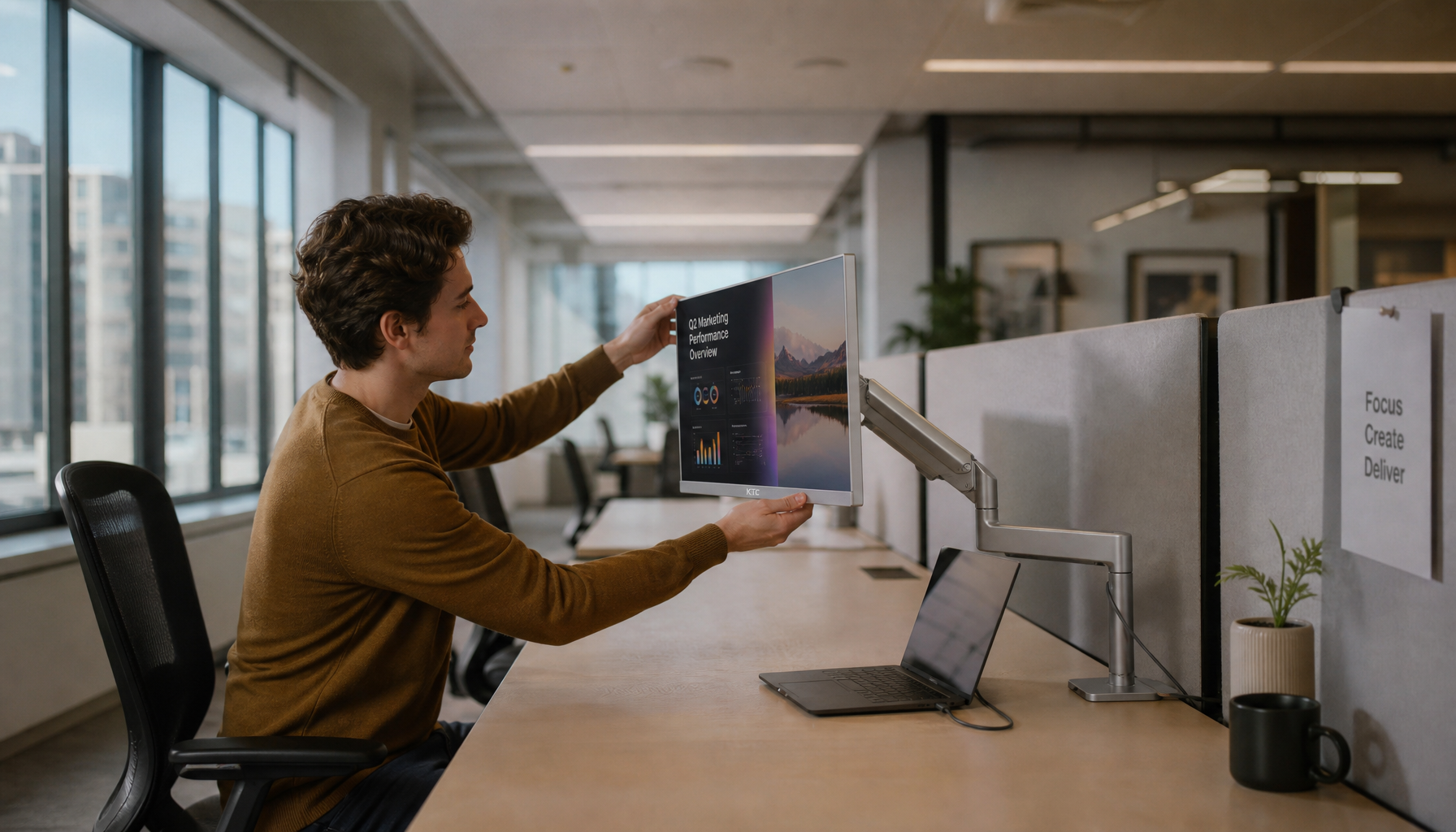
A monitor with a built-in KVM lets one keyboard, monitor, and mouse control two connected computers, commonly a desktop and a laptop. The monitor becomes the switching hub: video comes in through HDMI, DisplayPort, or USB-C, while keyboard and mouse signals travel through the monitor’s USB upstream connection to whichever computer is active.
That matters because a hardware KVM physically routes keyboard, video, mouse, and often USB accessory signals, while software KVM tools usually share only keyboard and mouse over a network. For locked-down work laptops, BIOS access, mixed operating-system desks, and recovery screens, hardware switching is the dependable choice because it does not need an app running inside the operating system.
A monitor KVM is not a wireless repeater. It is still a USB hub and video switch inside the display. If your wireless mouse uses a USB dongle, the dongle is treated like a USB HID device. If your keyboard uses Bluetooth directly to the laptop, the monitor KVM may not control that Bluetooth connection at all. This is why two wireless setups can behave differently on the same monitor.
The Best Wireless Method: 2.4 GHz Receiver First, Bluetooth Second

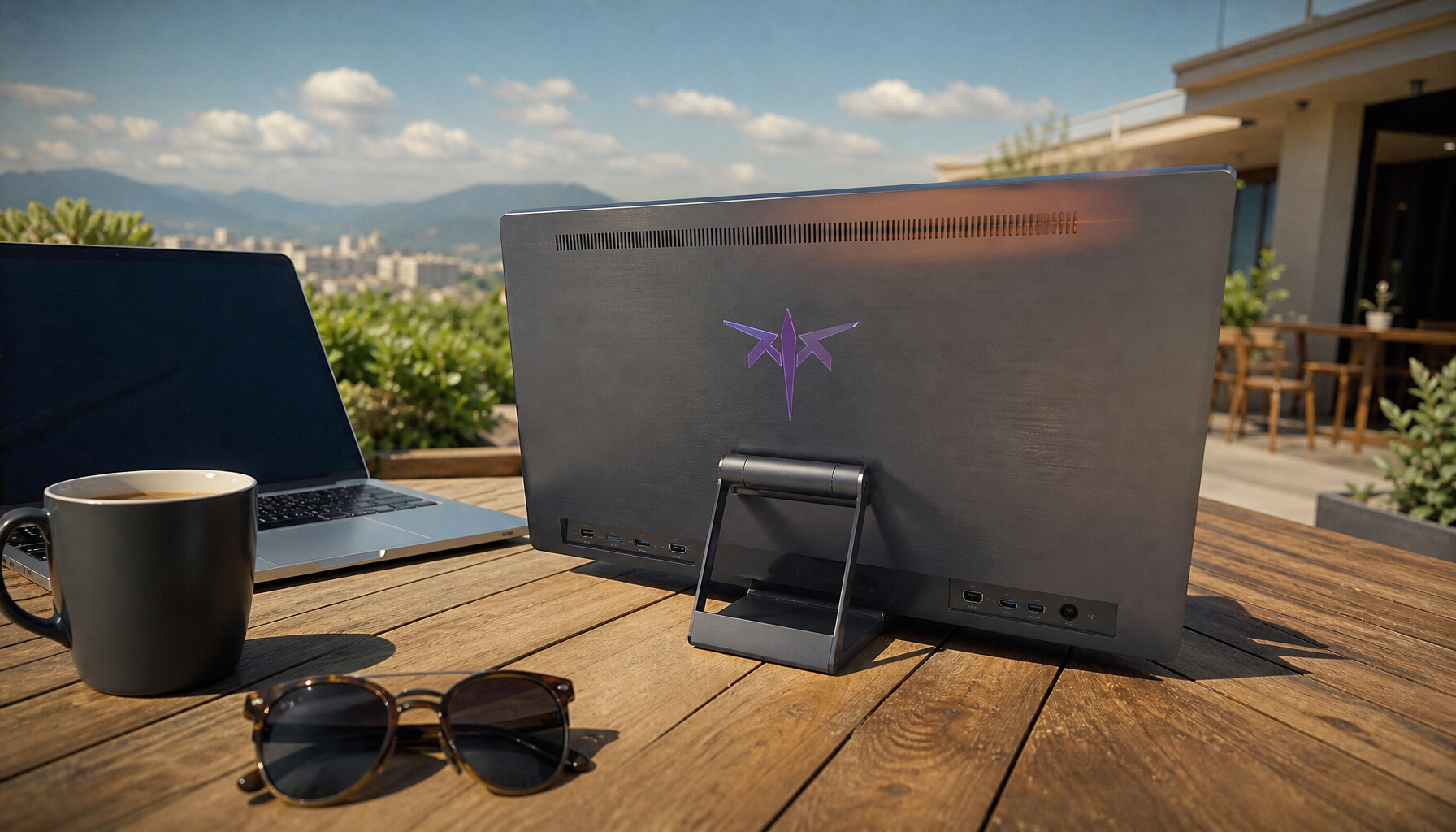
For the fewest connectivity drops, plug the wireless keyboard and mouse receiver into the monitor’s downstream USB port. Then connect each computer to the monitor’s required USB upstream path. On a USB-C laptop, that may be one USB-C cable carrying video, USB data, and sometimes charging. On a desktop, it may be DisplayPort or HDMI for video plus a separate USB-B or USB-C upstream cable for keyboard and mouse data.
A 2.4 GHz USB receiver is often the strongest choice because it gives the KVM one stable USB device to switch. Smart-monitor guidance also favors 2.4 GHz USB receivers when lower latency, more stable wake behavior, and more responsive input matter. Bluetooth is cleaner for travel because it avoids a dongle, but it can be more sensitive to pairing states, sleep recovery, and crowded 2.4 GHz airspace.
Here is the practical difference for a real desk. If you use a 27-inch 1440p gaming monitor with a desktop on DisplayPort and a work laptop on USB-C, plug the mouse and keyboard receiver into the monitor, then set the monitor’s USB input assignment so DisplayPort pairs with the desktop upstream cable and USB-C pairs with the laptop. When you switch inputs, the receiver follows the active computer. If instead your keyboard is paired over Bluetooth to the laptop and your mouse receiver is in the monitor, only the mouse reliably follows the KVM.
Wireless setup |
Dropout risk |
Best use |
One 2.4 GHz receiver in monitor USB |
Low |
Shared keyboard and mouse across two computers |
Separate receiver in each computer |
Medium |
Devices that support multi-host switching |
Bluetooth paired to each computer |
Medium to high |
Travel, light office use, smart screens |
Receiver plugged into rear PC port |
Low for one PC, poor for KVM |
Single-computer use |
Why Drops Happen
Most drops come from USB routing, not from the monitor panel. A KVM switch sits between your devices and computers, so it can add latency or switching delay. Modern quality units usually keep normal input delay below the threshold most users notice, but latency depends on input processing, cable length, peripheral compatibility, and the switching method.
The first failure point is an incomplete upstream connection. A monitor may show video over HDMI, but that does not mean USB data is connected. HDMI and DisplayPort carry video, not your keyboard and mouse. If the desktop is connected only by DisplayPort with no USB upstream cable, the monitor can display the desktop but cannot pass the wireless receiver to it.
The second failure point is wireless interference. A USB receiver buried behind a monitor, pressed against metal, or surrounded by USB 3.0 storage cables may have weaker reception. For a high-DPI mouse, that can show up as pointer stutter, delayed wake, or brief disconnects after switching. A short USB extension cable that moves the receiver to the front edge of the desk can solve more problems than replacing the monitor.
The third failure point is sleep and wake behavior. Some monitors power down downstream USB ports during standby, and some laptops renegotiate USB-C after sleep. That can make the receiver disappear for a second or two. If your first keystrokes vanish after waking the laptop, test the monitor’s USB charging or standby USB settings, then test again after a full reboot and after a sleep/wake cycle.
Performance for Gaming, Office Work, and Creative Desks

For office productivity, a built-in monitor KVM with a wireless receiver is usually strong enough. Typing in documents, using spreadsheets, coding, joining video calls, and switching between a company laptop and personal desktop are exactly the workflows monitor KVMs are built to clean up. Independent KVM testing found that several low-cost HDMI KVMs showed no visible blur or lag and switched in a few seconds, with differences between tested models often coming down to ports, build quality, and switching controls rather than basic usability.
For gaming, the bar is higher. The KVM’s resolution and refresh-rate support must match the monitor, especially for 1440p, 4K, and high-refresh gaming displays. A KVM that works fine at 4K 60Hz for office use may be the wrong match for 1440p at 240Hz with HDR or adaptive sync. If you play competitive shooters, plug the gaming mouse receiver directly into the gaming PC for a test session, then compare it with the receiver through the monitor KVM. If you cannot feel or measure a difference and switching remains stable after sleep, the monitor path is acceptable.
For creative and productivity displays, the decision is usually less about mouse latency and more about video fidelity and workspace stability. A good hardware KVM should preserve EDID behavior so windows do not reshuffle every time you switch. Some dock-style KVM products advertise EDID emulation to keep monitors logically connected, which helps prevent layout disruption during switching.
Built-In Monitor KVM vs External KVM

A built-in monitor KVM is the cleanest option when you have one main display, one laptop, one desktop, and a modest set of peripherals. It saves desk space, reduces cable clutter, and often pairs naturally with USB-C laptops. The tradeoff is expandability. If you need dual displays, a webcam, a headset, external drives, a programmable controller, and a high-polling gaming mouse, the monitor’s internal USB hub may become the limiting factor.
External KVMs give you more control over ports and performance. Current buying guidance for a 2x1 KVM points to HDMI 2.0 or DisplayPort 1.4a, USB 3.0 pass-through, reliable EDID handling, and physical or hotkey switching as practical baseline features. Budget HDMI models can make sense for 1080p, 1440p, or 4K 60Hz desks, while DisplayPort models cost more but are better suited to high-refresh and high-bandwidth setups.
The value call is simple: use the monitor’s built-in KVM if it supports your exact display mode and has enough USB reliability for your keyboard and mouse. Step up to an external hardware KVM if you need dual-monitor switching, more USB devices, stronger EDID handling, or explicit support for gaming refresh rates.
Setup That Minimizes Connectivity Drops

Start by using one shared 2.4 GHz receiver for the keyboard and mouse if your peripheral set supports it. Plug that receiver into the monitor’s USB-A port, preferably one with a clear line of sight to your hands. Then connect the laptop through USB-C if the monitor supports USB-C data and video, and connect the desktop with its video cable plus the monitor’s USB upstream cable.
Keep cables short and certified. The display side is just as important as the input side because broad claims such as “4K support” can hide refresh-rate limits. A laptop USB-C port must support DisplayPort Alt Mode or Thunderbolt to carry native video, and USB-C does not always support video. If your laptop shows no picture or the KVM does not pass input, the port may be charging-only or data-only.
Test the setup like a performance display, not like a phone charger. Switch from PC to laptop ten times. Wake both systems from sleep. Reboot each machine while the other one is active. Open a browser, type continuously, move the pointer across the full screen, and watch for pauses. If the mouse drops only when an external drive or webcam is connected to the same monitor hub, you have a USB bandwidth or power issue, not a keyboard problem.
Pros and Cons
The advantage of using wireless peripherals with a monitor KVM is a cleaner desk with fast switching between machines. A single receiver can make a USB-C laptop and gaming desktop feel like one unified workstation. You also keep your best keyboard and mouse in use across both systems instead of accepting the cramped input experience of a laptop keyboard during serious work.
The downside is that wireless adds one more variable. Bluetooth pairing can be less predictable than a USB receiver. Some monitor hubs have limited power management options. Gaming mice with proprietary software may fall back to basic behavior when routed through a generic USB path, especially if onboard memory is not configured. For specialized workflows, devices with onboard profiles are valuable because they carry button mappings between computers without relying on software installed on each machine.
FAQ
Can I Plug a Bluetooth Dongle Into the Monitor KVM?
Yes, but a standard Bluetooth dongle may behave like it belongs to whichever computer currently receives the monitor’s USB connection. That can work, but it is usually less seamless than a dedicated 2.4 GHz keyboard-and-mouse receiver because Bluetooth pairing and reconnection behavior varies by operating system.
Will a Monitor KVM Reduce My Refresh Rate?
Not inherently. The risk is buying or using a KVM path that does not support your exact resolution, refresh rate, HDR mode, or adaptive sync feature. A 4K 60Hz office path and a 1440p 240Hz gaming path are very different loads.
Should I Use Bluetooth on a Portable Smart Screen?
Bluetooth is fine for travel and light work, especially when ports are limited. For a desk where you care about wake reliability and fast pointer response, a 2.4 GHz receiver remains the stronger choice.
Bottom Line
A wireless keyboard and mouse can work reliably through a monitor’s built-in KVM when the USB path is wired correctly, the receiver has a clean signal, and the display mode is within spec. For the most dependable, performance-minded setup, use a 2.4 GHz receiver in the monitor, verify every upstream USB connection, and test switching after sleep before trusting the desk for work or play.