Dry eyes during long monitor sessions are usually caused by reduced blinking and faster tear evaporation, not by one harmful display specification. A well-chosen, properly positioned monitor can reduce aggravating factors, but no refresh rate or “eye-care” mode replaces regular blinking and breaks.
Do your eyes start burning, feeling gritty, or slipping in and out of focus after a few hours of work or gaming? During concentrated screen use, blink frequency may fall by more than half, leaving the eye’s surface less evenly lubricated. Understanding that mechanism makes it easier to separate useful monitor features from marketing claims and build a setup that remains comfortable for longer sessions.
Why Monitor Use Can Make Your Eyes Feel Dry
The surface of each eye is covered by a thin tear film that keeps it smooth, clear, and comfortable. Every complete blink redistributes this film. During focused monitor use, however, people tend to blink less often, so tears have more time to evaporate before the next blink refreshes the eye.
Screen users may blink about five times per minute, compared with 10 to 12 times during other activities, and computer use has been associated with a reduction in blink frequency of more than 50%. A medical source gives a similarly low range of three to seven blinks per minute during screen viewing. That difference becomes significant during a four-hour spreadsheet session, a long editing project, or several consecutive gaming matches.

Reduced blinking changes the tear surface
Fewer blinks mean less frequent tear-film renewal. When the tear layer becomes unstable, the eye’s surface may feel dry or gritty, and vision can temporarily become blurry because light is passing through an uneven optical surface. A blink may briefly sharpen the image again, which is one clue that dryness rather than monitor resolution alone is contributing to the problem.
Research on the relationship between digital screens and dry eye supports this mechanism. After only 20 minutes of computer video-game play, young adults showed measurable changes that included shorter tear breakup time, reduced tear meniscus height, and changes in the tear film’s lipid layer.
Duration and concentration both matter
The risk is not limited to office work. Programming, competitive gaming, video editing, and detailed design can suppress blinking because each task demands sustained visual attention. The more absorbed you become, the easier it is to stare without noticing.
Screen exposure also has a cumulative effect. In one study of office workers, severe dry-eye symptoms were more common among people using screens for more than four hours per day, with an odds ratio of 1.83. A much larger study involving 102,582 participants found that each additional hour of daily screen use was associated with higher odds of clinically diagnosed dry-eye disease.
Which Monitor Characteristics Affect Eye Comfort?

No monitor specification directly restores the tear film. Display characteristics can still make a session more or less demanding by affecting glare, focus, text clarity, viewing behavior, and the amount of time you stare without repositioning.
The most useful monitor features are therefore the ones that support comfortable brightness, clear text, low glare, and correct positioning. High refresh rates and specialized viewing modes may improve particular aspects of visual comfort, but they should be treated as supporting features rather than dry-eye treatments.
Monitor factor |
How it may affect comfort |
What to look for |
Brightness control |
A screen that is much brighter than the room can feel harsh and encourage squinting |
A wide adjustment range with comfortable low-brightness operation |
Glare handling |
Reflections can force repeated refocusing and awkward viewing positions |
Effective matte coating or controlled room lighting |
Text clarity |
Small, soft, or poorly scaled text increases sustained focusing effort |
Appropriate resolution, operating-system scaling, and adjustable font size |
Refresh rate |
Higher rates can make motion and scrolling look smoother |
Choose based on motion use; do not treat refresh rate as a dry-eye cure |
Flicker behavior |
Visible or perceived flicker may add discomfort for sensitive users |
Verified flicker-free dimming across the brightness range |
Stand adjustment |
Poor height or tilt can expose more of the eye’s surface and strain posture |
Height, tilt, swivel, and preferably standard mounting support |
Screen size |
A screen that is too large or too close increases eye and head movement |
Match size to desk depth and normal viewing distance |
Curvature |
Curvature may make a wide screen easier to scan at a suitable distance |
Consider moderate curvature for large ultrawide displays |
Anti-glare coating |
Heavy coatings can reduce reflections but may soften fine text |
Balance reflection control with visible text sharpness |
Brightness and glare deserve priority
Dry moving air, bright lighting, screen glare, and poor monitor placement can all worsen eye strain and dryness. Before assuming that the panel technology is the problem, compare the white background on your monitor with a sheet of white paper under the room’s lighting. If the screen appears to glow like a lamp, reduce its brightness.
Also check the display while it is dark. Reflections from a window, ceiling fixture, or desk lamp may become obvious on a black screen. A matte monitor can help in a bright office, but controlling the light source is usually more effective than expecting an anti-glare coating to correct a poor room layout.
Text clarity can change how long you stare
Low-contrast or undersized text makes the eyes work harder to identify details. A medical source notes that digital displays can be demanding because users repeatedly focus on pixel-based content and because screen text may have limited contrast.
For a high-resolution 27-inch or 32-inch monitor, use operating-system scaling instead of forcing yourself to read tiny interface elements just to gain more desktop space. A higher-density 27-inch office display such as a high-resolution home and office monitor is mainly relevant here as a text-heavy work comparison point; readable scaling, suitable brightness, regular blinking, breaks, and a position that does not pull you forward still matter more than resolution alone. For long documents, increasing the font by one or two steps can be more useful than switching among color-temperature presets.

Do Gaming, High-Refresh, and Ultrawide Monitors Help?
A 144 Hz, 240 Hz, or faster gaming monitor can make cursor movement, camera motion, and scrolling appear smoother than on a 60 Hz display. That may reduce motion-related discomfort for some users, especially during fast games, but it does not address the main dry-eye mechanism: reduced blinking during concentration.
A high refresh rate should therefore be viewed as a motion-quality feature. If a 240 Hz gaming monitor is excessively bright, positioned too high, or used for six hours without breaks, the user can still develop significant dryness. Conversely, a properly adjusted 60 Hz office monitor may be comfortable for document work when glare, text size, distance, and break habits are well controlled.
Ultrawide monitors require enough desk depth
An ultrawide display can reduce window switching and replace a dual-monitor arrangement with one continuous workspace. However, a 34-inch or 49-inch screen placed too close may require frequent eye, head, and neck movement. The outer edges can also become difficult to view if the panel is flat or the user sits off-center.
Curvature can help keep the edges of a large ultrawide at a more consistent viewing distance, but it cannot compensate for a shallow desk. Position the display far enough away that you can scan the full width without leaning backward or rotating your head sharply. Frequently used windows should remain near the center, with reference material and communication apps toward the sides.
Portable monitors need deliberate positioning
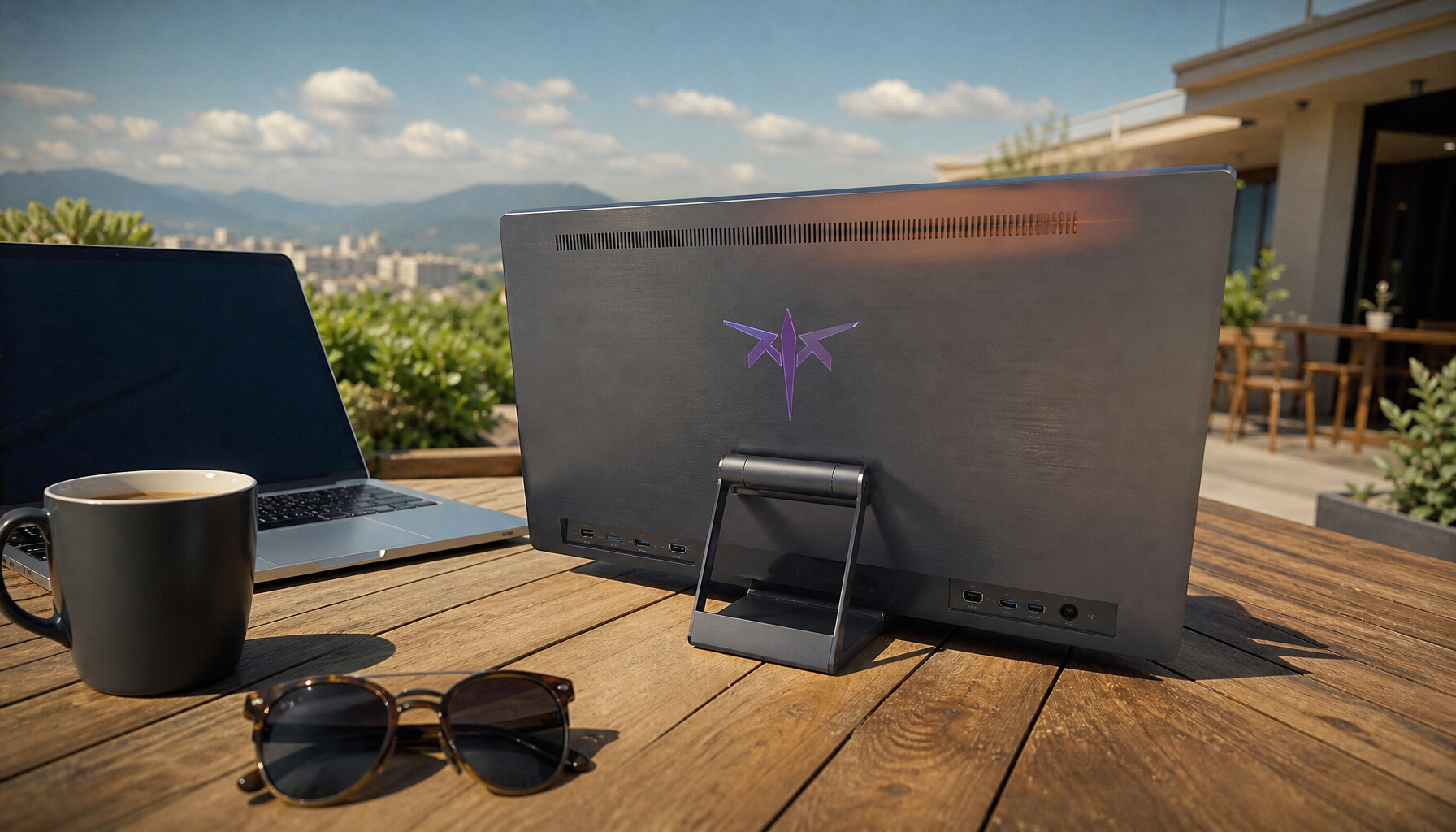
Portable monitors are often placed directly on a desk using a low folding cover. This can force the user to look sharply downward, lean forward, and work at a shorter viewing distance than intended. The compact screen may also encourage small text and high brightness, especially in hotels, shared offices, or other brightly lit spaces.
For sessions longer than a quick meeting, place the portable monitor on a stand and use an external keyboard and mouse. Match its scaling and brightness to the primary display so your eyes do not repeatedly adapt between a dim laptop screen and a bright portable panel.
How to Set Up a Monitor for Drier, Tired Eyes

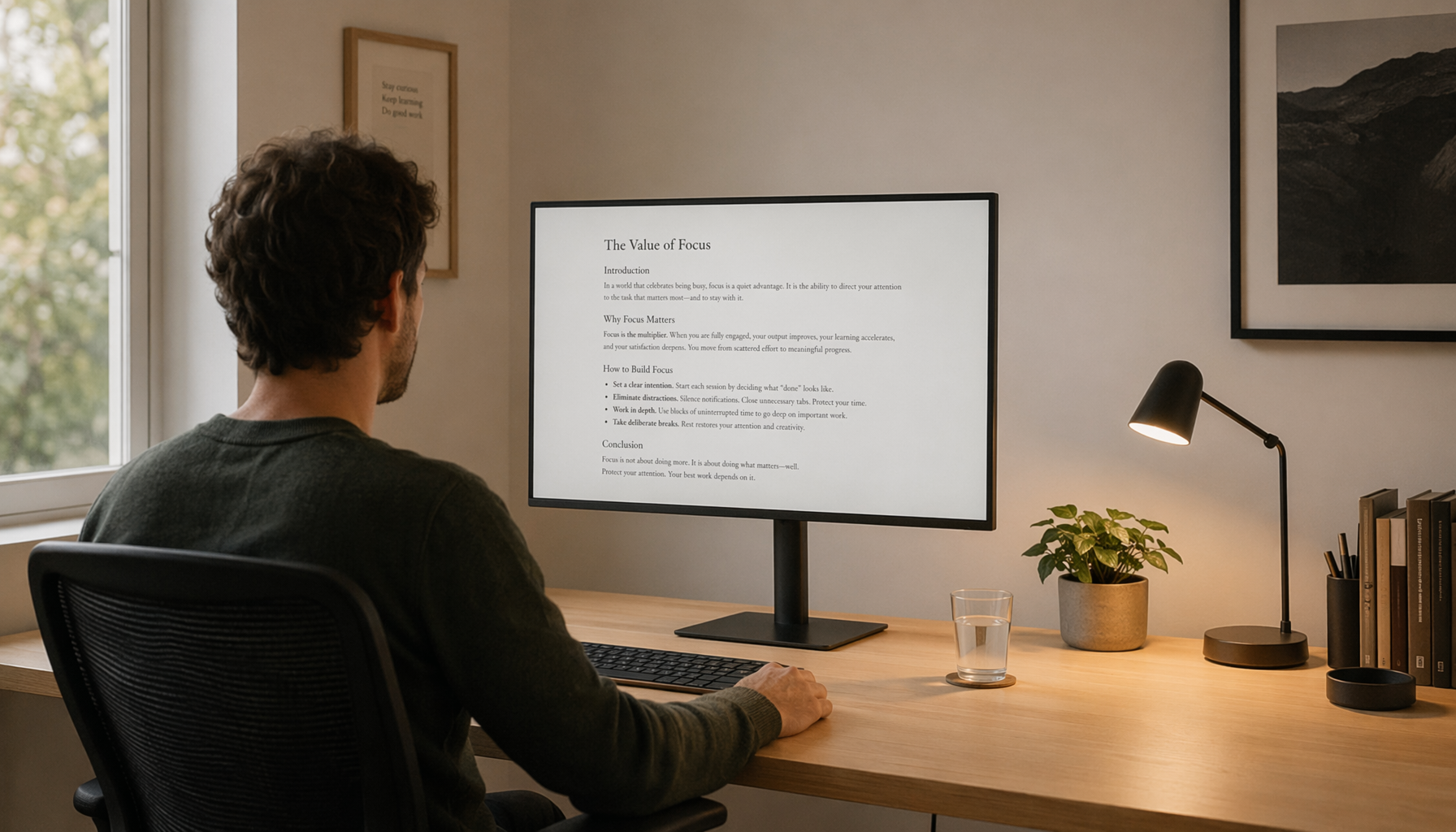
A practical starting distance is approximately 20 to 28 inches from the eyes, depending on screen size, resolution, and text scaling. The display should sit about 4 to 5 inches below eye level rather than directly above it. These ranges are consistent with computer vision syndrome guidance covering monitor distance, viewing angle, glare, text size, and breaks.
A slightly lower screen position can be helpful because looking downward naturally reduces how widely the eyelids are held open. Less exposed eye surface may slow tear evaporation. The position should still allow an upright neck and relaxed shoulders; lowering a monitor so far that you hunch over simply trades eye discomfort for posture problems.
Use a five-minute setup test
Sit in your normal working position rather than arranging the monitor while standing over the desk. Relax your shoulders, extend one arm, and check whether the screen is roughly an arm’s length away. Then look straight ahead: your gaze should land near the upper portion of the display, allowing most content to sit slightly below eye level.
Open a document, a dark application window, and a page with small interface text. Adjust brightness, contrast, scaling, and room lighting until all three are comfortable. This test is more useful than copying another person’s exact brightness percentage because monitor output and ambient lighting vary substantially.
Build breaks into the session
The 20-20-20 method means looking at something at least 20 feet away for 20 seconds every 20 minutes. This relaxes near-focus demand and creates a natural opportunity to blink. After every two hours of continuous device use, take a longer break of about 15 minutes.

A timer is useful at first, but breaks can also be tied to workflow events. Look across the room after sending an email, completing a game round, rendering a video, or finishing a section of a document. During the break, make several slow, complete blinks instead of rapidly squeezing the eyelids.
What to Prioritize When Buying a Monitor
Start with the physical constraints of your desk. A large screen is not automatically more comfortable if the desk cannot provide an appropriate viewing distance. Measure the available depth before choosing a 32-inch display or a large ultrawide, and account for the space occupied by the stand.
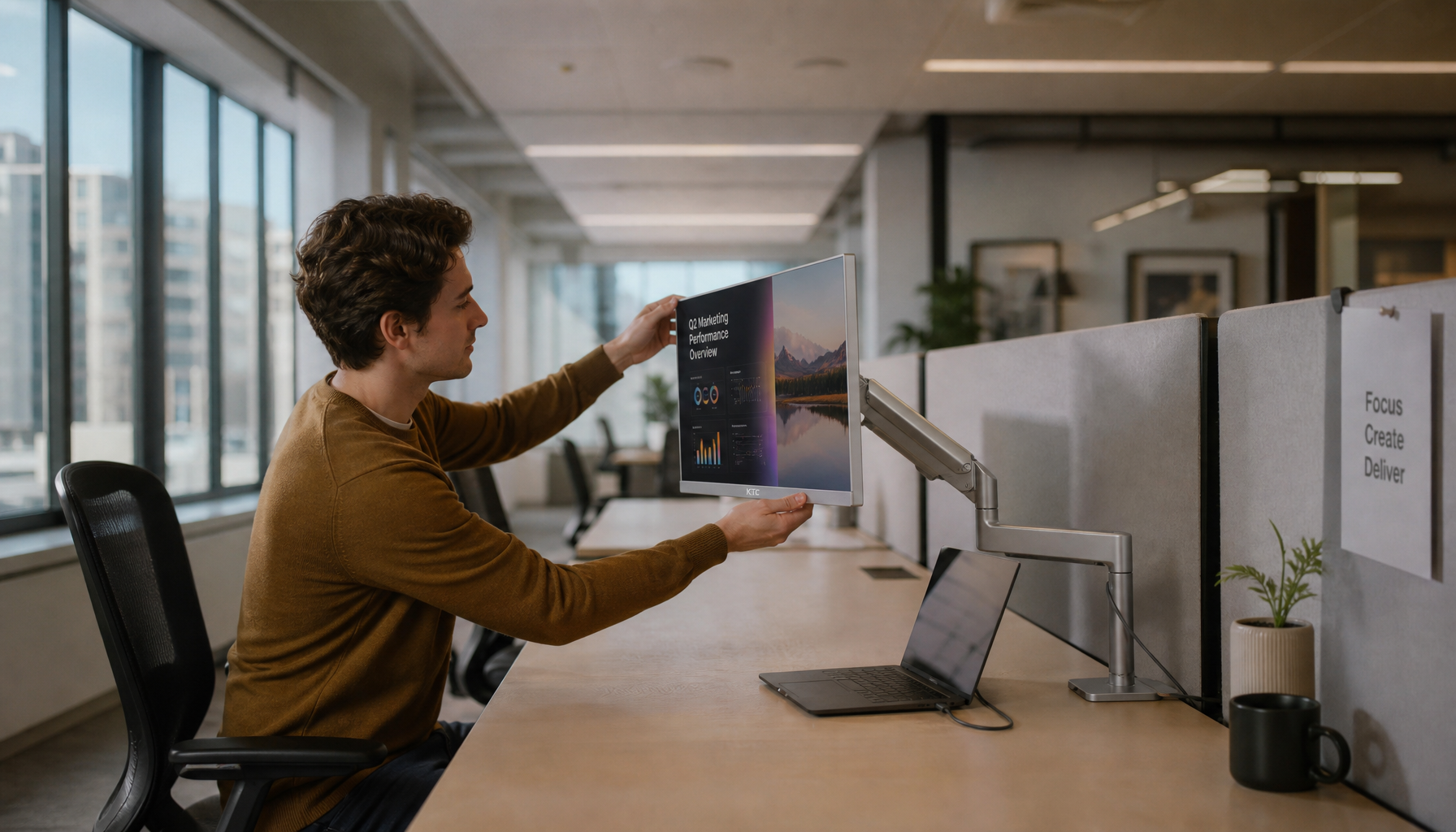
Next, prioritize ergonomic adjustability, usable brightness control, glare handling, and text clarity. A monitor with a height-adjustable stand or standard mounting support is usually easier to position than a model limited to basic tilt. For gaming, select the refresh rate and variable-refresh support that fit your graphics hardware, but evaluate those separately from dry-eye comfort.
Features worth treating cautiously
Labels such as “eye care,” “reading mode,” or “low blue light” do not prove that a monitor will prevent dryness. A warmer preset may look more comfortable at night, but it does not make you blink more. The same caution applies to high refresh rates: smoother movement may improve the experience without restoring tear-film stability.
Artificial tears can help some users prevent or relieve dry eyes, and preservative-free products may be used more frequently when appropriate. However, persistent pain, redness, light sensitivity, double vision, or blurred vision that does not clear with blinking warrants professional evaluation. Digital strain may overlap with an outdated prescription, an underlying dry-eye condition, medication effects, or another eye-health issue.
Practical Next Steps
Use this checklist before replacing a monitor solely because your eyes feel dry:
- Move the screen to approximately 20 to 28 inches from your eyes.
- Set the top portion of the display so the main viewing area is about 4 to 5 inches below eye level.
- Reduce brightness until white areas look appropriate for the room rather than self-illuminated.
- Increase text size or display scaling until you can read without leaning forward.
- Remove direct reflections and keep fans or air-conditioning vents from blowing toward your face.
- Follow the 20-20-20 method and take a 15-minute break after every two hours of screen use.
- Seek eye care if symptoms persist, worsen, or occur even when you are not using a display.
The central buying lesson is straightforward: choose a monitor that fits your desk and can be adjusted to your body. Brightness range, glare control, sharp text, stand flexibility, and appropriate screen size usually matter more for dry-eye comfort than a single headline specification.
Frequently Asked Questions
Q: Will a higher refresh rate stop my eyes from feeling dry?
A: Not directly. A higher refresh rate can make scrolling and game motion appear smoother, which may reduce motion-related discomfort for some people. Dryness is still primarily associated with altered blinking and tear evaporation, so breaks, complete blinks, suitable brightness, and correct positioning remain necessary.
Q: Is an ultrawide monitor worse for dry eyes?
A: Not inherently. An ultrawide can be comfortable when it is placed far enough away, centered correctly, and used with suitable text scaling. Problems are more likely when a large panel is too close, its edges require excessive head movement, or the user becomes so immersed in a wide workspace that breaks and blinking decrease.
Q: Why does my vision become blurry but clear after I blink?
A: Dryness can make the tear film uneven, temporarily reducing the optical smoothness of the eye’s surface. A complete blink spreads fresh tears across that surface, so vision may briefly become clearer. Repeated or persistent blur should still be evaluated by an eye-care professional, particularly if blinking does not resolve it.