A monitor arm that still droops is usually overloaded, adjusted at the wrong joint, or worn at the point that controls screen angle. The fix is to match the arm to the monitor’s real weight, separate height tension from tilt tension, and check for wear before replacing hardware.
What monitor-arm droop usually means
The first thing to separate is whether the whole arm is dropping in height or whether the screen itself is pitching forward at the head, because arm tension and tilt hardware are adjusted separately. That distinction matters more than how tight the arm feels in your hand. If the screen stays at the same height but its face keeps nodding downward, the tilt joint is the likely problem. If the entire display sinks lower, the lifting section is usually out of balance with the load.

On real desks, this is the fastest way to tell: height drift points to support force, while forward droop points to the screen-angle hinge. A monitor arm can feel firm in one direction and still fail in the other, which is why tightening one visible screw often changes nothing.
Symptom |
Most likely issue |
Best next move |
The whole monitor sinks lower |
The arm’s support force is too low for the load |
Re-adjust arm tension and verify the monitor’s real weight |
The monitor stays up but tilts forward |
The tilt joint or adapter connection is slipping |
Tighten the tilt hardware and inspect the head |
The setup shifts or feels unstable |
The clamp, grommet, or desk surface is moving |
Re-seat the mount and check desk fit |
Why it happens even when the arm feels maxed out
The arm is outside its real weight range
The most common cause is a capacity mismatch. Arm capacity is the weight range the lifting section is designed to hold in place. If an arm is rated for 10 to 25 lb and the bare monitor actually weighs 27 lb, it will drift down no matter how much you tighten it. The opposite problem also happens: if the monitor is too light, the arm can float upward instead of staying lowered.

This is where many setups go wrong. People account for the monitor without its factory stand, then forget the added load from a VESA adapter, a heavy curved panel, or a large ultrawide display. Manufacturer examples show why this matters: one dual arm may be aimed at 4.4 to 22 lb screens up to 27 inches, while a heavy-duty single arm may jump to 24 to 44 lb for larger displays. That is a reminder that screen size and supported weight do not scale casually.
You tightened the wrong adjustment point
A second common failure is confusing arm tension with tilt and swing adjustment. Height tension controls whether the monitor stays at the right height, while tilt hardware controls whether the screen face stays at the angle you set. When people say the arm is fully tightened, they often mean the visible tilt bolt is cranked down even though the real issue is the lifting section above it.

A simple example makes this easier. If your 27-inch display drops 2 inches every time you raise it, but the screen face remains level, that is not a tilt problem. If the height stays perfect but the top edge keeps tipping toward you, the tension setting may be fine and the head is where the slip lives.
The tilt head or adapter is the weak spot
Field troubleshooting also shows that some drooping starts at the tilt swivel or adapter connection, not in the main arm at all. That is especially common when a monitor uses a separate VESA adapter, which is simply the plate or interface that lets the monitor attach to the arm. In those cases, tightening the nut or bolts at the tilt point can solve it, at least when the hardware is still sound.
That same pattern offers a useful sanity check. If the monitor tilts forward even on its original stand, the weakness may be in the monitor hinge itself rather than the arm. That is not the most common outcome, but it is a smart check before you blame the mount and replace the wrong part.
How to fix it without guessing
Reset the arm around the monitor’s real weight
The cleanest fix is to start with the published weight range and a fresh tension adjustment. Weigh the monitor without its original stand, confirm that number fits the arm’s supported range, then adjust the arm in small increments until it stays where you leave it. A readjustment after a few years is normal and does not automatically mean the arm has failed.
This is also the point where replacement becomes obvious. If your screen is already sitting at the top end of the arm’s rating, you may be able to tame the droop temporarily, but you are asking the hardware to live at its limit every day. For a heavy 38-inch to 43-inch display, the better long-term move is often a heavier-duty arm built for 24 to 44 lb, not another round of over-tightening.
Bring the arm closer to neutral before locking tilt
A helpful fix from real-world troubleshooting is to avoid excessive forward lean at the head. If the lower arm is set in a way that throws the screen’s weight forward, the tilt point carries more of the load and droop gets worse. Bringing the arm back toward a more level, neutral position often reduces that leverage enough for the tilt hardware to hold.

Temporary shims can work, but they trade away adjustability and create a poor load path. They are fast and cheap when you need the monitor usable today, yet they usually turn a flexible arm into a fixed stand and add stress to the joint. If you keep changing the screen angle during the day, that is a sign to repair or replace the weak part instead of propping it up.
Check the base and the desk, not just the arm
Mount stability also matters. Guidance on clamp and grommet mounting highlights a point many buyers miss: a good arm still depends on a desk and mount style that fit each other. If the clamp is not seated well, the desk edge is weak, or the base can shift under load, the whole setup may look like a drooping arm when the real problem is movement at the mount.

This shows up most often on deep desks where the screen is extended far forward. If your desk has no grommet hole, a clamp mount is practical and common, but it still needs a solid grip on a sturdy edge. If the base rocks when you press on the desk, fix that first before chasing smaller adjustments higher up the arm.
When repair stops being the smart value play
A healthy arm is worth tuning; a worn-out one is not worth fighting forever. When a proper tension reset no longer holds, the tilt joint keeps slipping after re-tightening, or the monitor sits outside the arm’s supported range, replacement is usually the more reliable choice. The best value is not the cheapest option today. It is the option that ends daily readjustment, protects the monitor, and restores smooth movement.
There is also a usability cost to living with a bad arm. A screen that drifts during gaming, color work, coding, or office multitasking quietly pushes you into a chin-up posture, forward lean, and constant micro-corrections. That is exactly the ergonomic penalty a monitor arm is supposed to remove.
After the fix, set it where your eyes actually want it
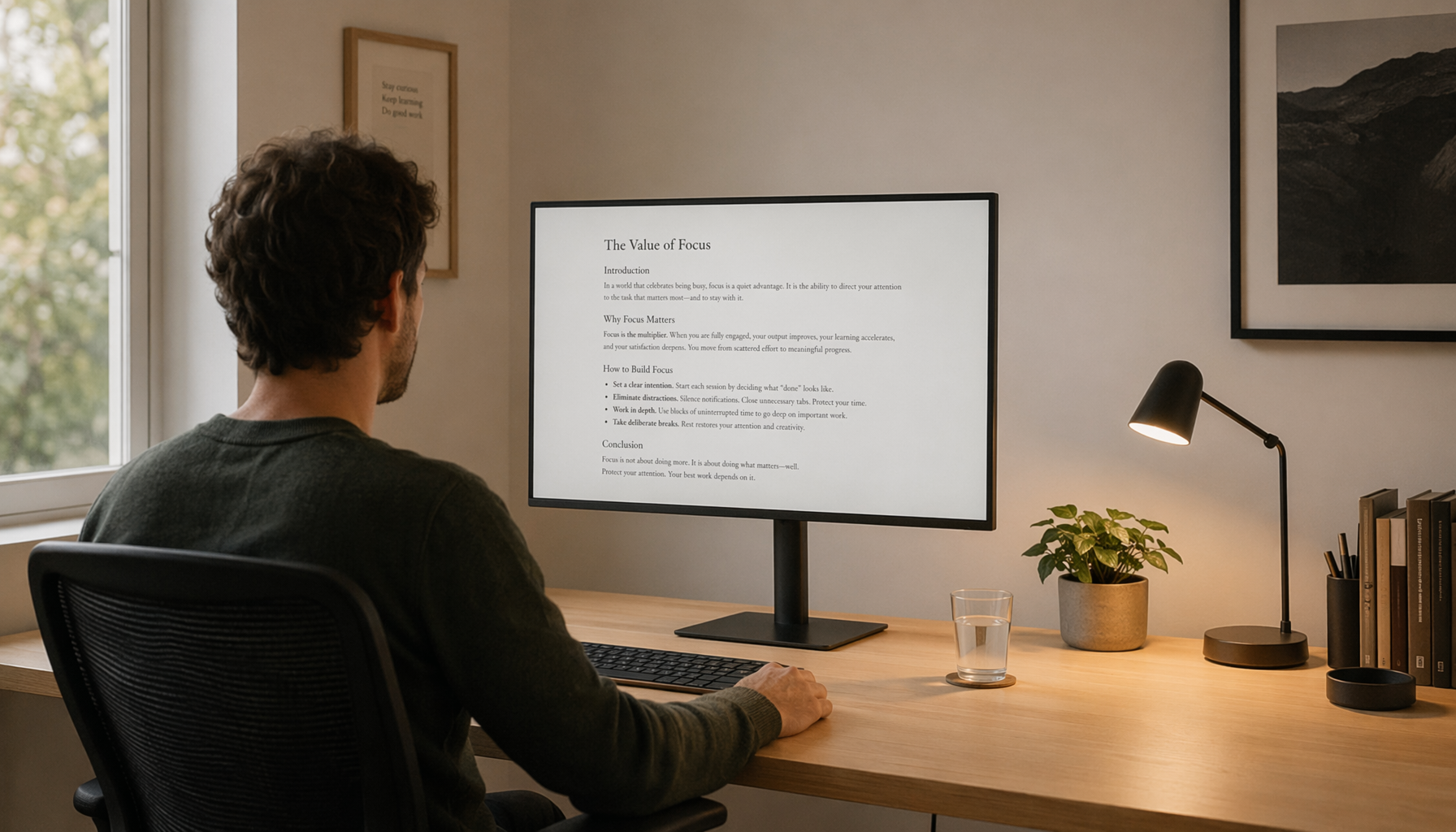
Once the droop is gone, good monitor positioning keeps the arm from becoming another strain point. A strong baseline is to place the screen directly in front of you, with the top of the display around eye level and the panel roughly 18 to 28 inches from your face. That central placement matters because even a perfectly stable monitor becomes fatiguing if you keep turning your head or lifting your chin to use it.
A useful nuance appears with larger screens. A 27-inch monitor often works better at 24 to 32 inches rather than at the closer end of the generic rule, because the larger image often needs more distance to stay fully in view without extra eye and head movement. The same source also favors keeping the top of the screen at or just below eye level and using a modest backward tilt, which helps explain why closer is better is not always true for bigger panels.
A monitor arm should make the screen feel weightless, steady, and easy to place. If yours only behaves when over-tightened, propped up, or left untouched, the arm is telling you something useful: the load is wrong, the adjustment point is wrong, or the hardware is worn out. Fix the real failure point, and the whole setup becomes calmer, cleaner, and more comfortable.