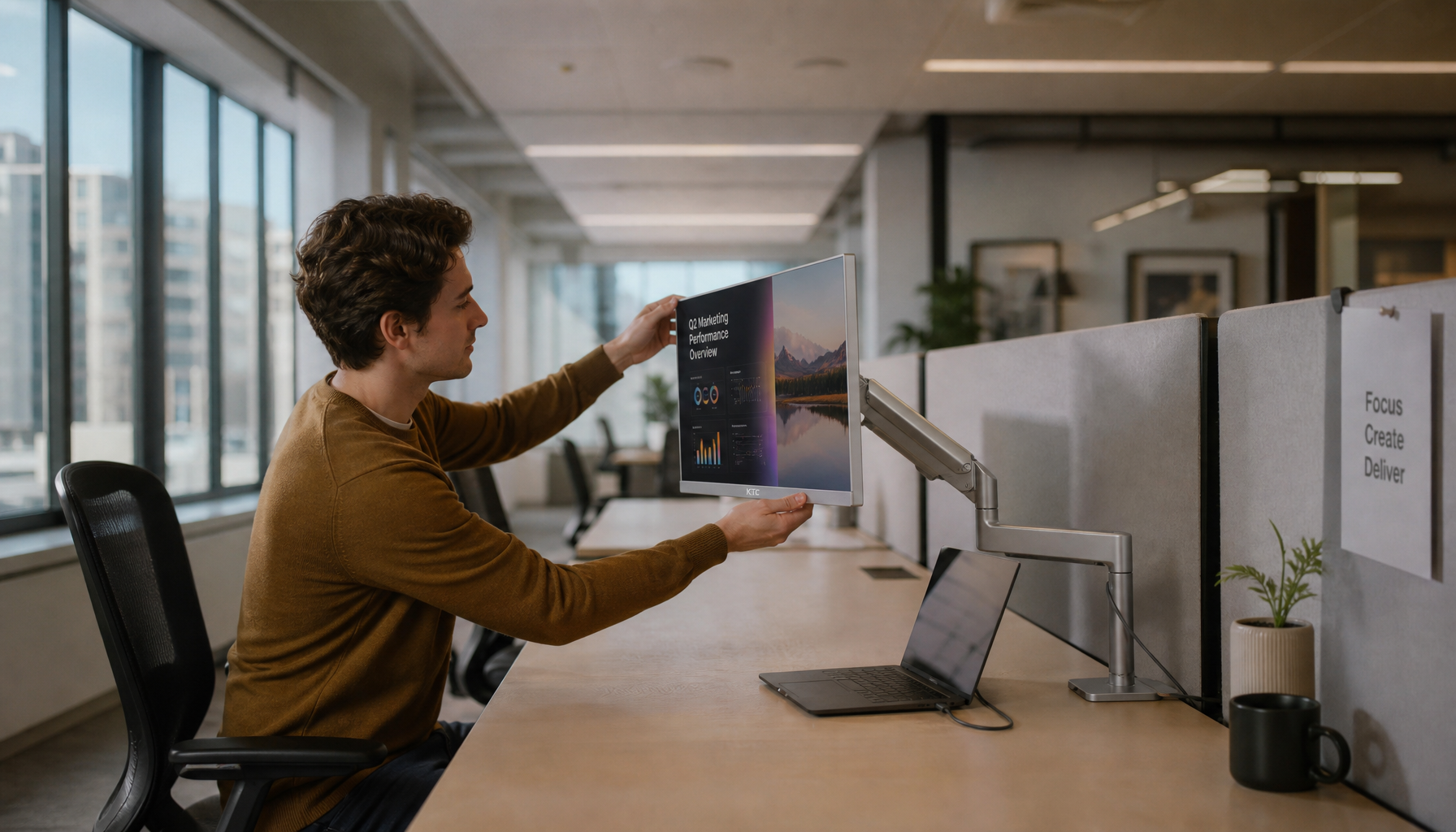
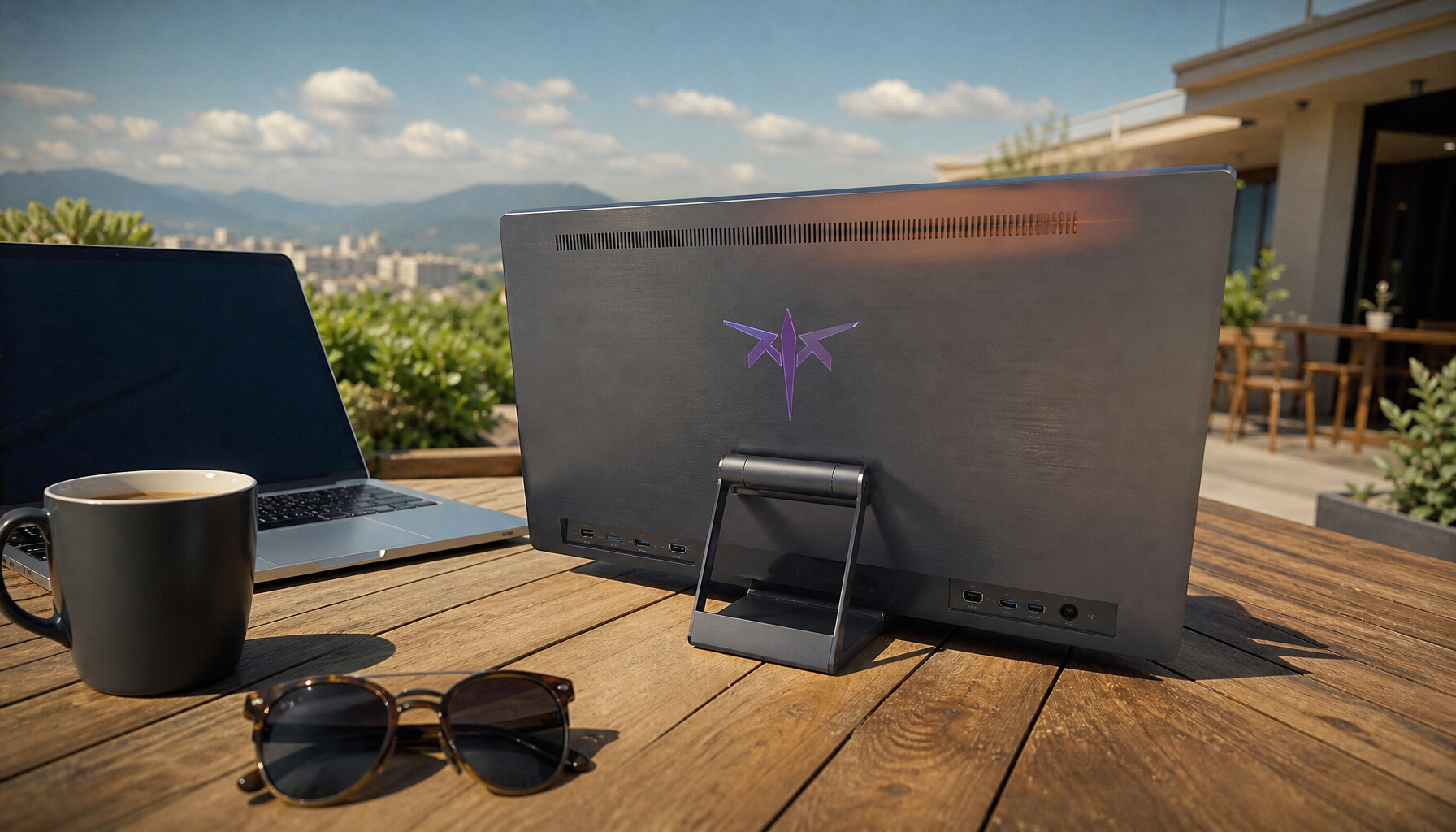
A USB-C KVM monitor setup can simplify a dual-device desk, but only if you treat video, USB switching, and charging as separate checks. That distinction matters because a port that carries data does not always carry display, and a monitor that can switch peripherals may still not charge your laptop the way you expect.

What a USB-C KVM Monitor Setup Actually Does
The basic goal is simple: one monitor, one keyboard, and one mouse that can serve two computers without forcing you to rewire the whole desk every time you switch. In real use, that is a convenience layer, not a guarantee that every part of the workflow will work through one cable.
Think of a USB-C KVM monitor setup in three layers. First is video, which is the picture on screen. Second is USB switching, which is what lets your keyboard, mouse, and other peripherals move between devices. Third is power delivery, which is what may charge a laptop through the monitor.
Those layers do not always travel together. A laptop might send video over USB-C but still need separate USB routing for peripherals, or it might recognize the display but not take enough power from the monitor to replace its charger. Apple’s accessory guidance is a reminder that even the peripheral side can depend on system settings, not just the cable path.
That is why this article starts with compatibility instead of product names. If your setup is mostly about convenience, a built-in KVM monitor may be enough. If you need rock-solid switching, extra charging headroom, or fewer wake-up surprises, a dedicated dock or external KVM can be the safer desk design.
Check Device and Monitor Compatibility First
Before buying cables, check the source devices, the monitor inputs, and the USB path separately. That order keeps you from assuming that one USB-C port can do everything just because the connector fits.
For Mac and Windows desks, separate OS behavior from monitor hardware behavior. The monitor can only switch what it physically supports, while the computer decides how it handles sleep, wake, and accessories. On macOS, Apple notes that you may need to adjust the Allow accessories to connect setting so USB peripherals attached through a KVM monitor are recognized correctly.
The first yes-or-no question is whether the laptop or desktop actually supports the display mode you want through the available USB-C or video port. If the source device cannot output video over that connection, the monitor may still power on but show no signal. The second question is whether the monitor supports the same path on its input side. A cable can fit cleanly and still fail to carry the right signal.
Then check the USB path. If you want one keyboard and mouse to move with the display, the monitor or KVM path has to pass USB data, not just video. That matters most on mixed desks, where one computer might work normally while the other never sees the peripherals at all.
Power delivery is a separate check. A monitor may charge a laptop well enough for light use, yet still fall short if you expect it to replace a dedicated charger during heavier work. KTC’s one-cable USB-C KVM setup is a useful follow-up here, because the right question is not “does USB-C exist,” but “does this exact path support my display, USB, and charging needs?”
Use this rule of thumb: if any one of those three layers is uncertain, test the path first or plan on a mixed-cable setup. That is usually better than buying a monitor that looks convenient but cannot handle your actual desk behavior.
Mac and Windows Behavior
On a mixed-platform desk, the operating system can change how switching feels even when the hardware is fine. A Mac may wake or reconnect differently than a Windows PC, especially if the monitor is acting as the shared USB hub.
That is why a Mac-and-Windows USB-C KVM monitor setup should be judged as two workflows, not one universal experience. If one machine is dependable and the other is not, the problem may be in the source device’s sleep or accessory handling rather than in the monitor itself.
If you regularly switch between Apple Silicon and Windows, verify wake behavior and input selection before you rely on the setup every day. When that is not stable, a dedicated dock or external KVM is usually the better choice.
USB-C Video and Data Requirements
USB-C is not a single promise. Some ports carry display output, some carry data, and some do both only under specific conditions. That is why the same cable can work in one desk and fail in another.
The reader check here is straightforward: does the source device support the display path you need, and does the monitor or hub accept that path on its USB-C input? If you are unsure, start with the most direct connection and confirm that the monitor can show the source before you add peripherals or extra adapters.
This is also where a short cable troubleshooting mindset helps. If a setup fails, a direct test tells you whether the issue is the source device, the cable, or the monitor input. That is much faster than swapping every component at once.
For readers who want a deeper comparison of port behavior, the USB-C, HDMI, and DisplayPort guide is a useful companion before you commit to a cable path.
Power Delivery and Charging Fit
Charging through the monitor is convenient, but it is not automatic and it is not always enough. The charging result depends on the monitor’s power delivery implementation and the laptop’s needs.
If you want one cable to handle work and charging, check whether the monitor is meant to serve as a main charger or just a convenience charger. A laptop can still run a display over USB-C while drawing more power than the monitor is able to supply comfortably. In that case, the setup works, but it is not the best single-cable desk.
The practical boundary is simple: if you need all-day charging headroom or a laptop that stays topped up under load, do not assume the monitor will replace your adapter. Treat that as a model-specific check, not a universal USB-C feature.
Wire the Monitor, USB, and Power Cleanly
A stable USB-C KVM monitor setup is easier to get right when you connect it in the same order every time. Start with the direct video path, then add USB sharing, then confirm power, and finally verify the active input on the monitor.
- Connect the primary video path first. Confirm that one computer can show a picture on the monitor before you add any sharing features.
- Add the USB path for keyboard, mouse, and any other peripherals you want to move between devices.
- Confirm charging or power delivery only after the display and USB path are stable.
- Check the monitor’s active input source, because a good cable still looks like a bad setup if the screen is listening to the wrong port.
- If something fails, change one cable or one setting at a time.
That sequence prevents the most common mistake on hybrid desks: assuming the whole setup failed when only one layer did. In other words, video can work while USB switching fails, or USB can work while charging is weak.
For readers still sorting out the right physical cable path, the premium display cables are a reasonable starting point for a clean direct connection, especially when you want to remove cable quality from the troubleshooting list.
Fix the Most Common USB-C KVM Problems
Most failures fall into four buckets: blank screen, USB peripherals not switching, charging that is missing or too weak, and wake behavior that differs between Mac and Windows. If you sort the issue by symptom first, you usually find the cause faster.
Blank Screen or No Signal
Start with input selection, cable seating, and whether the source device is awake. Those three checks solve more setup confusion than any advanced menu digging does.
If the monitor is on the wrong input, the setup may look dead even though the cable is fine. If the source device is sleeping or not outputting video, the monitor will also appear to fail. A direct connection test is the cleanest way to separate source limitations from monitor limitations.
Keyboard and Mouse Do Not Switch
This usually means the USB path is missing, not that the display is broken. A monitor can show video correctly while the keyboard and mouse still stay attached to only one machine.
Test one peripheral at a time if you need to isolate the problem. That helps you see whether the shared USB port, the hub path, or the source device is the real issue. If the display switches but the USB devices do not, the KVM side is the part to inspect first.
Charging Is Slow or Missing
Charging problems often come from a mismatch between the monitor’s output and the laptop’s expectation. A setup can still be useful for display and USB sharing while being too weak to serve as the only charger.
If your laptop battery drains during normal work, do not force the monitor to be your only power source. Use the laptop adapter or a dock when charging headroom matters more than cable minimalism.
Mixed Mac and Windows Wake Issues
Sleep and wake can behave differently across operating systems, even on the same hardware. That is one reason a desk can feel unstable even when every component seems correct.
If wake behavior is inconsistent, try waking the source device first and then switching inputs. If that still feels unreliable, the best fix is often not another menu setting but a different desk architecture. Apple’s accessory permission page is still the first macOS reference to check.
Choose the Right Monitor for Your Desk
The best USB-C KVM monitor setup is the one that matches your desk behavior, not the one with the most features on the box.
| Desk Profile | What Matters Most | What To Verify Before Buying | Best-Fit Path |
|---|---|---|---|
| Productivity-first hybrid desk | Clean switching, stable input selection, enough charging for routine use | USB-C video support, USB data sharing, and whether the monitor can charge your laptop at the level you need | Built-in USB-C/KVM monitor if the workflow is light and predictable |
| Mac and Windows mixed desk | Wake behavior, accessory recognition, and simple recovery when something sleeps oddly | macOS accessory settings, input handling, and whether both systems support the same display path | Built-in KVM only if you can tolerate occasional tuning; otherwise use a dock-assisted setup |
| Reliability-first desk | Fewer surprises, consistent wake, and predictable peripheral identity | Whether switching, charging, and wake behavior must work every time | Simple monitor plus external dock/KVM |
| Light creator or second-computer desk | Clear visuals, easy cable routing, and enough flexibility for the second device | Source device video support, monitor inputs, and whether you need high certainty more than one-cable convenience | Hybrid setup with a monitor that supports the path you actually use |
For readers who want a practical KTC option after the compatibility checks, the KTC M27P6 is worth a look as a conditional fit: it is a 27-inch 4K Mini-LED monitor with built-in KVM and 65W USB-C Power Delivery. That makes it a reasonable candidate for dual-device desks that want convenience first, not a universal answer for every workflow.
If your desk leans more toward office work than mixed gaming use, browse office monitors instead of chasing KVM features you may never use. If you care more about gaming refresh rate than single-cable convenience, a gaming monitor may be the better category to compare.
A practical decision sentence: choose built-in USB-C/KVM when convenience matters and your devices already support the path; choose an external dock or KVM when reliability matters more than keeping the desk simple.
Wrap-Up
Before you buy, confirm three things: your source device supports the display path, the monitor supports the USB and power path you want, and your daily workflow can tolerate the switching friction built-in KVM creates. If those checks pass, a simpler setup is usually the better one. If they do not, use a dock-assisted fallback instead of forcing one cable to do too much. For cable-path decisions, the USB-C vs HDMI vs DisplayPort guide is the cleanest next step.
FAQs
How Do I Know If My Laptop Supports USB-C Video Output?
Do not assume every USB-C port carries display. Check your laptop’s spec for video output support, often listed as USB-C display output, DisplayPort over USB-C, or a similar feature. If the spec only mentions charging or data, the port may not drive the monitor the way you want.
Can a USB-C KVM Setup Charge My Laptop at the Same Time?
Sometimes, but not always. Charging depends on the monitor’s power delivery output and your laptop’s charging needs. If the monitor cannot keep up under your usual workload, treat charging as a bonus and keep the laptop adapter nearby.
What Should I Use If My Mac and Windows PC Behave Differently?
Check each device separately before blaming the monitor. On macOS, accessory permission can affect recognition, while Windows may behave differently around sleep and wake. If one machine is stable and the other is not, the problem may be in the computer’s behavior rather than the KVM path.
Why Does My Monitor Show No Signal Even Though the Cable Fits?
A fitting connector does not guarantee the right signal. The source device may not support video on that port, the monitor may be on the wrong input, or the cable may only carry data. A direct connection test is the fastest way to isolate the failure.
Can I Switch Keyboard and Mouse Without Switching the Display Input?
Sometimes, but only if the monitor or hub design supports separate USB switching. Video and USB sharing are related, but they are not always the same feature. Check the model spec before you expect the peripherals and the display to behave independently.