A USB-C KVM monitor can clean up a dual-computer desk, but it only feels simple when the laptop, monitor, and cable all support the same video, charging, and USB switching features. The main payoff is fewer cable swaps between a work laptop and a desktop, while the main risk is assuming every USB-C port does the same job.

Why One Cable Matters at a Dual-Computer Desk
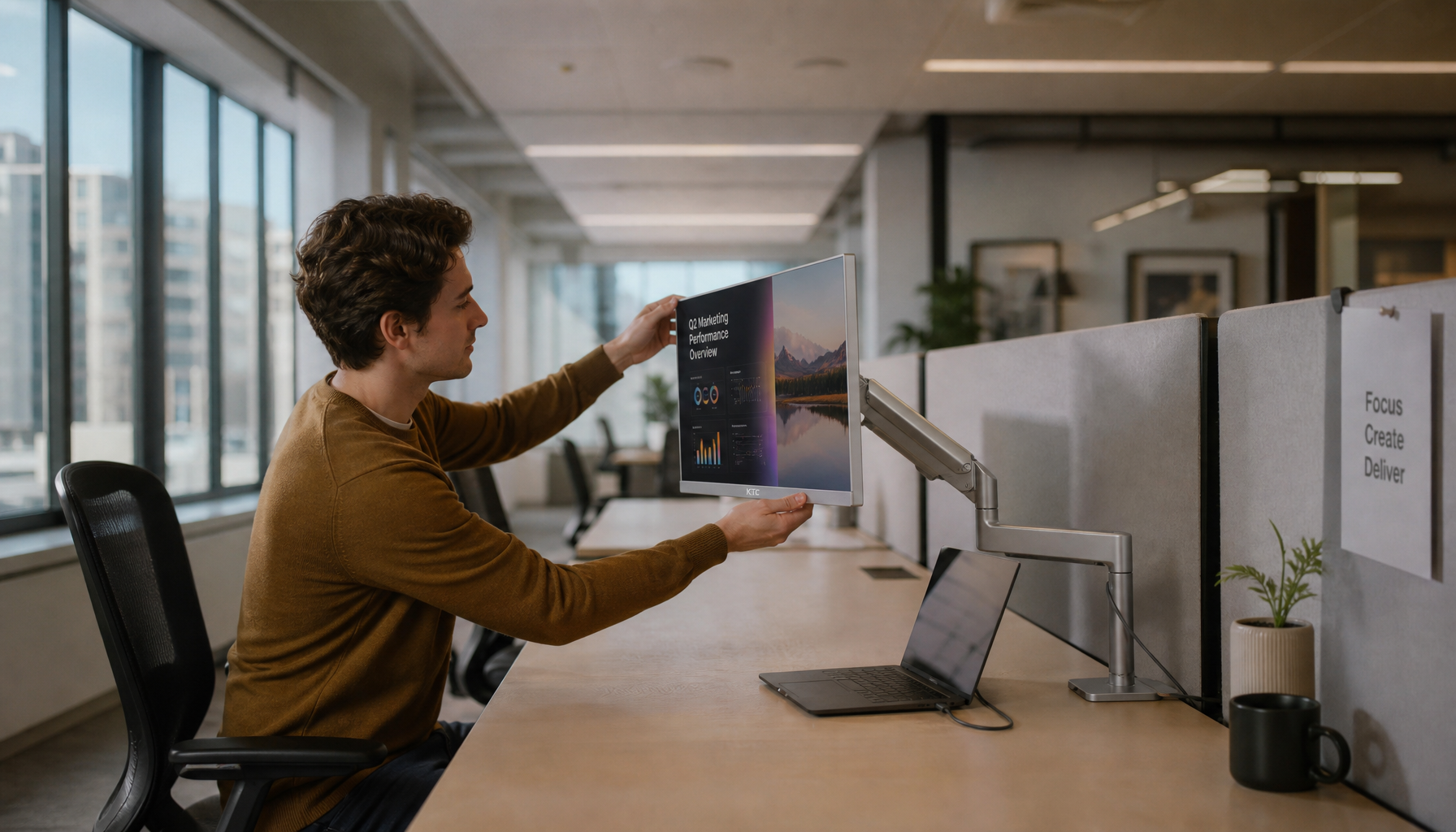
For hybrid workers, the appeal of a USB-C KVM monitor is practical: one connection can carry display signal, laptop charging, and USB data when the setup is designed for it. That means less unplugging, fewer docks sitting on the desk, and fewer moments where the keyboard or mouse ends up on the wrong machine.
The catch is that the convenience only shows up if the source device, cable, and monitor agree on the same feature set. A port that charges a laptop is not automatically a video port, and a monitor with USB ports is not automatically a full KVM solution.
A good rule of thumb is this: if you want a one-cable setup, verify the laptop's USB-C video support first, then the monitor's charging and USB switching path, then the cable. If any one of those pieces is incomplete, the setup usually degrades into partial convenience instead of true one-cable switching.
For a deeper workspace overview, see How a USB-C Monitor Can Streamline Your Workspace.
How USB-C Video, Charging, and KVM Actually Work
USB-C Alt Mode and Video Output
The first thing to check is DisplayPort Alt Mode, because that is the feature that lets a USB-C port carry video at all. The USB-IF and VESA guidance on DP Alt Mode over USB-C is the cleanest way to think about it: the connector shape is not the feature. The port behavior is.
In plain English, that means a USB-C port can look correct and still fail to send display signal. If the laptop only supports charging or limited data, the monitor may power on while the image never appears. That is why USB-C video output needs a separate compatibility check, not just a guess based on the plug shape. For bandwidth details, see USB-C Alternate Mode Lane Configuration: How 2-Lane vs 4-Lane Affects Video Bandwidth.
Power Delivery and Laptop Charging
Power Delivery, or PD, is the part that determines whether the monitor can charge the laptop while you work. It matters most for users who want the desk to behave like a dock replacement, because a weak PD rating can leave the laptop charging slowly or not at all under load.
As StarTech notes in its USB-C feature guidance, charging capability and video output are separate checks. That means a laptop can charge through USB-C without necessarily sending a display signal, and it can also send display signal without receiving enough power for a comfortable all-day setup.
KVM Switching and USB Upstream Paths
KVM is about sharing keyboard, mouse, and sometimes other USB peripherals between computers. The important detail is that the USB switching path is separate from the video path on many monitors, so video can work while the peripherals do not follow the active source.
That is the part buyers often miss. A monitor may accept USB-C video from a laptop and HDMI from a desktop, but still require a dedicated upstream USB connection before the keyboard and mouse will switch correctly. StarTech's KVM setup guidance describes this separation clearly enough to use as a buyer check, even if the exact menu labels differ by model.

What to Verify Before You Buy
Before you buy a USB-C KVM monitor, use this checklist in order:
- Confirm the source USB-C port supports DisplayPort Alt Mode, because charging alone does not guarantee video output.
- Check the monitor's Power Delivery rating against your laptop's real charging needs, especially if the laptop is also powering a lot of peripherals.
- Look for a true upstream USB path for the KVM feature, not just a USB-C port that happens to accept video.
- Use a full-featured USB-C cable that supports the needed video mode, because weaker cables are a common source of flicker, dropouts, or missing video.
- Start with a direct connection before adding docks, adapters, hubs, or extension cables.
That order matters because it separates the most common failure points. If video fails, the source port or cable is usually the first suspect. If the image works but the mouse and keyboard do not switch, the USB upstream path is the more likely problem.
A useful decision sentence is this: if your laptop only exposes USB-C charging or a limited data port, skip the one-cable expectation and plan on a mixed-cable setup instead. If the laptop supports Alt Mode and the monitor has enough PD and USB routing, the setup is usually far less frustrating.
If you want a broader explanation of why some ports work and others do not, Why Your USB-C Monitor Works Perfectly With One Laptop but Not Another is a good sanity-check read before you buy.
Which Monitor Type Fits Your Two-Computer Workflow
The right monitor type depends on what you do most at the desk, not just on whether the monitor has USB-C.
| Workflow | Best Fit | Why It Fits | When It Breaks Down |
|---|---|---|---|
| Mixed office work with a laptop and desktop | 27-inch 4K office-style monitor | Text looks sharper and the desk stays simple | Not ideal if you care more about high-refresh gaming than document clarity |
| Work by day, gaming by night | 27-inch 4K high-refresh monitor | You can keep productivity sharp without giving up speed | A lower-refresh office panel can feel limiting on the desktop |
| HDR-heavy gaming or creator-adjacent work | Mini-LED 4K monitor | Stronger contrast and brighter highlight impact can help | Only worth it if the USB-C and KVM features still match your workflow |
| Budget productivity desk | 27-inch QHD office monitor | Simple, affordable, and good enough for documents and browser work | Not the best fit if you want both premium HDR and full one-cable convenience |
For a neutral shopping starting point, the Office Monitor collection is the broad category to browse if your priority is desk productivity first and gaming second. If you want a single model that still keeps work and play in one place, the KTC 27-inch 4K gaming monitor is the most directly relevant option in this set because it combines 4K productivity, high refresh, and 90W USB-C Power Delivery.
That does not make it the right choice for everyone. If your desktop use is mostly fast-motion gaming and your laptop only needs light docking, a pure high-refresh gaming monitor can be the better fit. If your use is mostly email, docs, and video calls, an office monitor is usually easier to justify.
Set Up the Monitor Without Replugging
- Start with one computer first. Get the monitor working with a direct connection before you add KVM routing, USB hubs, or extra adapters.
- Connect the laptop by USB-C only if that port supports video output and the monitor supports the charging level you want.
- Connect the desktop with HDMI or DisplayPort, then add the monitor's upstream USB path for KVM switching.
- Plug the keyboard and mouse into the monitor's USB ports only after the video signal is stable.
- Switch between devices and confirm that both the image and the USB peripherals follow the selected source.
A clean first test saves a lot of confusion later. If you build the whole desk at once, it becomes harder to tell whether a problem comes from the laptop port, the desktop input, the cable, or the monitor menu.
For a setup walkthrough that is closer to a real hybrid desk, see KVM Monitor Setup: Share One Display Between MacBook and Gaming PC.
Where a KTC Monitor Can Fit In
If you are comparing store-side options, the H27P6 monitor is the clearest fit when you want a productivity-first dual-computer desk that still leaves room for gaming. Its 90W USB-C Power Delivery and dual-mode refresh behavior make sense for buyers who want one monitor to cover mixed work and after-hours play.
By contrast, if you want a broader browsing route rather than a single featured pick, the All Monitors collection is the safer place to compare sizes, refresh rates, and use cases without locking into a specific category too early.
Fix the Most Common Switching Problems
No Image Over USB-C
If charging works but the screen stays dark, the source USB-C port may not support DisplayPort Alt Mode, or the cable may not support the needed signal path. That is the most common reason a setup appears half-working.
The fastest test is to remove extras and try a direct connection with a known-good cable. If that still fails, check the laptop's port specs before you blame the monitor. See How to Determine the Maximum Resolution Your USB-C Connection Actually Supports for port testing steps.
USB Devices Stop Following the Active Source
If the image switches but the keyboard or mouse does not, the upstream USB path is probably missing or incomplete. In many cases, the monitor is receiving video from one path and USB control from another path that was never fully connected.
This is where buyers often assume the KVM is broken when the real issue is routing. Recheck the upstream USB cable, confirm the monitor's KVM setting, and make sure the peripherals are plugged into the correct monitor ports.
Charging Works but Video Does Not
This is the clearest sign that USB-C power is working but video is not. The source port may be power-only, data-limited, or missing Alt Mode support, and the cable may also be too weak for reliable video.
Do not jump straight to dock swapping. First verify the port capability, then the cable, then the monitor input selection. That sequence usually saves time.
The Setup Worked Once, Then Failed
If the system worked and then broke after switching sources, recheck cable seating and remove extra adapters before changing anything else. Many "random" failures are just marginal cable paths that stop behaving once the desk gets bumped or re-routed.
In that situation, the most useful fix is often the least exciting one: simplify the path, reconnect each end firmly, and retest from the simplest direct cable arrangement.
The Best Next Step for a Clean Dual-Computer Desk
The cleanest USB-C KVM setup is the one you can verify in layers: Alt Mode first, Power Delivery second, KVM routing third. If your laptop and monitor both meet those checks, a one-cable desk is realistic. If they do not, the safer move is a mixed connection plan rather than forcing the monitor to do everything. Using Monitor USB Hubs to Clean Up Cable Clutter can further reduce visible cables once the core switching works.
FAQs
Q1. How Do I Know If My Laptop Supports USB-C Video?
Check the laptop's port specs for DisplayPort Alt Mode or another verified video output mode. A charging-only USB-C port can look identical at the connector level, but it will not send video to the monitor.
Q2. Can a USB-C Monitor Charge a Laptop and Switch KVM at the Same Time?
Yes, but only if the monitor supports both Power Delivery and a separate upstream USB switching path. Charging and KVM are different functions, so one does not guarantee the other.
Q3. Why Does My Keyboard Work but My Mouse Does Not After Switching?
That usually points to partial USB enumeration or an incomplete upstream path. Try reconnecting the upstream cable and the USB devices, then switch sources again to see whether the monitor fully reassigns the USB path.
Q4. What Cable Should I Use for a USB-C KVM Monitor Setup?
Use a full-featured USB-C cable that supports the video mode your setup needs. Lower-quality or incomplete cables can cause flicker, dropouts, or missing video, especially once you add charging and peripherals.
Q5. Can I Use MacBook and Windows With the Same USB-C KVM Monitor?
Usually yes, but treat it as a compatibility check, not a guarantee. Both systems still need the correct video support and the monitor's KVM routing has to be set up properly for each source.
What to Check Before You Commit
A USB-C KVM monitor is worth considering when your desk has a clear laptop-plus-desktop routine and you want fewer cables visible all day. It is less convincing when you have to rely on adapters, the source port is unclear, or you are not sure the monitor has the right upstream USB path. Check those three pieces first, and the rest of the setup becomes much easier.