For competitive console play, VRR is usually worth using only when it smooths unstable frame rates without adding inconsistent feel. The best fix is to pair a 120 Hz performance mode with low-lag monitor settings, then disable VRR for games that already hold a stable 120 FPS.
Ever win a close duel one round, then feel like your aim is half a beat late in the next? On a console connected to a gaming monitor, that “random” delay often comes from unstable frame pacing, sync behavior, or display processing rather than the controller itself. With a few repeatable tests, you can decide whether VRR is helping your setup or quietly making competitive moments less predictable.
Why Console VRR Can Feel Laggy Even When It Reduces Tearing
VRR lets a gaming monitor refresh when the console finishes a frame, which can reduce tearing and uneven motion when frame rates fluctuate inside the supported range. A 120 Hz signal updates every 8.33 ms, while 60 Hz updates every 16.67 ms, so a 120 Hz console mode gives the display twice as many opportunities to show a new frame 120 Hz signal.
The catch is that VRR cannot create missing frames. If a game dips to 45 FPS, each rendered frame lasts about 22.2 ms, making stutter, blur, and input delay more noticeable even though the monitor’s pixel response time has not “slowed down” 45 FPS. In competitive games, that inconsistency can matter more than a perfectly tear-free image.
The Real Problem Is Latency Variability

Input lag is the full delay from button press or stick movement to the visible result on screen, not just the monitor’s advertised response time. It can come from the controller, game engine, render queue, sync mode, display processing, monitor firmware, and network conditions input lag.
That is why VRR can feel excellent in one match and worse in another. If the frame rate swings between 75 FPS and 110 FPS, VRR may smooth motion; if it repeatedly falls near the lower VRR range or triggers compensation behavior, the timing of visible updates can become less predictable.
Should You Use VRR for 120 Hz Console Gaming?
For most players, the best starting point is 120 Hz performance mode with VRR enabled, Game Mode on, and extra image processing off. Console VRR works best when the display supports a modern high-bandwidth display connection with VRR, the monitor can run 120 Hz, and the game has variable frame-rate support high-bandwidth display connection VRR.
However, competitive shooters are a special case. A stable 120 FPS mode on a low-lag gaming monitor often feels better than a prettier mode that bounces around under VRR. A company’s esports latency research found that performance improved consistently as refresh rate increased from 60 Hz to 120 Hz and 240 Hz, and that added latency of 4 ms or 8 ms hurt performance in aiming tasks performance improved.
A Practical Decision Table

Scenario |
Recommended Setting |
Why It Helps |
Game holds stable 120 FPS |
120 Hz, VRR optional or off |
Prioritizes predictable input timing |
Game ranges around 75-110 FPS |
120 Hz with VRR on |
Reduces tearing and uneven motion |
Game is locked at 60 FPS |
60 Hz or 120 Hz output, VRR low priority |
VRR benefit is usually minor |
Competitive mode feels inconsistent |
Test VRR off for the same map |
Confirms whether VRR timing is the issue |
Dark OLED or VA panel flickers with VRR |
Try VRR off or cap frame rate |
Reduces refresh swings and flicker risk |
Monitor Settings That Reduce VRR Input Lag Spikes
Start with the monitor’s Game Mode or low-lag mode. Disable motion smoothing, noise reduction, dynamic contrast, unnecessary scaling features, and any “cinema” or “enhanced” processing modes. These features are built for image presentation, not fast controller-to-pixel response.
Use the highest console-supported refresh rate that your monitor and game can run cleanly. A 60 Hz display refreshes every 16.7 ms, 144 Hz every 6.9 ms, and 240 Hz every 4.2 ms, but sync settings can add far more delay than the refresh interval alone refresh rate. For console players, that usually means 120 Hz over 60 Hz whenever the game supports it.
If you are testing an adaptive-sync-capable 4K display such as the 27” 4K 160Hz/1ms gaming monitor, start at 120 Hz with balanced overdrive before deciding whether VRR actually improves the feel in your main competitive game.

Use Balanced Overdrive, Not the Fastest Label

Many gaming monitors offer overdrive settings such as Off, Normal, Fast, Faster, or Extreme. The fastest setting can create inverse ghosting, especially when frame rates fluctuate under VRR. For competitive console use, Normal or Balanced is often the better choice because it keeps motion clear without adding distracting artifacts during frame-rate dips.
OLED and VA monitors also deserve extra testing. VA and OLED panels have higher visible VRR flicker risk, especially in dark scenes, menus, loading screens, HDR scenes, and dark-to-light transitions VRR flicker risk. IPS panels are usually less prone to obvious VRR flicker, while mini-LED LCD behavior can vary because local dimming zones change brightness dynamically.
Console and Game Settings to Test First
Use the correct display connection port and cable before changing deeper settings. For 4K at 120 Hz with VRR, the monitor should support high-bandwidth display connection performance, and the console should be connected to the monitor’s full-bandwidth display connection input rather than a secondary limited port.
Then test one change at a time in the same game mode, map, or practice area. If you change VRR, HDR, overdrive, and graphics mode at once, you will not know which setting fixed the input spike. The most useful comparison is simple: replay the same scene with VRR on, then replay it with VRR off.
Action Checklist
- Set the console to 120 Hz output if the game and monitor support it.
- Enable the monitor’s Game Mode or low-lag mode.
- Turn off motion smoothing, dynamic contrast, extra sharpening, and unnecessary image processing.
- Use Normal or Balanced overdrive instead of Extreme.
- Test VRR on and off in the same match type or practice area.
- If the game offers modes, choose Performance over Quality for competitive play.
- If input timing still feels uneven, disable VRR for that specific game.
When to Turn VRR Off
Turn VRR off when a competitive game already holds a stable 120 FPS and your main priority is consistent input timing. VRR is most useful for demanding games with fluctuating frame rates, not for every high-refresh competitive setup. One week-long test on a 360 Hz monitor found VRR more useful in large-budget games around 80-120 FPS than in competitive shooters running much higher frame rates VRR more useful.
On consoles, you will not be running 250-350 FPS, but the principle still applies: smoothness is not always the same as responsiveness. If a 120 Hz performance mode feels snappier with VRR off, keep it off for that title and use VRR for single-player or graphically demanding games where tearing and stutter are more noticeable.
The Best Setup for Most Competitive Console Players
A strong competitive console monitor setup is usually a 27- to 32-inch 4K gaming monitor with 120 Hz or higher refresh, high-bandwidth display connection support, VRR support, and low input lag in Game Mode. Ultrawide monitors can be excellent for computers, but console support varies, so competitive console buyers should prioritize clean 16:9 120 Hz behavior over extra screen width.
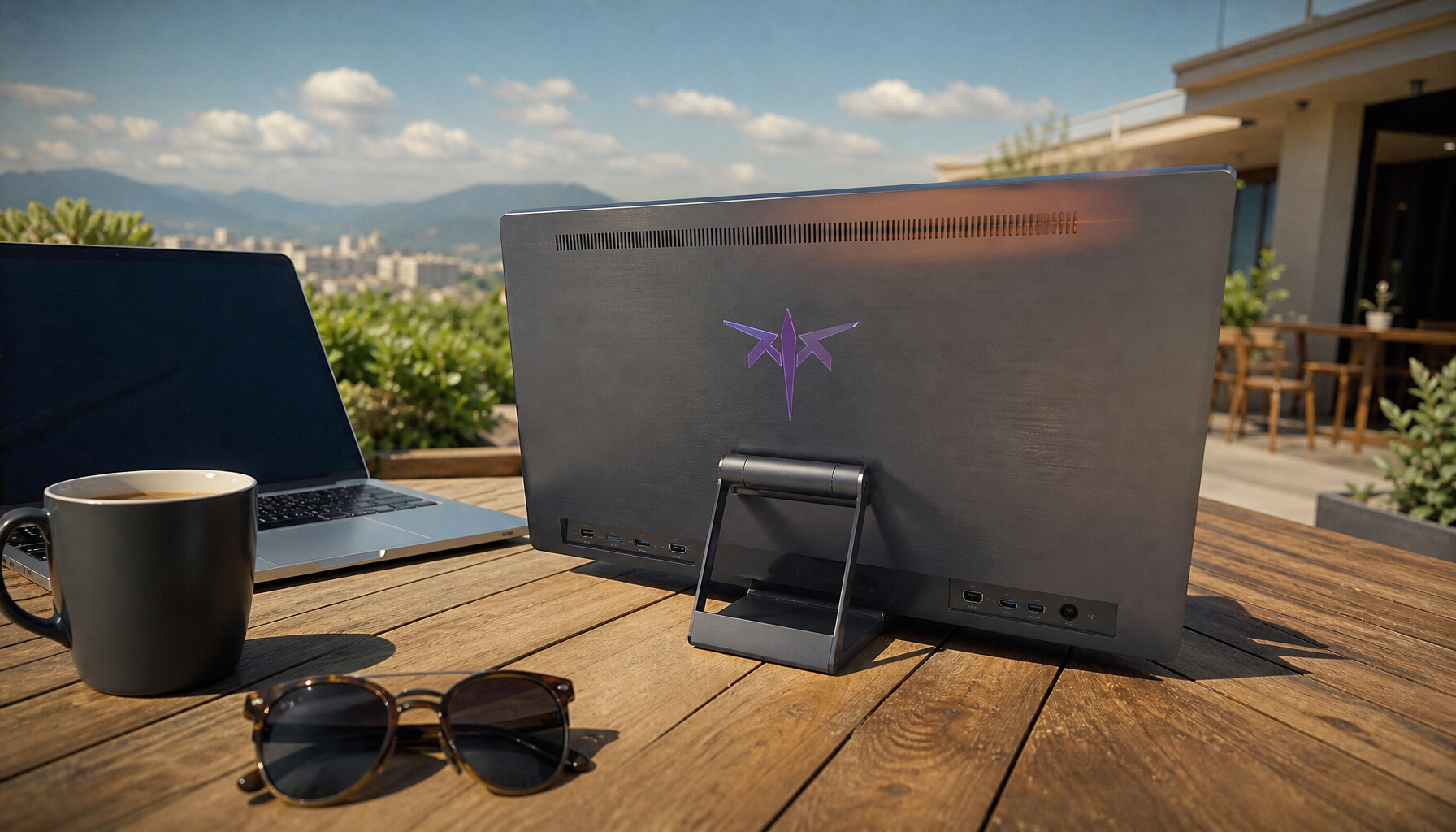
Portable monitors are useful for travel setups, but verify their real refresh rate, display connection compatibility, and Game Mode behavior before relying on them for ranked play. A compact display with poor processing latency can feel worse than a full-size gaming monitor even if both claim 120 Hz support.
FAQ
Q: Does VRR always add input lag on console?
A: No. VRR can reduce tearing without the same latency pattern as traditional vertical sync, but it can still feel inconsistent when frame rates fluctuate heavily or the monitor adds processing. Test it per game rather than treating it as always on or always off.
Q: Is 120 Hz more important than VRR for competitive games?
A: Usually, yes. A stable 120 Hz performance mode gives more frequent display updates than 60 Hz and often feels more responsive. VRR is most helpful when the game cannot hold its target frame rate.
Q: Can HDR make VRR input lag spikes worse?
A: HDR itself is not always the cause, but HDR modes can interact with monitor processing, local dimming, brightness transitions, and VRR flicker behavior. If input feel changes after enabling HDR, test HDR off with the same VRR and 120 Hz settings.
Key Takeaways
For competitive console gaming, start with 120 Hz, Game Mode, low processing, and balanced overdrive. Use VRR when the game’s frame rate fluctuates enough to cause tearing or stutter, but disable it when a stable performance mode feels more immediate.
The most reliable method is a same-scene test: VRR on, VRR off, no other changes. If your aim, camera control, and shot timing feel more consistent with VRR disabled, save VRR for slower, more cinematic games and keep your competitive monitor profile focused on predictable latency.