Yes, a monitor arm can reduce shoulder tension compared with a fixed stand when it lets you place the screen at the right height, distance, and angle for your body.
Do your shoulders creep toward your ears after a long spreadsheet session, ranked match, or dual-screen workday? In real desk setups, the practical test is simple: if the arm lets your eyes land naturally on the screen without neck tilt, shoulder shrugging, or forward reaching, tension often drops within the first few work sessions. Here is how to decide whether a monitor arm is worth it, how to set it up, and when a fixed stand is still the smarter buy.
Why Monitor Position Affects Shoulder Tension
Shoulder tension rarely starts in the shoulders alone. It often comes from a chain reaction: the monitor sits too low, your head moves forward, your upper back rounds, and your shoulders stabilize that position for hours. If the screen is too high, the chin lifts and the upper neck works harder. If it is too far away, you lean forward or reach for the mouse, which loads the upper back and shoulder area.

Workplace ergonomics research notes that poor viewing angles can increase neck and shoulder discomfort, while ergonomics guidance connects monitor position with posture, comfort, vision, productivity, and musculoskeletal risk through monitor position. That matches what shows up at actual desks: people often blame the chair, but the screen is the object their eyes chase all day.
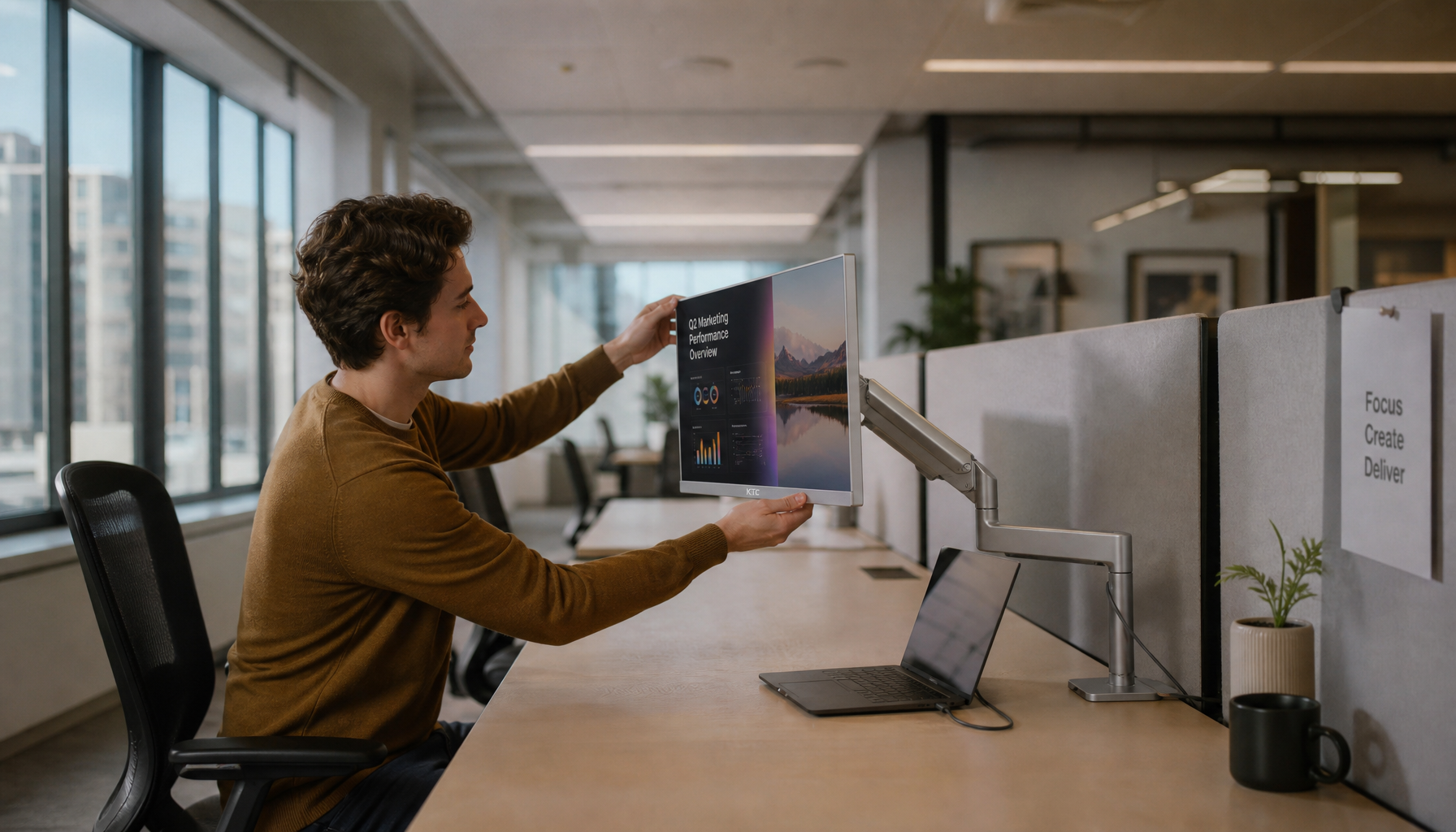
A fixed stand can help if its height happens to match your body and desk. The problem is that many stock stands offer limited height, tilt, depth, or rotation. A monitor arm is different because it turns the display into an adjustable surface. You can pull it closer for dense editing, push it back for a 32-inch panel, raise it for standing work, or angle a secondary display inward without dragging the whole base around.
Monitor Arm vs. Fixed Stand: The Real Ergonomic Difference

A monitor arm is not automatically healthier. It is healthier when it solves a positioning mismatch. A fixed stand is a desktop support that holds the monitor in a mostly stable position. A monitor arm clamps to the desk edge or mounts through a grommet hole, then supports movement in height, depth, tilt, swivel, and sometimes rotation.
The most important distinction is adjustability under real working conditions. Ergonomic mounting guidance describes monitor arms as semi-permanent mounting solutions with articulating links that can provide broad positioning flexibility and free desk space through broad positioning flexibility. That matters because shoulder tension is often caused by small repeated compromises: a short forward lean, a slight shrug to reach the mouse, or a monitor that is just too low for your chair and desk height.
Setup |
Best For |
Shoulder-Tension Advantage |
Tradeoff |
Fixed stock stand |
Simple, stable single-monitor desks |
Works if the default height fits you |
Limited height and depth control |
Adjustable monitor stand |
Budget setups and portable desks |
Raises the screen without installation |
Still occupies desk space and may not adjust depth |
Monitor arm |
Sit-stand desks, dual screens, compact desks, shared workstations |
Fine control over height, distance, tilt, and angle |
Requires compatibility checks and stable mounting |
Ultrawide, large gaming, or creator displays |
Keeps large screens positioned without forcing posture |
Costs more and needs a stronger desk surface |
How a Monitor Arm Can Reduce Shoulder Tension
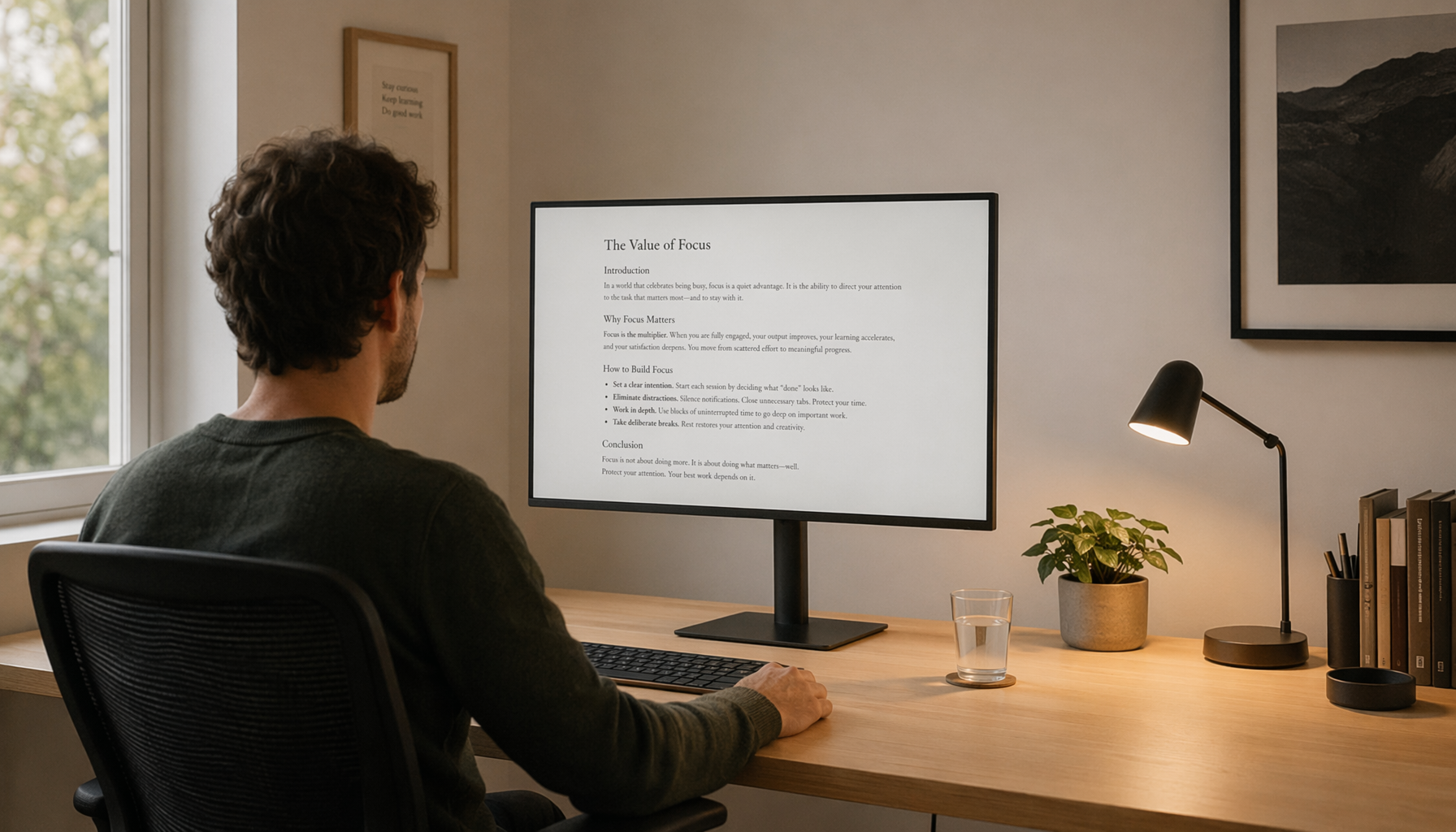
The strongest ergonomic benefit is that a monitor arm helps you keep a neutral upper-body posture. Your shoulders should feel relaxed, not lifted. Your elbows should sit near a right angle while typing. Your head should stay balanced over your shoulders rather than drifting toward the screen.

Several setup notes point to the same target: the top of the screen should be at or just below eye level, and the center of the screen should sit slightly below the natural line of sight. Dual-monitor guidance recommends placing screens at about arm’s length and keeping them at the same height and distance where possible through same height and distance. For a typical 27-inch productivity monitor, that often means roughly 3 to 4 ft away; for a 32-inch screen, the notes suggest closer to 5 ft when the desk allows it.
Here is a simple desk test. Sit back in your chair with your feet supported and shoulders relaxed. Look straight ahead, then let your gaze drop slightly. If your eyes land near the upper third or main content area of the display without moving your head, the monitor is close. If you need to lift your chin, tuck your chin, lean forward, or twist, the setup is asking your neck and shoulders to compensate.
A monitor arm also helps with depth. This is underrated. If a fixed stand’s base forces the screen too close, your eyes work harder and your shoulders may tense as you pull away. If the screen sits too far back, you may lean forward. A good arm lets you tune that distance by task. For writing and coding, you may pull the display slightly closer. For a large gaming monitor or ultrawide, you may push it back and lower the center of action slightly so your head stays steady.
When a Fixed Stand Is Enough
A fixed stand is not a bad choice if your screen already lands in the right position. For a single 24-inch office display on a desk with good depth, a sturdy height-adjustable stand may be enough. It can be cheaper, simpler, and less likely to wobble than a low-quality arm.
A monitor-support comparison frames stands as simple desktop accessories that elevate a monitor while often adding storage or organization through storage or organization. That is a fair value argument. If your desk is temporary, your monitor is light, and you rarely change posture or screen angle, a stand can deliver most of the benefit for less money.
The limitation appears when your body, desk, and display do not naturally match. Standard desks often sit around 28 to 30 inches high, which does not fit everyone. Add a large monitor base, a thick desk edge, a laptop, or a dual-display layout, and the fixed stand can become the reason your shoulders stay loaded.
Dual Monitors: Where Arms Become More Valuable

Dual monitors are where arms often outperform fixed stands. The goal is not just height; it is symmetry, angle, and rotation control. If both displays are used equally, they should sit side by side, at the same height and distance, angled inward like a shallow cockpit. If one is primary, it should sit directly in front of you, while the secondary display sits to the side and angles toward you.
Health-focused ergonomics guidance notes that dual screens can improve productivity, but poor placement increases neck and shoulder strain through poor placement. In practice, the key is reducing repeated neck rotation. A designer comparing reference art on one display and editing on another should not be turning 45 degrees hundreds of times per day. A finance user watching dashboards should not have one monitor 3 inches higher than the other. A gamer using chat, streaming controls, or telemetry on a secondary screen should keep the main panel centered and the side panel close enough that the eyes move more than the torso.
Monitor arms make this easier because they remove bulky bases and let both screens sit closer together. They also help align bezels and heights when two different stands would otherwise put the screens at mismatched levels.
Buying Checks Before You Blame the Stand
The wrong monitor arm can create new problems. If the arm sags, bounces while typing, or cannot reach the right height, it may be worse than a basic stand. Before buying, check the monitor’s VESA pattern, weight, size, desk thickness, rear clearance, and the amount of wall space behind the desk.
Buying guidance emphasizes that VESA compatibility, monitor weight, desk surface restrictions, stability, and space behind the desk all affect whether an arm will work well through VESA compatibility. This is especially important for performance displays. A 32-inch high-refresh monitor, an ultrawide, or a heavy creator panel can exceed the practical limits of cheaper arms even when the product page looks compatible.
Another comparison gives a useful value frame: arms generally cost more than stands but offer more ergonomic control, while stands are simpler, stable, and portable through more ergonomic control. For a permanent desk, the arm’s value compounds because you adjust once, then keep a cleaner work surface and better viewing position every day.
How to Set Up a Monitor Arm for Less Shoulder Tension

Start with the chair and keyboard, then move the screen. If your chair is too low or your keyboard is too high, you may still shrug your shoulders even with a perfectly placed monitor. Sit with your feet supported, back resting against the chair, elbows near a right angle, and mouse close to the keyboard.
Now set the monitor height. For most users, place the top edge at or slightly below eye level, with the main content area a little below straight-ahead gaze. Ergonomics guidance also notes that bifocal users often need the monitor lower and tilted back more than non-bifocal users through monitor lower and tilted back. That nuance matters because a “perfect” eye-level setup can still force someone with progressive lenses to tilt the head back, which loads the neck and shoulders.
Next, set distance. Use arm’s length as the quick baseline, then adjust for screen size and text clarity. If you squint, increase text size before pulling the monitor too close. If you lean forward, bring the monitor closer or enlarge interface scaling. Finally, tilt the top of the screen slightly back to reduce glare and support a natural viewing angle.
Run a short trial instead of assuming it is done. Work for five minutes on your most common task. If your shoulders rise, lower the desk input height or bring the mouse closer. If your chin lifts, lower the screen. If your neck bends forward, raise the screen slightly or bring it closer. Small changes matter; a 1-inch adjustment can be the difference between relaxed viewing and all-day tension.
Office, Gaming, and Portable Setups
For office productivity, a monitor arm is usually the highest-value upgrade when you use a sit-stand desk, dual monitors, or a shallow desktop. It clears space for documents, notebooks, docks, and a wider mouse zone. It also lets you keep the primary display centered, which reduces twisting during long focus sessions.
For gaming, the answer depends on monitor size and movement. A premium arm can make a cockpit-style setup feel immersive and controlled, especially with a main display plus a side screen. But heavy ultrawide monitors need serious support. A weak arm that shakes during intense keyboard or mouse input can break immersion and increase visual fatigue.
For portable smart screens and laptop-plus-monitor setups, an arm is most useful when the external screen becomes your primary display. A laptop stand with external keyboard and mouse can solve part of the problem, but a mounted portable display can sit closer to eye level and reduce the hunch that happens when the laptop screen stays low.
So, Should You Switch?
Choose a monitor arm if your current stand makes you tilt your head, lean forward, twist toward a secondary display, or shrug your shoulders to work comfortably. Choose a fixed or adjustable stand if your setup is already stable, correctly positioned, and rarely changes.
A monitor arm reduces shoulder tension by giving the screen the range of motion your body needs. The best setup is not the most expensive one; it is the one that keeps your shoulders relaxed, your gaze natural, and your display exactly where the work demands it.