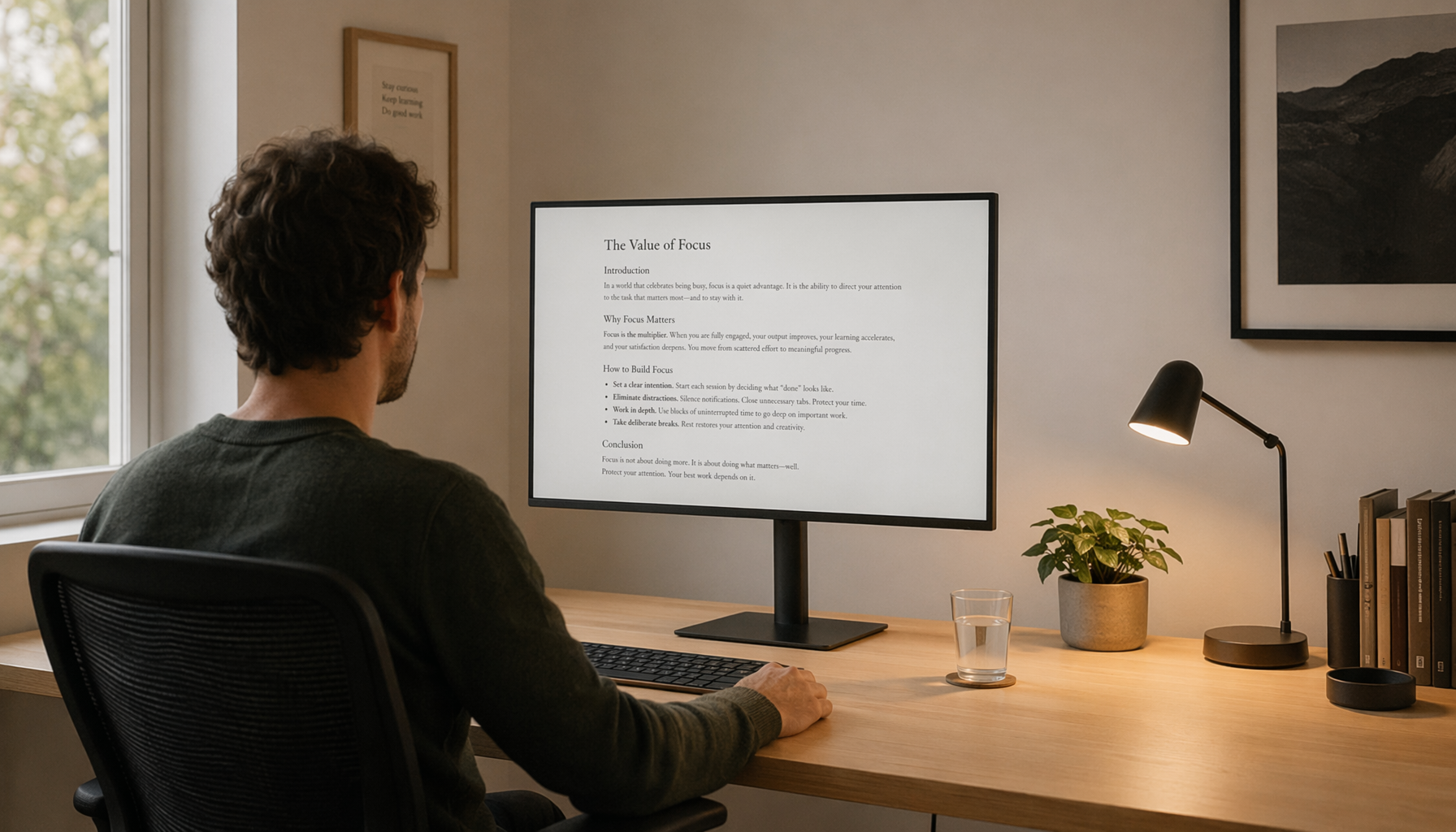
Place the light behind the display and aim it at the wall, not at your eyes or the screen. The goal is a soft, even halo that lowers contrast between the bright panel and the room without adding glare.
Start With Indirect Light, Not Visible LEDs
Bias lighting works because it adds low-level light around the display while staying outside your direct field of view. Proper bias lighting should sit behind the screen and face away from you, creating diffuse wall glow instead of visible light points.
For a monitor on a desk, attach the strip to the rear edge of the display, about 1–2 in from the outer frame. If the monitor is close to the wall, this keeps the halo controlled and reduces bright edge spill.
For a wall-mounted TV or large gaming display, lighting three or four sides can work well. If cables, a stand, or a soundbar create hot spots at the bottom, skip that edge and keep the glow clean on the top and sides.
Aim the Glow at the Wall, Then Check for Reflections
The light should bounce off a matte wall behind the display. Glossy paint, glass, mirrors, framed posters, polished shelves, and windows can turn a comfort upgrade into a reflection problem.
Use this quick placement check:
- Sit in your normal viewing position.
- Turn the display off with the bias light on.
- Look for bright LED dots or wall glare on the screen.
- Shift the strip inward or dim it until reflections disappear.
- Turn the display back on and confirm the wall glow feels even.

This matters because front-facing lamps and overhead lights can create screen reflections, while rear lighting helps avoid that by keeping illumination behind the panel.
Set Brightness Low Enough to Help, Not Compete
Bias lighting should support the display, not become the main visual event. A strong rule for performance setups is to keep the backlight around 5–10% of the display’s peak brightness.
In practical terms, if your monitor is bright enough for competitive gaming or spreadsheet-heavy office work, start with the LED strip at its lowest usable setting. Increase it only until the wall behind the display is softly visible.
If your room is fully dark, slightly more bias light may feel better. If you already have soft ambient lighting from a floor lamp or wall light, use less. The target is balance: the screen should no longer feel like a flashlight in a dark room, but the wall should not pull attention from the image.
Choose Neutral White for Accuracy, RGB for Mood
For color-critical work, editing, and serious display evaluation, use neutral white near 6500K. Many bias-lighting recommendations point to 6500K because it aligns with common display white-point standards and helps protect perceived color accuracy.
For gaming ambience, RGB can be fun, but keep it restrained. Saturated red, blue, or purple behind the monitor can change how blacks, whites, and skin tones feel on-screen. Use 6500K white for work, ranked play, and media accuracy; warm dim light for late-night casual browsing; low-saturation color for ambience; and static lighting for focus. Save reactive lighting for moments when immersion matters more than accuracy.
Some comfort-focused users prefer warmer light at night, but warmer bias lighting can shift perceived screen color, so use it knowingly.
Tune the Whole Desk, Not Just the Strip
Bias lighting is only one layer. If your overhead light is harsh, your window is reflecting in the panel, or your monitor brightness is maxed out, the strip cannot solve everything.
Lower display brightness until white pages look closer to a well-lit sheet of paper, then adjust the bias light around that. A practical home office setup should balance screen brightness, room lighting, and task lighting so the display is not fighting the environment.
For compact desks, a rear LED strip plus a downward-angled monitor light bar can be a strong pairing: the bias light handles screen contrast, while the bar lights your keyboard, notes, and controls without shining into the panel. Keep both dimmable, keep both indirect, and let the screen stay the focus.