A reliable app-to-monitor setup starts with correct display arrangement, then uses built-in window memory, app settings, or trigger-based tools when needed.
Does your game keep launching on the office display while your high-performance panel sits ready, or does a chat app steal the screen you reserved for design work? A clean monitor assignment can turn a messy dual-screen desk into a repeatable workflow where your main app, reference window, chat, and media land where you expect them. Here is the practical setup path for desktop systems, games, productivity apps, and stubborn programs that refuse to remember their place.
Why App-to-Monitor Assignment Matters
A multi-monitor setup is not just “more screen.” It is a layout system. Your primary monitor should support your highest-focus task, while secondary displays should carry supporting work such as chat, dashboards, preview windows, code output, research, streaming controls, or a game launcher. A typical multiple-monitor workflow starts with identifying, arranging, extending, and remembering displays, because monitor order and display mode form the foundation for where windows appear.
The benefit is direct. If your 27-inch high-refresh gaming monitor is reserved for esports titles and your 32-inch 4K office display handles spreadsheets, you avoid dragging windows across the desktop every time you switch modes. If your portable smart screen carries team chat, system stats, or a stream chat, app placement keeps the main panel clean and visually immersive.
The tradeoff is that operating systems do not treat every app the same way. Traditional desktop apps often remember their last position. Browser-based apps may reopen wherever the existing background process tells them to. Games may ignore desktop placement and follow the primary display unless the game has its own monitor selector.
Start With the Correct Display Foundation

Before assigning apps, confirm that your monitors are physically and logically arranged. Open display settings, use the identify option so each physical screen shows its number, then drag the numbered rectangles until they match your desk. If your left monitor is shown on the right in settings, window movement and mouse travel will feel wrong even if the app eventually lands on the correct panel.
Set the display mode to extend when you want each monitor to act as a separate workspace rather than a mirror. The projection menu lets you switch between single-screen, duplicate, extend, and second-screen-only modes. For serious multitasking, extend mode gives apps room to live on different displays.
Your main display also matters. The main display is where the system tends to place core desktop elements and many default app launches. If you want your productivity LCD to remain the primary display while your OLED gaming monitor stays secondary, that is valid, especially if you are managing panel wear or keeping work tools centered. The downside is that some games will still chase the primary display unless you override them inside the game or with third-party software.
The Built-In Desktop Method

Most desktop systems can remember an app’s last location, but this is not a true per-app assignment system. The basic method is simple: close every instance of the app, open it, move it to the desired monitor, resize it if needed, close it from that monitor, and reopen it. Many productivity apps will return to that screen because the system and the app saved the last window bounds.
A lesser-known shortcut can improve the odds. Flex Labs documents a practical sequence where you move the app to the target display, press Win + Shift + Enter, close the app, and then reopen it to test whether the system retained that preferred monitor. This is not the same as a visible settings toggle, so treat it as a useful field technique rather than a guaranteed policy.
A real-world example: if your email app keeps opening on your gaming panel, close all of its windows, relaunch it, move it to your office monitor, press Win + Shift + Enter, then close the app. Reopen it from the taskbar. If it returns to the office display three times in a row, your setup is likely stable. If it works once and fails later, the app may be launching from a background process or restoring a separate profile state.
When Window Memory Is Not Enough
Placement breaks down most often with apps that keep background processes alive. Browsers, chat apps, game launchers, and communication tools may appear closed while a process remains active in the background. In that case, the “new” window is not really a fresh launch, so the app may ignore the monitor behavior you just trained.
Support discussions for advanced display tools highlight this exact process-level issue: basic window-management behavior may apply only to the first window of a process, while trigger rules can target windows more consistently when set to run every time. For power users, that distinction matters. A trigger that says “when this app window is created, move it to monitor 2” is stronger than hoping the system remembers where the last copy appeared.
Advanced multi-monitor tools can offer automated window triggers, monitor profiles, custom hotkeys, and window actions. Similar productivity-first tools add per-monitor taskbars, title-bar buttons, and window movement controls that make each display feel more like a complete desktop with an extended taskbar. Free or lighter tools can also help with snapping, hotkeys, and moving windows, but the key feature to look for is event-based automation, not just manual window movement.
Approach |
Best For |
Strength |
Limitation |
Windows last-position memory |
Office apps and simple desktop tools |
Free and already built in |
Inconsistent with games and background apps |
Win + Shift + Enter method |
Apps that almost remember placement |
Fast to test |
Not an official per-app settings panel |
Trigger-based tools |
Stubborn apps, browsers, launchers |
Can automate window creation behavior |
Requires setup and paid features for some workflows |
Dock assignment |
External-display users |
Clean per-app workflow |
Depends on workspace behavior |
Games and full-screen apps |
Best when available |
Many games still default to primary display |
Assigning Apps on Systems With Spaces
Some desktop systems handle this more elegantly when separate workspaces are configured correctly. Connect every display first, then open system settings, go to the desktop and Dock controls, and enable separate spaces for each display. After that, the workspace manager can treat each display as its own workspace, and apps can be assigned from the Dock.
The Dock method is the cleanest path. Open the app, right-click its Dock icon, choose Options, then Assign To, and select the target display. Jigsaw24’s guidance notes that apps can be assigned to display-specific Spaces, while apps set to all desktops may open on whichever display currently has the pointer.
For a creator using a laptop with a 4K editing monitor and a portable smart display, that means the main editing app can stay on the color-accurate screen, while notes, messages, or a shot list opens on the side display. It is a low-friction setup once spaces are stable.
Gaming Monitor Strategy

Gaming is the hardest case because many titles choose the primary display by default. If a game includes a display selector, use it first. Look in video settings for Monitor, Display, Output Display, or Adapter. Set the game to the high-refresh panel, apply the setting, exit normally, and relaunch.
If the game does not provide that setting, you have three practical options. You can temporarily make the gaming monitor the main display before launching. You can use Win + Shift + Left Arrow or Right Arrow to move a borderless-windowed game between displays. Or you can create a third-party trigger or monitor profile that changes display behavior for your gaming session.
The main-display swap is reliable but disruptive. It may move your taskbar, desktop icons, and new windows. For a competitive setup, the better long-term move is to use borderless fullscreen when input latency is acceptable and reserve exclusive fullscreen for titles that behave correctly on the desired monitor. The practical rule is simple: the monitor with the best refresh rate, response time, and HDR performance should carry the game, but the monitor with the most stable text clarity and ergonomics can remain the default work display.
Ergonomics Still Decide the Layout

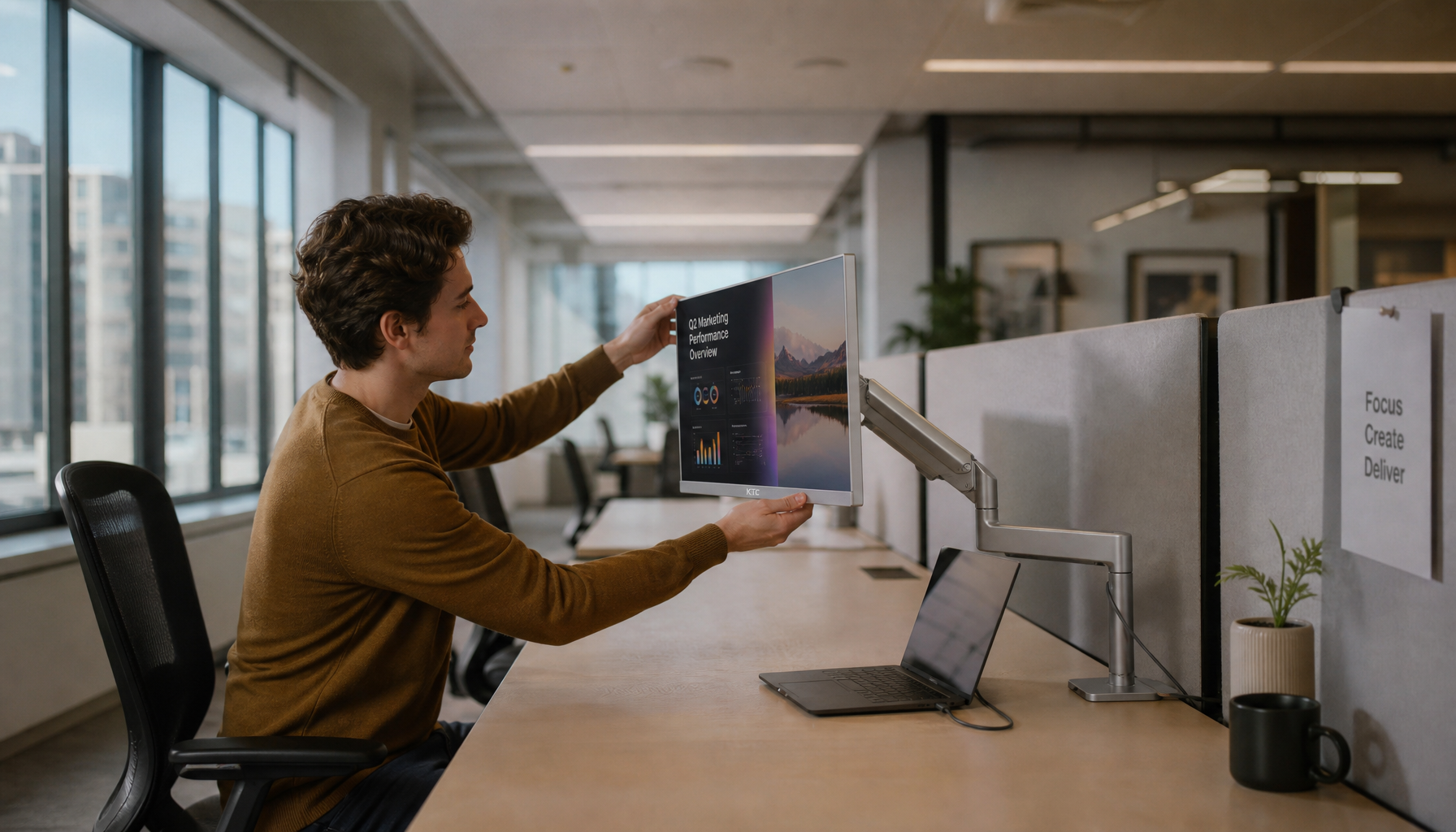
App assignment should follow how your body actually uses the desk. If one monitor carries 80% of your work, place it directly in front of you and angle the secondary display inward. Ergonomic dual-monitor guidance commonly recommends keeping screens about an arm’s length away, roughly 20 to 28 inches, with the top of the screen at or slightly below eye level.
For equal-use dual monitors, center yourself between them. For gaming plus work, center the gaming panel only when you are actively playing, or use a monitor arm so the high-refresh screen can slide into the primary position. A portable smart screen is best treated as a glance display: chat, playlists, meeting controls, recording controls, or system monitoring belong there, not your main writing or design canvas.
Troubleshooting Stubborn App Placement
If an app keeps opening on the wrong monitor, first confirm that the system still sees the monitors in the same order. Docking stations, USB-C hubs, graphics driver updates, and unplugging a portable display can cause display numbering or remembered positions to shift. Standard troubleshooting recommends checking cables, detecting missing displays, and rearranging numbered displays when the layout does not match the physical desk.
Next, close background processes. For browsers and launchers, open the process manager and end leftover processes only when you have saved your work. Then relaunch the app, move it, use the shortcut method if you are testing window memory, and close it again from the target monitor.
Finally, decide whether the app deserves automation. If you move the same app every morning, use a trigger-based tool. If it fails only after unplugging a laptop, create separate monitor profiles for docked and undocked use. Remote-support and IT-focused workflows also benefit from tools that understand multiple endpoint monitors, especially when technicians need to view or switch between a user’s screens without disrupting the session.
FAQ
Can a desktop system natively assign one app to one monitor forever?
Not in the strict policy sense. Most systems can remember many window positions and support multiple-monitor arrangement, main display selection, and window restoration, but they do not offer a universal “always open this app on monitor 2” control for every program.
Why do some apps ignore the monitor I chose?
Some apps restore their own window state, some keep background processes running, and many games use the primary display or graphics adapter instead of the last window position. Browser and launcher behavior is especially process-dependent.
Should I make my gaming monitor the main display?
Make it the main display if most games you play refuse to launch on it otherwise. Keep your productivity monitor as primary if you value stable taskbar placement, OLED preservation, or a work-first layout. The better answer depends on which screen carries your highest-priority sessions most often.
A designated-monitor workflow is worth tuning because it removes small interruptions from every session. Start with the operating system basics, test the app’s own memory, then use trigger-based software for the programs that keep fighting the layout. A high-performance display setup should feel intentional the moment the first window opens.