Custom display presets work best when you separate the monitor’s built-in picture mode, the operating system’s display profile, and an automation trigger that applies the right setup when an app launches.
Ever open a competitive shooter after hours in spreadsheets and realize your screen still looks warm, dim, and sluggish? A practical preset workflow can switch from a comfortable office view to a high-refresh gaming layout or a color-managed editing setup before your eyes have to compensate. You’ll get a reliable way to define presets, match them to apps, and avoid the color and HDR mistakes that make automation feel random.

Why App-Based Display Presets Are Worth Building
A display preset is a saved display behavior for a specific job: gaming, writing, coding, video editing, photo proofing, or late-night reading. It may include brightness, refresh rate, HDR state, scaling, resolution, color profile, audio output, and monitor layout. The value is consistency.
For gaming, the priority is motion clarity and response. Higher refresh rates such as 120 Hz update twice as often as 60 Hz, which can make fast movement feel smoother when the PC can feed enough frames to the monitor, as explained in this refresh rate comparison. For office work, the priorities change: readable text, comfortable brightness, and stable scaling matter more than maximum motion performance. For creative work, the wrong preset can shift color enough to make skin tones, product colors, or print previews unreliable.
The best automatic setup treats presets like workbenches. An image editor opens a color-accurate SDR profile. A spreadsheet app opens a calmer office profile with larger scaling and moderate brightness. A shooter opens a high-refresh mode with VRR and lower processing delay. A movie app opens HDR only when the content and display support it well.
Start With Three Core Presets
Before automating anything, build a small preset library. Too many presets become hard to trust, and trust is the whole point. Most users need a Work preset, a Gaming preset, and a Color preset. Portable smart screen users may add a Travel preset with conservative brightness and simple scaling, especially when switching between a laptop panel and a USB-C secondary display.
Preset |
Best For |
Typical Settings |
Main Risk |
Work |
Documents, browsers, coding, dashboards |
Native resolution, comfortable scaling, moderate brightness, neutral or slightly warm white point |
Too dim or too warm for bright rooms |
Gaming |
FPS, racing, action, esports |
Highest practical refresh rate, adaptive sync, low-lag mode, tuned overdrive |
Inverse ghosting or washed-out blacks |
Color |
Photo, video, design, proofing |
Calibrated ICC profile, stable brightness, correct color space, enhancements off |
Switching modes after calibration |
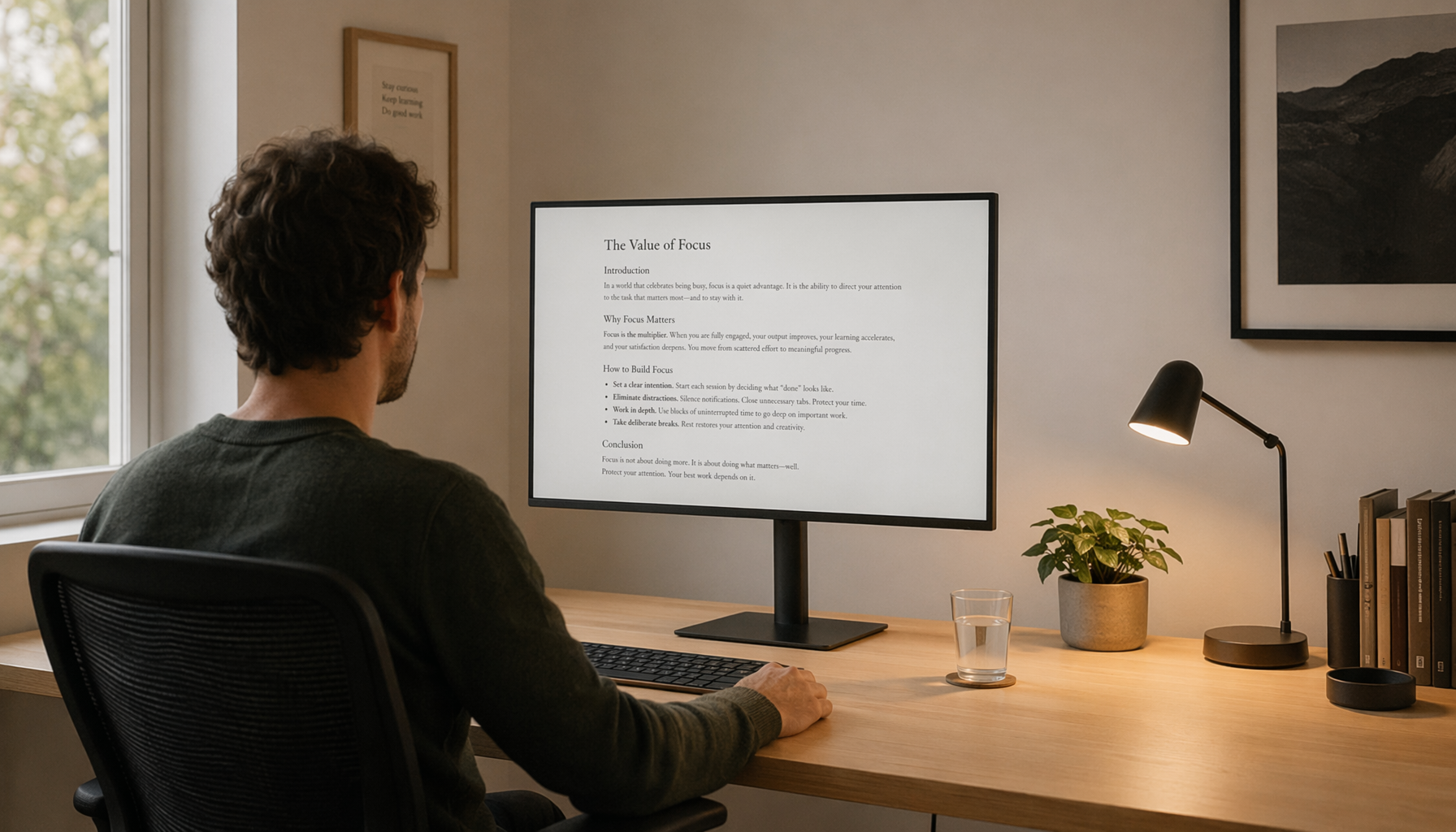
For work comfort, use positive polarity when it fits the task: dark text on a light background. A systematic review of display comfort found that positive polarity and high contrast were repeatedly associated with better legibility, visual comfort, or task accuracy across reading-style tasks. A simple real-world test is a 30-minute document edit: if you lean forward, squint, or lose the cursor, the preset is not doing its job.

For gaming, start with the monitor’s native resolution and highest stable refresh rate, then tune overdrive by feel and artifact visibility. Overdrive speeds pixel transitions but can create inverse ghosting when pushed too hard. That means “Fastest” is not automatically best. If a white trail appears behind dark objects, step down one level.
Define What Each Preset Actually Controls
A strong preset is more than “bright for games” or “warm for night.” It should name exactly which layer it controls.
The monitor OSD controls hardware-level behavior such as brightness, contrast, color temperature, sharpness, response time, overdrive, HDR mode, and input source. A general monitor optimization workflow should include resolution, refresh rate, color depth, brightness, gamma, HDR, and calibration, because these variables affect both clarity and responsiveness, as this monitor optimization workflow explains.
The operating system controls resolution, scaling, refresh rate, HDR status, ICC or ICM profile association, multi-monitor arrangement, and sometimes color management. On a desktop PC, that may involve display settings, advanced display controls, color management, GPU software, and a third-party profile tool. On a laptop or desktop workstation, it may involve display controls, color profiles, comfort features, and reference-style presets on supported hardware.
The app automation layer watches what you open and applies the correct profile. This is where desktop PC users have the most flexibility. A free, open-source app can save and switch display profiles from the system tray; its profiles can include resolution, refresh rate, HDR state, DPI scaling, monitor position, primary display status, enabled displays, and audio device choices. The project is marked as on hold, so treat it as useful but not something to build a mission-critical studio workflow around without testing.
Build the Presets Manually First
Automation should come last. First, create each preset manually and confirm that it looks and behaves correctly.
For a Work preset, use native resolution, scaling that lets you read text at your normal viewing distance, and brightness that matches the room. Accessibility advice emphasizes that users can adjust brightness and display settings to make screens easier to see, including options like zoom, hover text, color filters, automatic white-point adjustment, and warmer evening modes. In practice, a 27-inch 1440p office monitor often feels balanced around 100% to 125% scaling, while a 4K panel may need 150% scaling for comfortable all-day use.

For a Gaming preset, set the monitor to its maximum useful refresh rate in the operating system first, then adjust in-game settings so frame rate can stay near that target. Visual clarity is not just sharpness; it is the combination of brightness, contrast, refresh rate, response time, and processing delay. A gaming clarity workflow should check brightness and contrast in a dark scene so shadow detail remains visible without turning blacks gray.
For a Color preset, choose the target before calibrating. If you edit web imagery, sRGB is usually the predictable baseline. If you work in print or wide-gamut photography, a wider color space may be relevant depending on your workflow. The critical rule is simple: calibrate with the intended display mode already active, then do not casually switch to another picture mode afterward. A community discussion around laptop display presets captures the practical concern well: changing a preset can make the display appear slightly warmer and raises the question of whether the preset behaves like a standard target or a visual filter, especially for color-accurate work.
Add Automatic Switching on Desktop PCs
Most operating systems do not include a polished built-in feature that says, “When this image editor opens, apply this full monitor preset.” You can still get there with profile tools, shortcuts, scripts, and app launch triggers.
A practical workflow starts by saving named profiles in a display profile manager. Create one profile for Work, one for Gaming, and one for Color. Confirm that each profile restores the exact monitor arrangement, refresh rate, HDR state, scaling, and audio output you expect. Then bind each profile to a hotkey or shortcut. Once shortcuts work reliably, use a launcher, macro deck, scheduler rule, or automation tool to run that shortcut when a target application opens.
The important test is reversibility. Open the game, confirm the Gaming preset applies, close it, then return to Work. If the system does not return cleanly, do not expand the setup yet. Fix the two-preset loop first. Multi-monitor setups are especially sensitive because a profile may depend on the exact display identity and topology. If a laptop docks to two office monitors in the morning and a single gaming monitor at night, save profiles while connected to each real setup rather than trying to build them abstractly.
For SDR and HDR profile switching, some users rely on command-line color-profile scripts. The forum workaround uses dispwin.exe to remove one ICC or ICM profile and install another, with separate scripts for SDR and HDR. The key idea is to keep both local profile files available and make the switch explicit; the author recommends checking Profile Associations afterward to confirm the intended monitor profile is active.
Handle Color Profiles and Shortcuts on Workstations
Color-managed workstations can be excellent for creative work, but automatic per-app full display switching is less straightforward than it sounds. Built-in laptop displays, first-party external displays, and third-party monitors do not all behave the same. On supported displays, reference modes or preset-style display targets can control characteristics such as gamut, white point, brightness, and transfer behavior, but those choices are professional targets, not casual filters.
For creative apps, keep the Color preset intentionally boring. Disable automatic white-point adjustment and warmer evening modes while evaluating color, avoid vivid or game modes on external monitors, and use the ICC profile created for that exact display state. If your laptop display preset shifts warmer than the default, treat that as a change in viewing condition until proven otherwise. The safe workflow is to select the target preset, calibrate or profile in that state, then keep that state for the matching work.
For office and evening comfort, tools like warmer evening modes, zoom, color filters, and brightness controls can be useful. They should not be mixed into the same preset used for color judgment. A good split is simple: productivity apps can use comfort settings, while image editing, video editing, or print proofing apps use the stable Color preset.
Match Presets to Screen Size and Desk Reality
Automation cannot fix a poor physical setup. A 24-inch 1080p monitor and a 27-inch 4K display need different scaling and viewing assumptions. A 27-inch monitor generally gives more workspace for multitasking and higher resolutions, while a 24-inch screen is easier to scan at close range and is often favored for competitive play, as this 24-inch and 27-inch comparison explains.
If your desk is shallow, a high-refresh 24-inch gaming preset may feel faster and cleaner than a larger screen that forces constant head movement. If your workday involves spreadsheets, dashboards, or code beside documentation, a 27-inch or dual-monitor Work preset will feel more productive. The preset should reflect the physical use case, not just the app name.

Pros and Cons of Automatic Presets
Approach |
Pros |
Cons |
Manual monitor OSD presets |
Reliable, hardware-level, easy to understand |
Slow to switch and hard to tie to apps |
OS color profiles |
Better for calibration and color consistency |
Can be confusing with HDR and multi-monitor setups |
Third-party profile managers |
Can switch many settings at once |
Maintenance, compatibility, and topology issues vary |
Scripted ICC switching |
Precise for SDR/HDR profile control |
Requires careful paths, testing, and rollback behavior |
Full app automation |
Fast and immersive once stable |
Bad rules can apply the wrong preset at the wrong time |
The performance-driven choice is not always full automation. If you only switch twice per week, a tray icon or hotkey is cleaner. If you switch between games, editing, office work, and streaming every day, app-based automation pays for itself quickly.
Troubleshooting When Presets Do Not Switch Correctly
When a preset fails, isolate the layer. If the monitor OSD changed but the operating system did not, check the OS profile or display arrangement. If the operating system changed refresh rate but not HDR, confirm the tool can actually control HDR state on your version. If the ICC profile changed but colors still look wrong, make sure the app is color-managed and that the monitor is still in the same mode used during calibration.
Avoid copying someone else’s ICC profile as a fix. Full calibration requires specialized equipment, and users should not copy calibration settings blindly because even two units of the same monitor model can need different values. Use shared settings as a starting point for layout and behavior, not as proof of color accuracy.
A final sanity check is to name profiles by outcome and target, not mood. “FPS 240 Hz SDR,” “Office 125 Bright Room,” and “Photo sRGB 120 nits” are more useful than “Gaming,” “Work,” and “Nice Colors.” The name should tell you what the screen is doing before you trust it.
FAQ
Should HDR turn on automatically for every game?
No. HDR should be app-specific and content-specific. Some games look excellent in HDR, while others look flatter, raised, or inconsistent depending on the monitor’s HDR capability and local dimming behavior. Keep an SDR gaming preset as the default and create an HDR gaming preset only for titles you have tested.
Can one preset work for both photo editing and video editing?
Sometimes, but not always. If both workflows target the same color space, brightness, and viewing condition, one Color preset can work. If one workflow is SDR web imagery and the other is HDR video, separate them.
Is a blue light filter a good automatic evening preset?
It can be useful for comfort, but keep it away from color-critical work. Warm evening presets are better matched to reading, email, browsing, and office tasks than editing product images or grading video.
A strong preset system makes the display disappear as a problem. Your office apps become easier to read, your games feel faster, and your creative tools stop fighting your calibration. Build the presets first, automate only what proves repeatable, and let each app open on the screen it actually deserves.