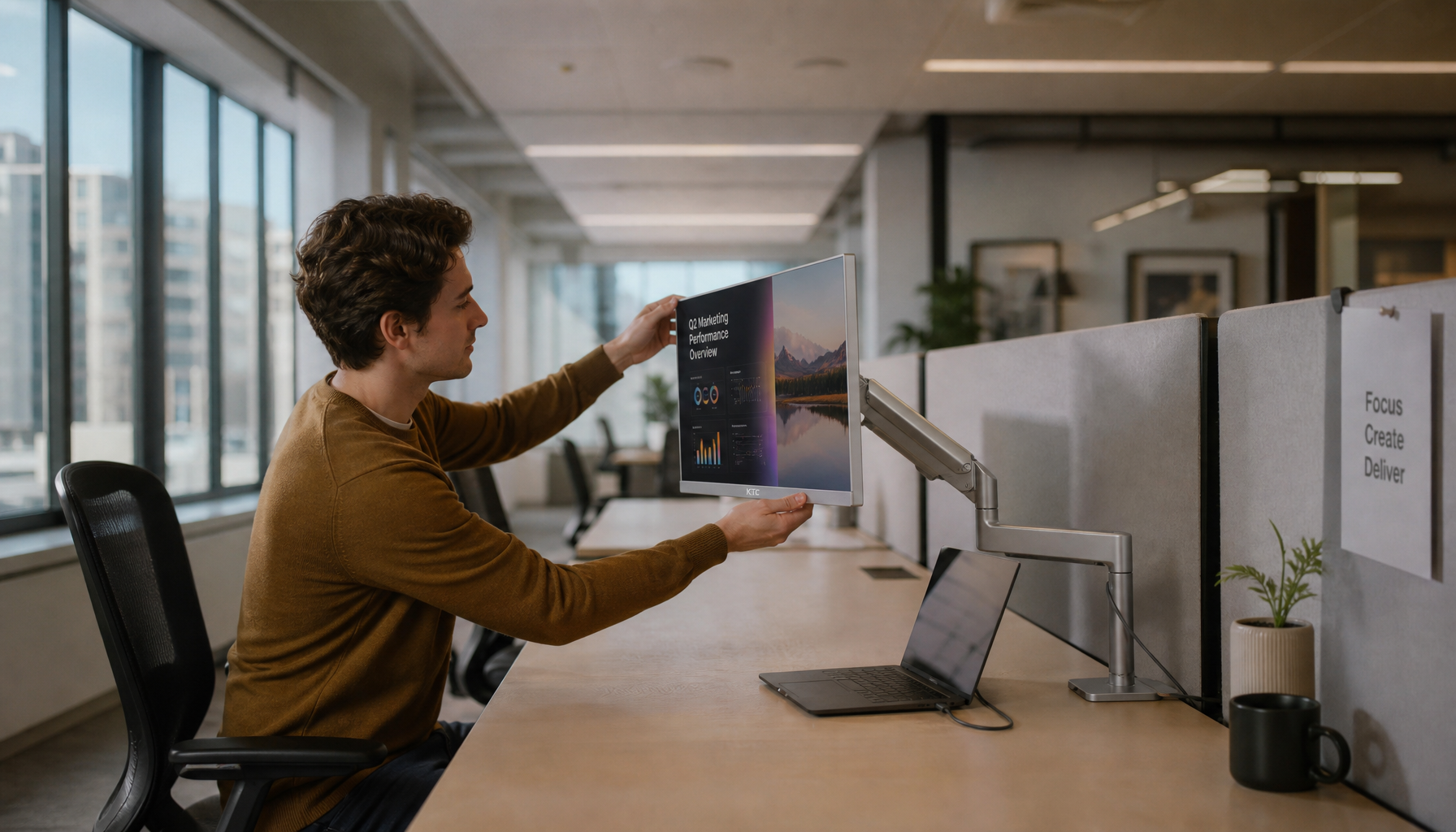
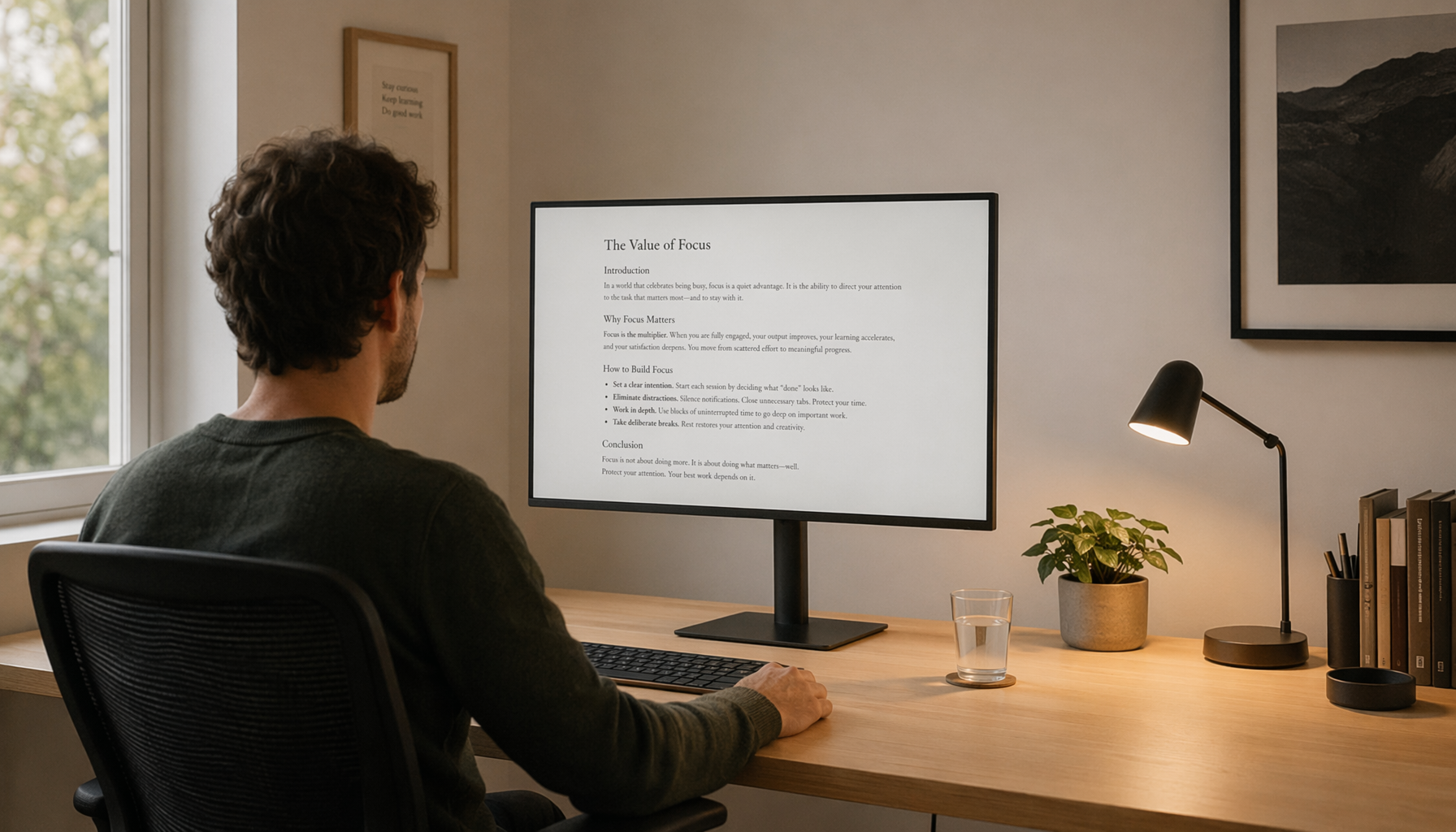
Move the reflection path, not your neck: place the monitor at arm’s length, slightly below eye level, perpendicular to strong light, then adjust tilt and clothing brightness until your shirt, watch, necklace, or rings no longer appear on the dark screen.
Do you ever sit down for a focused match, spreadsheet session, or edit and see your own white shirt, metal watch, or necklace floating over the blacks? A simple screen-off reflection check can reveal the culprit in under a minute, and the fix is usually a small change in angle, distance, lighting, or wardrobe contrast. Here is the practical setup process that keeps the panel readable without forcing your posture into a compromise.
Why Clothing and Jewelry Show Up on the Screen
Your monitor is not just emitting light; it is also reflecting light from the room. Display screens reflect illuminated objects in front of them, which means a bright shirt, silver bracelet, glossy watch, ring, necklace, white desk mat, or even a light-colored chair back can overlay the image and reduce contrast.
There are two reflection problems worth separating. Specular reflection is the sharp, mirror-like image of your shirt logo, chain, or watch face. Diffuse glare is a softer wash that makes dark content look gray and weak. Specular reflections are especially disruptive on glossy gaming monitors, OLED screens, glass-covered portable displays, and laptops because your eyes may keep switching focus between the nearby pixels and the reflected object.
The physics is simple enough to use at your desk: light bounces off a surface at the same angle it arrived. Studio photographers use this same angle-of-incidence principle to remove reflections from glass, metal, and glossy products, and it works on monitors too. If your necklace reflects into the center of the panel, the goal is to rotate, tilt, lower, raise, or relight the setup so that reflected light no longer travels from jewelry to screen to eyes.
Start With the Dark-Screen Reflection Test
The fastest diagnostic is to sit normally, turn the monitor off, and look at the black screen from your real working posture. A practical glare check is to turn the screen off because reflections become easier to see when the display is dark.

Do not lean in, sit unusually straight, or remove your hands from the keyboard if that is not how you actually work. Wear the shirt, hoodie, necklace, watch, earbuds, or ring you normally wear. If you use a portable monitor beside a laptop, test both screens, because the secondary display often catches reflections from your sleeves or watch when it is angled inward.
A high-performance setup treats this like calibration. First, note what is reflected. Then change only one variable at a time: monitor angle, screen height, distance, light direction, brightness, or clothing. If the reflection moves off the active image area, the adjustment worked. If it only shifts from the center to the lower corner where your game HUD, timeline, or spreadsheet tabs sit, keep tuning.
Set the Monitor Height Before Chasing Reflections
Reflection fixes fail when they make the monitor ergonomically wrong. OSHA warns that a monitor positioned too high can strain back muscles if you tilt your head backward to see it, so height comes before aggressive tilt.
For most users, the top of the screen should sit at or slightly below eye level, with the screen center below your straight-ahead gaze. Ergonomic guidance describes the usable viewing zone as roughly 0 to 30 degrees below the line of sight, and several ergonomic sources converge around the same practical result: you should see the main content with a relaxed, slightly downward gaze.

For reflections from clothing, this matters because a monitor that is too low often reflects your chest and shirt. A screen that is too high may reflect your face, glasses, earrings, or overhead lighting. The clean target is a screen high enough that your torso is not dominating the panel, but low enough that your chin stays level and your shoulders stay relaxed.
If you wear progressive, bifocal, or varifocal lenses, the setup changes. Ergonomic posture guidance notes that progressive lens users may need the monitor lower and tilted slightly back to reduce neck craning. In that case, solve clothing reflections more with lighting, distance, and wardrobe contrast rather than raising the screen until your neck has to compensate.
Use Distance to Reduce Big, Bright Reflections
Arm’s length is the baseline because it supports posture and reduces exaggerated head movement. Ergonomic guidance commonly recommends placing the monitor about an arm’s length away, often around 20 to 44 inches depending on screen size, resolution, and visual comfort.
For clothing reflections, distance changes the size and intensity of what the screen “sees.” If a glossy 27-inch monitor is only 18 inches from your chest, a white shirt can fill a large portion of the reflection field. Moving the panel back toward 28 to 32 inches, while increasing text size if needed, often shrinks the reflected torso enough that it no longer competes with dark UI elements.
The tradeoff is readability. If you push the monitor back and start leaning forward, you have not fixed the setup; you have moved the strain into your neck and upper back. A better move is to keep the monitor at a comfortable distance, then increase OS scaling, browser zoom, game HUD size, or editor font size. Ergonomic guidance notes that monitor distance should account for monitor size and resolution, which is exactly why a 32-inch 4K panel and a 14-inch portable screen should not be treated identically.
Angle the Screen So Reflections Miss Your Eyes
Once height and distance are reasonable, use angle as the precision control. A slight downward tilt can send reflections from your chest, chain, or bright sleeves away from your eyes, while a slight backward tilt may help progressive-lens users maintain a neutral neck.
The best tilt is the smallest one that removes the reflection while preserving a relaxed gaze. Too much downward tilt can make the top of the screen harder to read and may reflect the keyboard, desk surface, or hands. Too much backward tilt can catch overhead lights or your face. On a glossy gaming panel, a change of just a few degrees can move a watch reflection from the minimap area to below the bezel.
Side angle matters too. A monitor should generally sit directly in front of your seated position for primary work because off-center placement increases neck rotation. An ergonomics summary of sEMG-based research reports that a monitor 35 degrees off-center can sharply increase neck muscle workload, so do not solve jewelry glare by swinging the whole screen far to one side.
For dual monitors, keep the main display straight ahead and angle the secondary display inward only enough for comfortable viewing. If the secondary screen reflects your watch or ring while you use the mouse, rotate it a little less, move it farther back, or switch the task that needs dark backgrounds to the primary display.
Control Light Before Blaming the Panel
Your clothing only becomes a screen problem when light hits it and bounces toward the display. The strongest fix is usually room geometry: put bright windows and lamps to the side of the screen, not behind you and not directly in front of the monitor. Ergonomic guidance recommends placing the monitor at a right angle to windows or away from task lights to minimize reflected glare.

Think of your shirt as a reflector. A white hoodie under a ceiling light can act like a softbox aimed at your screen. A polished watch under a desk lamp can create a sharp flash on a glossy portable monitor. A pendant necklace can catch sunlight from a side window and throw a small bright reflection into the lower third of the display.
Indirect lighting is usually better than intense overhead lighting. Lighting guidance describes indirect lighting as a glare-control strategy because it spreads light more evenly across walls and ceilings instead of creating harsh bright points. For a gaming desk or productivity station, a dimmable lamp aimed at the wall, soft bias lighting behind the monitor, or filtered daylight through blinds will usually outperform a bright lamp behind your shoulder.
Clothing and Jewelry Choices That Actually Matter
You do not need a dress code to use a monitor well, but reflective materials matter. Light-colored clothing reflects more light than dark clothing, and glare-reduction guidance specifically notes that darker clothing may help because lighter clothing can reflect back onto the screen.
The most visible offenders are bright white shirts, shiny satin or nylon, reflective logos, metallic necklaces, polished watches, rings, and glossy smartwatches. In dark-mode workflows, competitive games, video editing, CAD, and code editors, these objects stand out because the screen has large dark regions where reflections are easier to see.
The practical fix is contextual. For tournament-style gaming or color-critical work, wear a darker, matte top and remove or cover highly reflective jewelry. For office work, you may not want to change clothes, so shift the light source, tilt the monitor, raise the panel slightly, or add a matte screen protector. The advantage of wardrobe changes is zero cost and no image-quality penalty. The disadvantage is obvious: it is not always realistic, especially in shared offices, client calls, or hybrid workdays.
Glossy, Matte, Curved, and Anti-Glare Screens
Panel finish changes the problem, but it does not erase poor positioning. Glossy screens produce sharper reflections with stronger perceived contrast, which can be beautiful for image depth but unforgiving when a bright shirt or watch is in the reflection path. Matte coatings scatter reflections, making them less mirror-like, but they can slightly soften the displayed image.
Screen glare research explains that anti-glare treatments can reduce focusable reflections, while some coatings may diffuse the screen image. That is the core tradeoff for performance users: a glossy OLED or high-contrast gaming monitor may look more immersive in controlled lighting, while a matte productivity monitor is often more reliable in mixed office light.
Curved screens require extra attention. Screen glare research notes that flat or low-curvature screens tend to reduce reflections better than curved screens because curved displays catch light from a wider field of view. If you use an ultrawide curved panel, the side wings may reflect sleeves, watches, speakers, or windows even when the center looks clean. Test the left, center, and right thirds separately with the screen off.
Anti-glare filters, matte protectors, privacy filters, blinds, hoods, and monitor arms are all valid tools, but the order matters. First fix placement and lighting, then use accessories for conditions you cannot control. A filter that dims the image may force higher brightness, while a monitor arm gives you repeatable control over height, distance, and angle without degrading image quality.
Display Settings That Support the Physical Setup
Brightness and contrast cannot remove a true mirror reflection, but they can reduce how much it interferes with work. Ergonomic guidance recommends matching brightness to the room, with lower brightness in dimmer home environments and higher brightness in standard office lighting. The goal is not maximum brightness; it is balance.
If the room is bright and the screen is dim, reflections win. If the screen is extremely bright in a dark room, your eyes work harder against contrast, and visual fatigue rises. Display positioning guidance also emphasizes that screen brightness should match the surrounding environment because strong contrast between display and background can increase eye strain.
Dark mode is a mixed tool. It can reduce emitted light and feel excellent in controlled lighting, but it makes reflections from clothing and jewelry more obvious because the background is darker. For spreadsheet work or documents, a lighter background can sometimes make a faint shirt reflection less distracting. For gaming or OLED use, keep dark mode but improve room lighting and reflection geometry.
A Reliable Setup Example
Picture a 27-inch glossy gaming monitor on a desk, a window behind the chair, a white hoodie, and a stainless-steel watch. The screen shows the hoodie across the lower center and a watch flash near the right edge. The strongest fix is to rotate the desk or monitor so the window is to the side, lower the overhead light, move the monitor to roughly arm’s length, and set the top edge near eye level.

Next, tilt the screen slightly downward until the hoodie reflection drops below the visible image area. Move the task lamp so it lights the desk from the side without striking the watch directly. If the reflection remains during dark games, wear a darker matte top or remove the watch during sessions where visual clarity matters. The result is not just less glare; it is a more stable viewing position with less neck movement and better perceived contrast.
Quick FAQ
Should I tilt my monitor up or down to avoid clothing reflections?
Usually, a slight downward tilt helps move chest and shirt reflections away from your eyes. If you wear progressive or bifocal lenses, a slightly lower screen tilted back may be more comfortable, so use lighting and clothing adjustments instead of forcing a tilt that makes your neck work harder.
Does jewelry really affect monitor glare?
Yes, especially on glossy screens. Rings, watches, necklaces, bracelets, and reflective earbuds can create small, bright specular reflections that are more distracting than a broad shirt reflection because they appear as sharp flashes.
Is a matte screen protector worth it?
It can be worth it when you cannot control windows, lighting, or shared-office layout. The downside is that matte films may slightly soften image clarity, so competitive gamers, designers, and video editors should first optimize placement, lighting, and tilt before adding a filter.
Final Calibration
A reflection-free monitor is built from geometry, not guesswork. Sit normally, turn the screen off, find the reflected shirt or jewelry, then tune height, distance, tilt, lighting, and surface finish until the reflection path misses your eyes. The best setup feels invisible: stable posture, clean contrast, and a screen that lets the work or game take over.