Use the 20-20-20 rule as a flexible eye-reset rhythm, not a hard interruption: every 20 minutes or so, look about 20 ft away for 20 seconds during natural pauses like matchmaking, loading screens, respawns, round transitions, or cutscenes.
Ever come out of a long ranked session with dry eyes, a dull headache, or that delayed refocus when you finally look across the room? Gamers commonly play for long blocks, and survey notes from a professional association describe single gaming sittings that can stretch up to 3 hours with breaks under 15 minutes. The goal is to keep the visual reset without yanking you out of the match, story, or raid.
Why the Standard 20-20-20 Rule Feels Awkward for Gaming
The rule is simple, but games are not
The classic 20-20-20 rule asks you to look at something 20 ft away for 20 seconds every 20 minutes. That works cleanly for office work because stopping mid-email usually has low consequences, but gaming has different pacing: a 20-minute alarm can land during a boss phase, a clutch round, a sim-racing corner, or a story scene you do not want to miss.
That conflict matters because gaming adds visual load beyond normal screen use. Players track motion, scan HUD elements, react to bright high-contrast scenes, and often maintain near-focus for extended periods; gaming can worsen digital eye strain when poor lighting, glare, posture, or viewing distance are part of the setup.
Eye breaks are still relevant on modern displays
A high-refresh-rate monitor can make motion feel smoother, especially at 120 Hz, 144 Hz, 165 Hz, or higher, but it does not remove the basic problem of prolonged near-focus. Digital eye strain includes symptoms such as dry eyes, blurred vision, headaches, and tired eyes, and continuous digital device use for 2 hours can be enough to trigger symptoms for some users.
The exact 20-minute timing is also not sacred. The 20-20-20 rule is widely recommended, but evidence for that exact interval is limited; a review of small studies notes that supporting the exact timing remains unclear. For gaming, that means the practical target is not perfect compliance. It is reducing uninterrupted near-focus often enough that your eyes get a real distance reset.
Build Breaks Around the Game, Not the Clock
Use natural pauses as visual checkpoints
The best gaming version of 20-20-20 is event-based. Instead of letting a timer interrupt you mid-fight, attach the habit to predictable game moments: matchmaking, lobby countdowns, loading screens, character selection, killcams, respawns, end-of-round screens, inventory sorting, fast travel, replay screens, and cutscenes that do not require active input.

This keeps the habit compatible with immersion. In a first-person shooter, you might look across the room after every two rounds or every queue screen. In an RPG, you might use fast travel and dialogue transitions. In a racing game, you can reset your eyes between races rather than during a lap. A professional association notes that gamers may play a single game for up to 3 hours and often take short or no breaks, so break reminders should be designed for the way games are actually played.
Make the break invisible to your hands
A 20-second eye break does not need to mean standing up, leaving the desk, or opening a wellness app. Keep your hands on the controller, mouse, or keyboard, then shift your gaze to a fixed object at least 20 ft away: a wall clock, doorway, window view, shelf, hallway light, or poster across the room.
For a practical setup, choose the distance target before the session starts. If your desk faces a wall, place a small non-glossy object far enough to the side that you can glance at it without turning your whole chair. If you game in an apartment or small room where 20 ft is not available, use the farthest stable object you have and pair it with longer breaks every couple of hours.
Match the Rule to Your Session Type
Competitive sessions need predictable timing
Competitive games punish poorly timed interruptions, so use match structure instead of strict alarms. For round-based games, a good rule is one 20-second distance look after every round or every two short rounds. For battle royale or extraction games, use the queue, drop/loading phase, death screen, or post-match stats screen.
A timer can still help, but it should be quiet. Use a watch vibration, a keyboard macro light, a programmable keypad icon, or a subtle monitor reminder instead of a loud phone alarm. A vision-health platform notes that timers or apps can help schedule gaming breaks, and reminders such as timers are useful because immersive play makes it easy to lose track of time.
Story, strategy, and MMO sessions need longer reset points
Long-form games are where players accidentally stack two, three, or four continuous hours. For these genres, keep the 20-second distance glances, but add a larger 10- to 15-minute reset after about 2 hours of continuous play. Use chapter breaks, quest turn-ins, dungeon clears, save points, raid wipes, or settlement-management pauses.
This matters because digital eye strain is not only about the eyes. Reviews describe ocular symptoms such as dryness and blurred vision, plus non-ocular symptoms such as neck, shoulder, and back discomfort; digital eye strain symptoms can build through posture and sustained visual effort. A 15-minute break every couple of hours is also a practical point to stand, refill water, change room lighting, and check whether your display is too bright for the room.
Tune Your Gaming Monitor Before You Blame Your Eyes
Brightness should follow the room
A monitor that looks impressive in a store can be punishing in a dark room. If you play at night, lower brightness until white UI elements stop feeling like small flashlights. For a dim room, a practical range is about 120 to 180 nits, with soft room lighting behind or beside the monitor to reduce contrast shock between the screen and the room.

The key is matching screen brightness to ambient lighting. A professional association recommends matching room lighting to screen brightness and reducing glare, while monitor-specific guidance for late-night gaming points to brightness around 120 to 180 nits in dim conditions. If you cannot measure nits, use this test: a white web page or inventory menu should look readable, not glowing.
Contrast, color temperature, and refresh rate all matter
For long sessions, avoid max contrast unless the game truly needs it. A moderate contrast setting, often around 60% to 70%, can reduce harsh transitions between dark scenes, menus, and bright HUD elements. A slightly warmer color temperature at night can also feel easier, especially in games with white menus or high-contrast overlays.
Refresh rate is worth setting correctly. If your monitor supports 144 Hz but your system is running it at 60 Hz in the operating system, you are leaving smoothness on the table. A vision-health platform notes that comfort may improve with a refresh rate of 70 hertz or higher when available. For gaming displays, the practical advice is simple: use the highest stable refresh rate your monitor, cable, GPU, and game can consistently support, but still keep the eye-break rhythm.
Set Viewing Distance by Screen Size and Monitor Type
Larger displays need more distance
A 24-inch monitor at arm’s length is different from a 32-inch 4K screen or a 34-inch ultrawide wrapped around your field of view. Sitting too close increases eye movement across the panel and can make HUD tracking more demanding. A practical baseline is at least 20 inches from larger screens, while many 32-inch and ultrawide setups feel better around 28 to 32 inches or more.

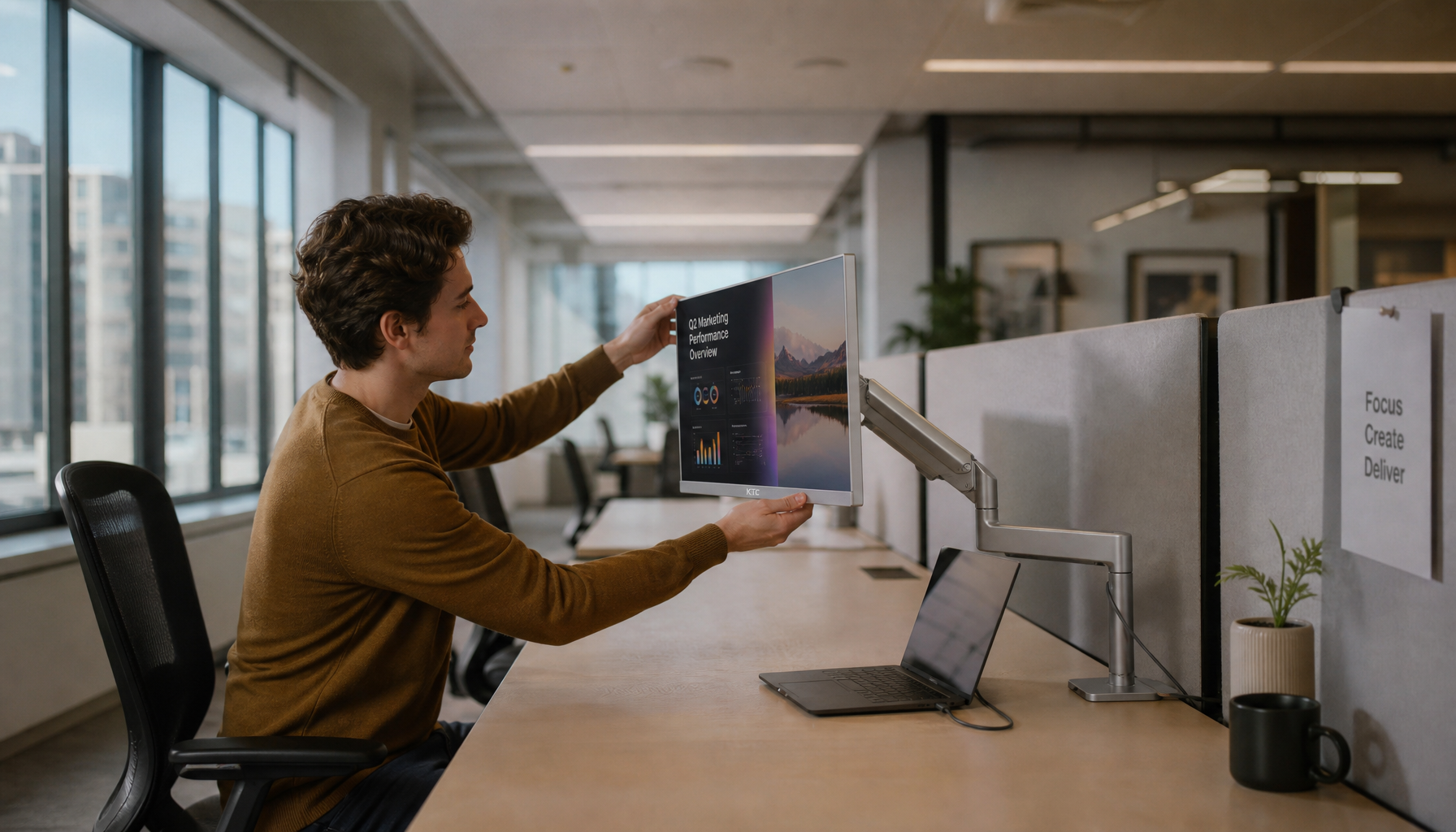
Screen tilt also helps. A professional association recommends sitting at least 20 inches from larger screens and tilting the screen so the bottom is slightly toward you to reduce glare; setup changes like distance, lighting, and tilt are part of the eye-comfort equation. If you use a deep desk, a monitor arm is often a better comfort upgrade than another software filter because it lets you set distance and height precisely.
Portable monitors and handheld setups need stricter habits
Portable monitors and handheld gaming devices invite closer viewing. A professional association notes a 13-inch viewing distance for smaller devices, but in practice, handheld play often drifts closer during intense scenes. That makes 20-second distance looks more important, not less.
For a portable gaming monitor, raise the screen so you are not looking sharply downward, and avoid glossy placement near windows or overhead lights. If you use a laptop plus portable display, set both screens to similar brightness and color temperature so your eyes are not constantly adapting between mismatched panels.
Setup Option |
Best Break Cue |
Viewing Distance Target |
Monitor Setting Priority |
Watch-Out |
24-inch gaming monitor |
Every match lobby or save point |
About 20 to 28 inches |
Refresh rate and brightness |
Sitting too close during competitive play |
27-inch high-refresh monitor |
Every 1-2 rounds or quest turn-in |
About 24 to 30 inches |
120 Hz+ if stable, moderate contrast |
Bright HUDs in dark rooms |
32-inch 4K monitor |
Loading screens and post-match stats |
About 28 to 32 inches or more |
Lower brightness, correct scaling |
Excessive eye travel across corners |
34-inch ultrawide |
Zone changes, race resets, raid pauses |
About 30 inches or more |
Glare control and uniform brightness |
HUD elements pushed too far outward |
Portable monitor |
Every chapter, match, or 20-minute timer |
As far as practical on the desk |
Matching brightness with main display |
Low screen height and close viewing |
Handheld gaming device |
Every level, death screen, or loading pause |
At least about 13 inches |
Lower brightness at night |
Holding the screen too close |
A Practical 20-20-20 Gaming Checklist
Build the habit into your setup
Use this checklist before a long session, especially if you are playing at night or planning anything longer than 2 hours:

- Choose one distance target about 20 ft away before launching the game.
- Tie 20-second eye resets to natural pauses: lobbies, loading screens, respawns, cutscenes, or save points.
- Set your monitor to its highest stable refresh rate in the operating system and in-game settings.
- Match brightness to the room; dim the monitor for nighttime play and use soft ambient lighting.
- Sit at least 20 inches from larger displays, and move farther back for 32-inch or ultrawide monitors.
- Add a 10- to 15-minute full break after about 2 hours of continuous play.
- Stop screen use at least 1 hour before bedtime when late-night gaming is affecting sleep.
Use symptoms as feedback, not failure
If your eyes feel dry, gritty, watery, or slow to refocus, your current setup is asking too much. Screen users may blink three to five times less during screen use, which helps explain why people blink three to five times less is a practical detail rather than trivia. During quieter moments, blink deliberately a few times before returning your gaze to the display.
Also pay attention to headaches and neck or shoulder tension. Those symptoms often point to monitor height, distance, glare, or posture instead of the game itself. If the problem shows up mainly after switching from a 24-inch monitor to a 32-inch or ultrawide display, your distance and HUD layout are the first things to adjust.
FAQ
Q: Do I need to follow the 20-20-20 rule exactly while gaming?
A: No. Treat it as a target rhythm, not a punishment timer. The exact 20-minute interval has limited evidence behind it, but the underlying idea is useful: break up continuous near-focus by looking at a distant object for short periods.
Q: Does a high-refresh-rate gaming monitor reduce the need for breaks?
A: No. A high-refresh-rate monitor can improve motion smoothness and may feel more comfortable than a low-refresh display, but it does not stop dryness, reduced blinking, or prolonged near-focus. Keep the 20-second eye resets and add longer breaks during multi-hour sessions.
Q: What is the best monitor setting for reducing eye strain at night?
A: Start with brightness. In a dim room, lower the screen until white menus are comfortable, often around 120 to 180 nits if your monitor provides a brightness estimate. Then use moderate contrast, a slightly warmer color temperature, soft room lighting, and the highest stable refresh rate your setup supports.
Final Takeaway
The gaming-friendly version of 20-20-20 is not about breaking immersion; it is about using the pauses games already give you. Look 20 ft away for 20 seconds during lobbies, loading screens, respawns, save points, or cutscenes, then add a longer break after about 2 hours of continuous play.
Your monitor setup decides how hard your eyes have to work between those breaks. A comfortable gaming display is not just high refresh rate or high resolution; it is the right brightness for the room, enough viewing distance for the screen size, controlled glare, readable contrast, and a break rhythm that fits the games you actually play.