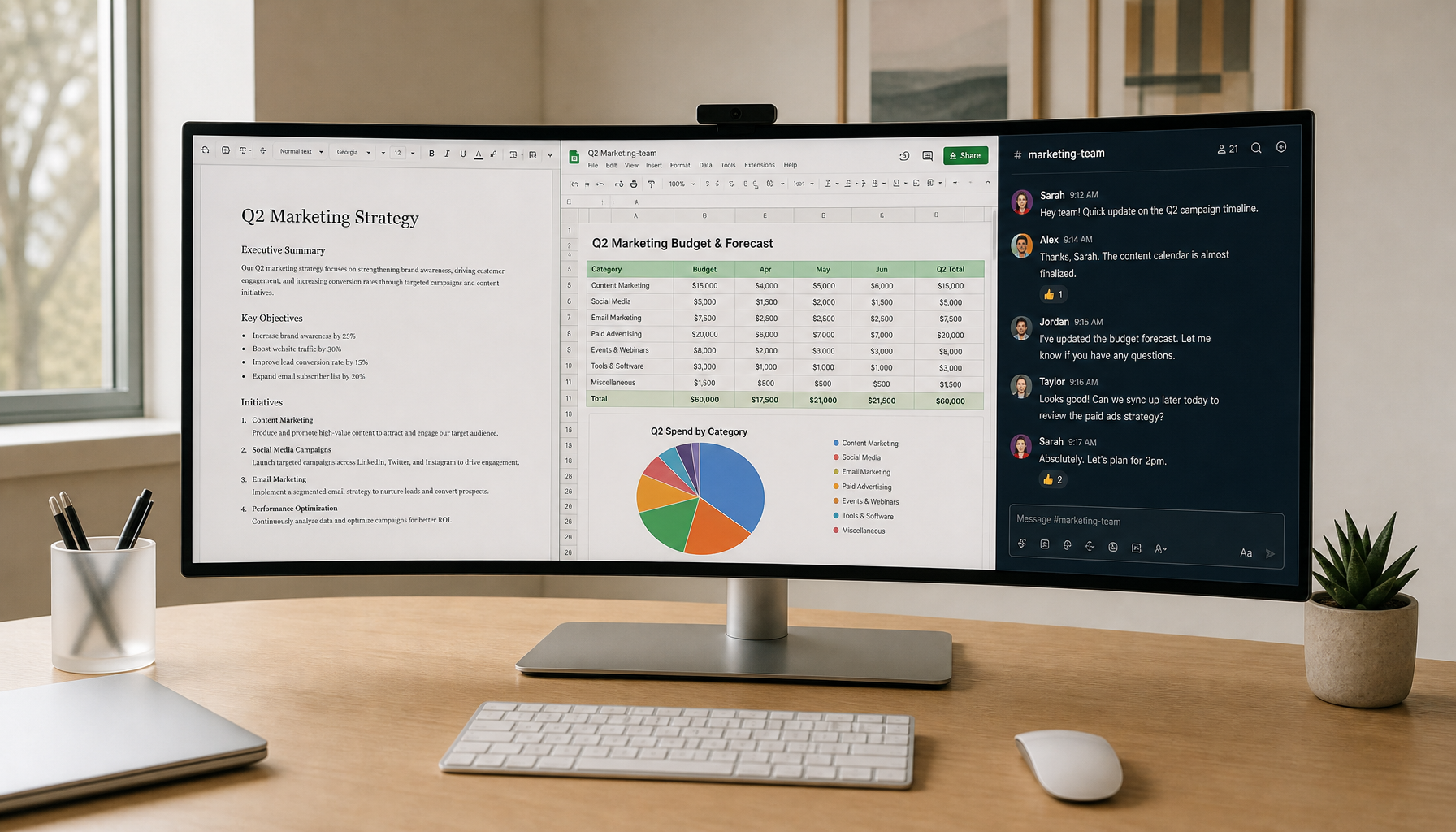
In 2026, workstation users face a confusing choice between Thunderbolt 5 and USB4 v2. Both promise 80Gbps bidirectional bandwidth for single-cable monitor docking, yet the real difference lies in guaranteed minimums versus optional features. Thunderbolt 5 delivers a predictable performance floor that suits creators running high-refresh 4K or 5K displays alongside fast storage or eGPUs. USB4 v2 can match or exceed it in well-implemented docks but often requires careful spec checking to avoid bottlenecks in demanding setups.
The 80Gbps Illusion: Why 'Bandwidth Boost' Changes the Math
Both standards advertise 80Gbps bidirectional bandwidth, yet their handling of high-resolution displays diverges in practice. Thunderbolt 5 guarantees a dynamic shift to 120Gbps in one direction—known as Bandwidth Boost—whenever a display like a 5K panel or dual 4K setup demands extra headroom, while keeping a stable return path (Thunderbolt 5 Technology Brief).
USB4 v2 supports the same 120Gbps asymmetric mode on paper, but the feature remains optional for manufacturers. This creates a fragmentation risk where two docks labeled “80Gbps” may deliver different real-world results for high-bandwidth monitors (USB-IF Announces Publication of New USB4® Specification to Enable USB 80Gbps Performance).
For creators editing video or color-critical work, the distinction matters. Thunderbolt 5 removes the need to hunt fine-print details on every dock; the Bandwidth Boost activates automatically when required. With USB4 v2, the safe approach is to verify asymmetric-mode support before purchase. Treat Thunderbolt 5 as the performance floor if your workflow regularly pushes 5K or dual high-refresh 4K displays.
The Uncompressed 4K 240Hz Reality Check
An 80Gbps connection does not automatically deliver uncompressed 4K at 240Hz. Raw bandwidth must share space with protocol overhead, concurrent USB data transfers, and potential cable-length limitations. These factors frequently trigger Display Stream Compression (DSC), a visually lossless technique that many controllers enable by default for link stability (USB4 v2 and Thunderbolt 5 for Real People: Cables, Docks, Displays, and Speed You Can Trust).
Achieving true uncompressed performance requires the entire chain—host controller, certified cable, dock, and monitor—to support DP 2.1 UHBR20 without fallback. Even then, real throughput often lands below the theoretical maximum once USB 3.2 traffic or PCIe tunneling shares the pipe. This friction is especially noticeable in creator workflows where any compression artifact or refresh-rate drop disrupts color-accurate timelines.
Check your intended monitor’s input specs and the dock’s documented UHBR20 support. If the setup must stay uncompressed, plan on shorter certified cables and test for DSC behavior in your specific host. For most users, the visual difference from DSC remains negligible, but purists or those pushing maximum refresh rates should verify the full signal path.

For background on how video, data, and power share lanes in these connections, see our explainer on DisplayPort Alternate Mode Over USB-C: How Video, Data, and Power Share the Same Lanes.
The Single-Cable Bottleneck: Storage and eGPUs at 80Gbps
Creators who dock a high-resolution monitor while running an external NVMe RAID or eGPU encounter a hidden PCIe tunneling limit. Thunderbolt 5 mandates a minimum of 64Gbps PCIe throughput—effectively doubling the data floor of Thunderbolt 4 and protecting storage or GPU performance even when video demands spike (The Difference Between Thunderbolt 4 and Thunderbolt 5 ~ Plugable Technologies).
USB4 v2 permits lower optional PCIe minimums. A dock may drive your monitor successfully yet starve the data tunnel during large file transfers, causing stuttering in timelines or reduced eGPU acceleration. In dual 6K or heavy RAID-editing scenarios, this difference often flips the recommendation toward Thunderbolt 5.
Thunderbolt 5 vs USB4 v2: PCIe Floor and Display Load
Compare the guaranteed PCIe floor with display-demand tiers to judge when Thunderbolt 5 is the safer choice for eGPU or NVMe RAID setups that also drive monitors.
View chart data
| Category | Guaranteed PCIe floor (Gbps) | Display load tier |
|---|---|---|
| USB4 v2 (good implementation) | 40.0 | 2.0 |
| Thunderbolt 5 | 64.0 | 3.0 |
The chart above illustrates the guaranteed PCIe floor against typical display-load tiers. Thunderbolt 5’s higher floor makes it the clearer choice when your workflow combines a demanding monitor with high-speed storage or external acceleration. USB4 v2 remains viable for lighter data loads provided the specific dock implementation meets or exceeds the optional PCIe minimum.
Power and Peripherals: The 240W Charging Reality
True single-cable docking needs robust power delivery alongside bandwidth. Thunderbolt 5 requires a minimum of 140W for compatible laptops and supports up to 240W, ensuring even power-hungry workstations stay charged under load (Thunderbolt 5 Technology Brief).
USB4 v2 also reaches 240W, yet this capability stays optional. Some docks may advertise 80Gbps speeds but deliver only 100W or less, causing battery drain during intensive creative sessions. Always verify the dock’s documented Power Delivery rating matches your laptop’s peak draw.
Peripheral support follows the same pattern. Thunderbolt 5’s predictable tunneling simplifies daisy-chaining monitors or attaching multiple high-speed devices. USB4 v2 works well when the implementation prioritizes it, but compatibility quirks around lane allocation can surface in mixed-peripheral chains. For users who value set-it-and-forget-it reliability, Thunderbolt 5 reduces these variables.
See how a single USB-C connection can simplify an entire workspace in our guide to How a USB-C Monitor Can Streamline Your Workspace.
Choosing Your 80Gbps Standard: Creators vs. General Workstations
Match the standard to your actual workflow rather than the headline speed. Creators working on 5K displays—such as the KTC 27" 5K@60Hz 2K@120Hz Home&Office Monitor | H27P3—or dual 4K/144Hz panels paired with external storage should choose Thunderbolt 5. Its mandatory Bandwidth Boost, 64Gbps PCIe floor, and 140W+ charging deliver the guaranteed headroom these workloads require without repeated spec verification.
General workstation users running a single 4K 60Hz or 144Hz monitor with basic peripherals can often suffice with a well-specified USB4 v2 dock. These setups rarely saturate the optional lanes, and the lower cost may outweigh the need for Thunderbolt 5’s stricter minimums. The key check is confirming the specific dock lists asymmetric 120Gbps support and adequate PCIe tunneling for your storage needs.
Don’t buy if your dock or cable lacks certification for 80Gbps PAM-3 signaling or if the manufacturer does not explicitly confirm Bandwidth Boost and 64Gbps PCIe minimums. In those cases, you risk fallback modes that negate the 80Gbps advantage. Test real-world performance with your exact laptop, monitor, and workload before committing to a permanent desk layout.
When shopping monitors, consider collections that align with your chosen standard. The Office Monitor and 4K Monitor lines include models like the H27P3 that pair naturally with high-bandwidth docks. For mixed creative and gaming use, review Gaming Monitor options such as the KTC 27" 4K 160Hz/320Hz 90W Gaming Monitor | H27P6 that benefit from stable single-cable connections.
Additional reading on color-critical work can be found in What Delta E Values Actually Mean for Your Creative Work and What Does Bit Depth Mean, and How Does 8-bit Differ From 10-bit Display?.
Will Thunderbolt 5 and USB4 v2 Work With My Existing 2025 Laptop?
Most 2025 laptops with Thunderbolt 4 or USB4 ports can connect to Thunderbolt 5 or USB4 v2 docks, but they will negotiate at the lower host speed. Full 80Gbps or 120Gbps performance requires a 2026-era host controller that implements the new standards. Check your laptop’s specification sheet for explicit “Thunderbolt 5 ready” or “USB4 80Gbps” language before expecting maximum bandwidth.
Does 80Gbps Eliminate the Need for Separate Power and Data Cables?
It can in theory, yet only when the dock, cable, and laptop all support the full optional 240W Power Delivery and the required PCIe tunneling. Many early USB4 v2 docks ship with 100W or 140W limits. Thunderbolt 5’s mandatory 140W floor improves the odds, but you should still confirm the exact dock rating matches your laptop’s sustained power draw under load.
Which Cable Do I Need for Reliable 120Gbps Operation?
Use a certified 80Gbps Thunderbolt or USB4 cable rated for PAM-3 signaling. Many existing 40Gbps passive cables function at 80Gbps for short runs, but reliability drops with length or interference. Certified cables reduce handshake failures and fallback to lower modes. Avoid unbranded long passive cables when pushing 5K or dual 4K high-refresh configurations.
Is Thunderbolt 5 Worth the Premium for Non-Creators?
For users with a single 4K 144Hz monitor and light peripheral use, a quality USB4 v2 dock usually suffices and costs less. The premium for Thunderbolt 5 becomes justified mainly when you combine a high-resolution display with fast external storage, eGPU acceleration, or frequent daisy-chaining. Run your specific workload for a week on a loaner dock to determine whether the guaranteed minimums translate into noticeable stability gains.
When Should I Wait for Future Standards Instead of Buying Now?
If your current laptop lacks native 80Gbps support and your monitor needs rarely exceed 4K 120Hz with basic peripherals, waiting 12–18 months for broader USB4 v2 adoption and lower prices makes sense. Creators already pushing 5K, dual high-refresh panels, or professional storage arrays will see immediate value in Thunderbolt 5’s predictable behavior today.