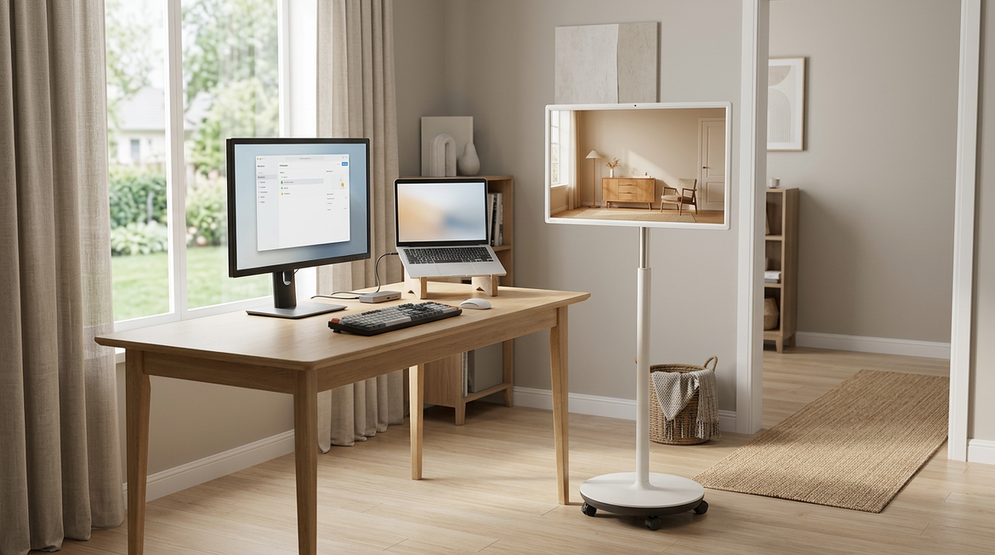
Rolling smart display vs wall tablet comes down to one question: will the screen move often, or does it need a permanent home? If you shift it between rooms, a rolling setup usually fits better. If the display stays in one place and you want a fixed footprint, a wall-mounted setup is easier to live with.

What Buyers Need to Decide First
Start with the use pattern, not the specs. A rolling smart display makes sense when the screen needs to follow the day, while a wall tablet works better when the room is already the right viewing spot. Installation tolerance matters too: fixed mounting adds alignment work and leaves a more permanent mark on the room. Shared use also matters, because one movable screen can serve more people across the day.
Check room traffic patterns first. If doorways stay clear and outlets sit within six feet of likely parking spots, rolling stays practical. If walls already hold brackets or artwork that cannot move, wall mounting avoids extra work. Rolling smart display vs wall tablet decisions also hinge on household size: larger groups benefit when one screen travels instead of requiring multiple fixed units.
If you want a quick category starting point, the portable touch screen options collection is the cleanest browsing path for mobile-first models.
Rolling Versus Wall-Mounted Trade-Offs
The basic trade-off is simple. Rolling smart displays are better when room-to-room movement is part of daily life. Wall tablets are better when the screen can stay fixed and the wall location already matches the way you use it.

A Wirecutter comparison of freestanding portable displays notes the obvious upside of movement: you do not keep repeating the mounting process. The catch is that mobility brings new planning tasks. You need a place to park the unit, access to power, and a cable route that still makes sense after the screen moves.
Here is the practical difference in plain language:
| Decision Factor | Rolling Smart Display | Wall Tablet |
|---|---|---|
| Mobility | Easy to move between rooms | Stays in one place |
| Installation | Minimal wall work | Requires mounting and alignment |
| Wall Impact | No permanent wall footprint | Leaves holes and a fixed location |
| Floor Space | Needs parking space | Off the floor |
| Cable Planning | Changes with movement | Usually more stable |
| Shared Viewing | Easier to bring to the group | Tied to one room |
| Long-Term Flexibility | Easier to reposition later | Better for a set layout |
This scenario map shows the likely fit: choose a rolling smart display when you need room-to-room movement, and choose a wall tablet when you want fixed placement with a simpler footprint.
Rolling wins for daily room changes and shared household use. Wall tablets win for fixed rooms and narrow traffic paths.
When a Rolling Display Fits Better
A rolling display fits best when one screen needs to serve different rooms at different times. That is common for a kitchen-to-living-room setup, a home office that becomes a family viewing screen, or a multipurpose room where you do not want to install several displays.
If you want a product-side example of that setup, the KTC MEGAPAD 32" 4K Android 13 Google EDLA Smart Touch Monitor with 9500mAh Battery is the kind of mobile format that matches room-to-room use. Use that kind of screen when movement is the point, not the compromise. The KTC MEGAPAD 27" FHD Android 14 Google EDLA Smart Touch Monitor with 9500mAh Battery adds another rolling choice with built-in wheels and a 6-hour battery for longer sessions.
The decision sentence here is straightforward: if a display has to move weekly or daily, rolling usually wins. If the screen is only moving once in a while, the extra floor-space planning may not be worth it.
This is also where shared use matters most. For families, a rolling screen can follow the activity instead of forcing everyone to gather in one room. That can feel more natural for cooking shows, video calls, workouts, or casual streaming.
Where Wall Tablets Still Make Sense
A wall-mounted setup still makes sense when the screen location is stable and the room layout already fits the job. It can be the better choice when you want the display out of the traffic path, when the room is narrow, or when you do not want to think about parking space.
A guide to wall-mount tablets points to the main advantage: once the wall position is set, the setup is simple to live with. That stability is the reason fixed installs still work well for kitchens, hallways, and other places where the viewing spot does not change much.
If you want to browse fixed options, the fixed monitor collection is the broader category view. One example is the KTC 27" FHD 180Hz 1ms Wall Mount Gaming Monitor, which is better thought of as a fixed-position monitor path than a mobile screen.
The rule of thumb is simple: if you already know the screen's home and do not want to move it, wall mounting is usually the cleaner fit. If you expect the room plan to change, a fixed screen can become a regret later.
Power, Wiring, and Daily Movement
Power access is part of the purchase decision, not just the setup step. A rolling smart display still needs a sensible parking spot, and the outlet you choose today affects how easy the unit is to move tomorrow. That is why mobility is never just about wheels.
Cable management matters more on a mobile unit because the path changes as the screen moves. In real use, that means you are planning for where the display will live when it is not being used, not just where it looks best in a product photo. This is one reason movable setups can feel slightly less tidy, even when they are more flexible.
For a fixed wall setup, the trade-off flips. You do more work up front, but daily repositioning disappears. That is why a wall tablet can feel calmer in a stable room, while a rolling display can feel more convenient in a changing household.
One practical check is enough: if you can point to a clear parking spot, a nearby outlet, and a cable path that will not trip people up, rolling stays in the running. If any of those are awkward, fixed placement may be safer.
Final Checklist Before You Choose
Use this checklist before you decide:
- Confirm how often the screen needs to move: weekly, daily, or almost never.
- Confirm whether wall mounting is acceptable in the room where the display will live.
- Confirm whether floor space and parking space are easy to manage.
- Confirm whether the display is for one person, a family, or multiple rooms.
- Confirm whether you want the setup to stay fixed or change over time.
If you still want a flexible browsing path after that check, start with portable touch screen options or the broader fixed monitor collection. If you already know the wall location is final, a fixed monitor path is usually the more practical next step.
Related Resources
- 32-inch rolling MegPad details
- MegPad event planning guide
- Rolling telehealth screen uses
- AI hobby station setup
FAQs
Q1. How Hard Is It to Install a Wall-Mounted Setup?
It is usually the more permanent option because it adds mounting, alignment, and wall prep. That makes sense for a stable room, but it is less forgiving if you think the screen location may change later.
Q2. What Makes a Rolling Display Easier to Use Every Day?
Daily use feels easier when the screen can follow the task. You do not need to re-mount it, and you can move the display toward the room where people are already gathered.
Q3. Can a Rolling Display Handle Power Planning Better in Shared Spaces?
It can help if you park it where the outlet, walkway, and viewing angle all work together. The key is not fewer power needs, but better placement flexibility after setup.
Q4. Why Does Screen Sharing Feel Different Between the Two Options?
A movable screen can join the group instead of making the group come to it. A wall-mounted screen works best when the room itself is already the shared viewing hub.
Q5. What Long-Term Flexibility Does Each Choice Offer?
Rolling is easier to adapt when rooms, routines, or household needs change. Wall mounting is better when you want one fixed plan and do not expect to rearrange the space often.