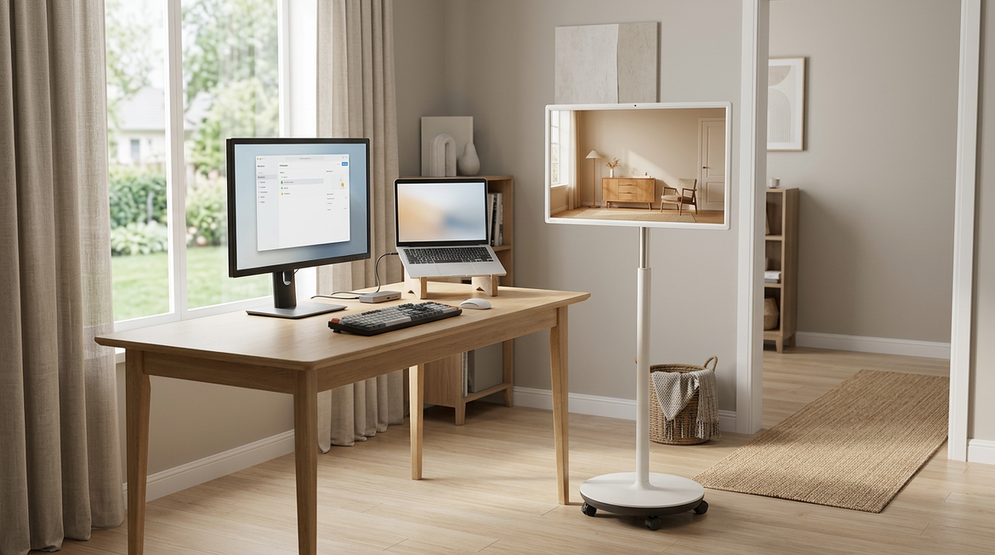
Rolling smart display Matter 2.0 setups make more sense than wall tablets when the home control point needs to move with daily routines. If your automations happen in the kitchen, living room, office, and bedroom, mobility is usually the bigger win than a permanently mounted screen.

Why Wall Tablets Lose Their Advantage
Fixed tablets are fine when one room is the center of action, but home control rarely stays on one wall. A dashboard that follows people where they actually cook, relax, work, or wind down is easier to use than one that asks everyone to come to it.
That is the main reason the rolling smart display Matter 2.0 angle matters. It shifts the control surface to the room that needs it right now, instead of spreading attention across multiple fixed screens.
The Display Challenge of Working from Different Rooms Throughout the Day is a useful follow-up if you want the broader room-to-room use case. For many households, the key question is not screen quality. It is whether the control point stays useful once the family moves.
What Mobility Changes in Daily Control
Mobility helps when the dashboard needs to follow routine instead of forcing routine to orbit a wall. In practice, that means a single screen can cover different moments in the day without asking you to stand in the same place every time.

Kitchen-To-Living-Room Control Flow
A rolling display can start with recipe-linked automations in the kitchen, then move to the living room for lighting, climate, or security checks. That is a better fit when the same household uses one dashboard many times a day, but not always in the same room.
Shared Family Access Without Installation
Families also benefit because one shared dashboard can be used by different people in different places. That reduces the friction of deciding where the “main” smart-home screen belongs, especially in homes where nobody wants a permanent wall install.
Accessibility and Everyday Repositioning
When needs change, a movable screen is easier to reposition than a mounted tablet. That does not make it universally better, but it does lower the effort required to keep the interface near the user instead of leaving the user to chase it.
Mobile Touch Screen is the broader category if you want to compare portable touch-screen options. The practical gain is simple: the display can move to the person, not the other way around.
Battery and Placement Trade-Offs
The trade-off is that portability changes how the device behaves in a home network and power setup. Matter uses IP-based protocols such as Thread and Wi-Fi, and Thread’s battery-device behavior means sleepy end devices conserve power instead of staying immediately reachable at all times. A Matter controller manages device installation and control across a shared fabric.
That matters because a battery-powered rolling unit can be more convenient, yet it does not automatically behave like a fixed always-on wall tablet. If the household needs a panel that stays visible in one place all day, a wall tablet is still the cleaner fit.
The choice usually flips on one question: do you want a single control point that moves, or several fixed points that stay put? Rolling smart display Matter 2.0 setups are strongest when the first answer is yes.
| Use Case | Wall Tablet Fit | Rolling Display Fit |
|---|---|---|
| Single-room fixed control | Strong | Weak |
| Mixed-room control | Moderate | Strong |
| Multi-room roaming control | Weak | Strong |
A concrete example helps. The KTC MEGAPAD 27-inch FHD includes built-in wheels and a battery, so it matches the mobile-control idea well for room-to-room use. The KTC MEGAPAD 32-inch 4K goes larger and sharper, which is more relevant if the dashboard will also serve as a shared viewing surface.
How to Choose a Rolling Command Center
-
Check where control actually happens. If it is spread across rooms, a rolling unit is more likely to earn its keep than a wall tablet.
-
Match the screen to movement, not just to size. A display that can be rolled quickly is more useful than a larger screen that stays awkward to reposition.
-
Compare battery runtime to real away-from-outlet time. If the screen spends long stretches away from power, battery behavior becomes a real selection factor, not a spec detail.
-
Treat Matter and Thread support as a setup check, not a headline promise. A device can be a good mobile dashboard without proving every controller feature in advance.
-
Choose size by traffic pattern. The 27-inch class is easier to move and park, while a 32-inch class gives more shared visibility if the screen doubles as a family dashboard.
Building the 2026 'Invisible Desk': Minimalist Setups with Battery-Powered Smart Displays is a good next read if you want the broader battery-powered setup logic. For this choice, the simplest decision sentence is: if the home control point needs to travel, choose rolling; if the screen should stay fixed and always visible, keep the wall tablet.
A Practical Setup That Feels Natural
The best setup is usually the one that feels obvious to use every day. Park the display where the household starts the day, not where a wall mount happened to be convenient during installation.
Use the movable screen to reduce the need for separate always-on dashboards in every room. That is where the rolling smart display Matter 2.0 idea becomes practical rather than gimmicky.
Leave space for charging and docking so the device is easy to grab and return. If app access, sleep behavior, or charging habits are awkward, the convenience of mobility starts to disappear.
The right setup is not the one with the most features on paper, but the one you can actually keep near the place where control happens.
When a Wall Tablet Still Makes More Sense
A wall tablet is still the better choice when a room has a clear permanent command point and the screen should remain always on. That is especially true in hallways, entry areas, or single-purpose control spots where moving the screen would add friction instead of removing it.
It can also be the safer choice when the household does not want to think about charging, docking, or temporary parking. Rolling smart display Matter 2.0 setups are flexible, but flexibility is not free. If the screen must stay visible in one place every day, fixed placement is still simpler.
FAQs
Q1. What Makes a Rolling Smart Display Better Than a Wall Tablet?
Mobility is the main reason. A rolling display works better when the control point needs to move between kitchen, living room, office, or bedroom. A wall tablet still wins when one fixed location is enough and always-on visibility matters more than flexibility.
Q2. Can a Portable Smart Display Work as a Home Automation Command Center?
Yes, for many homes it can. The important check is whether the device can stay practical as a daily control point, not just as a screen. App support, network setup, battery behavior, and how often you move it all affect whether it feels central or merely portable.
Q3. Why Does Battery Power Matter for Matter 2.0 Control?
Battery power lets the screen move freely, which is the whole appeal of a rolling command center. The trade-off is that some battery-backed devices conserve power differently from always-on wall tablets, so you should watch how your own setup behaves when the screen sleeps or moves rooms.
Q4. How Do I Decide Between One Rolling Display and Multiple Wall Tablets?
Ask whether you want one mobile control point or several fixed access points. One rolling display is better when people share rooms and routines shift during the day. Multiple wall tablets only make more sense when each room truly needs its own always-visible controller.
Q5. Can a Rolling Display Replace a Wall Tablet in Every Room?
Not in every room. It can replace some fixed screens for many households, but it is a poor substitute where permanent placement is essential. If a room needs a controller that is always in the same spot, the wall tablet remains the more natural fit.
The Better Fit Is Usually the More Mobile One
For a multi-room Matter 2.0 home, a rolling display usually beats a wall tablet because it goes where people actually are. That advantage is strongest when one screen needs to serve different rooms, shared routines, and flexible access. Check room traffic patterns first, then compare battery runtime against daily movement needs. If fixed always-on visibility matters more than mobility, keep the wall tablet instead.