Battery power is the better starting point if you want to move a portable smart display between rooms, but plugged-in power is the safer choice if the display will live in one spot and run for long sessions. The real decision is less about the panel itself and more about whether you want mobility or always-ready stability.

Battery Life Changes How You Use It
For most buyers, battery power is not mainly about freedom in the abstract. It is about whether you can carry the screen from the living room to the kitchen, bedroom, or patio without planning around an outlet.
A useful baseline is that portable display runtime drops as brightness, volume, and video load go up. KTC's own battery guidance for the A25Q5 portable smart display shows that the same unit can land around 11 hours at lighter use, about 7 hours at a mid setting, and about 4 hours at max brightness and volume. That is the kind of spread buyers should expect from many battery-powered displays: the number on the box is usually a best-case starting point, not a guarantee for every session.
If you want a simple decision sentence, use this: battery power is a fit when movement matters more than all-day runtime certainty, but it stops being the better option once the screen becomes a daily fixed-location display.
Brightness matters because it is the easiest way to spend battery faster. The portable monitor power guidance from SSA Digital makes the same point clearly: brighter settings pull more power, so runtime falls fastest when you keep the screen at the top end indoors. In plain terms, a bright screen gives you convenience in sunlit or high-contrast rooms, but it also shortens the time between charges.
Moving rooms without replugging is the other big advantage. If you routinely use a display in the kitchen for morning routines and then move it to the bedroom or family room later, battery power removes one annoying step each time. That convenience matters most in homes where the screen is part of a routine, not a permanent desk setup.
Plugged-In Models Win on Stability
If the display will stay in one room, plugged-in models usually make more sense. They remove the need to watch battery percentage, manage charging pauses, or lower brightness just to preserve runtime.

That stability matters most for an always-on dashboard, a family screen that stays visible all day, or a media corner where the display is used for long stretches. In those cases, constant power is less exciting than battery freedom, but it is often the more practical choice.
A second decision sentence is worth keeping in mind: if your use pattern is mostly one room, one outlet, and long sessions, plugged-in power is usually the cleaner choice, but it becomes less convenient the moment you want to roll the screen elsewhere.
The other hidden trade-off is setup friction. Plugged-in models often ask less of you day to day because you are not charging them as often, but they depend more on where the outlet is and how visible the cable run will be. That is usually fine for a desk or media nook, and less fine if you dislike visible cords in shared living areas.
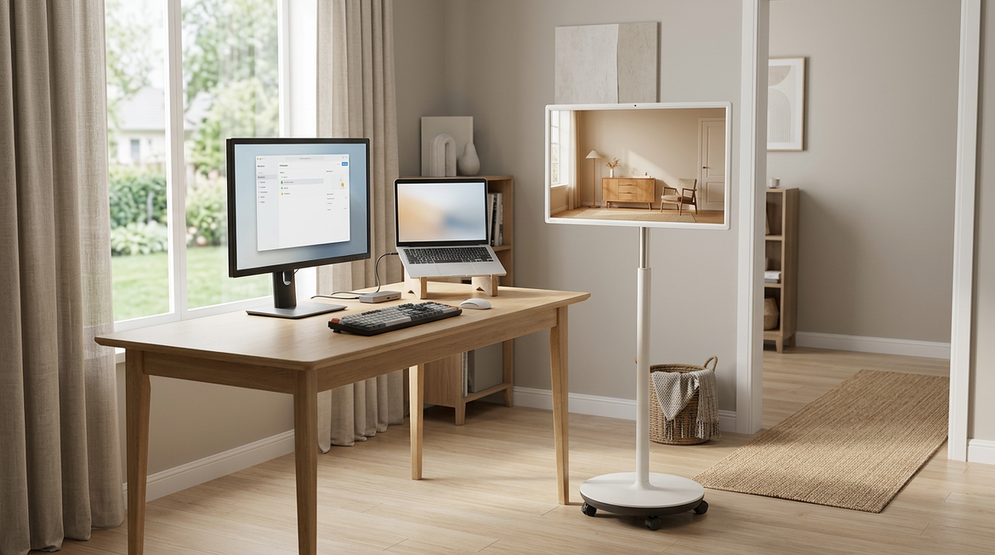
For readers who want a fixed smart-monitor style setup, a 32-inch smart monitor is the more natural fit than a battery model when the screen is meant to stay in place and act like a stable home display.
Which Features Actually Matter for Home Use
Before you compare battery versus plugged-in models, check the features that change real-world usefulness, not just the spec sheet.
| Feature | Battery-Powered Portable Smart Display | Plugged-In Smart Monitor | What It Means For You |
|---|---|---|---|
| Mobility | Easier to move room to room | Best when it stays put | Choose mobility if the screen follows your routine |
| Runtime | Finite, brightness-sensitive | No battery countdown | Choose battery only if charging breaks do not bother you |
| Placement flexibility | High | Lower | Choose portable if outlets are awkward or limited |
| Setup effort | Charging awareness is part of ownership | Cable routing matters more | Choose based on which hassle you dislike less |
| Viewing comfort | Often sized for flexibility | Often better for long sessions | Choose larger fixed screens for shared watching |
| Smart-app use | Good for dashboards and casual use | Better for always-ready use | Choose the class that matches how often you open apps |
| Video calls | Useful when moved around the home | Useful as a fixed station | Choose based on whether calls happen in one room or many |
| Upkeep | Recharge planning and battery care | Less charging, more cable management | Choose the maintenance style you will actually tolerate |
If your main use is a home dashboard, casual streaming, and quick room-to-room movement, battery power usually adds more value. If your main use is a living-room display, desk screen, or shared family screen, plugged-in power usually fits better.
For background on why smart displays are attractive in the first place, The Rise of Smart Displays: When Your Monitor Handles Apps Without a PC is a helpful companion read because it explains why app access and screen flexibility matter once you stop treating the device like a plain monitor.
Match the Display to Your Room Routine
The best setup depends on how your day actually flows.
Kitchen-and-living-room dashboards. Battery-powered models fit best when the screen starts in one room and ends up in another. That is common for recipe viewing, quick family schedules, and evening routines that move around the house.
Bedroom or workout-room entertainment. Battery power can help if you want a screen you can wheel or carry without making the room feel permanently dedicated to tech. If the screen mostly stays by the bed or the treadmill, though, plugged-in power may be simpler.
Home office and family video calls. Plugged-in models are usually the more predictable choice if the screen stays on a desk or in a fixed corner. They are easier to keep ready for long calls, screen sharing, and daily use without watching battery drain.
A mid-article option worth checking is the KTC MEGAPAD 25" FHD Google EDLA Portable Touch Monitor built in Camera. It fits the portable side of the comparison, and its published battery and movement-friendly design make it a more natural candidate for users who expect the screen to travel around the house rather than sit in one permanent spot.
If you want a larger mobile option, the KTC MEGAPAD 27" FHD Android 14 Google EDLA Smart Touch Monitor with 9500mAh Battery is another portable category example to evaluate, especially if you want a more substantial screen for mixed home use and you still care about room-to-room flexibility.
Setup Effort and Daily Maintenance
Battery models usually ask for more ongoing attention, even when the actual setup is simple.
- Battery models need charging awareness. If you forget to top them up, the battery advantage disappears right when you want to move the screen.
- Plugged-in models need cleaner cable planning. They are simpler day to day, but only if the outlet is in a sensible spot.
- Touch, Wi-Fi, Bluetooth, and account sign-in often matter more than the power type during the first hour. In other words, the display format is only part of the setup story.
- A fixed model is often easier to install once, while a portable model is often easier to reposition after it is already configured.
If you dislike routine maintenance, a corded setup is usually less annoying over time. If you dislike being locked into one spot, the portable format gives you more flexibility even though it asks for more charging discipline.
For users who want to turn a mobile screen into a household control point, Using the MegPad as a Mobile Smart Home Control Dashboard is useful because it shows the kind of day-to-day behavior a rolling display can support once it is part of a fixed routine.
A Simple Checklist Before You Buy
- Start with placement. If the screen needs to move, battery power should stay on the table. If it will stay in one room, plugged-in power is usually enough.
- Check your runtime tolerance. If you do not want to think about charging, pick the fixed setup. If occasional charging is fine, a portable model can make more sense.
- Match screen size to the job. A larger fixed display is usually easier to live with for long sessions, while a portable screen is easier to justify when flexibility matters more.
- Choose the format that matches your routine, not the one that sounds more modern. A battery screen is not automatically better, and a plugged-in monitor is not automatically boring.
- Rule out the wrong fit early. If you want an always-ready home hub, battery power can become a nuisance. If you want room-to-room use, a fixed monitor can feel too limiting.
If you are still deciding between a mobile and fixed setup, the Mobile Touch Screen collection is the better starting point for portable browsing, while the Smart Monitor collection is the better place to compare plugged-in options. The Ultrawide & Portable Displays collection offers additional flexible options when screen shape or travel size is a priority.
Use battery power when: you move the screen often, want fewer outlet constraints, and can live with charging routines.
Use plugged-in power when: the screen stays in one room, you want fewer runtime concerns, and you care more about stability than mobility.
Use a larger portable model when: you want a dashboard that also handles entertainment and occasional room-to-room display duty.
Use a fixed smart monitor when: you want the simplest always-on setup and do not need to carry or roll the screen.
FAQs
How Long Does a Battery-Powered Smart Display Usually Last?
Runtime usually depends on brightness, volume, and what you are doing on screen. A published battery figure is best treated as a baseline, then adjusted downward if you plan to keep brightness high or use the display for long streaming sessions.
Is a Plugged-In Smart Display Better for All-Day Use?
Usually yes, if the screen stays in one place. The advantage is not just constant power, but the lack of charging interruptions and battery management.
How Much Setup Do Battery Models Need?
The first setup is usually similar to any smart display, but battery models add one extra habit: you need to think about charging before the battery runs low. That matters more if the screen moves around the house every day.
Can a Portable Smart Display Work as a Home Dashboard?
Yes, if you want the dashboard to move with you. It works best when the screen is part of routines like morning checks, kitchen use, or evening family planning, not when it needs to stay visible in one fixed place all day.
What Should I Prioritize If I Want Smart Home Control and Entertainment?
Start with placement flexibility, then screen size, then app access. After that, choose battery or plugged-in power based on whether you need the display to travel or stay parked in one room.