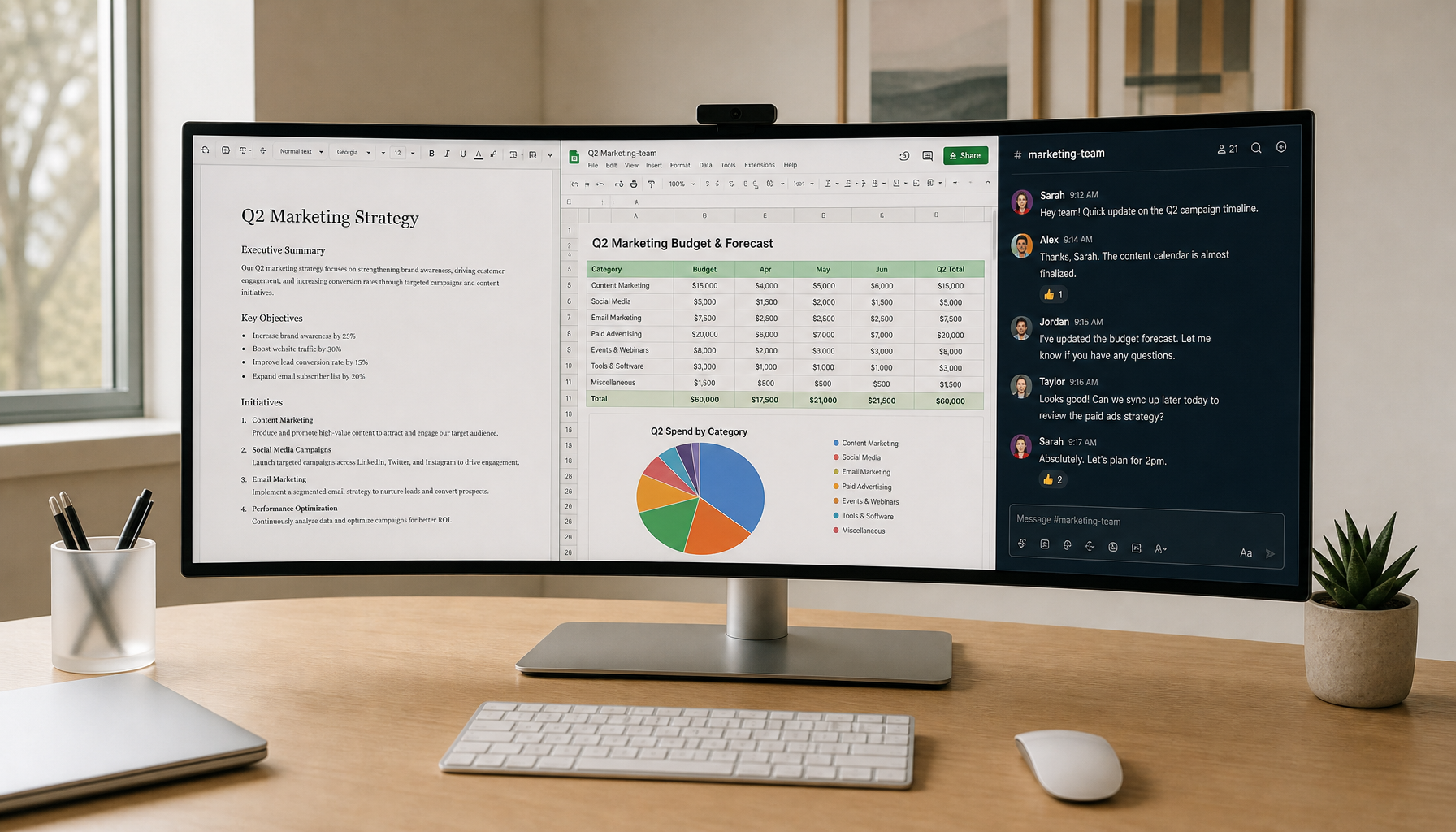
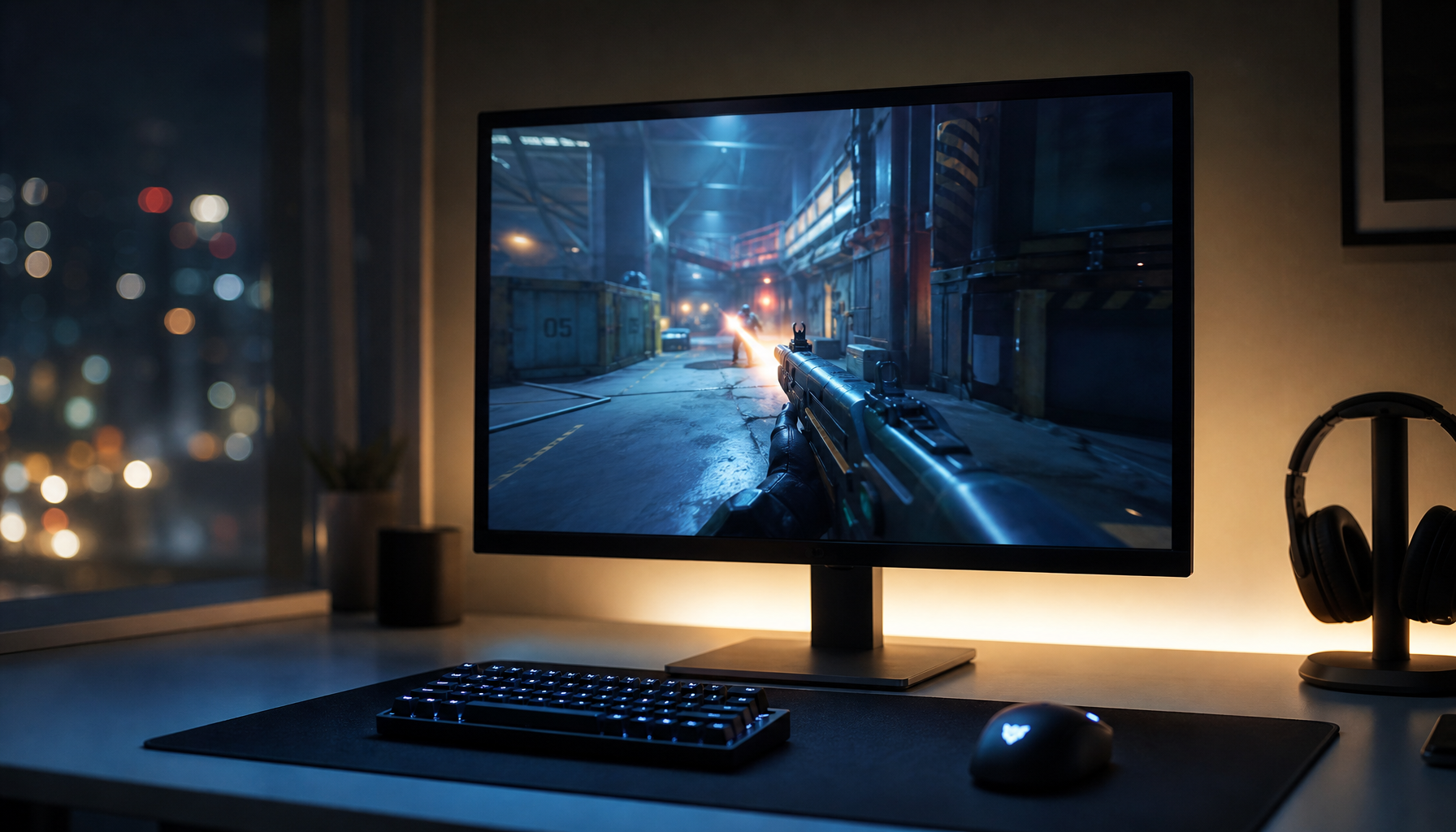
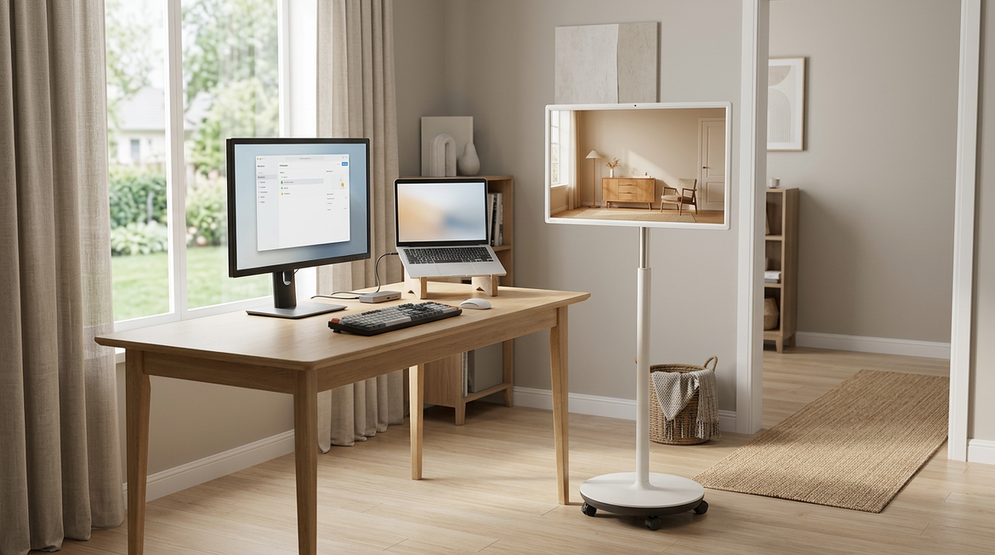
If you are comparing mini LED vs OLED vs IPS bright room options, start with the desk itself, not the panel name. Near a window or under strong lamps, brightness, reflections, contrast, and viewing angle all matter together, so the right choice depends on where you sit and what you do most.
What Changes in a Bright Home Office
In a bright home office, the screen has to stay readable before it can look impressive. Standard office monitors often sit around 250 to 350 nits, while brighter or sunlit rooms often need roughly 400 to 1,000 nits to keep content readable and fight glare, according to screen visibility guidance on nits.
That does not mean everyone needs the highest number on the box. A monitor can still feel hard to read if the window reflection is strong, the stand sits too low, or the screen is angled away from you. For most buyers, the first check is simple: if you work near a window, glare control may matter as much as peak brightness.
A second check is how you sit. Straight-on typing is easier to satisfy than a shared desk, side seating, or a setup that doubles as a media screen after work. That is why a mini LED vs OLED vs IPS bright room decision should be treated as a room-and-task question, not a spec-sheet contest.
Mini-LED bright room setup tips can help if you want a deeper look at how room layout changes the result.
How the Three Panel Types Behave
The short version is this: Mini-LED is the stronger bright-room performance option, OLED is the contrast-first option with caveats, and IPS is the practical office baseline. That ranking flips only when your room gets darker, your media use rises, or your seating position becomes more off-center.

| Panel type | Bright-room headroom | Contrast and black level | Viewing-angle comfort | Day-to-day office feel | Best fit |
|---|---|---|---|---|---|
| Mini-LED | Strong | Very good, depending on local dimming behavior | Usually good | Good for bright desks and mixed work | Window-side desks, mixed work, static UI use |
| OLED | Good, but room light can expose limits on some light screens | Best-in-class black level and contrast | Very good | Excellent for media, but can be less predictable for all-day documents | Contrast-first users, darker rooms, mixed work plus entertainment |
| IPS | Moderate to good | More modest than the other two | Strong and predictable | The easiest office baseline to live with | Shared desks, off-center seating, straightforward productivity |
A useful benchmark for premium Mini-LED is VESA DisplayHDR 1400 certification, which requires at least 1,400 nits peak brightness and a 500,000:1 contrast ratio. That does not make every Mini-LED monitor equal, but it shows why the category can feel more comfortable in bright rooms than ordinary office screens.
OLED's appeal is easy to understand: black backgrounds look deep, text edges can look clean, and media often feels richer. The catch is that bright-room productivity can be complicated by brightness limiting on large light-colored screens, a behavior many users report as ABL on PC Monitors forum discussions. For long browser, spreadsheet, or document sessions, that friction matters more than it sounds on paper.
IPS stays in the comparison because it is the least dramatic and often the least annoying. If you want a monitor that behaves consistently from a chair, a standing desk, or a shared workspace, browse IPS monitors and treat wide viewing-angle consistency as the main advantage, not premium contrast.
Contrast and text readability becomes especially useful when you spend a lot of time on dark interfaces or mixed content. Strong contrast helps, but it still sits inside the larger room-light problem.

The chart below summarizes the usual fit by room condition.
Bright-Room Monitor Fit by Panel Type
Use this as a quick workspace-fit guide: Mini-LED is the safer pick for bright rooms, OLED offers the strongest contrast but is less forgiving on light productivity screens, and IPS is the steady office baseline for wide viewing-angle consistency.
View chart data
| Scenario | Bright room / glare | Mixed lighting | Dark room / contrast focus |
|---|---|---|---|
| Mini-LED | 3 | 2 | 2 |
| OLED | 2 | 3 | 1 |
| IPS | 2 | 1 | 2 |
Brightness, Contrast, and Viewing Angle in Practice
Brightness helps readability until glare becomes the bottleneck. That is why a monitor with decent peak output can still feel dull if a lamp reflects directly off the panel. In practical terms, brightness is only one lever, while the room, the panel finish, and the angle of the desk still shape the result.
Contrast changes how clearly the image separates from the background. On an office desktop, that can affect how crisp text feels, how visible dark UI elements are, and how much depth you notice in mixed work and media use. If you mostly read documents and browser tabs, the difference is subtle. If you split time between work and movies, it matters more.
Viewing angle is the quiet spec that becomes obvious in shared desks and off-center seating. A display can look fine from one chair and lose consistency from another. That is one reason the IPS category keeps showing up in office-oriented buying advice: it is usually easier to live with when the screen position is not perfect.
For a more detailed take on readability and screen behavior, this contrast guide helps explain why the same monitor can feel sharper or softer depending on content and room light.
Which Panel Fits Your Desk Setup
- Choose Mini-LED if your desk sits near a window, you keep a lot of static windows open, and you want more bright-room headroom without moving to a pure contrast-first panel. If you want a concrete example, the KTC Mini LED 27" 180Hz 2K HDR1400 Gaming Monitor | M27T6 shows the kind of Mini-LED setup that can make sense for a daylight-heavy desk.
- Choose OLED if contrast and black level matter most and your room is not fighting the screen all day. A bright office can still work, but the tradeoff is worth it only if you accept that some light productivity screens may dim. The KTC OLED 27" 2K 240Hz/0.03ms USB-C Gaming Monitor | G27P6 is a useful example of the OLED branch, not a universal answer.
- Choose IPS if you want the simplest office decision, especially for shared desks, side seating, or long work sessions where predictability matters more than dramatic contrast. The KTC 32" 2K IPS 100Hz/120Hz Home&Office Monitor | H32T13 fits that practical office-first lane.
- If you are still undecided, pick the panel that matches the room first and the media habit second. A bright, window-side desk usually pushes the decision toward Mini-LED or IPS. A darker mixed-use room can make OLED more appealing.
A useful rule: do not pay for gaming-first features you will not use. If your day is mostly email, docs, and spreadsheets, the safest mini LED vs OLED vs IPS bright room choice is the one that keeps the screen readable without extra effort.
Before You Buy for a Bright Desk
- Check how much direct or indirect light hits the screen during your work hours.
- Decide whether your main task is typing, spreadsheets, creative work, or media.
- Note whether you sit straight on, off to the side, or share the screen with someone else.
- Compare panel behavior, not just one brightness number.
- Verify stand adjustment, returns, and warranty before you check out.
If you want a lower-risk office path, start with Mini-LED for static UI work or stay with IPS and avoid overbuying for contrast you may not notice every day. The right choice is the one that matches your room, not the loudest spec.