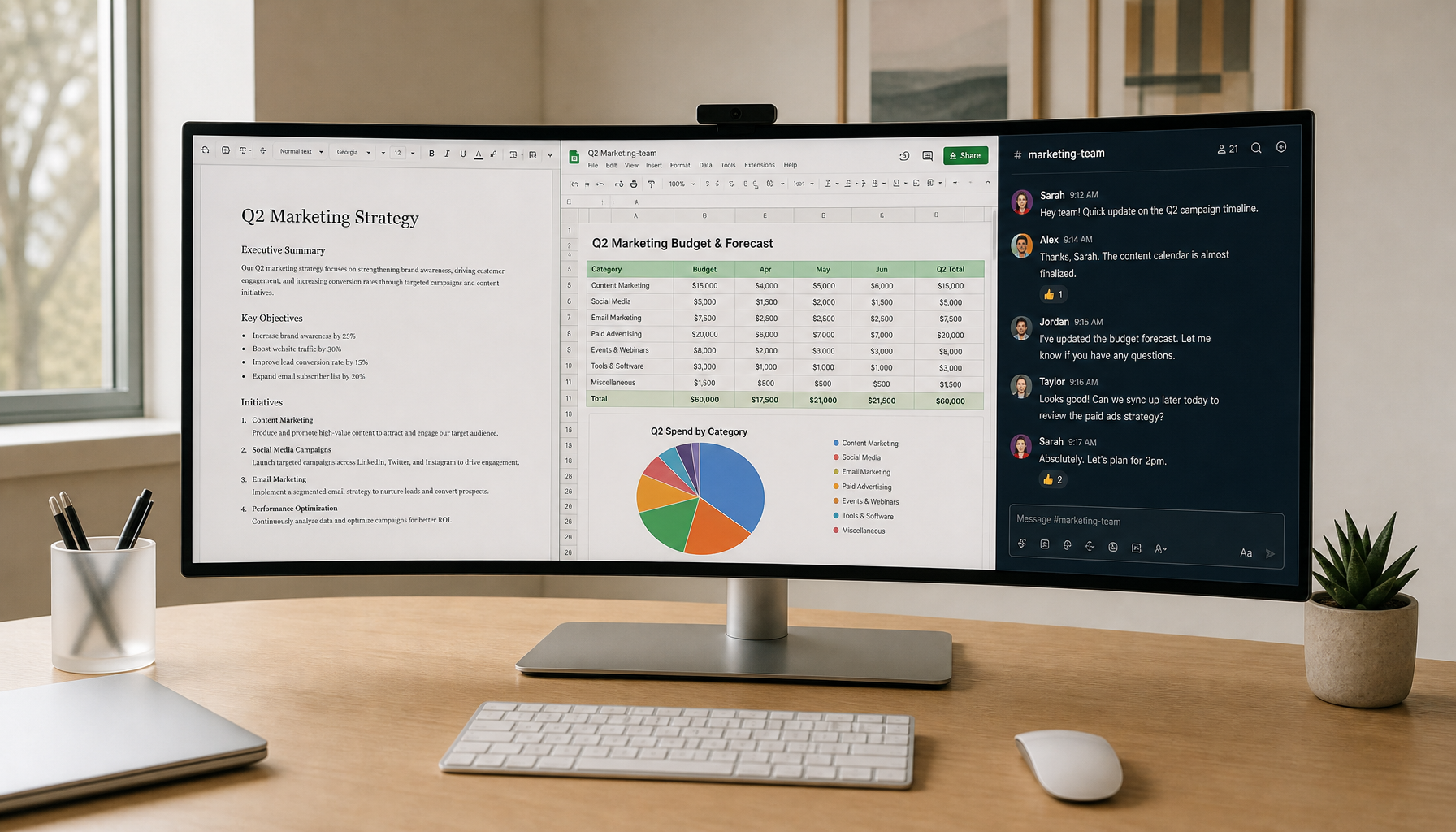
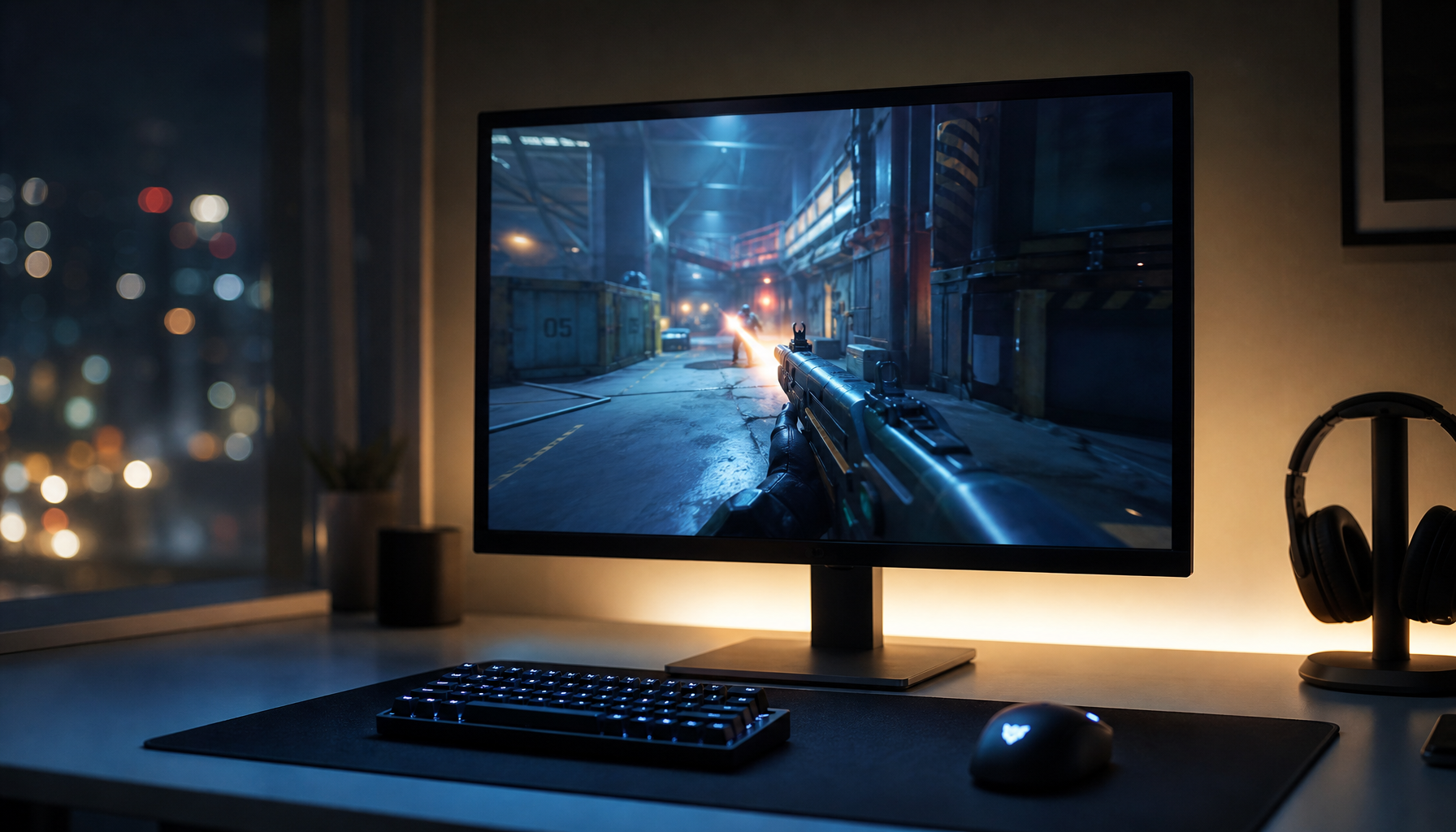
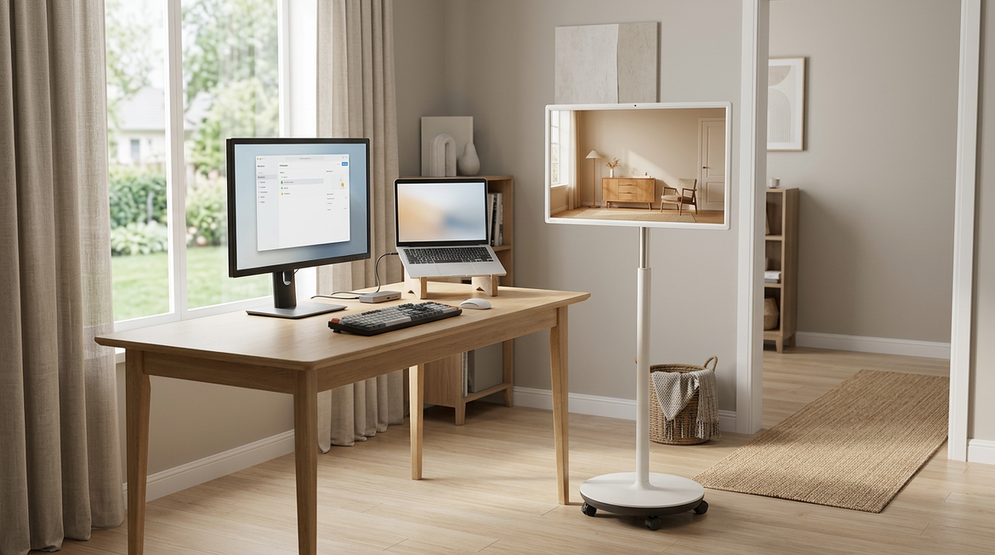
A built-in KVM monitor vs external dock comes down to compatibility first, convenience second. If your laptop can run display over USB-C, the cable is full-function, and the monitor's power delivery matches your needs, a KVM monitor can cover a clean shared desk. If any of those pieces fail, a dock still makes more sense.

KVM Monitor Versus Dock at a Glance
A built-in KVM monitor puts display switching and peripheral sharing into the monitor itself. An external dock is broader laptop expansion hardware, with more room for ports, adapters, and charging flexibility. USB-C docking monitors can act like a hub, but that only helps if the laptop and cable path support the full chain. For a deeper look at the basic difference, Docking Stations vs Monitors with Built-in Docks is a useful reference.
| Setup | What It Does Best | Main Trade-Off | Best Fit |
|---|---|---|---|
| Built-in KVM monitor | Shares a screen, keyboard, and mouse across two computers | Usually fewer ports and less flexibility than a dock | Shared work-and-play desks that value a cleaner surface |
| External dock | Expands laptop connectivity and charging options | Adds another box and another cable layer | Accessory-heavy desks and mixed-device workstations |
The practical difference is simple: a KVM monitor is usually about reducing friction at the desk, while a dock is about expanding what the laptop can handle. That distinction matters most when you move between a work laptop and gaming PC every day.
For readers comparing the two, a USB-C monitor as a docking station is worth considering only if you want fewer boxes and fewer cable swaps. If you need Ethernet, legacy ports, or several USB devices to stay attached all the time, the dock-first path is usually easier to live with.
How Built-In KVM Switching Actually Works
Built-in KVM is useful because it lets one monitor share input devices between two computers without replugging everything. In real use, that means your work laptop can stay connected during the day, then your gaming PC can take over after hours with fewer cable changes. For a shared desk, that is often the main reason buyers start looking at a KVM monitor setup.
The catch is that KVM is not the same as "everything over one cable" on every model. The monitor may switch the picture, while the USB path for keyboard and mouse follows a separate upstream connection. On the KTC H27P6, the manual says to connect video first, then the USB-UP path, which is a good reminder that the feature is a workflow, not just a checkbox.
For most players, KVM switching does not create a noticeable lag problem with normal gaming or productivity gear. The more common friction is setup, not performance. If you only need a keyboard, mouse, and one monitor input, KVM can feel clean and simple. If you expect the monitor to behave like a full workstation hub, that expectation is where disappointment usually starts.
What this means is that a KVM monitor is best treated as a shared-display controller, not a universal replacement for every dock function. That is why the first check should always be whether the source device can actually carry display over the same USB-C path you plan to use.
Where a Dock Still Wins
An external dock still makes more sense when the desk is accessory-heavy or the laptop has less forgiving power and port needs. In those cases, the extra flexibility is the point. A dock is usually the safer choice when you want more USB ports, more legacy connection options, or a cleaner way to reuse the same expansion setup with different monitors.
- You rely on Ethernet, multiple USB accessories, card readers, or older peripherals.
- Your laptop needs stronger or more flexible charging than the monitor provides.
- You swap monitors or workstations often and want the expansion layer to stay the same.
- You do not want monitor compatibility to decide whether your desk stays usable.
That is why the question is not "Which is better?" but "Which failure mode do you want to avoid?" A KVM monitor can simplify the desk, while a dock can protect you from port surprises. How USB-C docking monitors make hybrid work easier is helpful context only when the laptop's USB-C path and power needs line up.
If your setup depends on high power draw, a dock is often the more dependable choice. A monitor can charge a compatible laptop, but that is not the same as guaranteeing the laptop will stay charged under every workload. For a gaming laptop or a busier accessory stack, dock flexibility usually wins.
Who Benefits Most From a KVM Monitor
A built-in KVM monitor fits best when the desk is shared between work and play, but the accessory load stays modest. That is especially true for remote workers who also game on a separate PC and want a calmer desk without adding another hub. If you are looking at a model like the KTC H27P6, the 90W USB-C and KVM features make the idea easier to consider, but only if your laptop supports the same USB-C path.
The best-fit user usually values switching convenience and a cleaner surface more than maximum expansion. That makes KVM monitors attractive for smaller home offices, bedroom desks, and hybrid setups where the same display serves both work and gaming. The setup starts to make less sense when the desk grows into a permanent docking station with several accessories attached all the time.
A KVM monitor is also a better fit when you do not want to rewire your desk every time you change modes. If your day looks like laptop in the morning and gaming PC at night, a monitor with KVM can reduce friction enough to matter. If your day looks like laptop, tablet, webcam, Ethernet, storage, and multiple USB accessories, a dock is usually the better center of gravity.
One useful rule of thumb: choose the KVM monitor path when desk simplicity matters more than expansion, and choose the dock path when expansion matters more than simplicity. That is the cleanest way to think about the built in KVM monitor vs external dock choice.
What to Check Before You Replace a Dock
Before you assume a KVM monitor can replace your dock, check the compatibility gate in this order:
- Confirm USB-C video support on the laptop. If the laptop cannot send display over USB-C, the one-cable idea breaks immediately.
- Use a full-function USB-C cable. A charging-only or data-limited cable can leave you with power but no picture.
- Match power delivery to the laptop's needs. The monitor may supply power, but it only replaces the charger if the wattage is enough for that laptop.
- Count your peripherals. Keyboard and mouse are the easy case; webcams, storage, and audio devices make the desk more demanding.
- Check whether you need legacy ports or Ethernet. If you do, the dock is still the simpler answer.
- Verify the monitor's KVM path setup. On the H27P6, the manual calls for video first and USB-UP second, so the order matters.
A USB-C monitor can replace a laptop charger only when the monitor's power delivery matches the laptop's needs, and the cable path supports the full connection. That is the clearest boundary in the whole comparison, and it is why charger replacement should be treated as conditional, not automatic.
If you want a middle ground, a simple USB switcher can be enough for some desks that mainly share keyboard and mouse. But once display routing, charging, and multiple peripherals all need to move together, a full KVM monitor or a dock becomes the cleaner route.
The short version: if the laptop supports the monitor's USB-C path end to end, a KVM monitor can be enough. If any part of that chain is uncertain, keep the dock.

Final Takeaway
The built in KVM monitor vs external dock decision is mostly a compatibility question. Pick the KVM monitor when you want fewer boxes, quick switching, and a cleaner shared desk. Pick the dock when you need more ports, more charging flexibility, or fewer assumptions about the laptop. If you are unsure, start with the compatibility checklist before you buy.
FAQs
Can a KVM Monitor Replace a Dock for a Work Laptop?
Sometimes, but only in compatible USB-C setups. If the laptop supports USB-C video, the cable is full-function, and the monitor provides enough power delivery, a KVM monitor can cover a lot of the same desk tasks. If not, you will likely still need a dock or a separate charger.
What Peripherals Usually Work Through a Built-In KVM?
The common starting point is a keyboard and mouse. Many users also want a webcam, headset, speakers, or other USB devices to follow the active computer. The exact behavior depends on the monitor's implementation, so check whether the USB path and downstream ports actually switch the way you expect.
Why Does a USB-C Monitor Sometimes Need a Separate Charger Too?
Because display, data, and charging are related but not identical. A monitor may support USB-C charging, but the wattage may not be enough for every laptop, especially under load. If the laptop needs more power than the monitor provides, keep the charger in the setup.
How Do I Know If My Laptop Supports a Monitor-Based KVM Setup?
Check whether the laptop's USB-C port supports video output, then confirm the cable is full-function and the monitor supports the connection path you plan to use. If the laptop cannot carry display over that route, the KVM features may still help with peripherals, but the monitor will not replace the dock.
What Makes an External Dock Better Than a KVM Monitor?
A dock is usually better when you need more ports, legacy connections, Ethernet, or a more flexible charging setup. It is also easier to reuse across different monitors and workstations. For accessory-heavy desks, that flexibility often matters more than the cleaner look of a monitor-based hub.
Wrap-Up
A KVM monitor is a good fit when you want a simpler shared desk and your laptop supports the full USB-C path. A dock is the safer choice when you need more expansion or more certainty. Start with compatibility, then choose the setup that matches how you actually work.