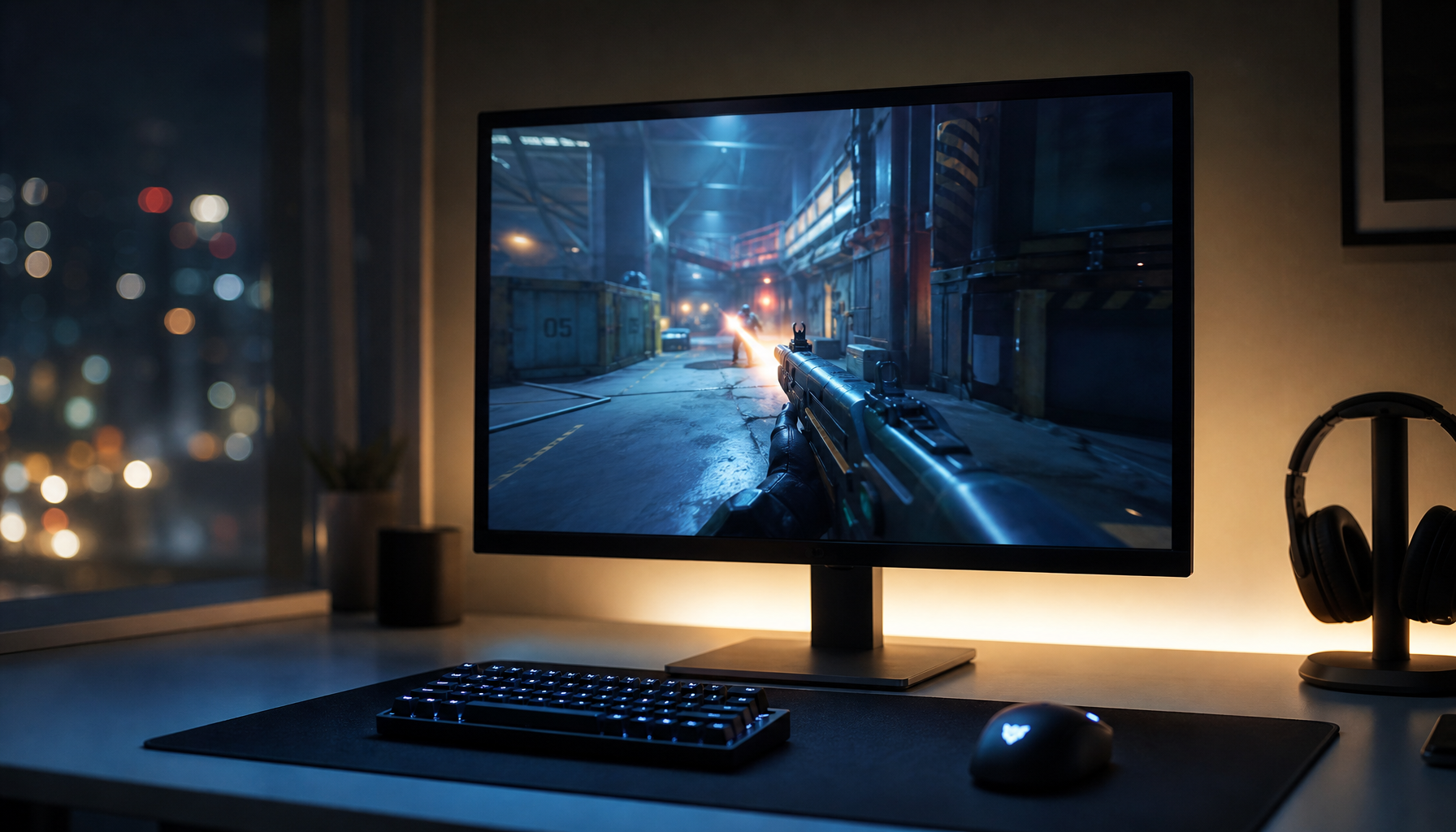
In competitive shooters like Valorant and CS2, the difference between a native 360Hz panel and one overclocked to 400Hz comes down to a 0.28ms reduction in frame time. That gain is real on paper but sits well inside most players' reaction-time variance and mouse-polling limits, making 400Hz a niche upgrade that only pays off for elite setups already running consistent 500+ FPS and 4000Hz+ mice.

360Hz vs. 400Hz: Is the 0.28ms Edge Real?
Frame time equals 1000 divided by the refresh rate. At 360Hz a new frame arrives every 2.78 ms; at 400Hz that interval drops to 2.5 ms. The resulting 0.28 ms improvement is mathematically exact, yet it is roughly one-fifth the size of the jump from 240 Hz (4.17 ms) to 360 Hz.
This shrinking return is the central reason many competitive players question whether the extra effort is justified. When human visual and motor systems already operate on 150–250 ms scales, a sub-millisecond display improvement can only matter if every other link in the chain—GPU frame pacing, mouse polling, and cable bandwidth—is already optimized. Without that foundation the 0.28 ms edge disappears into system jitter.
The chart below visualizes how these gains diminish.
Frame Time Shrinks Rapidly at First, Then Flattens at Higher Refresh Rates
Higher refresh-rate upgrades still reduce frame time, but the gain narrows as the numbers rise—especially from 360Hz to 400Hz.
View chart data
| Category | Frame time (ms) |
|---|---|
| 60Hz | 16.67 |
| 144Hz | 6.94 |
| 240Hz | 4.17 |
| 360Hz | 2.78 |
| 400Hz | 2.5 |
Motion Clarity and the 'Blur Busters Law' at 400Hz
Blur Busters Law states that one millisecond of sample-and-hold persistence produces roughly one pixel of motion blur at 1000 pixels per second of on-screen movement. Reducing persistence from 2.78 ms at 360 Hz to 2.5 ms at 400 Hz therefore yields a theoretical 10 % drop in blur.
In practice this improvement appears most clearly when tracking fast-moving targets across the screen in CS2 or Valorant. The extra clarity can make it fractionally easier to keep a crosshair glued to an enemy peeking at high speed. Yet the same law also shows that the biggest clarity leaps already occurred at 144 Hz and 240 Hz; each subsequent step delivers progressively smaller visible returns.
For that reason many pros treat 400 Hz as a refinement rather than a revolution. The motion-clarity benefit is measurable, but it remains bounded by the rest of the visual pipeline—including pixel-response time, overdrive tuning, and even the game engine’s frame-pacing behavior. See our deeper explanation of What Is Sample-and-Hold Blur and Why Higher Refresh Rates Don't Eliminate It? for the underlying mechanism.

The Hardware Bottleneck: Why Your Mouse Might Ruin 400Hz
A 1000 Hz mouse only reports its position 2.5 times inside each 400 Hz monitor frame. That mismatch can introduce perceptible micro-stutter or input jitter even when the display itself is perfectly smooth. Competitive players therefore treat a 4000 Hz or 8000 Hz polling-rate mouse as mandatory before the extra refresh rate can be felt.
The rest of the system must also clear several gates:
- GPU must sustain 1 % low frame times below roughly 2.5 ms (i.e., never dip under ~400 FPS).
- CPU and RAM must deliver stable frame pacing; engine-level hitches remain visible at any refresh rate.
- DisplayPort 1.4 with DSC or DP 2.1 cable is required to carry the full bandwidth without signal drops.
Without these conditions the monitor is simply updating faster than the input data arriving from the mouse and GPU. The result can feel less responsive than a well-tuned 360 Hz setup. Our guide on What Happens When Your GPU Can't Keep Up With Your Monitor's Refresh Rate? explores the symptoms and fixes in detail.
The 400Hz Stability Gate: Hardware Synergy Checklist offers a practical self-check you can run before investing in overclocking.
The Reality of Overclocking: Stability, Heat, and Risks
Monitor overclocking raises the refresh rate beyond the panel’s factory specification by forcing the timing controller (TCON) to run faster. Unlike GPU overclocking, the gains are not guaranteed; success depends on the silicon “panel lottery.” Not every 360 Hz panel can reach a stable 400 Hz without artifacts.
Common risks include:
- Frame skipping, where the display drops frames even though the GPU is sending them. The Blur Busters UFO test with high-speed camera is the only reliable way to detect it.
- Increased TCON heat that can shorten panel lifespan if the monitor runs 400 Hz for long daily sessions.
- Occasional signal dropout or artifacting that disappears only after reverting to native 360 Hz.
These downsides explain why many serious players treat 400 Hz as an optional peak rather than a daily driver. Overclocking is safe when done conservatively and monitored, yet it is not risk-free. The What Is Pixel Overdrive, and When Does It Create Inverse Ghosting? article explains how to tune response-time settings to avoid additional motion artifacts that sometimes appear at elevated refresh rates.
Decision Guide: Should You Push for 400Hz?
400 Hz overclocking delivers the ultimate spec-sheet edge only when three conditions are met simultaneously: your system sustains 500+ FPS 1 % lows, you use a 4000 Hz or faster mouse, and you accept the added thermal and stability risks. If any one of those is missing, a well-tuned 360 Hz monitor will usually feel more consistent and is the safer daily choice.
For most competitive shooters the 360 Hz sweet spot already sits beyond the point of clearly noticeable returns. The jump to 400 Hz is therefore best viewed as a refinement for players who have already eliminated every other bottleneck and want the absolute lowest possible persistence.
If that description matches your setup, the KTC 24.5 inch 360Hz/400Hz OC Fast IPS FHD Gaming Monitor HDR 400 | H25X7 is purpose-built for exactly this niche, offering native 360 Hz with a stable overclock path to 400 Hz and the supporting bandwidth and cooling features needed to minimize the risks outlined above.
Shop the full range of 240Hz-400Hz Monitors to compare options that match your current hardware headroom.
FAQ
Is a 400Hz monitor worth it for competitive shooters? Only if your PC consistently exceeds 500 FPS, you use a 4000 Hz+ mouse, and you are comfortable managing overclock heat. For the majority of players the marginal 1.3 % consistency gain does not outweigh the added cost and tuning effort.
How do you safely overclock a 360Hz monitor to 400Hz? Use the monitor’s OSD or manufacturer utility to select the 400 Hz option, then verify stability with the Blur Busters UFO test at maximum motion speed. Keep sessions under several hours initially and monitor panel temperature; revert immediately if frame skipping or artifacts appear.
Does 400Hz reduce input lag compared to 360Hz? The theoretical frame-time reduction is 0.28 ms, but real-world input lag is dominated by mouse polling rate, USB latency, and game-engine frame pacing. A 1000 Hz mouse will often mask any latency advantage the extra refresh rate might have provided.
What hardware is required to benefit from a 400Hz gaming monitor? You need a GPU capable of locked 400+ FPS (RTX 3080 or better in most titles), a 4000 Hz or 8000 Hz polling mouse, DisplayPort 1.4 with DSC or DP 2.1, and stable CPU 1 % lows below 2.5 ms. Anything less and the monitor cannot deliver its full potential.
Can overclocking damage my monitor? Prolonged high-temperature operation of the TCON can accelerate panel wear. While occasional use is generally safe, running 400 Hz 24/7 increases the chance of long-term degradation or sudden signal instability.