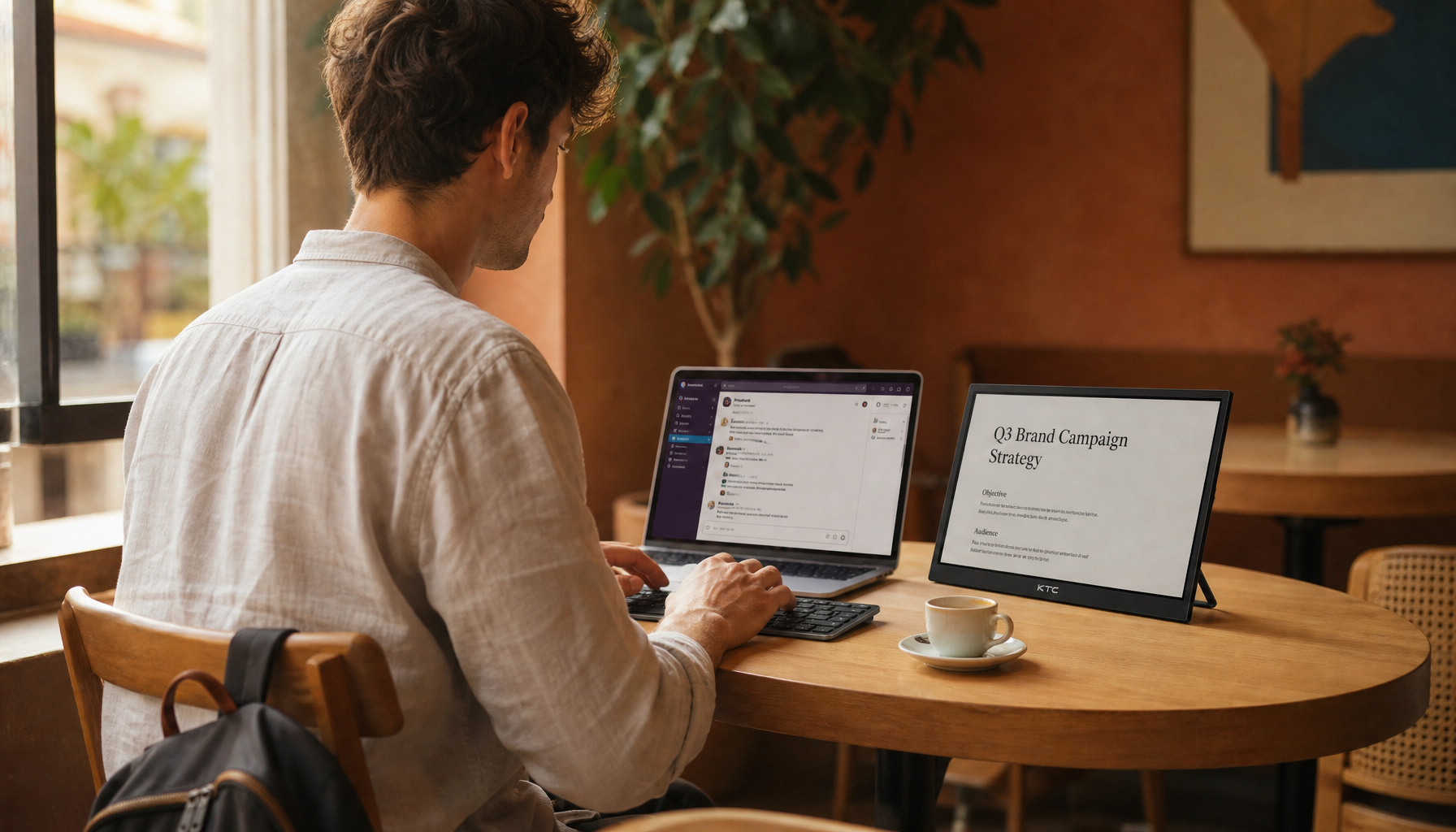
Your ultrawide monitor may feel uncomfortable because the screen is wider than your eyes, neck, desk depth, or software layout can comfortably handle. The fix is usually not “get used to it,” but adjust viewing distance, height, scaling, window placement, aspect-ratio settings, and sometimes the monitor size or curve.
Do you feel like you have to scan left and right just to see your taskbar, game HUD, or browser tabs? A 34-inch 3440 x 1440 ultrawide can add 880 horizontal pixels compared with a 2560 x 1440 16:9 screen, which is useful but also changes how your eyes and neck work. This guide explains why the whole screen feels hard to take in and how to make an ultrawide monitor more comfortable for work, gaming, and reading.
Why an Ultrawide Can Feel Too Big Even When It Looks Sharp
A new ultrawide often looks crisp because the resolution is high, but sharpness is not the same as comfort. A 21:9 or 32:9 display gives you more horizontal workspace than a standard 16:9 monitor, and that extra width can increase eye travel, head rotation, and neck twisting during long sessions horizontal workspace.
The Problem Is Often Width, Not Resolution
If you moved from a 27-inch 16:9 monitor to a 34-inch or 40-inch ultrawide, your old habits may no longer fit the new screen. Keeping a browser full-width, stretching a document across the panel, or placing active apps at the far corners can make the display feel like a dashboard instead of a monitor.
For most people, the center third should be the main work zone. Put your document, game crosshair area, spreadsheet columns, or code editor straight ahead, and use the outer edges for lower-priority content like chat, music, reference pages, or system monitors.
A 40-Inch or 49-Inch Screen May Overwhelm Some Setups
A 2024 lab study cited in ergonomic guidance found that head rotation increased with display width, and some users found a 40-inch display overwhelming head rotation increased. That tracks with real-world desk use: a 49-inch super-ultrawide can feel excellent for racing sims or timeline editing, but tiring for email, PDFs, and everyday browser work if the active window keeps drifting to the edges.
For example, a 49-inch DQHD 1000R curved ultrawide such as a 49-inch DQHD 180Hz 1000R curved gaming monitor should be judged by desk depth and viewing distance before buying, not just by screen size or refresh rate.
A 34-inch 3440 x 1440 ultrawide is often the more practical comfort point because it gives two useful work zones without the extreme side-to-side sweep of larger panels.

Viewing Distance, Height, and Desk Depth Matter More Than You Think
Many ultrawide discomfort problems start before you touch any software setting. If the monitor is too close, too high, or sitting on a deep stock stand, your eyes have to cover more screen angle than necessary.
Start Around Arm’s Length
A practical viewing distance for many ultrawide monitors is about 24 to 31 inches from your eyes 24 to 31 inches. If you are sitting closer than that, the edges may fall too far into your peripheral vision, making the whole display feel hard to read at once.

The top of the screen should sit at or slightly below eye level. If the monitor is too high, you may tilt your head back or open your eyes wider, which can worsen fatigue during long gaming, coding, or document review sessions.
Shallow Desks Can Make Good Monitors Feel Bad
A 24-inch-deep desk can be tight for a 34-inch, 40-inch, or 49-inch ultrawide, especially when the stock stand pushes the panel forward. Ergonomic guidance notes that large monitor bases can exceed the practical depth of a 24-inch work surface shallow desks.
If the screen feels too close, a monitor arm can be more effective than lowering brightness or changing color modes. It lets you push the panel back, center it precisely, and reclaim desk depth for your keyboard and mouse.
Curved vs. Flat Ultrawide: Which Is Easier to See?
Curvature matters more as the screen gets wider. A flat 27-inch monitor is usually easy to view, but a flat 34-inch or 40-inch ultrawide can make the edges feel farther away, especially if you sit close.

Curved Screens Can Help the Edges Feel More Natural
A prospective study of 20 healthy adults compared visual fatigue across flat and curved monitors using a 3440 x 1440 display that was 32.3 inches wide and 14.3 inches high. Participants viewed each screen from about 28 inches away for 30 minutes, and the flat monitor produced the largest change in near point of convergence, while the tightest curve tested showed the smallest change in accommodation visual fatigue.
That does not mean every curved monitor is automatically comfortable. It means curvature can reduce some edge-viewing strain when the screen is wide enough for edge distance and eye movement to matter.
Match Curve to Use Case
For gaming, a curved ultrawide can make the field of view feel more consistent, especially in racing, flight, RPG, and simulation titles. For productivity, a moderate curve can help keep spreadsheets, timelines, and side panels visually closer without forcing as much head movement.
Flat ultrawides can still work well for design, CAD-like layouts, and users who sit farther back. If you use a flat ultrawide, be stricter about distance, window width, and keeping your primary task centered.
Software Settings Can Make the Screen Feel Wrong
Sometimes the monitor is physically fine, but the signal, scaling, or content layout makes it uncomfortable. This is common when watching 16:9 video, playing older games, or switching between high-refresh-rate modes.
Do Not Stretch 16:9 Content Across 21:9 or 32:9
When 16:9 content appears on a 21:9 or 32:9 ultrawide, side black bars are normal. They preserve the original shape of the video or game instead of stretching it across the full panel side black bars.

Stretching a 2560 x 1440 image across 3440 horizontal pixels can distort faces, circles, UI elements, and even aim perception in games. Use settings such as “Maintain Aspect Ratio,” “Aspect,” “Original,” “1:1,” or “No Scaling” in the monitor OSD, GPU control panel, operating system, app, or game.
Recheck Refresh Rate After Scaling Changes
A high-refresh-rate ultrawide may fall back to 60 Hz after resolution or scaling changes because of cable bandwidth, port limits, or signal negotiation. If you bought a 144 Hz, 165 Hz, or 240 Hz gaming monitor, verify the refresh rate in your OS and GPU control panel after changing aspect-ratio or display modes.
Also remember that ultrawide gaming costs more GPU power. Moving from 2560 x 1440 to 3440 x 1440 increases pixel workload by about 34%, so some gamers lower resolution or use aspect-ratio scaling to keep frame rates high.
Reading, Work, and Gaming Need Different Layouts
The “whole screen” does not need to be active all the time. Ultrawide comfort improves when you stop treating the panel like one giant maximized window and start using zones.
For Reading and Writing
Reading comfort drops when text lines stretch too wide across the monitor. A 21:9 ultrawide is most useful when reading is paired with notes, references, browser tabs, or citation tools, not when a single PDF is stretched edge to edge text lines stretch.
For PDFs, test “Actual Size” first, then adjust zoom and window width. A 27-inch 16:9 monitor can be better for single-page PDF reading, while a 34-inch 21:9 ultrawide is stronger for mixed reading, notes, and multitasking.
For Gaming
For supported games, set the correct native resolution and field of view. If the HUD sits too far to the sides, check whether the game has HUD safe-zone settings, UI scaling, or a centered HUD option.
For competitive games, comfort and consistency matter more than filling every pixel. If full 21:9 or 32:9 makes minimaps, ammo counters, or enemies too far from your central vision, try 16:9 with pillarboxing or a centered windowed mode.
Comparison: Common Ultrawide Comfort Choices
Option |
Best For |
Comfort Strength |
Watch Out For |
27-inch 16:9 |
Single-window work, PDFs, esports |
Easy to see at once |
Less horizontal workspace |
34-inch 21:9 curved |
Mixed work, gaming, two-window layouts |
Strong balance of width and comfort |
Needs about 24 to 31 inches of viewing distance |
34-inch 21:9 flat |
Design work, users who sit farther back |
Straight geometry for layout-sensitive tasks |
Edges may feel distant when close |
40-inch ultrawide |
Large spreadsheets, timelines, multitasking |
More workspace than 34-inch |
Can feel overwhelming on shallow desks |
49-inch 32:9 |
Sim racing, trading-style dashboards, heavy multitasking |
Replaces two monitors without a bezel |
Requires deep desk, careful zoning, and more GPU power |
Action Checklist for a More Comfortable Ultrawide Setup
- Set the monitor 24 to 31 inches from your eyes.
- Lower or raise the panel so the top edge is at or slightly below eye level.
- Keep your main app, game focus, or document in the center third of the screen.
- Use side areas only for secondary windows, references, chat, or tools.
- Set 16:9 content to aspect-ratio scaling, pillarboxing, or 1:1 instead of stretch.
- Check OS scaling, browser zoom, game HUD size, and PDF zoom before blaming the monitor.
- Reconfirm refresh rate and adaptive sync after changing resolution or scaling.
FAQ
Q: Why can’t I see the whole ultrawide screen without moving my head?
A: The screen may be too wide, too close, or positioned too high for your setup. Start by moving it back to about 24 to 31 inches, centering your main task, and keeping the top edge at or slightly below eye level.
Q: Are black bars on an ultrawide monitor bad?
A: No. Black bars usually mean 16:9 content is being shown in the correct shape. Removing them by stretching the image can distort faces, UI, circles, and game aim perception.
Q: Should I return my ultrawide monitor if it feels uncomfortable?
A: Not immediately. Try distance, height, scaling, refresh rate, and window layout adjustments first. If a 40-inch or 49-inch display still feels overwhelming after setup changes, a 34-inch 21:9 model may be a better fit.
Practical Next Steps
If your new ultrawide feels hard to view, treat it as a setup problem first and a buying mistake second. Move the screen back, center your primary work, stop stretching 16:9 content, narrow reading windows, and verify refresh rate settings.
If those changes do not help, the monitor may simply be too large or too flat for your desk and viewing distance. For many users, a 34-inch 21:9 curved ultrawide is the most comfortable balance between immersive gaming, high-refresh-rate performance, and everyday productivity.
References
- 16:9 on Ultrawide Monitors: Stop Stretching & Black Bars
- Ultra-Wide Monitor Ergonomics: A Guide to All-Day Comfort
- Ultra-Wide Monitor Ergonomics: A Guide to All-Day Comfort
- Factors Associated with Visual Fatigue from Curved Monitor Use
- Ultrawide Monitor for Reading: Pros, Cons & Setup Guide
- Ultrawide Monitor for Reading: Pros, Cons & Setup Guide