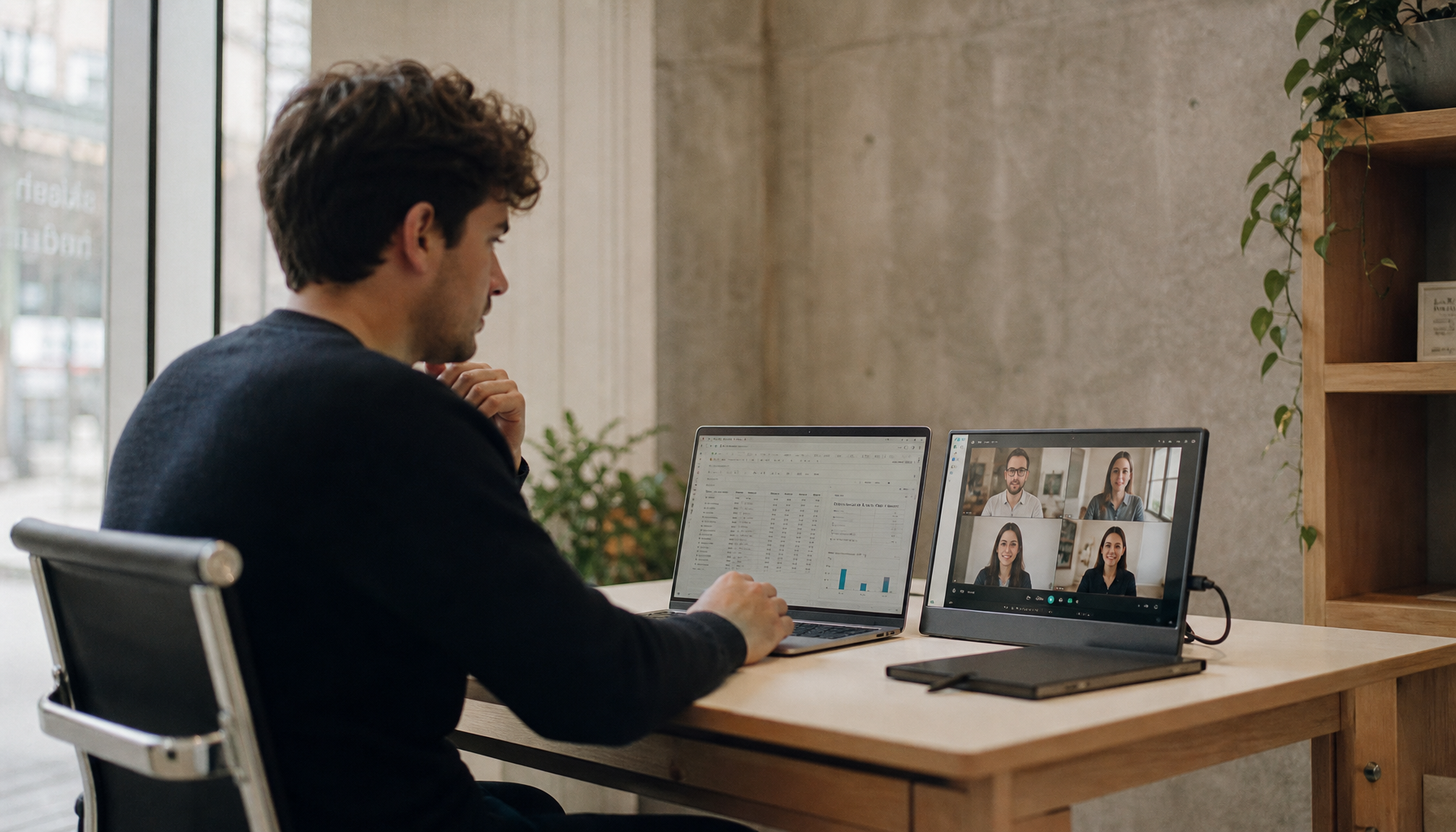
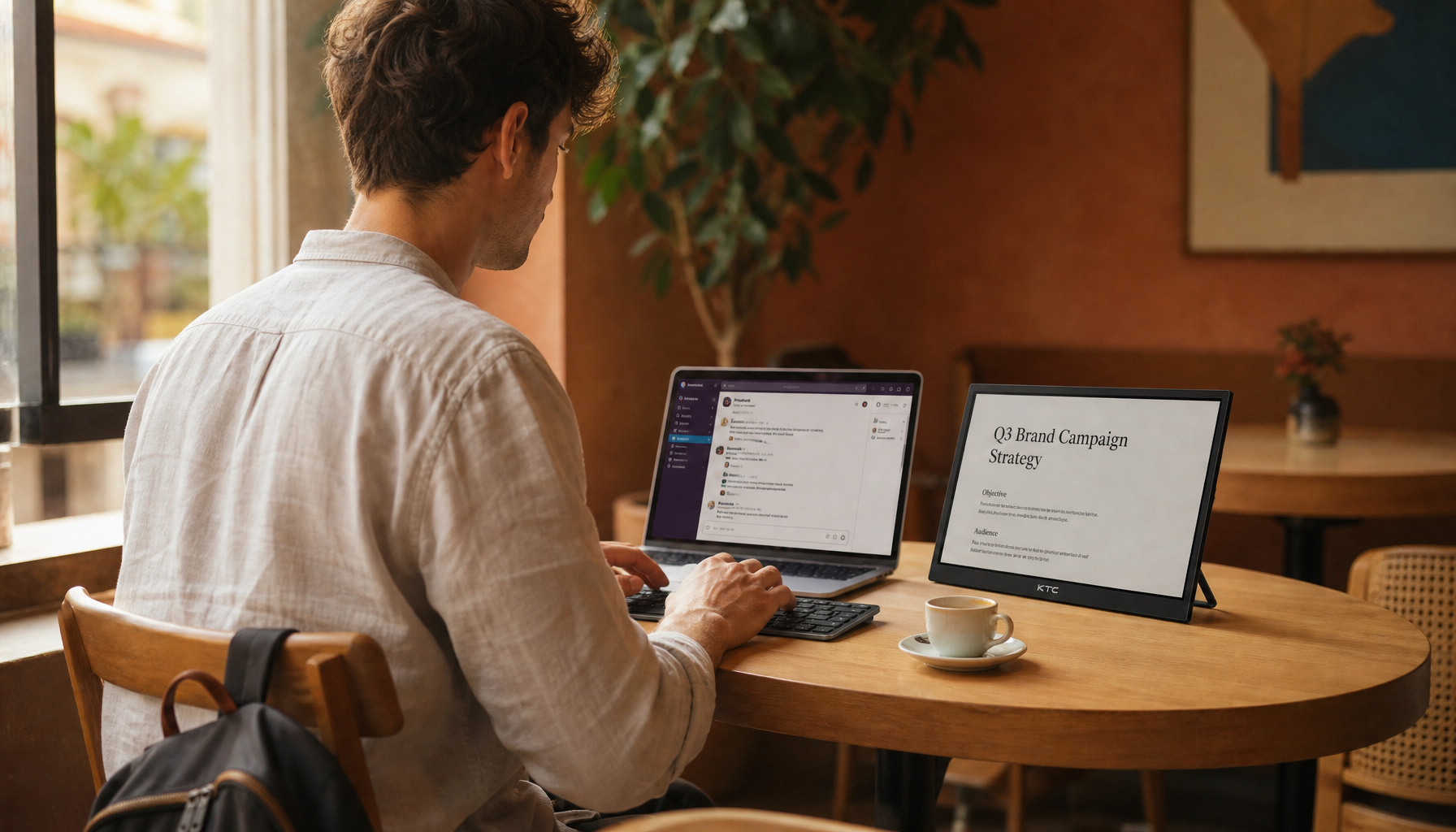
A 32-inch monitor can feel too close because the screen is physically large, the stand often pushes it forward, and many “standard” desks do not leave enough eye-to-screen distance for comfortable viewing.
If your 32-inch gaming monitor looks impressive but makes you lean back, turn your neck, or move your eyes too much, the issue may not be the panel itself. In real desk setups, reclaiming just 6 to 8 inches with a monitor arm can turn an uncomfortable oversized display into a usable one. Here is how to tell whether your setup needs a distance adjustment, a mounting change, different scaling, or a different monitor size.
Why a 32-Inch Monitor Feels Too Close
The screen fills more of your field of view
A 32-inch monitor is not just “a little bigger” than a 27-inch display. It has a much larger visible surface, so text, side panels, minimaps, chat windows, timelines, and browser tabs sit farther apart in your vision. When the screen is too near, your eyes and neck have to scan more aggressively from edge to edge.
Ergonomically, monitor comfort depends heavily on viewing distance and viewing angle. An ergonomics agency places the preferred monitor distance at 20 to 40 inches, while an occupational health organization notes that poor monitor placement can contribute to neck discomfort, eyestrain, blurred vision, dry eyes, burning eyes, and headaches through the wrong distance or angle monitor placement.
A factory stand can steal desk depth

The most common problem is not the 32-inch panel by itself. It is the combination of panel size, stand depth, and desk depth. On many 24-inch-deep desks, the original stand can take up 9 to 12 inches, leaving the screen much closer to your face than the desk measurement suggests.
That is why a “standard size” desk can still feel wrong. A 24-inch desktop may sound adequate, but once the monitor stand, keyboard, wrist space, and chair position are included, your actual eye-to-screen distance may land closer to 15 to 20 inches. For a 32-inch display, that can feel visually crowded, especially in fast games, spreadsheets, video editing timelines, and multi-window productivity layouts. If you are buying or replacing a 32-inch gaming monitor, a standard-mount-compatible option such as the a brand 32” 4K 165Hz Gaming Monitor with Standard Mount can make it easier to use a monitor arm instead of relying on a deep stock stand.
What Is the Ideal Viewing Distance for a 32-Inch Monitor?
Start with 24 to 30 inches, then adjust by resolution

For many 32-inch monitors, a practical starting distance is about 24 to 30 inches from your eyes to the screen. That range often works well for a 32-inch 4K monitor because the high pixel density lets text and interface elements stay sharp without sitting extremely far back.
Resolution changes the answer. A 32-inch 4K display is often comfortable around the mid-20-inch range, while a 32-inch QHD display may need closer to 37 inches for pixel structure and text edges to feel more natural at normal desktop scaling. A 32-inch desk-depth analysis places most 32-inch setups around 24 to 30 inches, with 4K and QHD behaving differently because of pixel density.
Gaming may need more distance than office work
For immersive gaming, especially racing, flight sims, RPGs, and shooters, many users prefer the monitor farther away than they would for email or writing. Around 38 to 42 inches can create a more natural field of view for a 32-inch gaming display, reducing the “sitting in the front row” feeling.
That does not mean every 32-inch gaming monitor needs to be 40 inches away. Competitive players often sit closer to keep the crosshair, HUD, and enemy movement prominent. But if your symptoms are neck turning, eye fatigue, or feeling like the corners are outside your comfortable view, distance is one of the first variables to test.
Is a Standard Desk Deep Enough?
A 24-inch desk is often tight for 32 inches
A 24-inch-deep desk can work for a 32-inch monitor only if the stand is shallow, the screen can sit near the rear edge, or you use a monitor arm. With the original stand, it often feels too close because the panel sits several inches forward from the wall or back edge.
A 30-inch-deep desk is a safer minimum for many 32-inch monitors using the factory stand. If you have a 24-inch desk and a large V-shaped gaming stand, the monitor may be physically unable to sit far enough back, even if your chair and posture are correct.
Desk depth is different from viewing distance

Desk depth is measured from the front edge to the back edge. Viewing distance is measured from your eyes to the front of the screen. Those are not the same number.
For example, on a 24-inch desk, a large monitor stand may place the screen 8 inches forward from the back edge. If your eyes are only a few inches behind the desk’s front edge while typing, your true viewing distance may be closer to 18 inches. That is below the comfort range many people need for a 32-inch display, even though the desk itself is “standard.”
Setup Scenario |
Likely Comfort Level |
Why It Feels That Way |
Better Fit |
32-inch monitor on 24-inch desk with factory stand |
Poor to fair |
Stand pushes the screen forward, leaving limited eye distance |
Monitor arm or smaller display |
32-inch monitor on 30-inch desk with factory stand |
Fair to good |
More depth helps reach the mid-20-inch range |
Good for 4K productivity and mixed use |
32-inch monitor on 24-inch desk with monitor arm |
Good if mounted far back |
Arm can reclaim about 6 to 8 inches |
Strong option for tight desks |
27-inch monitor on 24-inch desk |
Usually good |
Smaller screen needs less scanning |
Better for shallow desks |
34-inch ultrawide on 30-inch desk |
Depends on curve and use |
Wide edges can require more neck movement |
Best with a curve and arm |
Portable monitor beside main display |
Good for occasional use |
Adds screen space without enlarging the main focal display |
Useful for laptops and compact desks |
Height, Tilt, and Posture Matter as Much as Distance

A large monitor should often sit lower than expected
The old rule that the top edge of the monitor should be at eye level works reasonably well for smaller office displays. With 32-inch and larger screens, that rule can place too much content above your comfortable gaze, especially if the monitor is tall or mounted high.
A better target is to let your eyes land around the top third or upper half of the screen, with the screen center slightly below eye level. Large gaming monitor guidance recommends a slightly downward gaze toward the center and notes that the center may sit around 17 to 18 degrees below eye level. An ergonomics agency gives similar ergonomic direction: the top should be at or slightly below eye level, and the screen center is normally 15 to 20 degrees below horizontal eye level.
Chair position comes first
If your chair is too low, your monitor will seem too tall. If your chair is too far forward, your monitor will seem too close. Before buying anything, set your chair so your feet are flat, knees are near 90 degrees, lower back is supported, and your backrest is slightly reclined.
Then place the monitor directly in front of you. An ergonomics agency recommends keeping the monitor no more than 35 degrees to either side of your centerline directly in front, which matters for 32-inch displays because even a small off-center placement can make one edge feel uncomfortably far away.
Resolution, Scaling, and Refresh Rate Can Change the Feel
A 32-inch 4K monitor usually feels more flexible
A 32-inch 4K monitor has enough pixel density for sharp text, detailed games, and multiple app windows. It is often the most comfortable 32-inch choice for productivity because you can use scaling to make text readable without sitting extremely close.
For practical tuning, start with 125% or 150% scaling in a desktop operating system or a similar comfortable setting on another desktop operating system. If text feels tiny and you lean forward, increase scaling. If everything feels oversized and cramped, decrease scaling slightly or move the monitor back. The right setup lets you read normal body text without craning forward.
A 32-inch QHD monitor can feel larger than expected
A 32-inch QHD monitor can be excellent for gaming because it is easier to drive at high refresh rates than 4K. The tradeoff is lower pixel density. Text, browser content, and UI edges may look larger or softer at close range, which can make the display feel physically bigger than a 32-inch 4K panel at the same distance.
This matters when shopping. If your priority is high-refresh-rate gaming on a midrange GPU, 32-inch QHD may make sense. If your priority is reading, coding, design work, spreadsheets, or all-day office use, 32-inch 4K is usually easier to tune for comfort on a standard or slightly deeper desk.
How to Fix a 32-Inch Monitor That Feels Too Close
Make the cheapest adjustments first
Start by measuring the actual eye-to-screen distance. Sit normally, place your hands on the keyboard, and measure from your eyes to the screen surface. If you are under 24 inches, the monitor is likely too close for many 32-inch setups, especially if it is QHD or used for gaming.
Next, lower the monitor until your natural gaze lands near the upper third of the display, then tilt the screen slightly backward. A 10- to 20-degree backward tilt can help reduce glare and prevent posture shifts on large gaming displays slight backward tilt. Do not tilt so far that text looks distorted or reflections increase.
Use a monitor arm if the stand is the problem

A monitor arm is often the highest-impact fix for a 32-inch screen on a standard desk. It can move the display closer to the rear edge, free desk space, improve height control, and make small daily adjustments easier. In many setups, a monitor arm can reclaim about 6 to 8 inches of usable depth monitor arm.
Use this checklist before replacing the monitor:
- Measure your real eye-to-screen distance while sitting normally.
- Move the monitor as far back as the desk safely allows.
- Lower the screen so your gaze lands around the upper third, not the very top edge.
- Tilt the panel slightly backward to reduce glare and neck compensation.
- Adjust display scaling until you can read text without leaning forward.
- Try a monitor arm if the factory stand consumes too much desk depth.
- Consider downsizing to 27 inches or switching format if you still need to sit too close.
Should You Keep the 32-Inch Monitor or Choose Something Else?
Keep it if you can reach a comfortable distance
Keep the 32-inch monitor if you can sit at least around 24 to 30 inches away, keep your neck neutral, and read text without leaning forward. This is especially true for 32-inch 4K displays used for productivity, editing, console gaming, and mixed work-and-play setups.
A 32-inch monitor also makes sense if you use window snapping, side-by-side documents, large timelines, trading dashboards, or immersive single-player games. The size becomes a problem only when the desk and mount force the panel into your personal comfort zone.
Downsize or switch format if the setup keeps fighting you
A 27-inch monitor is often the better fit for a 24-inch desk, especially for competitive gaming or general office work. It requires less head movement, fits more naturally with factory stands, and still offers excellent options at 1440p, 4K, and high refresh rates.
A 34-inch ultrawide can be a better or worse choice depending on depth and curvature. It gives more horizontal workspace, but the edges are farther apart than a 32-inch 16:9 display. If you choose ultrawide, a curved panel and a monitor arm become more important, especially for gaming and multitasking.
FAQ
Q: Is a 32-inch monitor too big for a 24-inch desk?
A: Often, yes, if you use the original stand. A 24-inch desk can work when the monitor is mounted on an arm or pushed very close to the back edge, but many factory stands place the screen too far forward. If your measured eye-to-screen distance is under 24 inches, the setup is likely too tight.
Q: Why does my 32-inch 4K monitor feel better than my 32-inch QHD monitor?
A: A 32-inch 4K monitor has higher pixel density, so text and interface details look sharper at closer distances. A 32-inch QHD monitor can be great for high-refresh-rate gaming, but at desktop distances it may feel larger or softer because the pixels are less dense.
Q: Should the top of a 32-inch monitor be at eye level?
A: Not always. For a large monitor, the top edge at eye level can make the screen feel too tall. A more comfortable target is often having your natural gaze land near the top third or upper half of the display, with the screen center slightly below eye level.
Key Takeaways
A 32-inch monitor feels too close when your real viewing distance is shorter than the screen size, resolution, and field of view require. The most common cause is a shallow desk combined with a bulky factory stand, not necessarily a bad monitor choice.
For most users, aim for about 24 to 30 inches of eye-to-screen distance for a 32-inch 4K monitor, and consider more distance for QHD or immersive gaming. Set chair posture first, keep the monitor centered, lower large screens slightly, adjust scaling, and use a monitor arm before replacing the display. If the screen still feels crowded after those changes, a 27-inch monitor or a better-mounted ultrawide may fit your desk and eyes more naturally.
References
- OSHA: Computer Workstations - Monitors
- Canadian Centre for Occupational Health and Safety: Office Ergonomics - Positioning the Monitor
- KTC: How to Prevent Neck Strain from Large Gaming Monitors
- KTC: Monitor Size vs Desk Depth: Perfect Distance for 32-Inch Screen
- KTC: Monitor Size vs Desk Depth: 32-Inch Monitor Too Big for Desk