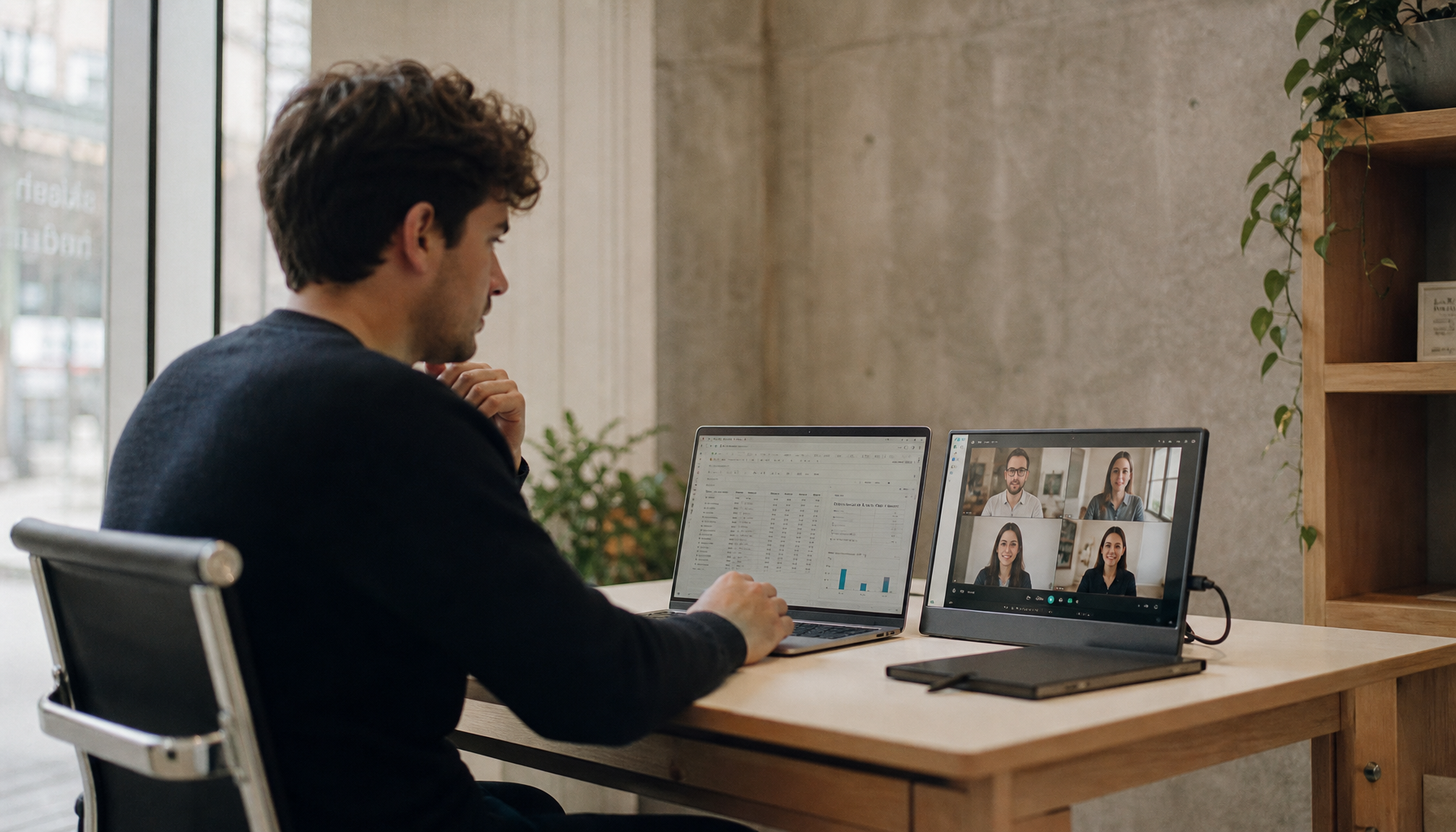
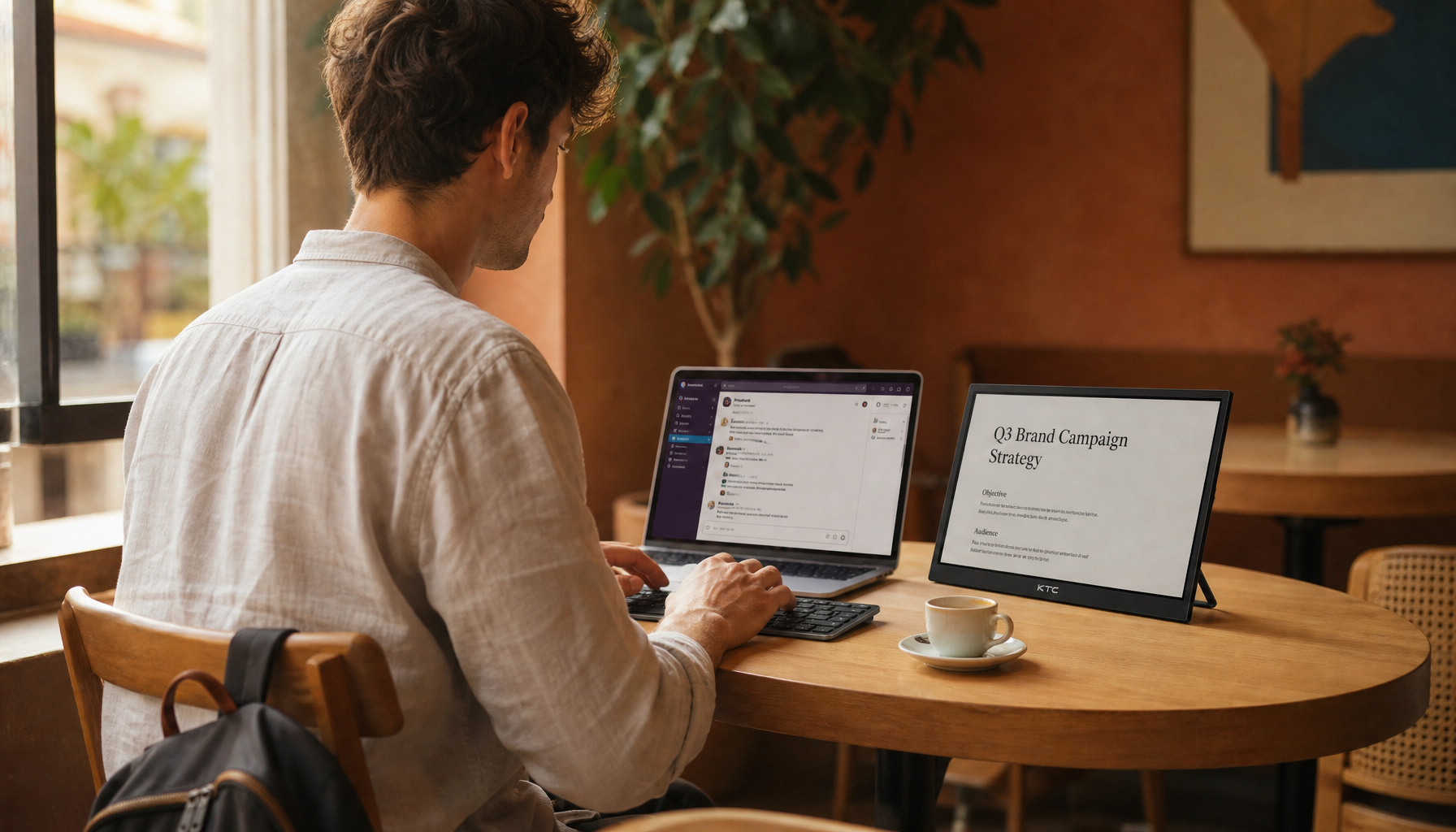
Yes, you can mix IPS, VA, and OLED monitors in one setup when each screen has a clear role. The key is matching each panel’s strengths to your workflow, then tuning brightness, scaling, color, refresh rate, and placement so the setup feels consistent.
Does your main screen look crisp while the side monitor feels darker, warmer, or smeared when you drag a window across? A mixed-panel setup can give you better gaming motion, stronger contrast for media, and more productive screen space without paying premium prices for every display. Here is how to combine different panel types without creating a distracting desk.
Mixed Panels Are Practical
Modern operating systems and graphics hardware do not require every monitor to use the same panel technology. You can run an IPS display beside a VA display, add an OLED gaming monitor as the main screen, or use a portable IPS screen with a desktop VA monitor. The system mainly cares about resolution, refresh rate, scaling, orientation, and connection bandwidth, not whether the pixels are IPS, VA, or OLED.
The reason mixed setups succeed or fail is visual consistency. IPS, VA, and OLED reproduce black levels, color, motion, and brightness differently. If you expect three different panel technologies to look identical out of the box, you will probably be disappointed. If you assign each display a role, the setup becomes more powerful and better value than buying identical premium screens.
Panel Type Basics
IPS, or In-Plane Switching, is the safest all-around panel for productivity, collaboration, light creation, and multi-monitor use. IPS panels are known for color consistency and wide viewing angles, and IPS viewing angles can reach about 178 degrees, which matters when a side screen is angled toward you.

VA, or Vertical Alignment, is the contrast-first LCD choice. It usually delivers deeper blacks than IPS, so documents, dashboards, movies, and darker games can look richer. The tradeoff is motion: VA panels often sit around 3000:1 contrast but may show slower 4-8 ms response behavior or ghosting in fast scenes.
OLED is the premium immersion panel. Each pixel emits its own light, so black pixels can turn fully off, creating exceptional contrast and near-instant motion response. The drawback is practicality: OLED burn-in remains a real concern when static desktop elements, toolbars, spreadsheets, or coding interfaces stay on screen for long periods.

Panel Type |
Best Role in a Mixed Setup |
Main Strength |
Main Caution |
IPS |
Main work screen or side productivity screen |
Consistent color and wide viewing angles |
Weaker black levels than VA or OLED |
VA |
Secondary media, dashboards, reading, budget large screen |
Strong contrast and deep blacks |
Possible ghosting in fast motion |
OLED |
Main gaming, HDR, video, or visual-review screen |
Perfect blacks and elite motion |
Burn-in risk with static work UI |
When Mixing IPS, VA, and OLED Makes Sense
A strong mixed-panel desk starts with one primary display and one or two support displays. For a hybrid gaming and productivity setup, a 27-inch 1440p high-refresh IPS or OLED monitor in the center is often the performance anchor, while a VA or IPS side display handles chat, documents, system monitoring, reference pages, or email. Multi-monitor gaming setups work best when gameplay stays on the best screen instead of stretched across two bezels.

For office productivity, an IPS main display plus a VA side display can be a smart value move. Put spreadsheets, browser tabs, and collaboration windows on IPS where viewing angle consistency helps. Use the VA screen for dashboards, dark-mode documents, video previews, or reference material where contrast adds comfort.
For creators, the most color-trusted screen should be the main editing display. That usually means a calibrated IPS monitor or a carefully managed OLED. The side monitor can be VA or IPS for timelines, tools, scripts, file browsers, or communication, but final color decisions should stay on the calibrated primary panel.
The Real Problems You Need to Solve
Color and Brightness Mismatch
Different panel types can make the same white background look cool on one screen and warm on another. This is normal. Start by setting all monitors to the same color mode if available, usually sRGB for web, office, and everyday creation. Then manually adjust brightness so white documents feel equally comfortable, not equally bright by percentage.

A practical target is visual comfort at your desk, not a spec-sheet match. If your OLED main screen is at 70% brightness and your IPS side monitor is at 35%, that may be perfectly correct because OLED and LED-backlit LCD panels behave differently. Independent display testing shows LED monitors can sustain much higher full-screen brightness than OLED, while OLED is stronger for contrast and small HDR highlights, so matching slider numbers is the wrong method.
Motion and Refresh Differences
You can run one monitor at 240 Hz and another at 60 Hz or 75 Hz. For gaming, set the high-refresh monitor as the main display and run the game there. Refresh rate affects smoothness in fast-paced games, but it only pays off when your PC can actually drive those frames.

A real-world example is simple: if your gaming monitor is 1440p at 165 Hz and your side monitor is 1080p at 75 Hz, keep the game, aim trainer, or racing sim on the 165 Hz panel. Put chat, a browser, streaming controls, or notes on the slower screen. Avoid dragging fast video or games across both panels because the visual rhythm will feel uneven.
Text Clarity on OLED
OLED can look stunning in games and movies, but text clarity can be less predictable than on LCD. Some OLED subpixel layouts, including QD-OLED and WOLED structures, can cause text fringing because operating systems and apps do not always render text for those layouts cleanly. That does not make OLED bad for desktop use, but it does mean heavy coding, spreadsheet, and document work may feel better on IPS or VA.
A good compromise is to use OLED as the centered gaming and media display, then keep an IPS monitor beside it for long writing sessions, code, email, and admin work. This also reduces static UI time on the OLED panel, which helps manage burn-in risk.
Setup Settings That Matter Most
After connecting the monitors, configure the desktop in software before judging the hardware. In your display settings, identify each screen so the numbered display matches its physical position. Multiple-monitor settings also let you choose Extend, arrange displays, and detect screens that do not appear automatically.
Set the primary monitor first. This should be the screen used for games, color work, or the most focused daily task. Then set each display to native resolution, confirm the maximum refresh rate, and adjust scaling so text size feels consistent. A 27-inch 1440p monitor at roughly 109 PPI will look sharper than a 27-inch 1080p display at close range, so identical scaling percentages may not feel identical.
Physical placement matters just as much. Center the primary display, angle side monitors inward, and keep top edges aligned at or slightly below eye level. For typical 24-inch and 27-inch monitors, a viewing distance around 20 to 28 inches works well for most desks. If a side monitor is VA, avoid placing it too far off-axis because color shifting can be more visible at extreme angles.
Best Mixed-Panel Layouts by Use Case
Gaming Plus Productivity
The strongest value setup is a high-refresh IPS or OLED in the center with an IPS or VA side monitor. Choose OLED if immersive single-player games, HDR, and motion quality are the priority. Choose IPS if you split time evenly between competitive games, work, and long static desktop sessions. A VA side display is excellent for walkthroughs, stream previews, music apps, and system dashboards.
Office and Remote Work
For daily office work, dual IPS monitors are the cleanest option, but IPS plus VA is often more cost-effective. IPS should hold video calls, documents, design mockups, or anything shared with others. VA can carry email, dashboards, reading panes, and dark-mode apps. Most office setups should prioritize IPS, but VA still has a place when contrast and budget matter.
Creator and Media Desk
A calibrated IPS primary plus OLED media or reference display can work beautifully if you understand the boundary. Use IPS for final color, layout, and text-heavy production. Use OLED for reviewing contrast, HDR-like impact, motion, and client-facing media impressions. IPS often remains the safer choice for color-critical work, while OLED has the edge in contrast and motion, so the right answer depends on which screen is making the final decision.
Should You Buy Identical Monitors Instead?
Identical monitors are still the easiest path for matching color, scaling, bezels, and ergonomics. They are ideal for finance desks, coding stations, trading layouts, and office users who move windows constantly between screens. The tradeoff is cost efficiency: two or three identical high-end monitors can waste budget on screens that only display email, chat, or static references.
Mixed panels are better when your tasks are mixed. Spend on the screen your eyes judge most critically. Save on the support displays. A premium OLED or fast IPS main monitor plus a modest IPS or VA side monitor often beats two expensive panels that do not both need premium performance.
Practical Buying Advice
Before buying, check ports and bandwidth. USB-C must support video output, not just charging. HDMI splitters usually duplicate rather than extend displays. DisplayPort, HDMI, USB-C Alt Mode, docks, and GPU limits all affect whether your monitors can run at the resolution and refresh rate you expect.
Also check ergonomics. A cheaper monitor with height adjustment, pivot, and stable tilt can be more useful than a better panel stuck on a weak stand. If you plan to rotate a secondary screen vertically for documents, chat, logs, or code, make sure the stand or mount supports portrait orientation cleanly.
Finally, avoid buying only by panel label. A good IPS can outperform a poor OLED for office work. A well-tuned VA can be more satisfying for movies than a low-contrast IPS. A fast OLED can be incredible for gaming but the wrong choice for a static spreadsheet-heavy workstation. Panel type sets the direction; the full monitor determines the result.
Final Verdict
You can absolutely use IPS, VA, and OLED monitors together. Put the best panel where performance matters most, use support screens for specific jobs, and tune the setup instead of expecting every display to behave the same. Done right, a mixed-panel desk gives you sharper work, deeper immersion, and better value from every screen on the arm.