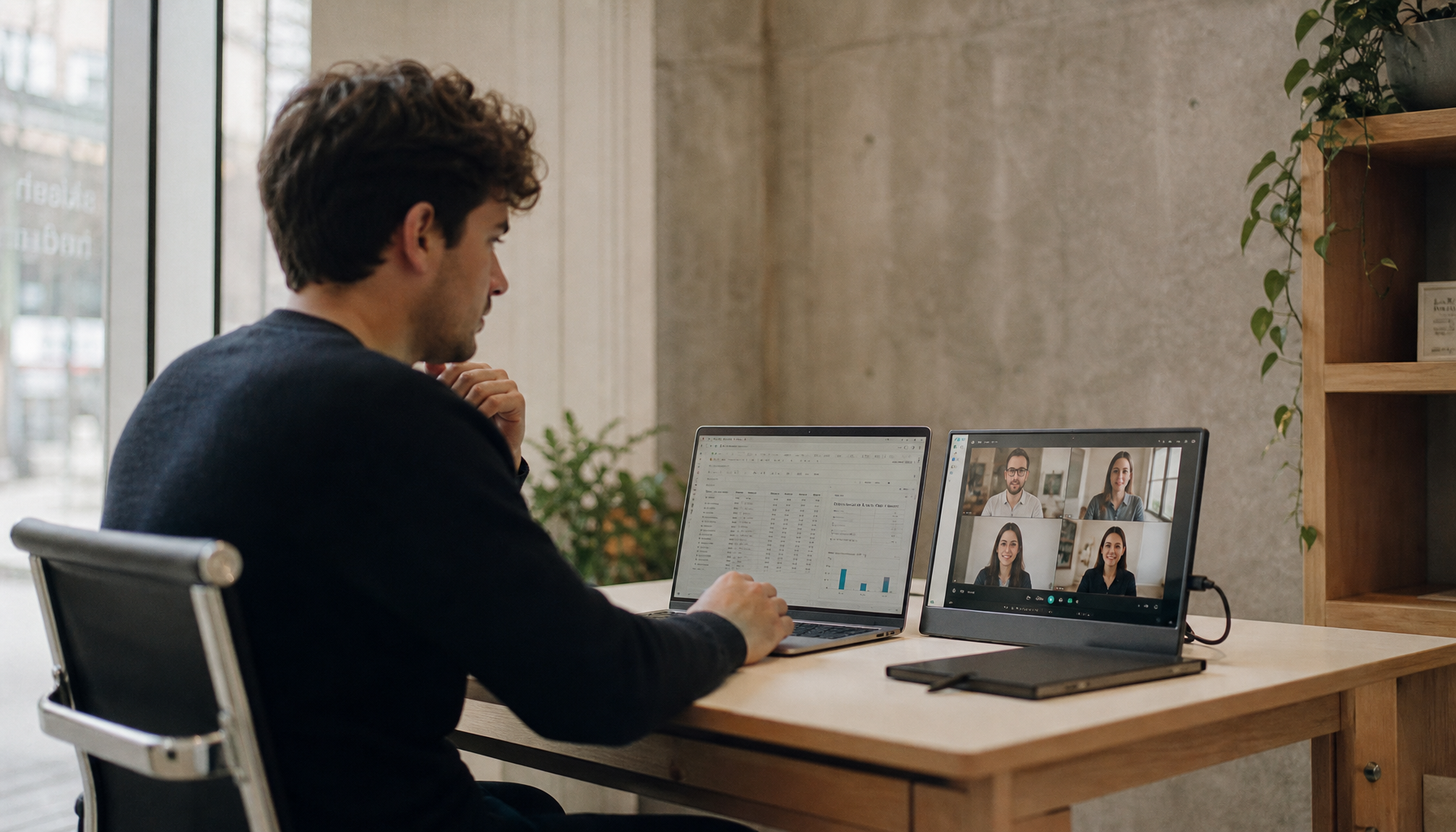
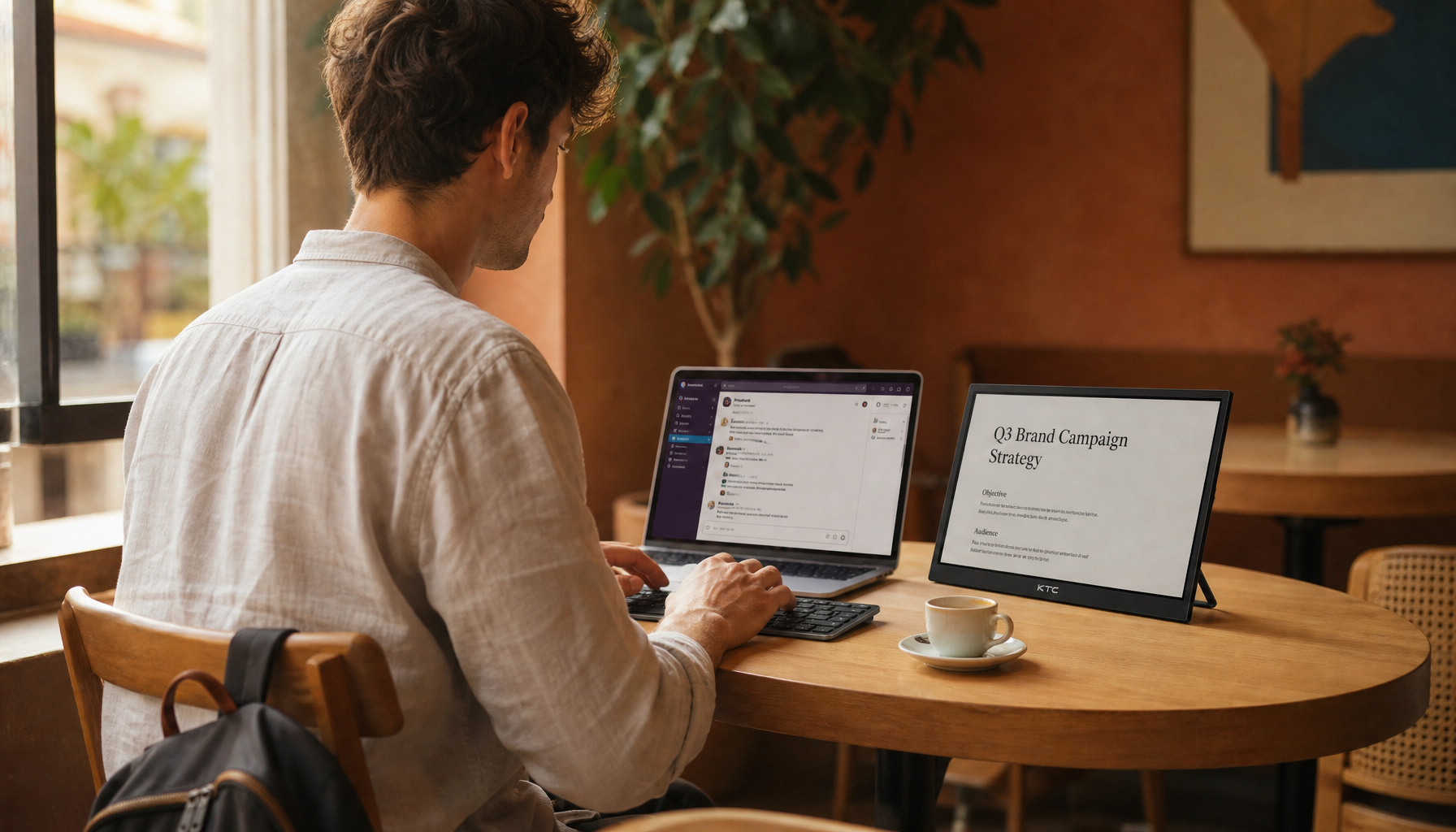
A USB-C KVM monitor is the cleanest path for a hybrid desk only when your laptop or MacBook, your gaming PC, and your cable all support the same video and USB routing. If charging works but the screen stays blank, or peripherals do not switch cleanly, the setup is missing a requirement, not just a setting.

Why Hybrid Desks Need One-Cable Switching
Hybrid desks break when the display, power, and USB path do not line up. The daily pain is usually small but repeated: cable swaps, extra adapters, slow source changes, or a keyboard that stays on the wrong machine.
The first decision is not which monitor looks best. It is whether your source devices can support USB-C video, charging, and KVM routing without help from a dock or extra switch.
If you want the setup to feel effortless, the goal is simple: one cable for the laptop side, one stable input path for the gaming PC, and no surprise replugging during the work-to-play changeover.
For the video side, USB-C matters only when the port actually carries display output. Power delivery and video output are separate functions, so a laptop can charge yet still fail to show a picture.
That distinction is the biggest early filter for a USB-C KVM monitor setup. If the port is charge-only, the rest of the workflow does not matter yet.

Check Ports, Video, and Power First
For most hybrid desks, the safest rule is: verify the source device first, then the cable, then the monitor. A monitor with KVM features cannot compensate for a laptop port that lacks display output.
Use this sequence before you buy or rewire:
- Confirm the laptop or MacBook USB-C port supports video output, not just charging.
- Confirm the cable is full-function USB-C, not a charge-only cable.
- Confirm the monitor's USB-C input or upstream path matches the way you plan to switch.
- Confirm Power Delivery is enough for your laptop use pattern, especially if you run bright screens, multiple apps, or a long day on battery.
The reason this matters is practical, not theoretical. The same USB-C port can charge fine while failing video, and a weak cable can block both image and peripheral routing even when the connector fits physically. A full-function USB-C cable is the safer default for a hybrid desk.
For mixed MacBook and Windows setups, do not assume every Type-C port behaves the same. Check the exact port behavior on the source device instead of the label alone.
Choose a Monitor That Fits Both Jobs
A hybrid desk monitor should be judged by workflow fit, not by refresh rate alone. If the screen only looks good for gaming but makes work switching awkward, it is the wrong compromise.
Here is the practical way to think about the trade-offs:
| Factor | Why It Matters For Hybrid Desks | What To Look For | Common Trade-Off |
|---|---|---|---|
| USB-C video support | Makes one-cable laptop use possible | Clear display-out support on the source device | A USB-C port may charge but not carry video |
| Power Delivery wattage | Keeps the laptop charged during work | Enough wattage for your device and workload | Higher-performance laptops may still need a charger under load |
| KVM behavior | Lets keyboard and mouse follow the active source | Documented USB upstream path and input switching | Some setups need extra menu steps or manual source selection |
| Refresh rate | Helps gaming feel responsive | A mode that fits your gaming habits | High refresh is less useful if the workday setup becomes clumsy |
| Panel type | Affects how the screen feels for work and play | A panel that stays readable for text and responsive for games | Better gaming panels can cost more or add desk-space demands |
| Stand and footprint | Matters in small rooms and apartment desks | Enough height, tilt, and clearance for cable bends | Fixed stands can limit positioning and cable routing |
If you want one model to do both jobs, the KTC 27" 4K 160Hz/320Hz 90W Gaming Monitor | H27P6 is a natural example because it combines 90W USB-C Power Delivery, KVM support through the USB-UP path, and dual-mode 4K@160Hz / 1080p@320Hz on a Fast IPS panel. That does not make it universal, but it does make it relevant to a hybrid desk that needs work polish and gaming speed in one screen.
For browsing broader options, the 4K Monitor collection is the cleaner place to compare 4K models, while the Gaming Monitor collection is better if your desk leans more toward play than office-first use.
Map Your Desk to the Right Monitor
Use this quick decision path if you are trying to match your desk to the least annoying setup.
- Identify the primary source devices. A MacBook-plus-Windows desk needs more careful port verification than a single-PC setup.
- Decide whether charging or video is the bottleneck. If the laptop must stay powered all day, Power Delivery becomes a first-order requirement.
- Estimate how often you switch. Frequent daily switching favors a monitor with simple input selection and predictable USB routing.
- Check peripheral needs. A keyboard and mouse are usually the first devices to keep on the KVM path.
- Match screen size to desk space. Small desks benefit from a footprint that leaves room for the laptop, mouse, and cable bends.
- Verify the final cable path before buying. If the cable route looks awkward on paper, it usually feels worse on the desk.
If you want a more specific fit, How to Stop a USB-C Monitor from Draining a Laptop Battery When the Lid Is Closed is the right follow-up when you plan to run the laptop closed on a dock-like setup. That matters because a desk can look "single-cable" while still quietly draining the battery if the power path is undersized.
A practical decision sentence: if you switch between work and gaming every day, prioritize clean USB routing first; if the laptop is your main device, prioritize Power Delivery first; if the desk is tight, prioritize stand shape and cable clearance first.
Route Peripherals Without Breaking the Signal
The cleanest setup starts with the monitor connection before any hub, dock, or adapter gets added. Once extra boxes sit in the middle, troubleshooting becomes harder because you cannot tell whether the problem is the monitor, the cable, or the hub.
Keep the most switch-sensitive devices on the KVM path first. That usually means keyboard and mouse. If those two follow the active source reliably, the rest of the desk is easier to manage.
Higher-draw accessories such as webcams, storage, or audio gear may be better off on separate ports if the switching path becomes unstable. A monitor KVM is great for reducing clutter, but it is not always the best place for every peripheral on the desk.
For cable selection, the premium display cables page is useful as a reference point because it includes a USB-C to USB-C cable rated for up to 20V / 5A plus HDMI and DisplayPort options. That is enough to support a clean wiring plan, as long as the cable type matches the actual source path.
If the monitor has a documented USB upstream path, use it exactly as instructed. KVM dropouts usually come from routing or enumeration problems, not from the panel itself.
Fix USB-C KVM Failures Fast
When the display works but switching fails, separate the fault into three buckets: video, power, or USB/KVM routing. That keeps you from replacing good parts just because the symptoms look similar.
Start with the simplest checks:
- Confirm the source device is awake and not sleeping too deeply.
- Reconnect the USB-C cable directly, with no adapter in the middle.
- Test a safer baseline resolution or refresh rate.
- Re-select the correct input source on the monitor.
- Check the monitor's USB upstream or KVM setting.
- Swap in a known-good full-function cable.
The key clue is this: if charging still works but the screen does not, the video path is the likely problem. If the screen works but the keyboard and mouse do not follow, the USB upstream path is usually the problem. If the image flickers or drops at higher settings, the cable or bandwidth limit may be the issue.
KVM switching problems often come from the monitor not being told which upstream path to use. KTC's own support guidance on USB device dropouts after KVM switching points to the same root cause: the upstream connection and the KVM setting both need to match the active source.
One useful rule of thumb: if a lower setting works but your target setting fails, keep the working mode and fix the cable path before pushing resolution or refresh back up.
Your Final Hybrid-Desk Setup Check
Before you buy or lock in the wiring, confirm five things: your source device supports USB-C video, your cable is full-function, your monitor's KVM path is documented, your stand fits the desk, and your final switch works on both machines. If any one of those fails, the setup is not truly one-cable yet.
For a fast last pass, think in this order: source device, cable, monitor routing, desk space, then daily switching. That sequence catches most regrets before they become clutter on the desk.
If you want a model that already fits many of these conditions, the H27P6 is worth checking against your exact laptop and PC ports.
Desk bottleneck check
| Scenario | USB-C video link | Laptop charging | USB/KVM routing |
|---|---|---|---|
| USB-C laptop | Strong | Moderate | Moderate |
| Desktop PC | Strong | Low | Strong |
Use the table as a quick boundary check: the desk usually breaks first at video bandwidth, laptop charging headroom, or USB/KVM switching friction depending on the exact device mix.
Related Resources
- The Ultimate Hybrid Desk: Switching Between MacBook Work and PC Gaming
- Software vs Hardware Workstation Control for Hybrid Mac and PC Desks
- USB-C to DisplayPort vs USB-C to HDMI adapters
FAQs
Q1. How Do I Verify USB-C Video Output Before Buying?
Check whether the laptop, MacBook, or USB4/Thunderbolt port explicitly supports display output, not just charging. If the spec sheet is unclear, test the device with a known video-capable USB-C cable and a monitor or adapter that already works. That is faster than guessing from port shape alone.
Q2. What Cable Spec Matters Most for a Hybrid Desk?
A full-function USB-C cable is the key starting point because it carries video, data, and power together. Length matters too, especially on wider desks where a short cable forces awkward routing. If you plan to push higher power or use a tighter cable path, verify the rating before you buy.
Q3. Can a MacBook and Windows PC Share One USB-C KVM Monitor?
Yes, but only if both source devices support the right video mode and the monitor's USB routing is set up correctly. Mixed-OS desks often work best when you verify each port individually, because one machine may use USB-C video while the other relies on DisplayPort or HDMI.
Q4. Why Does My Monitor Charge the Laptop but Show No Picture?
That usually means the Power Delivery path is working but the video path is not. The fix is to check the laptop's USB-C display support, then the cable, then the monitor input. Charging alone does not prove the port can carry video.
Q5. Can Peripherals Follow the Active Input Every Time?
Usually yes for a simple keyboard-and-mouse setup, but reliability drops when the upstream path is wrong or the desk adds more demanding USB devices. If switching gets flaky, keep the core peripherals on the KVM path and move storage, cameras, or audio gear off the switch path.
The best USB-C KVM monitor setup is the one that matches your actual devices, not the one with the biggest spec sheet. If your laptop supports video over USB-C, your cable is full-function, and the monitor's USB upstream path is documented clearly, the setup can feel almost invisible.